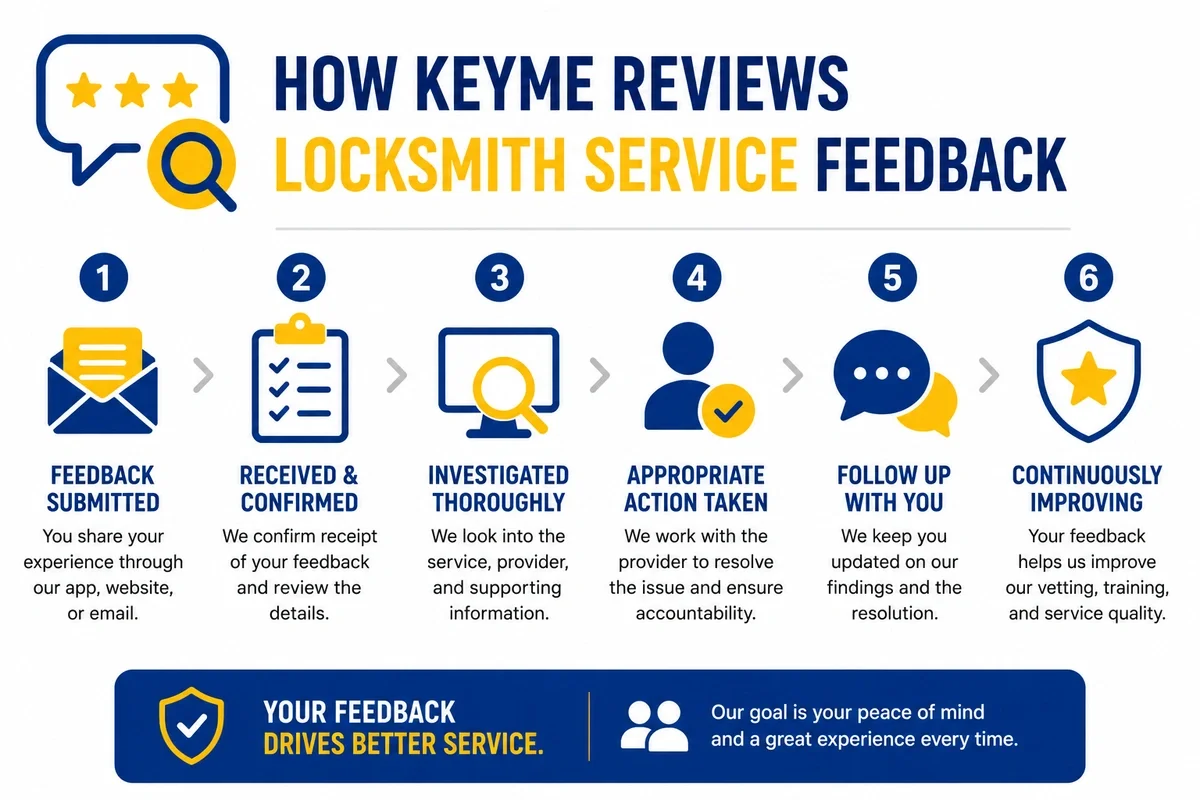
KeyMe reviews locksmith service feedback to better understand what happened during a service visit and how customers experienced the process.
Useful feedback can provide context about the provider's communication, the on-site assessment, the work recommended, customer authorization, professional conduct, completed service, and follow-up afterward.
This article focuses on how feedback is evaluated and what it can reveal about the service experience.
If you currently have an unresolved service concern and need to know what information to gather first, see What to Do If You Have a Concern After Locksmith Service.
Summary
- KeyMe service feedback can cover both positive experiences and concerns.
- Specific descriptions are generally more useful than broad ratings alone.
- Feedback can provide context about communication, authorization, provider conduct, completed work, and support.
- Receipts, timelines, photos, and other records may help establish the context of a service visit.
- One piece of feedback describes one experience, while recurring themes may help identify broader patterns.
- Feedback does not automatically establish why a problem occurred.
- KeyMe can use service feedback to reinforce expectations around communication, authorization, professionalism, and customer support.
Best Way to Provide Useful Locksmith Service Feedback
The most useful feedback describes the service experience clearly and separates observation from assumption.
When sharing feedback, focus on:
- What service you requested
- What happened after the provider arrived
- What the provider explained
- What work you understood you were authorizing
- What happened during or after the service
- Which parts of the experience went well or caused concern
You do not need to diagnose a lock, key, door, vehicle, or hardware problem yourself.
A statement such as:
"The new key enters fully but stops halfway through the turn."
provides more useful service information than:
"The locksmith made the lock worse."
The first describes an observable symptom. The second assumes a cause that may require further evaluation.
Why Customer Feedback Matters
Locksmith service can involve situations where customers need to make decisions quickly.
A provider may arrive for a lockout and discover damaged hardware. A customer requesting a replacement vehicle key may learn that programming is also required. A malfunctioning lock may turn out to involve both the lock and the way the door aligns.
Because the final scope can depend on what the provider finds on-site, the service experience involves more than the finished lock or key.
Communication matters too.
Customer feedback can help KeyMe understand whether:
- The original service need was clearly understood
- The provider explained the on-site assessment
- Recommended work was described clearly
- Authorization was confirmed before work began
- Changes in scope were explained
- The provider acted professionally
- The completed work was tested or explained
- The customer understood where to go with follow-up questions
Feedback is therefore useful not only when something goes wrong.
Positive feedback can also show what customers found clear, professional, or helpful.
Need a Locksmith? We're here to help
Connect with a trusted local locksmith for fast, professional assistance when you need it most.
What KeyMe Looks at When Reviewing Locksmith Service Feedback
Feedback becomes more informative when it can be connected to a specific part of the service experience.
Communication
One important area is whether the customer understood what was happening.
Relevant feedback may describe whether the provider:
- Confirmed the service request
- Explained what they found
- Answered reasonable questions
- Described the recommended service
- Explained a change from the original request
- Clarified what would happen next
For example:
"The provider explained that the deadbolt was not the only problem and showed me that the door was also misaligned before recommending additional work."
That feedback contains more context than simply saying communication was "good."
Likewise:
"The provider recommended replacing part of the lock, but I did not understand why the original service had changed."
helps identify the specific communication point that caused confusion.
Customer Authorization
Authorization is another important part of the locksmith service experience.
Customers should understand what service is being recommended before agreeing to the work.
Feedback may help clarify:
- What service was originally requested
- What the provider found on-site
- Whether the recommended work changed
- What work the customer understood they approved
- Whether additional work was discussed before it was performed
KeyMe's Understanding Locksmith Service Authorization guide explains why authorization should relate to a clear scope of work rather than a broad instruction to fix whatever is wrong.
For example, feedback might state:
"I requested a home lockout. After the door was opened, the provider recommended additional lock work and explained the reason before I decided whether to proceed."
Or:
"I approved the lockout, but I was unclear whether I had also agreed to replacement hardware."
Both descriptions help identify what part of the authorization process should be reviewed.
Professional Conduct
Feedback may also describe how the provider interacted with the customer and handled the service location.
Relevant observations can include:
- Respectful communication
- Professional behavior
- Willingness to answer questions
- Care around the home, vehicle, business, door, or hardware
- Clear explanation of what was happening
- Appropriate interaction with other people at the location
A useful report focuses on observable behavior.
For example:
"The provider walked me through the completed work and tested the lock with me before leaving."
Or:
"I asked what additional work was being recommended, but I did not feel I received a clear explanation."
Specific descriptions provide more information than a rating alone.
For a broader explanation of what customers can reasonably look for from a provider, see What Professional Locksmith Standards Should Customers Expect?.
Completed Service
Some feedback concerns the resulting function of the lock, key, door, or vehicle key.
For example:
-
A lock remains difficult to turn
-
A door does not latch normally
-
A deadbolt does not align correctly
-
A new key does not operate the expected lock
-
A car key performs some functions but not others
-
A remote button does not respond
-
A smart or proximity key is not recognized as expected
The important distinction is between describing the symptom and determining the cause.
Consider:
"After service, the key enters completely but requires several attempts before the lock turns."
That establishes a repeatable symptom.
It does not establish whether the cause is the key, cylinder, door alignment, pre-existing wear, or another condition.
Additional information may be needed before the cause can be understood.
Scope-of-Work Feedback
Locksmith jobs can change after inspection.
That makes feedback about scope especially useful.
A customer may initially request:
- Lockout service
- Rekeying
- Lock repair
- Broken-key extraction
- Car key replacement
- Smart-lock troubleshooting
After inspecting the problem, the provider may recommend something different or additional.
Useful feedback explains both stages.
For example:
"I requested rekeying, but after inspecting the lock, the provider recommended replacement because of a hardware issue."
That establishes the difference between the original request and the on-site recommendation.
If a changing recommendation itself is the concern, Why Locksmith Estimates Can Change After Arrival explains why an on-site assessment can alter the recommended scope.
Support Follow-Up
The service experience does not necessarily end when the provider leaves.
Feedback can also help KeyMe understand whether customers knew:
- Where to direct a question
- What information might be useful
- How to describe a service concern
- Which documentation to keep
- What follow-up information might be requested
If the issue is an active post-service concern, the dedicated guide on what to do after a locksmith service concern explains how to organize the relevant information.
This article does not duplicate that process because its purpose is different: understanding how the feedback itself can be evaluated.
Why Documentation Can Provide Useful Context
Receipts, photos, videos, timelines, and messages can be useful during feedback review, but each serves a different purpose.
Receipt or Service Documentation
A receipt may help identify:
- Service date
- Provider
- Service category
- Work recorded
- Relevant service details
Timeline
A timeline may help establish:
- What happened before the appointment
- What the provider found
- What changed during the visit
- When the customer first noticed the concern
Photos
Photos may help document visible conditions such as:
- Hardware
- Door alignment
- Lock condition
- Area surrounding a lock
- Visible damage
Videos
Videos can sometimes document function, such as:
- A key stopping repeatedly
- A deadbolt failing to extend
- A door not latching
- A vehicle-key function not responding
Messages
Texts, emails, or confirmation messages may help establish what was communicated before or after the service.
Documentation does not automatically prove what caused an issue.
It provides additional context that can help reconstruct the service experience.
How KeyMe Can Distinguish Different Types of Feedback
Not all locksmith feedback concerns the same thing.
Separating feedback by category can make the information more actionable.
Communication Feedback
Was the service explained clearly?
Authorization Feedback
Did the customer understand what work they were agreeing to?
Scope Feedback
Did the recommended service change after inspection, and was that change explained?
Professional-Conduct Feedback
How did the provider interact with the customer and handle the service location?
Completed-Service Feedback
Did the customer report an issue with the lock, key, door, vehicle key, or other serviced system afterward?
Support Feedback
Was it clear what to do when a question arose?
Positive Feedback
What did the provider do particularly well?
Positive feedback matters because understanding strong service experiences can be as useful as identifying areas of concern.
Why One Experience and a Broader Pattern Are Different
An individual piece of feedback provides information about a particular service visit.
It should be evaluated in that context.
One customer's experience does not necessarily establish how every service visit works.
However, repeated themes can provide different information.
For example, if similar feedback repeatedly concerns:
- Explaining changes in scope
- Confirming authorization
- Communication before additional work
- Testing completed work
- Support instructions
those themes may help identify an area where expectations or customer guidance could be clearer.
This distinction is important.
Individual feedback helps explain a specific experience. Patterns across feedback can help identify broader opportunities for improvement.
Neither should be overstated.
Find a KeyMe Kiosk Near You
Need a spare key fast? Find a KeyMe kiosk near you to copy many house, office, and eligible car keys in just minutes.
How Feedback Can Reinforce Provider Expectations
Customer feedback can help reinforce expectations around the service experience.
Depending on the situation, those expectations can include:
- Confirming the service requested
- Assessing the actual condition on-site
- Explaining findings in understandable language
- Describing the recommended scope
- Confirming authorization
- Explaining changes before additional work
- Treating customers and property professionally
- Helping customers understand what should work when the service is complete
These expectations align closely with the questions customers should consider before approving work.
For a practical consumer checklist, see Questions to Ask Before Locksmith Work Begins.
Examples of Useful Locksmith Service Feedback
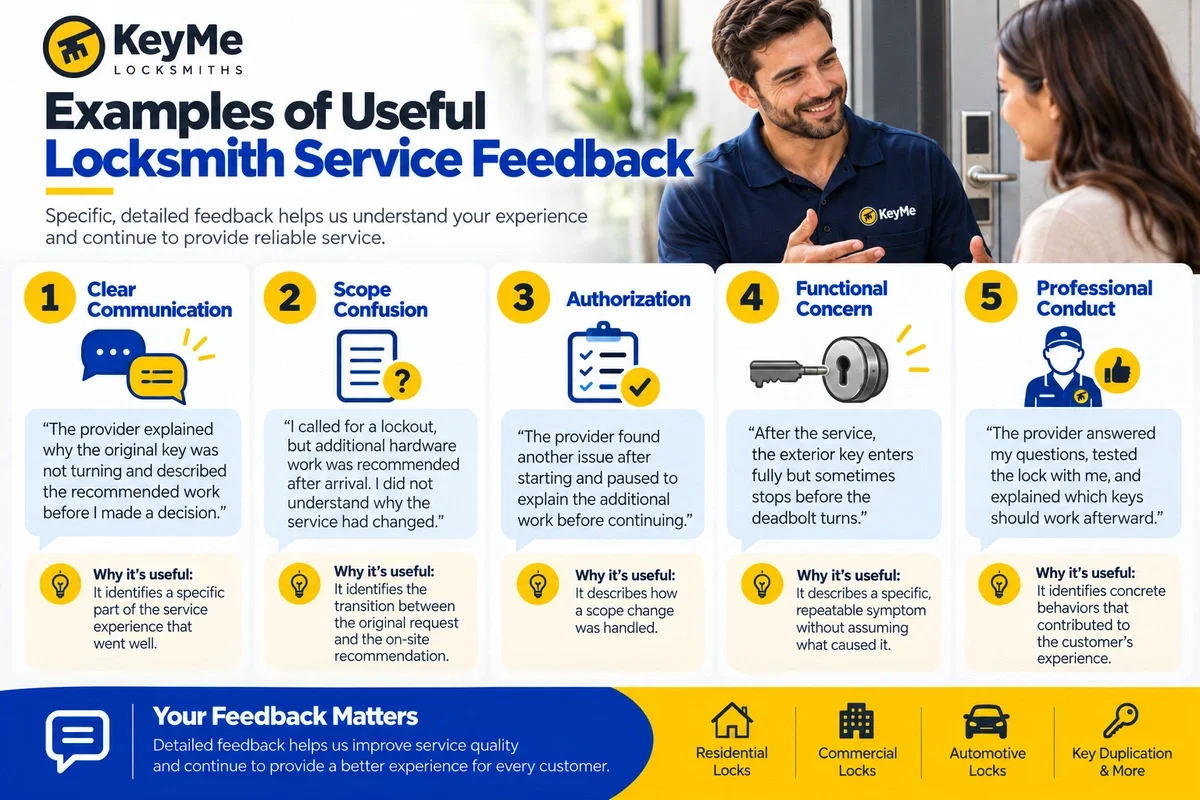 Example: Clear Communication
"The provider explained why the original key was not turning and described the recommended work before I made a decision."
Why it is useful: it identifies a specific part of the service experience that went well.
Example: Scope Confusion
"I called for a lockout, but additional hardware work was recommended after arrival. I did not understand why the service had changed."
Why it is useful: it identifies the transition between the original request and the on-site recommendation.
Example: Authorization
"The provider found another issue after starting and paused to explain the additional work before continuing."
Why it is useful: it describes how a scope change was handled.
Example: Functional Concern
"After the service, the exterior key enters fully but sometimes stops before the deadbolt turns."
Why it is useful: it describes a specific, repeatable symptom without assuming what caused it.
Example: Professional Conduct
"The provider answered my questions, tested the lock with me, and explained which keys should work afterward."
Why it is useful: it identifies concrete behaviors that contributed to the customer's experience.
Feedback Is More Useful When It Is Specific
Compare these two statements:
"The locksmith was confusing."
and:
"I originally requested a lockout. After inspecting the door, the provider recommended replacing part of the lock, but I did not understand why replacement was needed before I approved the work."
The second statement helps identify:
- The original request
- The changed recommendation
- The point of confusion
- The authorization question
The same principle applies to positive feedback.
Instead of:
"Great locksmith."
Try:
"The provider explained the problem before beginning, confirmed the work I approved, and had me test the lock before leaving."
Specificity makes the feedback more informative.
Copy Your Key from Anywhere - Right from Your Phone
Skip the kiosk and copy your key from home. Upload a clear photo of an eligible house or car key, and KeyMe will create a precise duplicate and mail it directly to your door.
If You Currently Have a Locksmith Service Concern
This article focuses on how feedback can be evaluated.
If you currently need to report or document a problem after a locksmith visit, use What to Do If You Have a Concern After Locksmith Service.
That guide covers:
- What documentation to gather
- How to create a timeline
- What functional problems to record
- How to separate the original condition from a new concern
- What information to provide when contacting support
Keeping those procedural steps on the concern page helps each resource answer a different question.
Why Choose KeyMe Locksmiths
KeyMe Locksmiths helps customers request residential, automotive, commercial, and emergency locksmith services.
Customer feedback can provide important context about the service experience, including how clearly work was explained, whether scope changes were understood, how authorization was handled, and how the completed service performed.
"Useful feedback does more than tell us whether an experience felt positive or negative. It helps identify where in the service process the experience was strong, unclear, or in need of closer review." - KeyMe Locksmiths
References
- KeyMe Locksmiths: What to Do If You Have a Concern After Locksmith Service
- KeyMe Locksmiths: Understanding Locksmith Service Authorization
- KeyMe Locksmiths: Questions to Ask Before Locksmith Work Begins
- KeyMe Locksmiths: Why Locksmith Estimates Can Change After Arrival
- KeyMe Locksmiths: What Professional Locksmith Standards Should Customers Expect?