

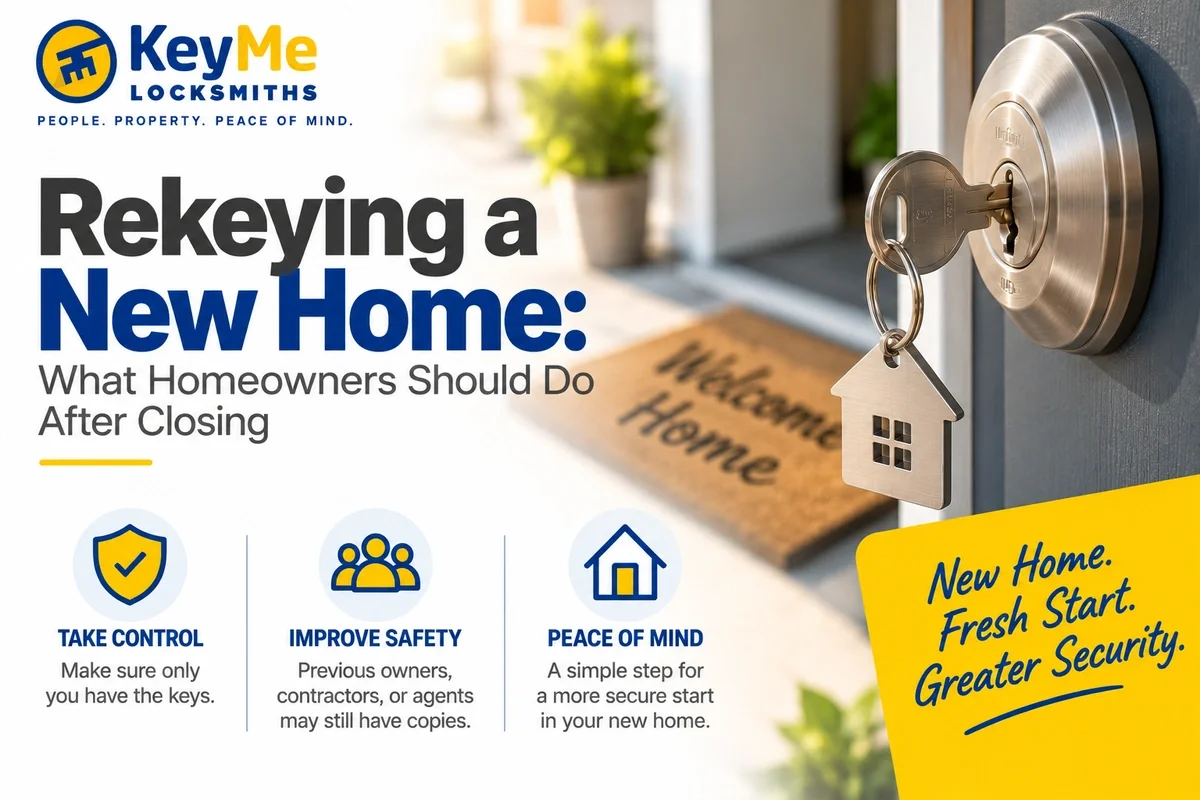
After buying a home, review every exterior lock and decide who should have access before settling into your normal key routine. Even when the seller provides all known keys at closing, a new homeowner generally cannot determine from the keys alone whether additional copies were made previously.
Rekeying is one way to address that uncertainty when the existing compatible locks are functioning properly. The lock hardware can remain in place while its keying is changed so the previous mechanical keys no longer operate it.
But rekeying the front door is only one part of taking control of a new home's access.
A useful post-closing review should also consider:
- Other exterior doors
- Garage access
- Detached buildings
- Smart-lock users
- Keypad codes
- Spare keys
- Existing lock condition
- Doors that use different keys
The goal is to establish a clear access system for your household.
Summary
- Receiving keys from the seller does not establish how many copies may have existed previously.
- Inventory every exterior keyed opening after closing, not just the front door.
- Rekeying can change which mechanical keys operate compatible functioning locks without replacing all the hardware.
- Existing locks should be inspected for damage or operational problems before automatically rekeying them.
- Ask whether compatible exterior locks can be keyed alike if reducing the number of household keys is important.
- Review garage-to-house doors, side entrances, basement doors, detached garages, sheds, and gates.
- Reset smart-lock ownership, codes, and digital users according to manufacturer instructions.
- Do not overlook physical backup keys for electronic locks.
- Decide which household members need new spare keys after the final keying arrangement is established.
- Handle old keys appropriately once they no longer operate the property.
Why Review Locks After Buying a Home?
A real-estate closing transfers ownership.
It does not provide a complete history of every physical key that may have been duplicated during the property's previous ownership.
Over time, keys may have been provided to:
- Household members
- Relatives
- Neighbors
- Contractors
- Cleaners
- Pet sitters
- Property managers
- Other previously authorized users
That does not mean any of those people still have keys or intend to use them.
It simply means a new owner may not have complete visibility into the property's historical key distribution.
ALOA's consumer guidance recommends changing or rekeying locks when moving into a home because previous key copies may remain outside the new owner's control.
Rekeying can therefore be part of establishing a new access system after closing.
"Closing gives you ownership of the property. Your lock and key review establishes how you want access to work under that new ownership. Treat it as a property-wide inventory rather than thinking only about the key handed to you at the front door." - KeyMe Locksmiths
Need a Locksmith? We're here to help
Connect with a trusted local locksmith for fast, professional assistance when you need it most.
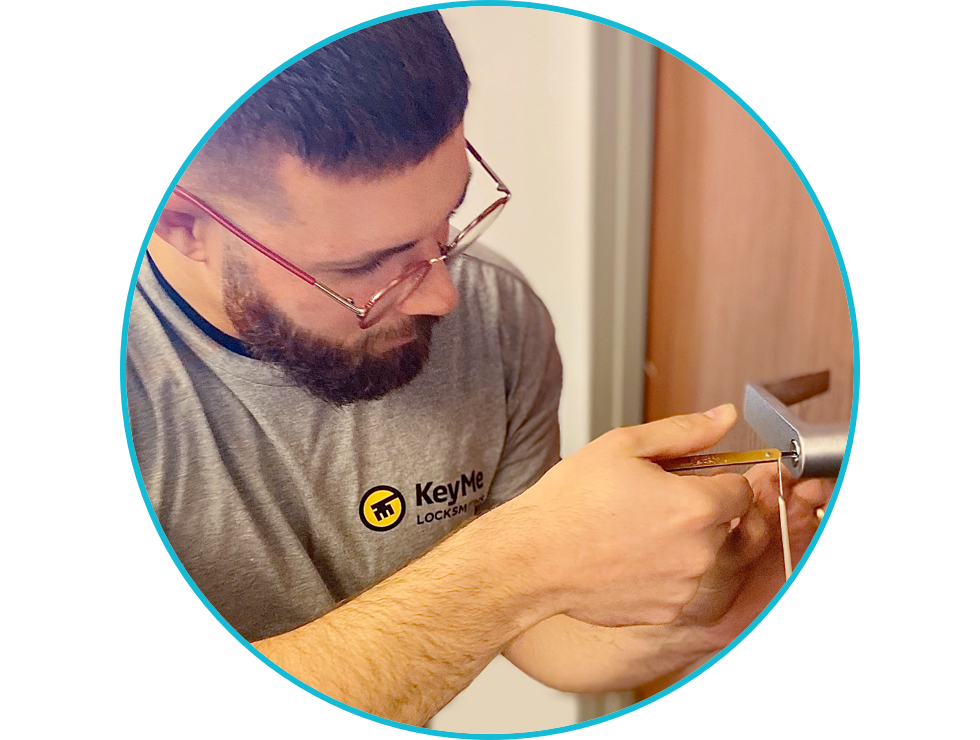
Step 1: Inventory Every Exterior Door
Start by walking the property.
Do not assume the front door is the only meaningful keyed entrance.
Depending on the home, inspect:
- Front door
- Back door
- Side door
- Garage-to-house door
- Exterior garage door
- Basement entrance
- Patio entrance
- Mudroom entrance
- Detached garage
- Shed
- Storage building
- Keyed gates
Record which key operates each opening.
You may discover:
- One key operates everything.
- Several doors use different keys.
- Some locks do not have working keys.
- A lock operates poorly.
- A door has electronic access.
- A detached building was overlooked during closing.
That inventory gives you the information needed to plan the new household access system.
Step 2: Separate Access Questions From Hardware Problems
Do not automatically assume every existing lock should simply be rekeyed.
Test each opening.
Look for:
- Key that is difficult to turn
- Deadbolt that binds
- Loose lever or knob
- Damaged cylinder
- Latch that does not engage normally
- Door that has to be pushed or pulled to lock
- Visible hardware damage
Rekeying changes which mechanical key operates a compatible lock.
It does not automatically correct those mechanical problems.
If the existing hardware is malfunctioning, lock repair or lock replacement may need to be considered.
For a detailed explanation of that decision, see Rekeying vs. Replacing Your Locks.
For help identifying symptoms, see The Most Common Home Lock Problems.
Step 3: Decide Which Locks Should Be Rekeyed
If the existing compatible locks operate correctly and you want previous mechanical keys to stop working, rekeying may be appropriate.
During rekeying, the compatible cylinder is changed to operate with a different key.
The existing lock hardware can remain on the door.
That makes rekeying fundamentally an access change, rather than a complete hardware change.
Your locksmith can evaluate which locks support rekeying and whether any existing hardware requires a different approach.
Step 4: Ask Whether Compatible Doors Can Use One Key
New homeowners sometimes inherit a key ring containing:
- Front-door key
- Back-door key
- Garage key
- Side-door key
- Shed key
Some of that may be unavoidable because the locks use different or incompatible systems.
In other cases, compatible locks may be capable of being keyed alike.
Keyed alike means one key operates multiple compatible locks.
This is different from a master key system.
If using fewer household keys is important, ask the locksmith which existing cylinders and keyways are compatible before deciding on the final keying arrangement.
For definitions of keyways, cylinders, keyed alike, master keys, and other terminology, see Locksmith Terms Explained.
Step 5: Check the Garage-to-House Door
Garages deserve particular attention because homeowners often focus on the overhead garage-door opener and overlook the mechanical lock on the door between the garage and living space.
Review:
- Mechanical lock
- Deadbolt, if present
- Keying
- Door operation
- Existing electronic access
- Garage remote controls
Follow the garage-door opener manufacturer's procedures when transferring or resetting remote access.
The mechanical lock on the house-entry door should be treated as part of the home's broader access inventory.
Step 6: Check Detached Buildings and Secondary Access
A new homeowner's key inventory should extend beyond the main house.
Look at:
- Detached garage
- Shed
- Workshop
- Storage room
- Pool enclosure where applicable
- Keyed gate
- Exterior utility spaces
These openings may use different hardware from the main home.
Do not assume every cylinder can be incorporated into the same keying arrangement.
The goal is first to know what exists, then determine what access system is practical.
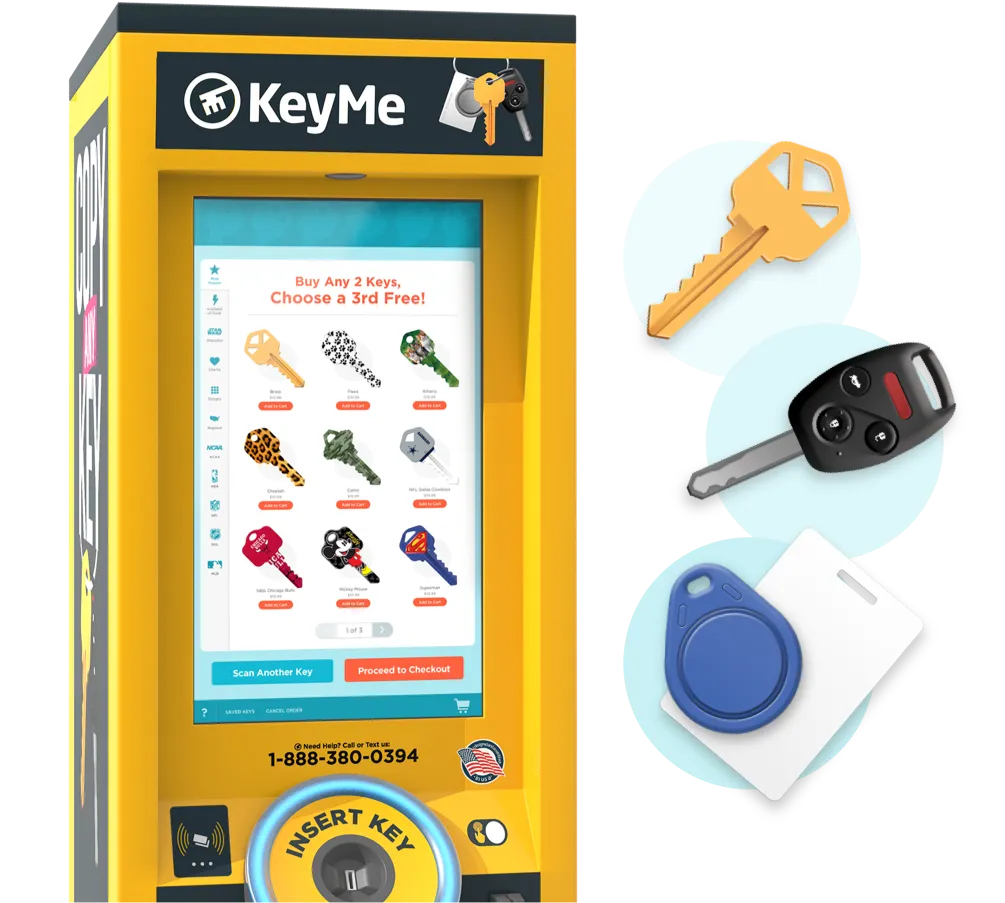
Find a KeyMe Kiosk Near You
Need a spare key fast? Find a KeyMe kiosk near you to copy many house, office, and eligible car keys in just minutes.
Step 7: Review Smart Locks and Electronic Access
A property with smart locks requires a different type of access transition.
Depending on the installed system, the previous owner may have used:
- Administrator account
- Mobile app
- PIN codes
- Temporary codes
- Household-member credentials
- Smart-home integration
- Physical backup keys
Follow the manufacturer's ownership-transfer or reset procedure for the exact lock.
Depending on the system, that may involve:
- Resetting the lock
- Establishing a new administrator
- Removing previous users
- Creating new codes
- Connecting the lock to the new owner's network
- Reviewing smart-home integrations
Do not rely only on deleting one visible PIN.
The objective is to establish the new owner's control according to the manufacturer's supported process.
For a broader comparison of electronic and mechanical access, see Smart Lock vs. Traditional Lock.
Step 8: Find the Mechanical Backup Keys
Some smart locks retain a mechanical key cylinder.
If yours does, determine:
- Whether a backup key was provided
- Which lock it operates
- Whether additional copies may exist
- Whether the cylinder can be rekeyed
- Where the household will keep authorized backups
Electronic credential changes do not necessarily change the mechanical backup key.
Treat the electronic and mechanical sides of the lock as separate access methods.
Step 9: Review Other Keyed Areas Around the Property
The house doors are the priority, but moving is a good time to understand the rest of the property's keyed hardware.
Examples may include:
- Mailbox
- Filing cabinets
- Padlocks
- Storage
- Gates
These locks may have different ownership, replacement, or duplication rules.
For example, mailbox key and lock procedures can depend on whether the box is owned by USPS, an HOA, a property, or another entity.
If mailbox access is part of the move, see Can You Copy a Mailbox Key?.
Step 10: Decide Who Needs New Keys
Once the final keying arrangement is established, decide who actually needs a copy.
Possible authorized users include:
- Adult household members
- Older children where appropriate
- Trusted family
- Other specifically authorized individuals
The number and distribution of spare keys is a household access decision.
Avoid making copies before finalizing the keying arrangement, or you may create copies of keys that are about to stop working.
When you're ready, see How to Get the Best Key Copy From an Original Key and How Home Key Duplication Works at Self-Service Kiosks.
KeyMe also provides key duplication for supported keys.
Step 11: Identify What Each New Key Opens
A key-control problem can start simply because nobody remembers what a spare key belongs to.
Once the property has been rekeyed or otherwise updated, create a simple household record of:
- Which key opens which doors
- Who has copies
- Where authorized backup keys are stored
- Which locks use electronic access
- Which secondary buildings have separate keys
Avoid labeling unattended keys in a way that unnecessarily identifies the exact property they access.
Step 12: Deal With the Old Keys
After rekeying, old keys may no longer operate the changed locks.
Do not accidentally mix them with the household's active keys.
Separate obsolete keys and handle them appropriately.
What If the Seller Says These Are All the Keys?
That information is useful, but it does not necessarily establish the complete duplication history of the property.
A seller may return every key in their possession and still be unaware of an old copy that was previously made.
The reason to consider rekeying is therefore not an assumption that someone is withholding a key.
It is a practical way for the new homeowner to establish a new mechanical access baseline.
What If the Locks Are New?
Age alone does not determine whether rekeying makes sense.
A recently installed lock may be in excellent condition but still operate with keys distributed before ownership changed.
In that case, the hardware condition and access question are separate.
If the lock works properly and supports rekeying, the hardware may be able to remain while the working key changes.
Copy Your Key from Anywhere - Right from Your Phone
Skip the kiosk and copy your key from home. Upload a clear photo of an eligible house or car key, and KeyMe will create a precise duplicate and mail it directly to your door.
What If the Locks Are Old?
Old does not automatically mean unusable.
Evaluate how the lock actually operates.
Signs that deserve further inspection can include:
- Repeated sticking
- Physical damage
- Loose hardware
- Failure to latch
- Deadbolt binding
- Cylinder problems
For guidance on whether hardware condition justifies a broader change, see Rekeying vs. Replacing Your Locks.
Should You Install Smart Locks After Moving?
That is a separate decision from taking control of the existing keys.
Smart locks may add features such as:
- PIN codes
- App management
- Remote access
- Digital credentials
- Smart-home integrations
Traditional mechanical locks avoid the electronic-management layer.
Neither category is automatically appropriate for every homeowner.
If you're considering a change, compare your access needs before replacing functioning hardware. See Smart Lock vs. Traditional Lock.
What About Renovations Immediately After Closing?
Some homeowners begin renovations before fully moving in.
That can temporarily increase the number of authorized people entering the property.
Depending on the project, access may be needed by:
- General contractor
- Electrician
- Plumber
- Painter
- Flooring installer
- Other trades
Plan contractor access deliberately rather than casually distributing household keys.
If the project will substantially change doors or hardware, coordinate the final lock plan with the renovation schedule.
See Working With a Locksmith During Renovations for a more detailed planning guide.
Best Way to Handle Locks After Closing
A practical post-closing sequence is:
1. Walk the Property
Identify every keyed and electronically controlled exterior opening.
2. Test Existing Hardware
Separate functioning locks from locks that need mechanical attention.
3. Document Existing Keys
Determine which provided keys operate which openings.
4. Decide on the Final Keying Plan
Ask whether compatible locks should use the same key or remain separate.
5. Rekey Appropriate Locks
Change mechanical access where compatible hardware is being retained.
6. Address Damaged Hardware Separately
Repair or replace hardware based on condition rather than assuming rekeying will correct mechanical problems.
7. Reset Electronic Access
Follow manufacturer procedures for smart locks, codes, apps, and previous users.
8. Create New Spare Keys
Make authorized copies only after the final keying arrangement is established.
9. Record Household Access
Know which keys and credentials exist and who has them.
10. Handle Obsolete Keys
Separate old keys from active household keys and dispose of them appropriately.
"The simplest way to approach a new home's locks is to establish a clean baseline. Inventory every entrance, determine what hardware is worth keeping, change access where appropriate, and then create only the new keys and credentials your household actually needs." - KeyMe Locksmiths
First-Week Home Access Checklist
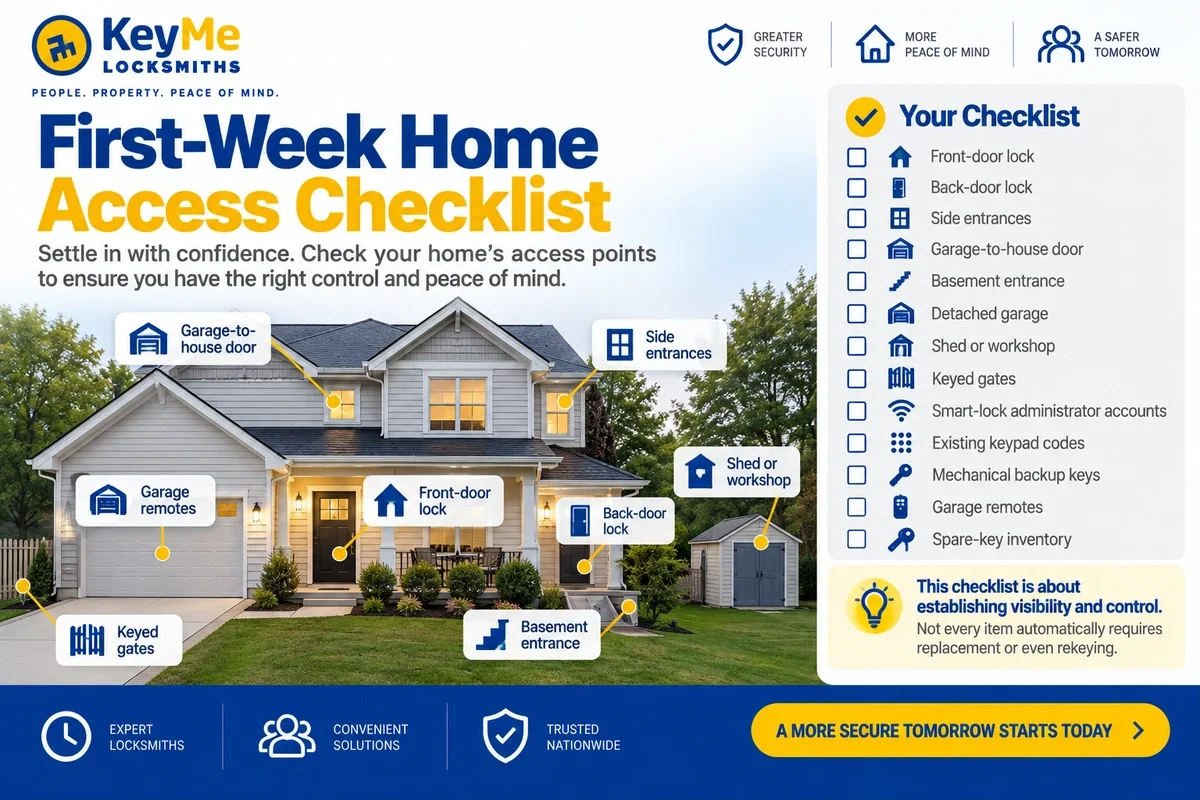
During your first week after closing, consider checking:
- Front-door lock
- Back-door lock
- Side entrances
- Garage-to-house door
- Basement entrance
- Detached garage
- Shed or workshop
- Keyed gates
- Smart-lock administrator accounts
- Existing keypad codes
- Mechanical backup keys
- Garage remotes
- Spare-key inventory
This checklist is about establishing visibility and control.
Not every item automatically requires replacement or even rekeying.
Make Access Part of Your Move-In Plan
Moving into a home involves much more than receiving a set of keys at closing.
A useful access transition asks:
What doors exist?
Which locks work properly?
Which old keys should stop working?
Can compatible locks use a simpler keying arrangement?
Which smart credentials need to change?
Who should receive the new keys?
Rekeying can be an important part of that process because it allows compatible functioning hardware to remain while establishing a different mechanical key.
But it should be part of a broader post-closing access review that includes the garage, secondary entrances, smart locks, detached buildings, backup keys, and spare-key planning.
If you're uncertain whether a particular lock should be retained, repaired, or replaced, see Rekeying vs. Replacing Your Locks.
KeyMe offers residential locksmith services, lock rekeying, lock repair and installation, lock replacement, lock installation, and key duplication for supported residential needs.
References
- Associated Locksmiths of America (ALOA). Should I Change My Locks? Consumer guidance addressing key control after moving and the uncertainty surrounding previously distributed keys.
https://www.aloa.org/consumers/changeyourlocks - National Association of REALTORS®. Consumer Guide: Home Selling Tips for Privacy and Safety. Guidance addressing property access, valuables, keys, and access management during real-estate transactions.
https://www.nar.realtor/ - National Association of REALTORS®. Lock Box Security Requirements. Information regarding controlled property access and lockbox practices in real-estate transactions.
https://www.nar.realtor/ - Builders Hardware Manufacturers Association (BHMA). Residential Door Hardware Resources. Information on residential locks, hardware standards, and product-performance considerations.
https://buildershardware.com/