

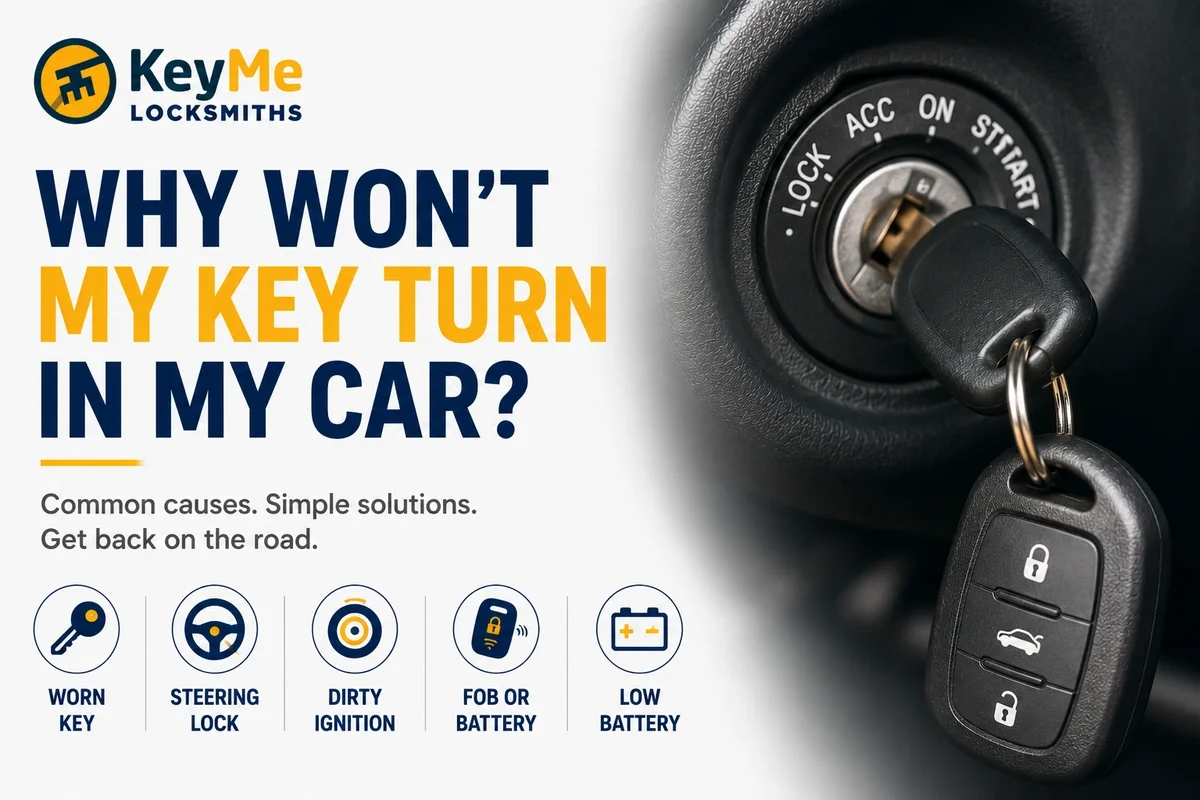
If your car key will not turn in the ignition, the most common causes include pressure from the steering lock, a worn or damaged key, an ignition cylinder problem, or a gear selector that is not fully in Park. The correct fix depends on what you feel when you insert and turn the key, so avoid forcing it. Excess pressure can bend or break the key or damage the ignition cylinder.
Some causes are normal vehicle behaviors rather than failures. For example, Honda owner documentation for vehicles with keyed ignitions instructs drivers to move the steering wheel left and right while turning the key when the steering lock prevents the ignition from moving.
If basic troubleshooting does not restore normal operation, an automotive locksmith can determine whether the problem involves the key, ignition cylinder, or another part of the vehicle's access system.
Summary
- A steering lock under pressure can prevent the ignition key from turning even when the key and ignition are working normally.
- Manufacturer guidance for some keyed vehicles recommends gently moving the steering wheel while turning the key to release steering-lock pressure.
- A worn, bent, or damaged key may no longer align correctly with the ignition cylinder.
- Some automatic-transmission vehicles require the selector to be fully in Park before the key can be removed or the ignition system will behave normally.
- Do not force a key that will not turn. Excessive force can break the key inside the ignition and create a more involved repair.
- If a key breaks, broken key extraction may be needed. If the ignition itself is damaged, ignition key replacement or another automotive locksmith service may be appropriate.
- Always check your vehicle's owner's manual because ignition and steering-lock procedures vary by manufacturer and model.
Why a Steering Wheel Lock Can Stop the Key From Turning
Many keyed vehicles use theft-deterrent systems that prevent normal vehicle operation when the key is removed.
Federal Motor Vehicle Safety Standard No. 114 has historically required covered vehicles to use a key-locking system that prevents normal engine activation and either steering or forward self-mobility when the key is removed. Manufacturers have used different approaches to meet those requirements, including steering locks, transmission interlocks, and electronic immobilizers.
On vehicles with a mechanical steering lock, turning the steering wheel after the vehicle is shut off can place pressure against the locking mechanism.
You may notice:
- The steering wheel moves slightly in one direction but not the other.
- The ignition key inserts normally but will not rotate.
- The problem occurs after parking with the wheels turned.
- The key worked normally immediately before the vehicle was parked.
Honda's owner documentation for several keyed models gives a specific example of this behavior. When the key will not turn from LOCK to ACCESSORY, Honda instructs the driver to turn the key while moving the steering wheel left and right so the steering lock can release.
"A steering lock can make a perfectly good ignition feel completely stuck. The important thing is to relieve the pressure rather than increasing force on the key." - KeyMe Locksmiths
What to Try
Keep your foot on the brake and make sure the vehicle is safely parked.
Then:
- Insert the correct key fully.
- Apply light turning pressure to the key.
- Gently move the steering wheel left and right.
- Try turning the key as the steering pressure releases.
Do not aggressively twist either the key or steering wheel.
Your owner's manual should take priority because the exact procedure varies by vehicle.
A Worn or Damaged Car Key Can Stop Engaging the Ignition
Mechanical keys change gradually through everyday use.
Over time, you may notice:
- Rounded edges
- Worn cuts
- A slight bend in the blade
- Cracks near the key head
- Difficulty inserting or removing the key
- A key that works only when moved a certain way
An ignition cylinder relies on the key having the correct physical profile. If that profile becomes significantly worn or distorted, internal components may no longer align as intended.
One useful test is to try a known-good spare key if you have one.
If the spare works normally while the everyday key does not, the original key deserves closer inspection.
If you still have a functioning key and want another authorized copy, KeyMe offers vehicle key services and car key replacement for supported vehicles.
Do Not Make a Severely Bent Key Straight by Force
Trying to bend a damaged automotive key back into shape can weaken the metal further.
A key that breaks inside the ignition can turn a simple key problem into an extraction problem. If a fragment becomes lodged inside the cylinder, professional broken key extraction may be appropriate.
Need a Locksmith? We're here to help
Connect with a trusted local locksmith for fast, professional assistance when you need it most.

The Ignition Cylinder May Be Worn or Damaged
If multiple properly functioning keys have trouble turning, the problem may be inside the ignition cylinder.
Possible signs include:
- The key feels gritty while turning.
- The ignition occasionally binds.
- The key is difficult to insert or remove.
- The problem has gradually become more frequent.
- A spare key behaves the same way as the primary key.
- The cylinder feels unusually loose.
Mechanical ignition cylinders contain components that must move into the correct position before the key can rotate.
Age, wear, debris, previous damage, or repeated force can interfere with that movement.
If the symptoms persist with more than one good key, an automotive locksmith can evaluate the ignition and determine whether repair or ignition key replacement is appropriate for the vehicle.
The Gear Selector May Not Be Fully in Park
On some automatic-transmission vehicles, the ignition and transmission selector are interlocked.
Honda owner manuals for multiple keyed vehicles state that the key cannot be removed unless the shift lever is in P, or Park.
Federal theft-protection requirements have also addressed transmission interlocks. NHTSA has explained that certain automatic-transmission vehicles with a Park position must prevent key removal unless the transmission or selector is locked in Park, or becomes locked in Park as a direct result of removing the key.
If the key will not turn or release normally:
- Verify that the vehicle is fully in Park.
- Keep your foot on the brake.
- Move the selector firmly into Park.
- Avoid forcing the ignition.
If moving the selector changes the ignition behavior repeatedly, the issue may involve the shift interlock or related components rather than the key.
Cold Weather Can Affect Mechanical Locks
Cold weather can make an existing mechanical problem more noticeable.
Low temperatures can affect:
- Lubricants
- Moisture inside mechanical components
- Existing wear
- Key and cylinder movement
If the ignition becomes difficult only during very cold conditions, do not compensate by applying significantly more force.
Avoid pouring hot water into an ignition cylinder. Introducing additional moisture can create new problems.
Follow your vehicle manufacturer's cold-weather guidance and seek professional diagnosis if the issue persists.
Could the Problem Be the Immobilizer?
Possibly, but an immobilizer problem usually produces different symptoms from a physically stuck ignition cylinder.
NHTSA describes immobilizing-type anti-theft systems as technology that can use computer chips in ignition keys or electronically interrupt systems needed for the engine to operate.
That means there is an important distinction:
Key will not physically turn: Look first at steering-lock pressure, key condition, ignition-cylinder condition, or gear-selector position.
Key turns but vehicle will not start: Electronic authorization, transponder communication, battery, or another starting-system issue may be involved.
If your vehicle uses a transponder key and the mechanical portion works but the engine does not recognize the key, car key programming may be relevant for supported vehicles.
Find a KeyMe Kiosk Near You
Need a spare key fast? Find a KeyMe kiosk near you to copy many house, office, and eligible car keys in just minutes.
Why Forcing the Key Can Make the Problem Worse
When an ignition feels stuck, applying more force is rarely a good diagnostic method.
Excessive force can lead to:
- A bent key
- A broken key
- Damage inside the ignition cylinder
- A key fragment becoming lodged in the ignition
- Additional difficulty determining the original cause
"Resistance is information. If the key suddenly requires much more force than normal, stop and determine why before the key or ignition becomes the next damaged component." - KeyMe Locksmiths
If a key has already cracked, bent significantly, or begun twisting under pressure, stop using it.
Best Way to Solve a Car Key That Won't Turn
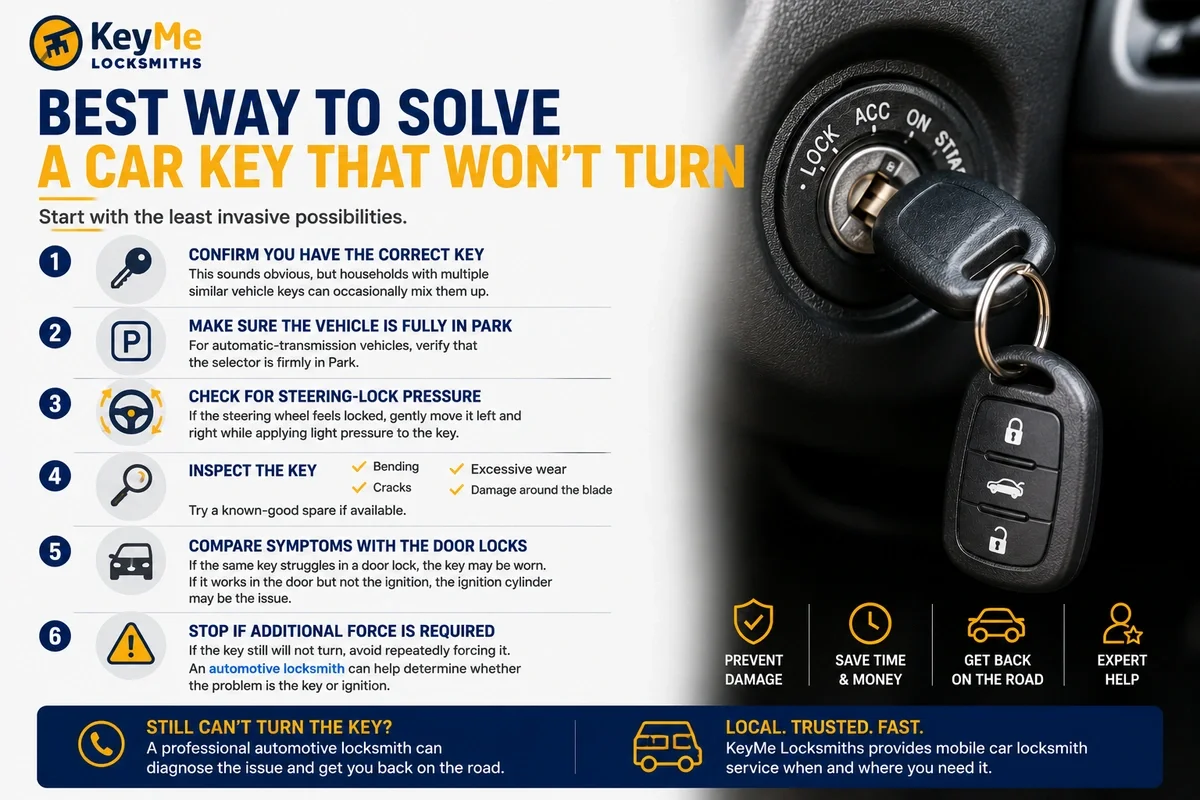
1. Confirm You Have the Correct Key
This sounds obvious, but households with multiple similar vehicle keys can occasionally mix them up.
2. Make Sure the Vehicle Is Fully in Park
For automatic-transmission vehicles, verify that the selector is firmly in Park.
3. Check for Steering-Lock Pressure
If the steering wheel feels locked, gently move it left and right while applying light pressure to the ignition key, following the procedure in your owner's manual.
4. Inspect the Key
Look for:
- Bending
- Cracks
- Excessive wear
- Damage around the blade
Try a known-good spare if available.
5. Compare Symptoms With the Door Locks
If the same mechanical key also struggles in a door lock, the key itself may be worn.
If it operates the door normally but repeatedly binds in the ignition, the ignition cylinder deserves closer evaluation.
6. Stop if Additional Force Is Required
If the key still will not turn, avoid repeatedly forcing it.
An automotive locksmith can help determine whether the problem is the key or ignition.
When Professional Help Makes Sense
Professional assistance may be appropriate when:
- The key will not turn after steering-lock pressure is relieved.
- A known-good spare also will not turn.
- The ignition feels gritty, loose, or inconsistent.
- The key is visibly bent or damaged.
- A key has broken inside the ignition.
- The key turns but the vehicle does not recognize it.
- The problem repeatedly returns.
- You are completely locked out of your vehicle.
Depending on the cause, relevant KeyMe services may include:
Copy Your Key from Anywhere - Right from Your Phone
Skip the kiosk and copy your key from home. Upload a clear photo of an eligible house or car key, and KeyMe will create a precise duplicate and mail it directly to your door.

Understanding the Cause Helps You Choose the Right Fix
A car key that will not turn does not automatically mean the ignition has failed.
On a keyed vehicle, the cause may be something as simple as steering-lock pressure or a gear selector that is not fully in Park. A worn key can produce similar symptoms, while persistent resistance with multiple good keys may point toward the ignition cylinder.
The safest approach is to diagnose the easiest possibilities first and avoid force.
If basic troubleshooting does not restore normal operation, KeyMe offers automotive locksmith services for supported vehicles, including ignition, key replacement, programming, extraction, and lockout needs.
References
- National Highway Traffic Safety Administration (NHTSA). Vehicle Theft Prevention. Information about immobilizing-type anti-theft devices, steering-wheel theft deterrents, and computer-chip vehicle keys.
https://www.nhtsa.gov/vehicle-safety/vehicle-theft-prevention - National Highway Traffic Safety Administration. Federal Motor Vehicle Safety Standard No. 114 Interpretation. Explanation of key-locking systems designed to prevent unauthorized engine activation and steering or forward vehicle movement.
https://www.nhtsa.gov/interpretations/gf005229-2 - National Highway Traffic Safety Administration. Key-Locking and Park Interlock Interpretation. Information about automatic-transmission key-removal requirements associated with Park.
https://www.nhtsa.gov/interpretations/aiam4789 - American Honda Motor Co. Owner's Manual, Ignition Switch Guidance. Manufacturer instructions showing that steering-lock pressure can prevent a key from turning and describing moving the steering wheel while turning the key to release it.
https://techinfo.honda.com/rjanisis/pubs/OM/AH/ATLA2222OM/enu/ATLA2222OM.PDF