

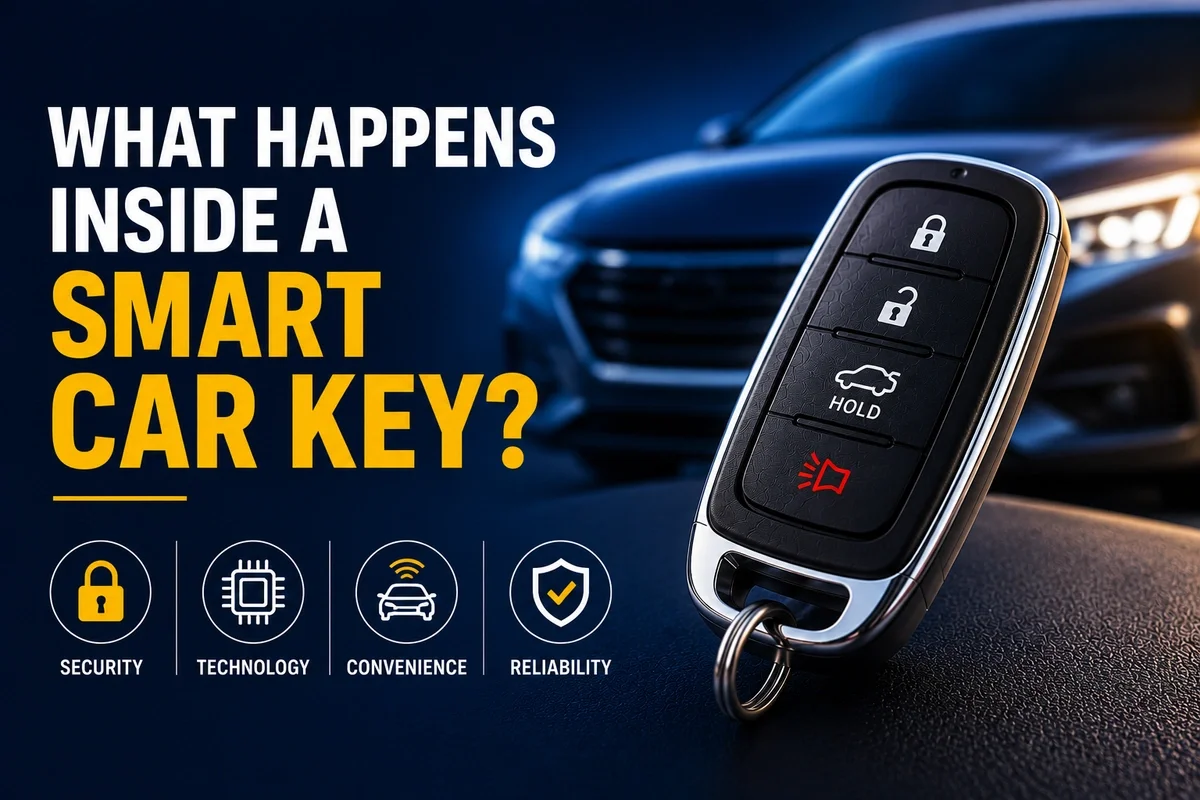
A smart car key contains several electronic and mechanical components that allow an authorized driver to communicate with a vehicle without inserting a traditional ignition key.
Depending on the system, the key may contain a printed circuit board, control electronics, radio-frequency components, antenna, battery, authentication technology, physical buttons, and a mechanical backup blade.
Each component serves a different role. Some provide power, some transmit or receive information, and others help the vehicle determine whether the key is authorized.
The important distinction is that a smart key is not simply a remote control. It is one part of the vehicle's electronic access and anti-theft architecture.
Summary
- Smart car keys combine several electronic and mechanical components.
- The circuit board connects and coordinates the key's electronics.
- Radio components allow information to move between the key and vehicle.
- Authentication technology helps the vehicle recognize an authorized credential.
- The battery powers active electronic functions but is only one part of the key.
- Physical buttons operate separate remote functions on many fobs.
- Some smart keys also contain a mechanical backup blade.
- Smart-key compatibility depends on the specific vehicle system.
- Cutting the right physical blade does not automatically create an electronically authorized smart key.
- For the separate question of why some keys require batteries while others do not, see Why Some Car Keys Need Batteries and Others Don't.
Best Way to Understand a Smart Car Key
Think of the device as several systems packaged together:
- Circuitry coordinates electronic functions.
- Authentication components help identify the credential.
- Radio components and antennas allow communication.
- Battery power supports active electronics.
- Buttons and switches provide manual remote commands.
- Mechanical backup hardware may provide physical door access.
The exact combination varies by manufacturer, model, model year, and key generation.
What Makes a Car Key "Smart"?
A traditional mechanical key primarily relies on its physical shape.
A smart key adds electronic communication and authorization.
The vehicle can detect an appropriate credential without requiring the driver to insert a conventional key into the ignition.
AAA explains that modern vehicle keys may use microchips, encoded identification, and electronic communication as part of anti-theft systems. AAA: Smart Keys
NHTSA has also documented keyless systems in which electronically transmitted information functions as the vehicle's key for authorization purposes. NHTSA: Keyless System Interpretation
At a high level:
Vehicle communicates with key → credential is evaluated → authorized function is permitted
The specific technical implementation differs among manufacturers.
Need a Locksmith? We're here to help
Connect with a trusted local locksmith for fast, professional assistance when you need it most.
What's Inside a Smart Car Key?
Although designs vary, several components are common.
1. Printed Circuit Board
The printed circuit board provides the foundation for the key's electronic components.
It may connect:
- Buttons
- Battery contacts
- Control electronics
- Radio components
- Antenna elements
- Authentication components
Rather than thinking of the smart key as one electronic part, it is more accurate to think of it as a small electronic assembly.
2. Control Electronics
The key also requires electronics that coordinate its functions.
Depending on the design, these electronics may help manage:
- Button input
- Radio communication
- Power use
- Authentication exchanges
- Other key-specific functions
This is one reason visually similar smart keys should not automatically be treated as interchangeable.
The shell may look the same while the electronics inside are different.
3. Authentication Technology
One of the most important components is the technology that allows the vehicle to determine whether the credential is authorized.
AAA explains that transponder keys contain encoded identification that the vehicle checks before allowing normal engine operation. AAA: Smart Keys
NHTSA has likewise documented immobilizer systems in which a properly coded electronic credential must be recognized before engine operation is permitted. NHTSA: Engine Immobilizer Interpretation
The exact authentication architecture varies, but the principle is straightforward:
The vehicle evaluates electronic authorization, not merely the physical shape of the key.
4. Radio Components
Smart keys communicate wirelessly with the vehicle.
Depending on the system, that communication may support:
- Passive entry
- Door locking
- Door unlocking
- Trunk access
- Interior key detection
- Push-button start
NHTSA has described smart-key systems where the vehicle communicates electronically with the key before allowing vehicle access or operation. NHTSA: Smart Key Interpretation
The smart key therefore functions as part of a larger vehicle communication system.
5. Antenna
Radio communication requires an antenna or equivalent component.
The vehicle also contains antennas or readers that interact with the key.
Depending on the vehicle, separate detection areas may be used to determine whether the credential is:
- Outside the vehicle
- Near a specific door
- Inside the passenger compartment
- In the appropriate area for starting
The antenna is therefore part of the key's communication architecture, not simply an accessory attached to the remote buttons.
6. Battery
The battery supplies power for active electronic functions.
Those may include:
- Proximity communication
- Remote lock
- Remote unlock
- Trunk release
- Panic function
- Other manufacturer-specific features
Battery dependence varies among different car-key technologies.
The deeper distinction between powered smart keys and passive transponders belongs in Why Some Car Keys Need Batteries and Others Don't.
7. Buttons and Switches
Many smart keys provide physical controls for functions such as:
- Lock
- Unlock
- Trunk or hatch
- Panic
- Remote start where equipped
These buttons operate electronic switches inside the fob.
The remote-control portion of the key should be understood as one layer of the overall smart-key system, rather than the entire system itself.
8. Mechanical Backup Blade
Many smart keys include a hidden mechanical key.
Consumer Reports notes that some push-button-start vehicles provide a mechanical blade inside the fob for situations where normal electronic entry is unavailable. Consumer Reports: Key Fob Features
The mechanical blade and electronic credential perform different jobs.
A mechanical blade may provide door access without replacing the electronic authorization needed for normal vehicle starting.
How Does the Car Know the Smart Key Is Nearby?
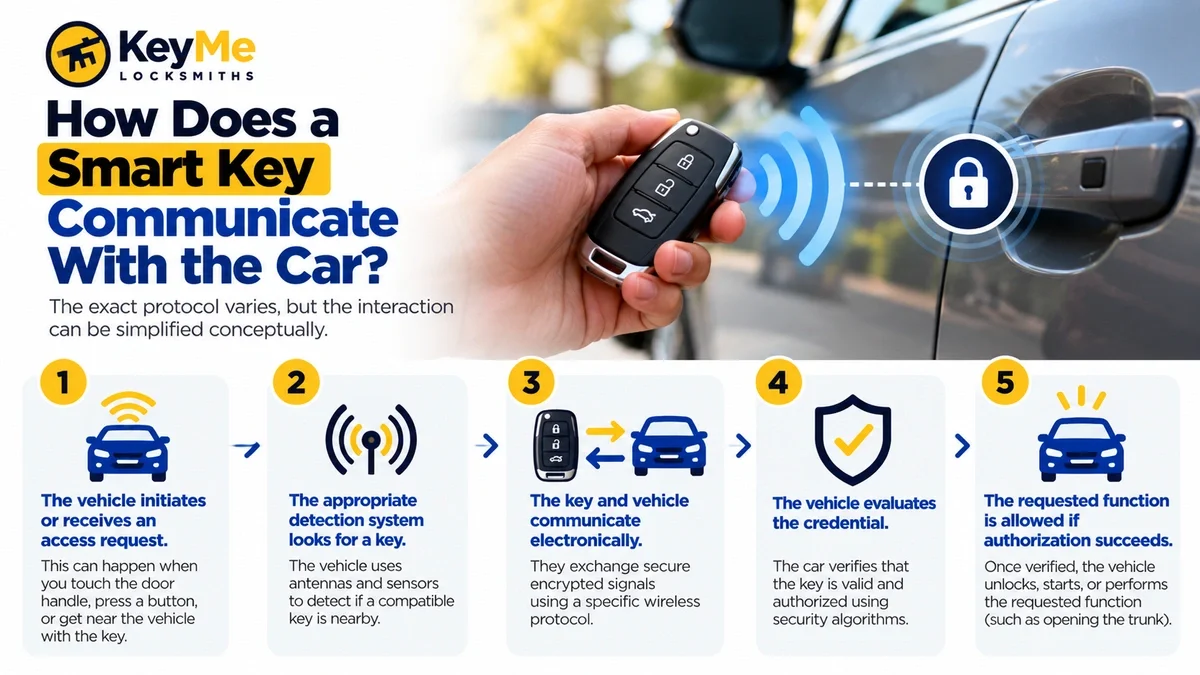
The exact protocol varies, but the interaction can be simplified conceptually.
- The vehicle initiates or receives an access request.
- The appropriate detection system looks for a key.
- The key and vehicle communicate electronically.
- The vehicle evaluates the credential.
- The requested function is allowed if authorization succeeds.
That interaction may happen when:
- A door handle is touched
- A button on the key is pressed
- The key enters the vehicle
- The start button is pressed
This article focuses on the components involved.
For troubleshooting a vehicle that cannot recognize an otherwise present key, see Key Not Detected Warning: Causes and Fixes.
What Happens When You Press Start?
Push-button start still requires authorization.
At a conceptual level:
Start request → credential detection → authentication → vehicle permits the starting process
The button itself does not replace the key.
Instead, the vehicle relies on the electronic credential carried by the driver.
NHTSA has recognized electronically transmitted codes as part of the "key" in certain keyless systems because they determine whether normal engine activation is authorized. NHTSA: Keyless System Interpretation
Find a KeyMe Kiosk Near You
Need a spare key fast? Find a KeyMe kiosk near you to copy many house, office, and eligible car keys in just minutes.
Why Does a Smart Key Need to Match a Specific Vehicle?
Smart keys are not universal.
Compatibility can depend on:
- Manufacturer
- Model
- Model year
- Immobilizer generation
- Communication system
- Frequency
- Hardware version
- Key configuration
- Vehicle electronics
Two keys can have nearly identical outer shells while containing different internal electronics.
That is why replacement starts with identifying the exact vehicle and key system rather than simply finding a fob with the right appearance.
Cutting and Electronic Authorization Are Different
Some smart keys include a mechanical blade.
Cutting that blade correctly addresses the mechanical portion of the key.
Electronic vehicle authorization is a separate issue.
A replacement credential may need to be electronically registered with the vehicle before all intended functions operate.
The step-by-step programming process belongs in How Car Key Programming Works.
Smart Key vs. Traditional Transponder Key
A traditional transponder key may combine:
- Mechanical blade
- Electronic transponder
- Immobilizer authorization
The key may still be inserted into an ignition cylinder.
A smart or proximity key may add:
- Passive entry
- Wireless proximity detection
- Push-button starting
- Remote functions
Both may participate in electronic authentication, but their physical design and communication architecture differ.
Smart Key vs. Remote-Only Fob
Not every remote control is a smart key.
Some vehicles use:
- A mechanical ignition key
- A separate lock/unlock remote
Others combine:
- Mechanical blade
- Transponder
- Remote buttons
A true proximity or smart-key system adds another layer by allowing the vehicle to detect an authorized credential without requiring the user to press a button for every normal interaction.
This distinction helps explain why the term key fob can refer to several different technologies.
Why Understanding the Components Matters
Breaking the smart key into its component systems helps clarify what automotive key service actually involves.
A modern key may contain separate elements responsible for:
- Mechanical access
- Remote commands
- Wireless detection
- Vehicle authentication
- Power
That is why replacing a complete modern vehicle key can involve more than copying a physical blade.
For supported vehicles, KeyMe provides car key replacement and car key programming.
Copy Your Key from Anywhere - Right from Your Phone
Skip the kiosk and copy your key from home. Upload a clear photo of an eligible house or car key, and KeyMe will create a precise duplicate and mail it directly to your door.
How KeyMe Supports Smart Car Keys
For supported vehicles, KeyMe offers automotive key services including:
- Car key replacement
- Car key programming
- Automotive locksmith services
- KeyMe Car Key Vans at participating retail locations
"A smart car key is best understood as several systems packaged into one device. Mechanical access, radio communication, power, and electronic authentication each perform different jobs, even though drivers experience them as a single key." - KeyMe Locksmiths
References
- AAA: Smart Keys
- NHTSA: Smart Key Interpretation
- NHTSA: Engine Immobilizer Interpretation
- NHTSA: Keyless System Interpretation
- Consumer Reports: Your Car's Key Fob May Have Hidden Features
- KeyMe Locksmiths: Why Some Car Keys Need Batteries and Others Don't
- KeyMe Locksmiths: How Car Key Programming Works
- KeyMe Locksmiths: Key Not Detected Warning: Causes and Fixes