

What Is A Commercial Grade Lock?
Commercial door locks are something we don't often consider until it is too late and the damage is done. Whether you are looking to learn about a commercial door lock for a brand new brick and mortar location or you've gone through multiple rounds having years of experience in door hardware and know every term from: access control, mortise lock, lever lock, and master key systems just to name a few - commercial door hardware provides a sea of options. Commercial grade locks, in particular, have become a cornerstone in the world of security.
“Many businesses only think about their door locks after a break-in or security issue. Choosing the right commercial-grade lock before that happens is one of the most effective ways to prevent it.” - KeyMe Locksmiths
Understanding Commercial Lock Grades
Commercial lock grades serve as a standardized metric, providing users with valuable insights into the strength, durability, and overall performance of a lock. These grades are determined by the American National Standards Institute (ANSI), a non-profit organization that develops and publishes standards for various industries. The ANSI grading system ranges from Grade 1 to Grade 3, with Grade 1 being the highest and most secure.
The Grade 1 Commercial Lock: Unparalleled Security
At the top of the hierarchy, Grade 1 commercial locks are designed to withstand the highest levels of physical attack. These locks are typically found in high-security environments merit high security locks, such as government buildings, financial institutions, and critical infrastructure facilities. Their durability is a testament to their construction, which often includes heavy-duty materials and advanced mechanisms.
Grade 1 locks are rigorously tested for endurance and resistance to forced entry, ensuring that they can withstand intense pressure and manipulation attempts. The presence of Grade 1 locks sends a clear message to potential intruders – gaining unauthorized access is an insurmountable challenge.
The Grade 2 Commercial Lock: Versatile Security
Grade 2 commercial locks strike a balance between security and cost-effectiveness, making them suitable for a wide range of commercial applications. While not as robust as their Grade 1 counterparts, Grade 2 locks still provide a formidable defense against unauthorized access.
These locks are commonly found in office buildings, retail spaces, and other commercial establishments where security is a priority, but the highest level of protection is not necessarily required. Grade 2 locks undergo stringent testing to ensure they can withstand common methods of forced entry, offering reliable security without breaking the bank.
The Grade 3 Commercial Lock: Basic Security
Grade 3 commercial locks are the entry-level option in the ANSI grading system. While they may not offer the same level of security as Grade 1 or Grade 2 locks, they still provide a baseline of protection suitable for low to moderate security needs.
Grade 3 locks are commonly used in residential and light commercial settings. They are cost-effective and meet the essential requirements for locking mechanisms, providing a level of security that is appropriate for less critical applications.
ANSI Grading System
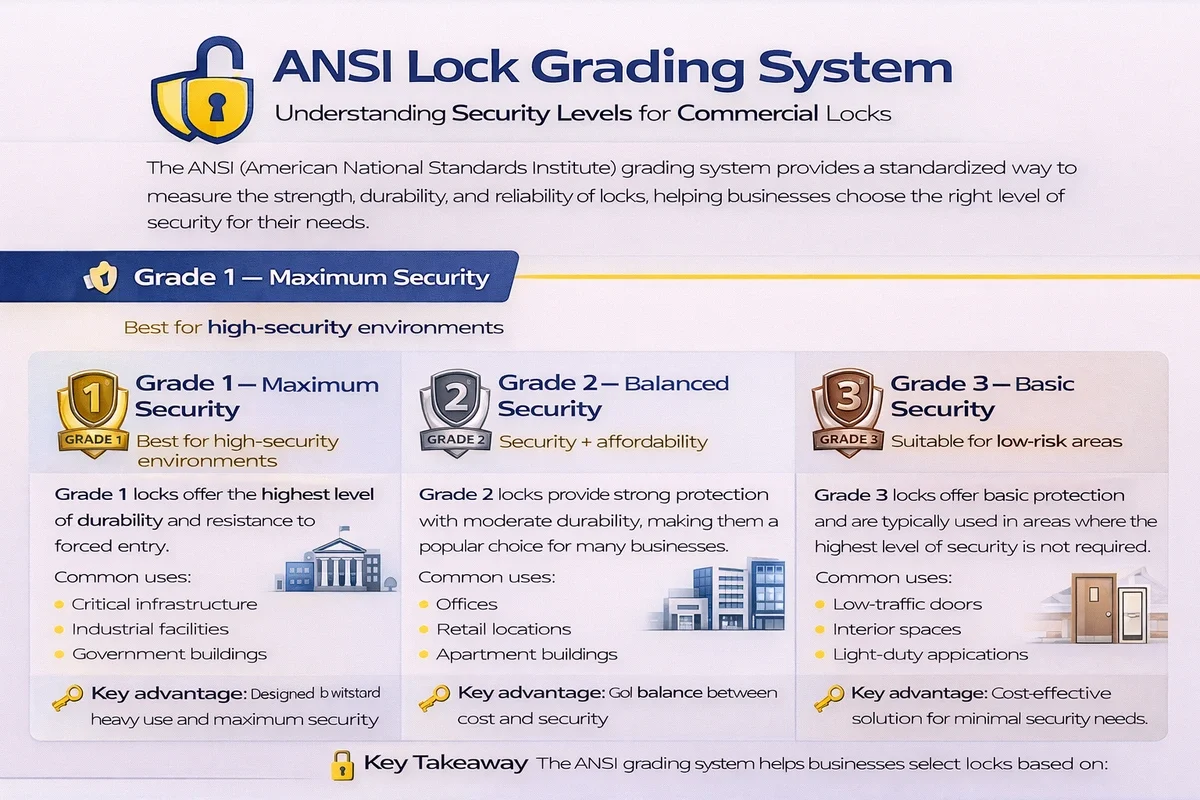
The ANSI grading system provides a clear and standardized way to evaluate the strength and reliability of locks, allowing businesses to make informed decisions based on their unique security requirements and budget constraints.
Investing in Grade 1 locks may be imperative for critical infrastructure and high-security environments, while Grade 2 locks strike a balance between security and affordability for a broader range of commercial spaces. Grade 3 locks, although offering basic security, play a crucial role in less critical applications where the highest level of protection is not a primary concern.
Ultimately, understanding the nuances of commercial lock grades empowers businesses and the commercial locksmiths that serve them to tailor their security strategy to meet their specific needs, ensuring that their premises remain safe and secure in the face of potential threats.
“The best commercial security strategy doesn’t rely on a single lock — it combines the right lock grade with access control, key management, and professional installation.” - KeyMe Locksmiths
Frequently Asked Questions
How do I know which lock grade is right for my business?
The right grade depends on:
- Foot traffic and usage frequency
- Value of assets inside the property
- Level of security risk
High-risk or high-traffic environments typically require Grade 1, while smaller offices may find Grade 2 sufficient.
Are higher-grade locks always better for every door?
Not necessarily. While Grade 1 offers maximum durability, it may be unnecessary for:
- Interior office doors
- Low-risk storage areas
Using the appropriate grade for each door helps balance security and cost.
Can commercial locks be upgraded without replacing the entire door?
Yes. In many cases, locks can be upgraded by:
- Replacing the existing hardware
- Retrofitting higher-grade components
- Adding reinforcements like strike plates
A locksmith can assess compatibility and recommend upgrades.
Do commercial lock grades apply to electronic or smart locks?
ANSI grading primarily applies to mechanical hardware, but many electronic locks are built to meet or exceed similar durability standards. It’s important to evaluate both:
- Mechanical strength
- Electronic reliability
How long do commercial-grade locks typically last?
Lifespan depends on usage:
- Grade 1: Built for heavy use, often lasting many years in high-traffic settings
- Grade 2: Moderate lifespan for standard commercial use
- Grade 3: Shorter lifespan under frequent use
Regular maintenance extends longevity.
Can commercial locks be rekeyed instead of replaced?
Yes. Rekeying is often the best option when:
- Keys are lost
- Employee turnover occurs
- Access needs to be restricted
It’s more cost-effective than full replacement while maintaining security.
Do commercial locks need regular maintenance?
Absolutely. Routine maintenance includes:
- Lubricating internal components
- Checking alignment and latch function
- Inspecting for wear or damage
Preventive care reduces unexpected failures.
How do commercial locks work with master key systems?
Many commercial-grade locks are designed to integrate with master key systems, allowing:
- Tiered access levels
- Centralized key control
- Simplified key management for large facilities
Can commercial locks be integrated with access control systems?
Yes. Many businesses combine mechanical locks with:
- Key card or fob systems
- Keypad entry
- Smart access control
- This creates a layered security approach.
When should a business consider upgrading its locks?
Consider upgrading if:
- You’ve experienced a break-in or attempted intrusion
- Locks show signs of wear or failure
- Security needs have increased
- You’re expanding or remodeling
About KeyMe Locksmiths
KeyMe Locksmiths is a leading provider of local locksmith services and key copy kiosks across 50 states and the District of Columbia. Proud to serve over 5 million customers, KeyMe Locksmiths cuts over 10 million keys annually. With more than 8,000 self-service kiosks in major retailers, an e-commerce platform delivering over 10,000 keys weekly, and a nationwide locksmith network, KeyMe Locksmiths provides fast, reliable solutions for residential, commercial, and vehicle needs. KeyMe Locksmiths is committed to delivering exceptional service backed by a 100% money-back guarantee. KeyMe Locksmiths also operates one of the nation’s leading retail media networks, connecting consumers to other brands seeking to advertise in-store and delivering over 2B monthly impressions.