

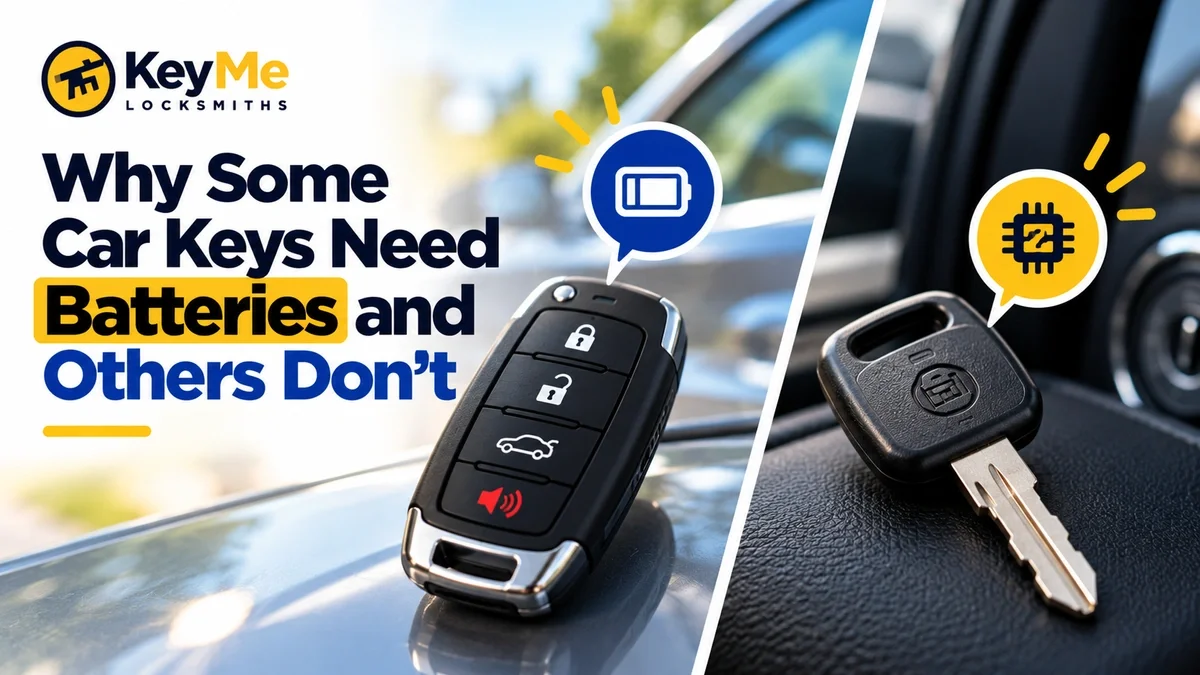
Some car keys need batteries because they must actively send or respond to wireless signals. Other keys do not need their own battery because they are either purely mechanical or use passive transponder technology that can receive the energy needed for authentication from the vehicle.
That distinction explains something that often surprises drivers:
A key can contain electronics without necessarily needing its own battery for every function.
For example, a remote-head key may use a battery to operate the lock and unlock buttons while a separate passive transponder participates in vehicle-start authorization.
Summary
- Traditional mechanical keys do not need batteries.
- Some electronic transponders can function without their own battery.
- Passive transponders can receive energy from the vehicle's reader at close range.
- Remote-control buttons need a power source because the key must transmit commands.
- Smart and proximity keys typically rely on batteries for normal active wireless operation.
- Different functions inside one key can use different power arrangements.
- A depleted remote battery does not necessarily eliminate every function of every key type.
- Manufacturer-provided backup procedures vary by vehicle.
- Battery replacement and key programming are separate processes.
- For the internal electronics themselves, see What Happens Inside a Smart Car Key?.
Best Way to Understand Why Car Keys Use Batteries
Separate vehicle keys into four broad technology groups:
- Mechanical keys rely on physical cuts.
- Passive transponder keys add electronic authorization without necessarily requiring a battery in the transponder.
- Remote-head keys may combine a passive transponder with battery-powered remote controls.
- Smart/proximity keys use battery power for normal active wireless communication.
- The key question is not simply:
"Does this key contain electronics?"
It is:
"Which functions need the key to supply its own electrical power?"
Mechanical Car Keys Need No Battery
A conventional mechanical car key relies on its physical blade.
It may operate:
- Door cylinder
- Ignition cylinder
- Trunk cylinder
- Other mechanical locks
No radio transmitter or powered proximity system is required.
Therefore, the key itself does not need a battery.
Need a Locksmith? We're here to help
Connect with a trusted local locksmith for fast, professional assistance when you need it most.
Electronic Does Not Always Mean Battery-Powered
Transponder technology changed car keys by adding electronic authorization.
AAA explains that transponder keys contain encoded identification that the vehicle can check before permitting normal engine operation. AAA: Smart Keys
But some transponder systems are passive.
The transponder does not necessarily use a replaceable battery of its own.
Instead, the vehicle's reader can provide the energy required for the transponder to respond at close range.
This is one of the most important distinctions in modern key technology:
Electronic and independently battery-powered are not synonyms.
How Does a Passive Transponder Get Power?
A passive transponder interacts with a nearby vehicle reader.
At a high level:
- The key enters the appropriate detection area.
- The vehicle generates an electromagnetic field or interrogation signal.
- The passive transponder receives energy.
- The transponder responds with its electronic information.
- The vehicle evaluates the credential.
NHTSA has documented immobilizer systems in which a properly coded electronic key must be recognized before normal engine operation is permitted. NHTSA: Engine Immobilizer Interpretation
The detailed security protocol varies by vehicle, but the power principle is what matters here.
The passive component can operate without carrying its own conventional fob battery.
Why Can a Key Have a Battery and a Passive Transponder?
Because one key can perform several separate functions.
A remote-head key may contain:
- Mechanical blade
- Passive transponder
- Battery
- Remote transmitter
- Lock button
- Unlock button
- Trunk button
The battery and passive transponder are serving different purposes.
Battery
Supplies power for active remote transmission.
Passive Transponder
Participates in close-range vehicle authentication.
This explains why losing one powered function does not automatically eliminate every function inside the key.
Why Do Remote Buttons Need a Battery?
A remote control must actively transmit a signal from the key to the vehicle.
That requires energy.
Functions may include:
- Lock
- Unlock
- Trunk release
- Panic
- Remote start where equipped
The battery provides power for those transmissions.
This article focuses on why the battery is required, rather than diagnosing declining remote range.
For progressive range problems, see Why Car Key Signals Lose Strength Over Time.
Why Do Smart and Proximity Keys Need Batteries?
Smart keys are expected to communicate wirelessly during normal vehicle use.
Depending on the system, the vehicle may interact with the key when:
- Driver approaches
- Door handle is touched
- Key enters the cabin
- Start button is pressed
NHTSA has documented smart-key systems in which electronic communication identifies an authorized credential before access or vehicle operation is permitted. NHTSA: Smart Key Interpretation
Normal proximity operation requires the smart key's electronics to be powered.
That is why these keys typically use replaceable batteries.
For the actual components inside the fob, see What Happens Inside a Smart Car Key?.
What Functions Can Depend on the Key Battery?
Depending on the vehicle, battery power may support:
- Remote locking
- Remote unlocking
- Trunk release
- Panic button
- Passive entry
- Proximity detection
- Normal wireless smart-key communication
- Other manufacturer-specific features
Not every function necessarily uses power in the same way.
That is why the key's technology matters more than simply asking whether there is a coin-cell battery inside the case.
Find a KeyMe Kiosk Near You
Need a spare key fast? Find a KeyMe kiosk near you to copy many house, office, and eligible car keys in just minutes.
What Happens When the Battery Is Completely Depleted?
The result depends on the key design.
Some vehicles provide alternative procedures so the authorized credential can still be recognized when normal battery-powered communication is unavailable.
Consumer Reports notes that some push-button-start vehicles allow a depleted fob to be placed directly against the start button or another designated detection location. Consumer Reports: Key Fob Features
The specific procedure is manufacturer- and vehicle-dependent.
Drivers should use the instructions in the owner's manual rather than assuming every push-button vehicle uses the same method.
Why Can Close-Range Backup Detection Work Without Normal Battery Power?
Normal proximity operation is designed to work at a greater distance.
Backup detection can place the credential very close to the appropriate vehicle reader.
Depending on the system, that close-range interaction can allow the vehicle to communicate with a passive authentication component even when normal battery-powered proximity functions are unavailable.
This is conceptually similar to passive transponder operation.
The exact design varies by manufacturer.
Why Might Remote Buttons Stop Working While the Key Still Starts the Car?
Because the functions may rely on different components.
A remote-head key may use:
Battery-powered transmitter → remote lock/unlock
while separately using:
Passive transponder → immobilizer authorization
If the fob battery is depleted, the remote portion may no longer have power while the passive authentication component remains usable.
This does not apply identically to every key system, so vehicle-specific documentation matters.
Why Does the Mechanical Backup Key Still Work?
A mechanical blade does not depend on electricity.
Some smart keys contain a hidden blade that can provide physical access when normal electronic entry is unavailable.
Consumer Reports notes that hidden mechanical keys are included in many keyless fobs. Consumer Reports: Key Fob Features
The mechanical blade provides a separate access method.
It does not replace electronic vehicle authorization.
Battery Replacement and Programming Are Different
Replacing a battery restores electrical power.
Programming establishes or changes the key's electronic authorization relationship with the vehicle.
Those are separate processes.
A battery replacement does not inherently:
- Add a new key to the vehicle
- Remove a lost key
- Reauthorize an incompatible credential
- Correct an immobilizer programming issue
Likewise, programming does not repair a failed power source.
For the programming process itself, see How Car Key Programming Works.
Why Isn't Every Electronic Key Designed as a Smart Key?
Vehicle key systems developed over time.
Different generations prioritize different combinations of:
- Mechanical operation
- Anti-theft protection
- Remote convenience
- Passive entry
- Push-button start
A traditional transponder key can provide electronic immobilizer authorization without requiring the more complex proximity functions of a smart key.
A smart key combines additional wireless functionality that requires its own power.
This evolution explains why several key technologies remain on the road simultaneously.
How Can You Identify Which Type of Key You Have?
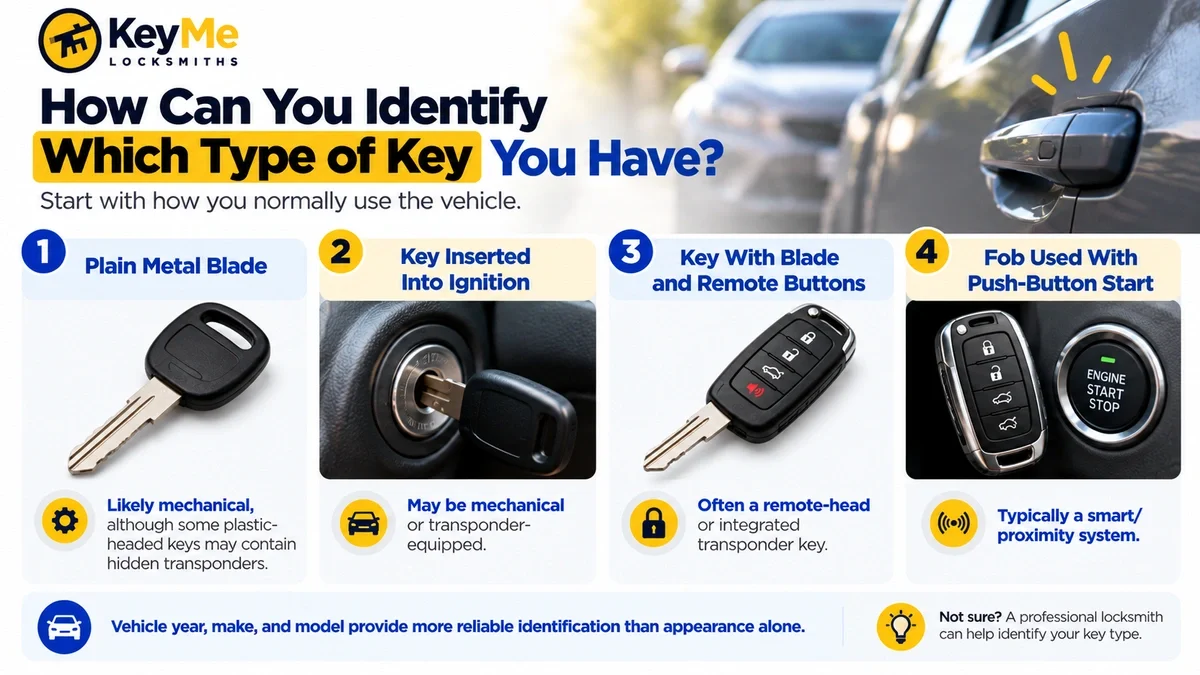
Start with how you normally use the vehicle.
Plain Metal Blade
Likely mechanical, although some plastic-headed keys may contain hidden transponders.
Key Inserted Into Ignition
May be mechanical or transponder-equipped.
Key With Blade and Remote Buttons
Often a remote-head or integrated transponder key.
Fob Used With Push-Button Start
Typically a smart/proximity system.
Vehicle year, make, and model provide more reliable identification than appearance alone.
What If Your Vehicle Says "Key Not Detected"?
That warning involves vehicle recognition, not just the general question of why the key has a battery.
A depleted battery can be one possible factor, but the warning can also involve communication, position, programming, damage, or vehicle-side conditions.
For the dedicated troubleshooting process, see Key Not Detected Warning: Causes and Fixes.
Copy Your Key from Anywhere - Right from Your Phone
Skip the kiosk and copy your key from home. Upload a clear photo of an eligible house or car key, and KeyMe will create a precise duplicate and mail it directly to your door.
What If Your Remote Range Is Getting Shorter?
Declining range is also a separate diagnostic topic.
Possible causes extend beyond the basic power architecture covered here.
For that specific symptom, see Why Car Key Signals Lose Strength Over Time.
What If You Think the Fob Is Starting to Fail?
This article explains why different keys need different power sources rather than diagnosing a deteriorating key.
If you are noticing intermittent operation, warnings, button problems, or other signs of declining performance, see How to Tell if Your Key Fob Is Dying.
That keeps battery architecture separate from symptom diagnosis.
How KeyMe Supports Electronic Car Keys
For supported vehicles, KeyMe offers:
-
KeyMe Car Key Vans at participating retail locations
"Whether a car key needs its own battery depends on what the key is being asked to power. Remote transmitters and proximity functions need active electrical power, while some authentication components can operate passively when energized by the vehicle." - KeyMe Locksmiths
References
- AAA: Smart Keys
- NHTSA: Smart Key Interpretation
- NHTSA: Engine Immobilizer Interpretation
- Consumer Reports: Your Car's Key Fob May Have Hidden Features
- KeyMe Locksmiths: What Happens Inside a Smart Car Key?
- KeyMe Locksmiths: How Car Key Programming Works
- KeyMe Locksmiths: Key Not Detected Warning: Causes and Fixes
- KeyMe Locksmiths: Why Car Key Signals Lose Strength Over Time
- KeyMe Locksmiths: How to Tell if Your Key Fob Is Dying