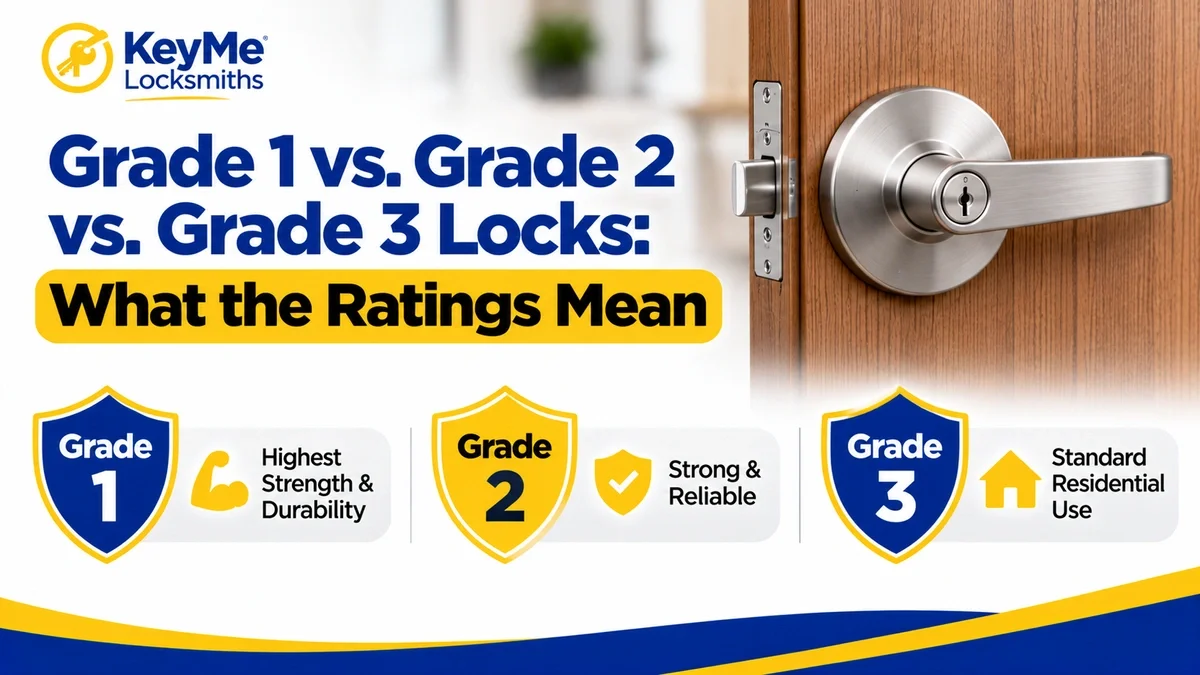
Grade 1, Grade 2, and Grade 3 are ANSI/BHMA performance classifications used for certain types of door locks and hardware. Grade 1 represents the highest performance level within the applicable standard, followed by Grade 2 and then Grade 3. The grades are based on testing requirements that can include durability, strength, operational performance, security, and other criteria.
The important detail is that a lock grade applies within a specific ANSI/BHMA standard.
It is not a universal score that makes every Grade 1 lock identical.
For bored and preassembled locks, the current applicable standard is ANSI/BHMA A156.2-2022. BHMA says that standard includes cycle, strength, operational, material, dimensional, and other performance tests.
Summary
- Grade 1 is the highest performance grade within the applicable ANSI/BHMA standard.
- Grade 2 is an intermediate performance level.
- Grade 3 meets a lower performance threshold than Grade 1 or Grade 2 within that standard.
- A higher grade can involve more demanding durability and strength testing.
- Grade does not automatically tell you whether a lock is appropriate for every door.
- The applicable lock type and ANSI/BHMA standard matter.
- Installation, door construction, strike, frame, maintenance, and environment also affect real-world performance.
- BHMA certification is more meaningful than an unsupported marketing claim.
- Residential smart locks may also use BHMA's separate AAA-style residential performance ratings, which should not be confused with Grade 1, 2, or 3.
Best Way to Choose Between Grade 1, Grade 2, and Grade 3
Use these questions:
-
What type of opening is this?
-
How frequently is the door used?
-
Is the application residential or commercial?
-
What level of durability is needed?
-
Are there building-code or fire-door requirements?
-
Does the lock need specific accessibility characteristics?
-
Is the product actually certified to the relevant standard?
-
What condition are the door, frame, strike, and hinges in?
A higher grade is not automatically the correct answer for every opening.
The goal is to match the hardware to the use case.
Grade 1 vs. Grade 2 vs. Grade 3 at a Glance
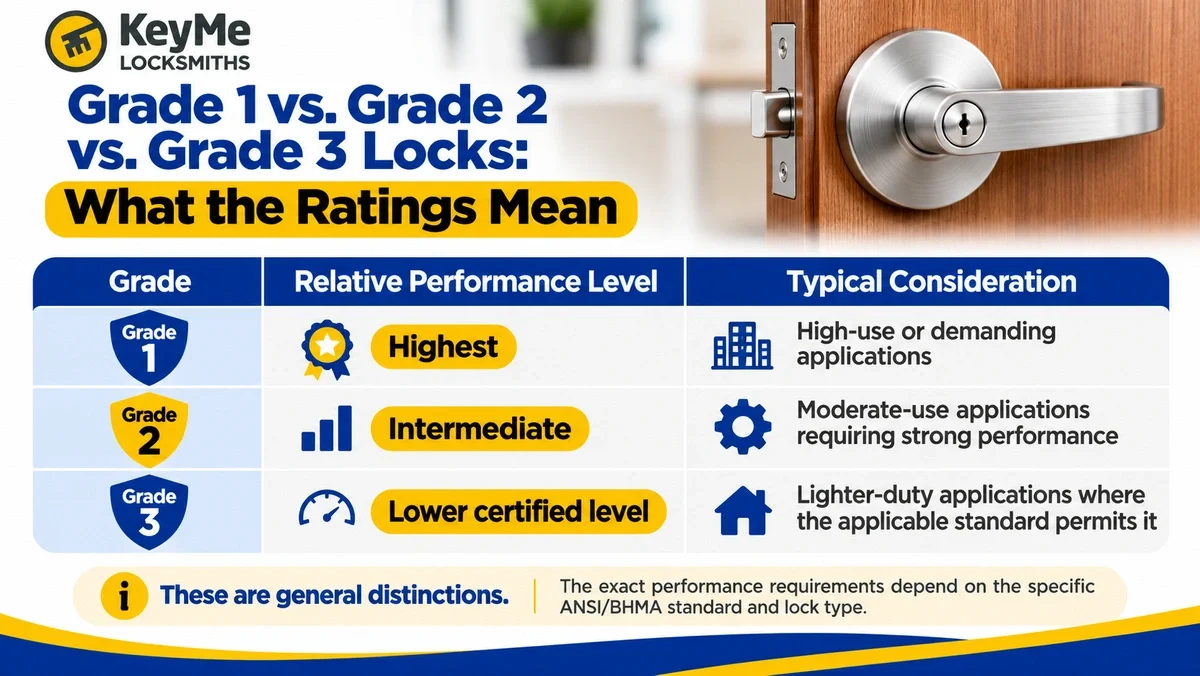
These are general distinctions.
The exact performance requirements depend on the specific ANSI/BHMA standard and lock type.
What Is ANSI/BHMA?
ANSI is the American National Standards Institute.
BHMA is the Builders Hardware Manufacturers Association.
BHMA develops performance standards covering builders hardware such as:
- Locks and latches
- Mortise locks
- Interconnected locks
- Cylinders
- Exit devices
- Door closers
- Hinges
- Other door hardware
BHMA's Hardware Highlights directory provides its current standards by hardware category.
Need a Locksmith? We're here to help
Connect with a trusted local locksmith for fast, professional assistance when you need it most.
What Does a Lock Grade Actually Measure?
Grade is not based on one test.
ANSI/BHMA standards can evaluate multiple performance characteristics.
For A156.2 bored locks, BHMA identifies categories such as:
- Operation
- Durability
- Safety and security
- Dimensional requirements
- Material evaluation
BHMA's A156.2 consumer guidance explains how certified locks must satisfy the applicable criteria for the grade at which they are listed.
What Is a Grade 1 Lock?
Grade 1 is the highest performance level under the applicable Grade 1/2/3 standard.
For bored locks under A156.2-2022, BHMA highlights a durability test in which a Grade 1 lock must withstand one million opening-and-closing cycles with a 10-pound axial load as one example of the standard's requirements.
That is only one part of certification.
The lock also has to satisfy the other applicable Grade 1 requirements.
Grade 1 May Be Appropriate For
- High-use commercial entrances
- Frequently operated office doors
- Institutional applications
- Other demanding openings where Grade 1 performance is specified
The final choice should still reflect the specific lock type, code requirements, and door system.
What Is a Grade 2 Lock?
Grade 2 represents an intermediate performance level.
It is below Grade 1 but above Grade 3 under standards that use the three-grade system.
A Grade 2 product must meet the complete Grade 2 criteria for its applicable standard rather than simply passing fewer tests.
Grade 2 may fit applications that require substantial durability without the same performance threshold specified for Grade 1.
Examples can include certain:
- Commercial offices
- Multifamily applications
- Interior commercial doors
- Lower-traffic business openings
The intended application should determine whether Grade 2 is sufficient.
What Is a Grade 3 Lock?
Grade 3 is the lower of the three traditional grade levels.
It still represents a defined performance level where the applicable product is certified, but the requirements are lower than Grade 1 and Grade 2.
Grade 3 may be associated more often with lighter-duty residential applications.
However, that does not mean every residential door should automatically use Grade 3.
Consider:
- Frequency of use
- Exterior vs. interior opening
- Door condition
- Desired durability
- Lock type
- Local requirements
Does Grade 1 Mean a Lock Is Unbreakable?
No.
A grade is a laboratory performance classification.
Actual real-world performance also depends on:
- Installation
- Door construction
- Frame construction
- Maintenance
- Alignment
- Environmental conditions
No lock grade eliminates every possible failure or security risk.
Grade 1 vs. Grade 2: What Is the Main Difference?
The key difference is the performance threshold the product must satisfy.
Grade 1 typically faces more demanding requirements than Grade 2 within the applicable standard.
That can include factors such as:
- Cycle testing
- Strength
- Operational performance
- Security-related testing
For a high-use opening, durability can become especially important.
For a lower-use door, Grade 2 may still be appropriate when it meets the building's requirements.
Grade 2 vs. Grade 3: What Is the Main Difference?
Grade 2 must satisfy a higher performance level than Grade 3.
That may matter when a door:
- Receives more frequent use
- Serves a business or common area
- Needs stronger durability
- Has higher operational demands
The right choice should be based on the actual opening rather than simply selecting the lowest available grade.
Do Cycle Counts Differ by Lock Type?
Yes.
This is an important point that is often lost in simplified grade comparisons.
Different hardware categories use different standards.
For example:
- A156.2 covers bored and preassembled locks
- A156.12 covers interconnected locks
- Other standards cover mortise locks, cylinders, exit hardware, and other components
The cycle requirement for Grade 1 in one category does not necessarily equal the Grade 1 requirement in another.
BHMA's ANSI/BHMA A156.12-2022 Interconnected Locks guidance, for example, cites 800,000 cycles for Grade 1 interconnected locks, while the current A156.2 guidance cites one million cycles for Grade 1 bored locks.
So you should not compare grades without checking the hardware category and standard.
Find a KeyMe Kiosk Near You
Need a spare key fast? Find a KeyMe kiosk near you to copy many house, office, and eligible car keys in just minutes.
Are Commercial Locks Always Grade 1?
No.
Commercial applications can use different grades depending on:
- Traffic
- Door function
- Building specification
- Hardware type
- Code requirements
- Security needs
- Grade 1 is commonly associated with more demanding commercial use, but Grade 2 can also be appropriate in many commercial environments.
The building's hardware schedule or design requirements should control the choice.
Are Residential Locks Always Grade 3?
No.
Residential hardware can be available at multiple performance levels.
Some homeowners choose higher-performing hardware for:
- Exterior entry doors
- Frequently used doors
- Rental properties
- Multifamily environments
- Other demanding residential applications
Residential products may also use BHMA's separate letter-based residential rating framework.
That system should not be confused with ANSI/BHMA Grade 1, Grade 2, and Grade 3 classifications.
What Does BHMA AAA Mean?
BHMA's residential rating system evaluates performance categories separately.
A lock labeled AAA is not automatically the same thing as an ANSI Grade 1 lock.
The terminology belongs to a different residential rating framework.
This is particularly relevant with smart locks, where manufacturers may advertise residential BHMA ratings.
Always check:
- Which BHMA standard applies
- Whether it is a Grade 1/2/3 classification
- Whether it is a residential letter rating
- What exact product is certified
Does Lock Grade Matter More Than the Door?
No.
The lock is only one component of the opening.
A high-performing lock installed on a poorly aligned, weak, or deteriorated door cannot compensate for every other problem.
Evaluate:
- Door construction
- Frame
- Strike
- Hinges
- Fasteners
- Alignment
- Installation
- Door closer where applicable
The complete opening matters.
What About Deadbolts?
Deadbolts can be tested under applicable ANSI/BHMA standards, but the relevant standard depends on the hardware design.
Do not rely on a generic "Grade 1 deadbolt" claim without checking the certification and product category.
BHMA's standards directory provides a starting point for identifying which standard applies.
Does a Higher Grade Mean Better Pick Resistance?
Not necessarily by itself.
Grade ratings evaluate a defined collection of requirements.
Specific resistance to:
- Picking
- Drilling
- Other specialized attacks
may involve additional cylinder standards or certifications.
BHMA maintains separate standards for cylinder and locking-component performance.
Do not treat Grade 1 as shorthand for every possible security characteristic.
When Should You Consider Grade 1?
Grade 1 deserves consideration when:
- Door has heavy traffic
- Building specification requires it
- Commercial use is demanding
- Higher durability is important
- Applicable requirements call for it
When Might Grade 2 Be Appropriate?
Grade 2 can be appropriate where:
- Usage is moderate
- Commercial-grade performance is desired
- Building specifications permit it
- The opening does not require the highest grade
When Might Grade 3 Be Appropriate?
Grade 3 may fit lighter-duty applications where:
- Applicable standard allows it
- Usage is relatively light
- The opening does not require Grade 1 or Grade 2
- Residential application is appropriate
Always confirm the hardware is suitable for the specific opening.
Copy Your Key from Anywhere - Right from Your Phone
Skip the kiosk and copy your key from home. Upload a clear photo of an eligible house or car key, and KeyMe will create a precise duplicate and mail it directly to your door.

Should You Upgrade an Existing Lock Based Only on Grade?
Not automatically.
Consider replacing a lock when:
- Existing hardware is worn
- Lock repeatedly fails
- Door use has changed
- Security requirements have changed
- Building specifications require another grade
- Existing lock is inappropriate for the opening
If the lock still functions well and matches the application, grade alone may not justify replacement.
For supported needs, KeyMe provides lock replacement and lock installation.
Grade 1 vs. Grade 2 vs. Grade 3 Locks: The Bottom Line
The simplest way to understand the three levels is:
Grade 1: Highest performance threshold.
Grade 2: Intermediate performance threshold.
Grade 3: Lower certified performance threshold.
But the grade alone is not enough.
You also need to know:
- What type of lock is being graded
- Which ANSI/BHMA standard applies
- Whether the product is actually certified
- How heavily the door is used
- Whether code or building specifications require a particular level
- Whether the rest of the door opening is in good condition
BHMA's current A156.2-2022 standard reinforces that lock performance involves more than cycle count alone, including operational, strength, dimensional, and other testing.
For homeowners comparing common lock manufacturers, see Schlage vs. Kwikset: An Objective Comparison for Homeowners.
References
- Builders Hardware Manufacturers Association. ANSI/BHMA A156.2-2022 Locks and Latches. Current standard summary for bored and preassembled locks, including operational, durability, strength, and security testing.
https://buildershardware.com/ANSI-BHMA-Standards/Hardware-Highlights/A1562-2022-Locks-and-Latches - Builders Hardware Manufacturers Association. ANSI/BHMA A156.12-2022 Interconnected Locks. Current standard summary illustrating that performance and cycle requirements vary by hardware category.
https://buildershardware.com/ANSI-BHMA-Standards/Hardware-Highlights/A15612-2022-Interconnected-Locks - Builders Hardware Manufacturers Association. ANSI/BHMA Hardware Highlights. Current directory of ANSI/BHMA standards covering locks, latches, cylinders, closers, hinges, exit devices, and related builders hardware.
https://buildershardware.com/ANSI-BHMA-Standards/Hardware-Highlights - Builders Hardware Manufacturers Association. ANSI/BHMA A156.2 Bored and Preassembled Locks and Latches. Consumer-facing explanation of testing, certification, grades, and the factors that affect installed performance.
https://buildershardware.com/Home-Sweet-Secure-Home/ansibhma-a1562-bored-preassembled-locks-and-latches - KeyMe Locksmiths. Schlage vs. Kwikset: An Objective Comparison for Homeowners. Related comparison of two major residential lock manufacturers.
https://key.me/article/schlage-vs-kwikset-an-objective-comparison-for-homeowners