The best high-security lock brand depends on what you need the system to do. Medeco stands out for independently certified high-security cylinders and long-term patented key control. Schlage Primus is a strong fit for facilities already standardized on Schlage hardware. Mul-T-Lock offers advanced patented key platforms and extensive master-key flexibility. SARGENT and Corbin Russwin are especially relevant to institutional and commercial facilities that need multiple security levels within a broader key system.
There is no single brand that is objectively best for every building.
A better comparison asks:
Does the specific cylinder provide independently tested physical security, controlled key duplication, the right master-key capacity, and long-term support for the facility?
Semrush also shows substantially more search activity around high-security door locks and individual manufacturers such as Medeco and Mul-T-Lock than around the exact phrase "best high-security lock brands." That makes it important to explain what qualifies as high security before comparing brands.
Summary
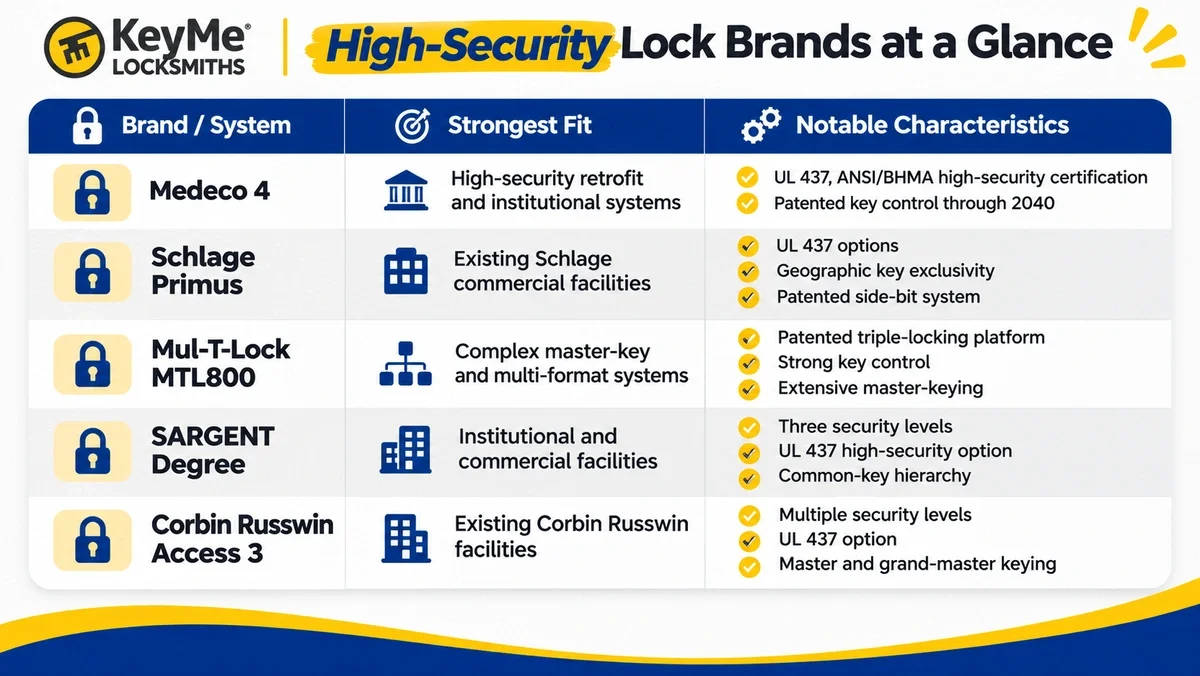
- Medeco: Strong choice for independently certified high-security cylinders, patented key control, retrofit applications, and long-term key-system planning.
- Schlage Primus: Strong fit for organizations already using Schlage commercial hardware and wanting restricted key control with UL 437 options.
- Mul-T-Lock: Strong option for patented key control, complex master-key systems, and multiple residential and commercial cylinder formats.
- SARGENT Degree: Strong fit for institutional facilities that want multiple security levels under one key system.
- Corbin Russwin Access 3: Strong option for existing Corbin Russwin facilities that want multiple security levels and UL 437 high-security cylinders within one hierarchy.
- UL 437 is one of the most important certifications to check when comparing high-security cylinders.
- ANSI/BHMA A156.30 provides another current performance standard specifically for high-security cylinders.
- A restricted key is not automatically a high-security cylinder.
- Grade 1 and high-security certification are different concepts.
- The complete door, frame, strike, lock body, and installation still matter.
Best Way to Choose a High-Security Lock Brand
Use this order:
- Decide whether you need a high-security cylinder, a complete lock, or an entire key system.
- Check for independent certifications such as UL 437 and ANSI/BHMA A156.30.
- Determine how tightly key duplication needs to be controlled.
- Review the remaining patent life of the key platform.
- Determine how complex the master-key hierarchy needs to be.
- Check compatibility with existing doors and lock hardware.
- Confirm local authorized service and replacement-key availability.
- Evaluate the entire opening, not just the cylinder.
What Does "High Security" Actually Mean?
"High security" should mean more than:
- Heavy-duty
- Commercial grade
- Pick resistant
- Restricted key
- Grade 1
Those terms can describe useful characteristics, but they do not all mean the same thing.
Schlage's current high-security guidance makes an important distinction: within its system, a cylinder must be UL 437 listed to claim high-security status.
The Builders Hardware Manufacturers Association also maintains ANSI/BHMA A156.30-2025, a dedicated standard for high-security cylinders.
That means a useful high-security comparison should look for evidence of both:
Physical Security
Resistance to defined forms of attack.
Administrative Security
Control over who can obtain or duplicate keys.
The strongest key system addresses both.
Need a Locksmith? We're here to help
Connect with a trusted local locksmith for fast, professional assistance when you need it most.
High-Security Lock Brands at a Glance
1. Medeco
Medeco is one of the most established names in U.S. high-security mechanical locking.
Its current flagship platform is Medeco 4.
The Medeco 4 system combines:
- Patented key control
- Multiple locking elements
- Physical attack resistance
- UL 437-listed configurations
- ANSI/BHMA high-security certification
- Multiple cylinder formats
- Master-key capability
Medeco states that its M4 high-security cylinders meet or exceed relevant ANSI/BHMA A156.30 and A156.5 Grade 1 criteria.
Selected Medeco 4 cylinders are also UL 437 listed.
Key-Control Advantage
Medeco 4's current U.S. patent protection extends through December 31, 2040 for applicable products.
That matters because active patent protection can support stronger manufacturer and distribution controls over unauthorized key duplication.
Retrofit Flexibility
Medeco 4 is available in formats designed to retrofit many existing commercial locksets.
That can be useful when a facility wants to upgrade the cylinder system without replacing every compatible lock body.
Medeco May Be a Good Fit If
- UL 437 certification is important.
- Long-term patented key control matters.
- Existing hardware should remain where possible.
- The building has complex master-key requirements.
- The property needs commercial, institutional, healthcare, educational, or government-grade key control.
Limitation to Keep in Mind
Medeco is a system, not one universal lock.
Certification and features vary by cylinder format.
Verify the exact product rather than assuming every Medeco cylinder carries the same rating.
2. Schlage Primus
Schlage Primus is the higher-security key-system platform within Schlage Commercial's cylinder portfolio.
The Schlage Primus system combines:
- Restricted keys
- Patented key control
- Secondary locking mechanisms
- Geographic key exclusivity
- UL 437 high-security cylinder options
- Compatibility with Schlage commercial hardware
Geographic Exclusivity
One of Primus's distinguishing features is the ability to control key availability geographically.
Depending on the Primus program level, key control can be structured around:
- Dealer territory
- Local area
- Regional area
- National organization
This can be useful for organizations trying to prevent the same restricted key blank from being widely available outside approved channels.
UL 437 Options
Schlage says Primus UL 437 cylinders use:
- Two independent locking mechanisms
- Restricted factory-milled side bitting
- Added drill-resistant components
Schlage explicitly distinguishes these high-security Primus cylinders from standard restricted-key systems.
Primus May Be a Good Fit If
- The facility already uses Schlage commercial locks.
- You want to maintain compatibility with an existing Schlage system.
- Geographic key exclusivity is valuable.
- UL 437 high-security cylinders are required at selected openings.
- You want different security levels within one Schlage ecosystem.
Limitation to Keep in Mind
Not every Primus or Everest cylinder is automatically UL 437 high security.
The exact cylinder configuration matters.
A restricted Schlage keyway may offer useful administrative security without carrying the same physical-security classification as a UL 437-listed Primus cylinder.
3. Mul-T-Lock
Mul-T-Lock offers several patented mechanical key platforms, including:
- MTL400
- MTL600
- MTL800
Its current premium platform is MTL800.
The MTL800 uses a multi-layered locking design that includes:
- Telescopic pinning
- Additional locking-bar mechanism
- Patented moving element in the key
- Restricted key control
- Extensive master-key capability
- Multiple cylinder and lock formats
Master-Key Strength
Mul-T-Lock specifically positions MTL800 for large and complex master-key systems.
It can support:
- Keyed different
- Keyed alike
- Master keyed
- Large system hierarchies
- Exclusive keyways
High-Security Hardware
Mul-T-Lock also offers products such as the Hercular deadbolt, which the manufacturer lists with UL 437 and ANSI Grade 1 credentials when configured appropriately.
Mul-T-Lock May Be a Good Fit If
- You need a highly flexible master-key system.
- You want patented key-control technology.
- You need multiple lock and cylinder formats.
- Residential and commercial openings need to share a system.
- Complex facility expansion is expected.
Limitation to Keep in Mind
Mul-T-Lock sells several different security platforms.
Do not treat:
- Classic
- MTL400
- MTL600
- MTL800
as equivalent.
Compare the actual platform and certification.
4. SARGENT Degree
SARGENT's Degree system is particularly relevant to institutional and commercial properties.
The SARGENT Degree platform provides three security levels within one broader key system.
That structure can allow a facility to use:
- Lower-security cylinders at ordinary openings
- Higher-security cylinders at critical openings
- A common key across appropriate levels
Current Features
SARGENT lists:
- Restricted key distribution
- Geographic exclusivity options
- Bump resistance
- Master-key capability
- UL 437-certified cylinder options
- ANSI/BHMA Grade 1 cylinder performance
Why Multiple Security Levels Matter
Not every door in a large building requires the same security level.
For example:
A supply closet may have different requirements from:
- Data room
- Pharmacy
- Finance office
- Critical mechanical room
A tiered platform can allow higher-security cylinders to be concentrated where they matter most.
SARGENT Degree May Be a Good Fit If
- You operate a school, hospital, office campus, or institutional property.
- The facility already uses SARGENT hardware.
- Different openings need different security levels.
- One master-key hierarchy needs to span those levels.
- UL 437 cylinders are required only at selected locations.
Limitation to Keep in Mind
The current Degree utility patent is listed through 2027.
For a new long-term installation, remaining patent life should be part of the key-control discussion.
5. Corbin Russwin Access 3
Corbin Russwin's Access 3 follows a similar tiered approach.
The Access 3 system provides three levels of security within a common key-system architecture.
The current system supports:
- Patented key control
- Multiple security levels
- Master keying
- Grand-master keying
- Construction keying
- Fixed and interchangeable cores
- UL 437 high-security options
- ANSI/BHMA Grade 1 configurations
Why Access 3 Can Work Well for Existing Facilities
Corbin Russwin specifically positions Access 3 as an upgrade path for facilities already using its hardware.
That can matter when a building wants to improve key control without replacing every compatible locking device.
Corbin Russwin May Be a Good Fit If
- Existing facility hardware is Corbin Russwin.
- Multiple security levels are required.
- Large master-key hierarchies are important.
- Construction keying is useful.
- UL 437 cylinders are needed at selected openings.
Limitation to Keep in Mind
Like SARGENT Degree, Access 3's current published patent protection extends through 2027.
Facilities planning a new long-term key system should evaluate future migration and replacement-key control before committing.
What About Older Corbin Russwin Pyramid Systems?
Corbin Russwin also has the Pyramid high-security platform.
However, the manufacturer currently labels Pyramid as:
Inactive, for existing systems only.
That makes it more relevant to organizations maintaining an existing Pyramid installation than to someone choosing a new system today.
This is an important example of why lifecycle support matters when comparing high-security brands.
Is UL 437 the Same as ANSI Grade 1?
No.
They address different things.
ANSI/BHMA Grade 1
Grade 1 describes a high performance level within the applicable lock or cylinder standard.
Depending on the product category, testing can include:
- Durability
- Operation
- Strength
- Other performance criteria
UL 437
UL 437 is specifically associated with high-security locking cylinders and attack resistance.
Schlage's current guidance describes UL 437 as the benchmark it uses to distinguish its true high-security cylinders from restricted-key products.
A lock can be Grade 1 without necessarily being a UL 437 high-security cylinder.
For more detail, see Grade 1 vs. Grade 2 vs. Grade 3 Locks: What the Ratings Mean.
What Is ANSI/BHMA A156.30?
The Builders Hardware Manufacturers Association's current ANSI/BHMA A156.30-2025 standard applies specifically to high-security cylinders.
The standard addresses mechanical and electrified high-security cylinder performance.
When comparing high-security products, certification to A156.30 provides more relevant information than vague claims such as:
- "Heavy duty"
- "Premium security"
- "Professional grade"
Find a KeyMe Kiosk Near You
Need a spare key fast? Find a KeyMe kiosk near you to copy many house, office, and eligible car keys in just minutes.
Restricted Key vs. High-Security Cylinder
These terms are often confused.
Restricted-Key System
Focuses primarily on controlling who can obtain or duplicate keys.
Possible features include:
- Restricted blanks
- Dealer authorization
- Signature verification
- Geographic exclusivity
- Patent protection
High-Security Cylinder
Adds defined physical attack resistance.
Possible characteristics include:
- UL 437
- ANSI/BHMA A156.30
- Drill resistance
- Pick resistance
- Additional locking mechanisms
- Hardened components
A strong facility program may want both.
Why Patent Life Matters
Patent protection is an important part of key control.
When an active patent applies to the key technology, manufacturers can exercise stronger legal and distribution controls over compatible key blanks.
That does not mean a patent makes a lock physically stronger.
It strengthens the administrative side of key control.
When comparing new systems, ask:
- When does the current patent expire?
- What happens afterward?
- Is there an upgrade path?
- Can the existing cylinders migrate to a newer platform?
For example:
- Medeco 4 lists patent protection through 2040.
- SARGENT Degree currently lists protection through 2027.
- Corbin Russwin Access 3 currently lists protection through 2027.
Those timelines can matter significantly for a facility planning a system expected to remain in service for decades.
Which Brand Is Best for a Large Master-Key System?
There is no automatic winner.
Medeco
Strong high-security certification combined with substantial commercial key-system flexibility.
Schlage Primus
Particularly attractive where the building already uses Schlage locks.
Mul-T-Lock
Explicitly designed to support large and complex master-key hierarchies.
SARGENT Degree
Useful where one hierarchy needs multiple security levels.
Corbin Russwin Access 3
Similar multi-level capability for Corbin Russwin facilities.
The best system depends on:
- Number of openings
- Number of access levels
- Expansion plans
- Existing hardware
- Key-control policy
- Authorized service network
Which Is Best for Retrofit Projects?
Medeco, Schlage, SARGENT, Corbin Russwin, and Mul-T-Lock all offer cylinder formats intended for existing commercial hardware in various configurations.
The most practical choice is often the platform that can integrate with the hardware already installed.
Replacing hundreds of functioning lock bodies solely to change key systems may not always be necessary.
A commercial locksmith or door-hardware consultant can inventory the existing cylinders before a system is selected.
Which Is Best for Residential High Security?
For an individual home, the comparison becomes somewhat different.
Look for:
- Compatible residential deadbolt
- UL 437-listed cylinder where high security is desired
- Strong door and frame
- Appropriate strike
- Controlled key duplication
- Practical local service
Medeco and Mul-T-Lock both offer residential-compatible high-security solutions.
Schlage also offers high-security cylinder options in compatible commercial-grade hardware.
But homeowners should not evaluate the cylinder in isolation.
The door, strike, frame, and installation still matter.
High-Security Cylinders Do Not Fix a Weak Door
A sophisticated cylinder cannot compensate for:
- Damaged frame
- Loose hinges
- Weak door
- Misaligned strike
- Poor installation
- Inappropriate lock body
Treat the opening as a system.
A high-security cylinder is one layer.
Which Brand Has the Best Key Control?
Rather than picking one brand universally, compare:
- Active patent life
- Blank distribution rules
- Dealer authorization
- Geographic exclusivity
- Documentation requirements
- Replacement-key process
- Master-key records
Schlage Primus, Medeco 4, Mul-T-Lock MTL800, SARGENT Degree, and Corbin Russwin Access 3 all approach key control differently.
The strongest solution is the one your organization can actually manage properly.
When to Consider a High-Security Lock System
A higher-security mechanical system may make sense for:
- Healthcare facilities
- Schools
- Government buildings
- Financial institutions
- Data centers
- Multifamily properties
- Utilities
- Critical infrastructure
- Commercial campuses
- High-value residential applications
The requirements should determine the hardware, not the label.
Copy Your Key from Anywhere - Right from Your Phone
Skip the kiosk and copy your key from home. Upload a clear photo of an eligible house or car key, and KeyMe will create a precise duplicate and mail it directly to your door.
When a Standard Commercial Lock May Be Enough
Not every door needs a high-security cylinder.
A building may reasonably use different security levels for:
- Ordinary offices
- Storage
- Public areas
- Sensitive rooms
- Critical infrastructure areas
A tiered approach can concentrate higher-security hardware at the most important openings.
Best High-Security Lock Brands: The Bottom Line
There is no universal "best" brand.
A more useful breakdown is:
Medeco 4: Strong choice for current independent certification, patented key control through 2040, retrofit flexibility, and high-security applications.
Schlage Primus: Strong choice for existing Schlage commercial environments and organizations wanting geographic key exclusivity with UL 437 options.
Mul-T-Lock MTL800: Strong choice for advanced patented key control and large, flexible master-key systems.
SARGENT Degree: Strong choice for institutional facilities that need several security levels within one key hierarchy.
Corbin Russwin Access 3: Strong choice for Corbin Russwin facilities needing multi-level security, master keying, and UL 437 options.
Before choosing a brand, verify:
Certification + key control + patent life + hardware compatibility + master-key requirements + long-term support.
That combination matters more than the logo on the cylinder.
References
- Builders Hardware Manufacturers Association. ANSI/BHMA A156.30-2025 High Security Cylinders. Current performance standard for mechanical and electrified high-security cylinders.
https://buildershardware.com/ANSI-BHMA-Standards/Hardware-Highlights/A15630-2025-High-Security-Cylinders - Medeco. Medeco High Security. Current overview of Medeco 4, UL 437, ANSI/BHMA high-security performance, patented key control, and high-security applications.
https://www.medeco.com/en/industrial-locking-systems/high-security - Medeco. Medeco 4 Key in Knob/Lever. Current specifications listing UL 437, ANSI/BHMA A156.30, A156.5 Grade 1, and patent protection through December 31, 2040.
https://www.medeco.com/en/products/cylinders-keys-keying/key-in-knob-lever/product-details.aehpdp-medeco4-key-in-knoblever-aeh_medeco_837187 - Schlage Commercial. High Security Solutions. Current guidance distinguishing restricted keyways from UL 437-listed Primus high-security cylinders.
https://commercial.schlage.com/en/solutions/by-requirement/high-security.html - Schlage Commercial. Key System Solutions. Current Primus key-control, geographic exclusivity, UL 437, and key-system management information.
https://commercial.schlage.com/en/solutions/by-requirement/key-systems.html - Mul-T-Lock. Patented Cylinder Platforms. Current overview of MTL400, MTL600, and MTL800 high-security mechanical key systems.
https://www.mul-t-lock.com/us/en/mechanical-solutions/patented-cylinder-platforms - Mul-T-Lock. Key Platforms. Current MTL800 specifications including patented locking technology, key control, and large master-key system support.
https://www.mul-t-lock.com/us/en/products/key-platforms - SARGENT. Degree Key System. Current information on its three security levels, UL 437-certified cylinders, Grade 1 performance, geographic exclusivity, and patent protection.
https://www.sargentlock.com/en/commercial-locks-products/key-systems/product-details.aehpdp-degree-aeh_sargent_219712 - Corbin Russwin. Access 3. Current information on multi-level key control, master keying, UL 437-listed cylinders, Grade 1 performance, and system compatibility.
https://www.corbinrusswin.com/en/commercial-locks-products/key-systems/product-details.aehpdp-key-systems-and-key-management-mechanical-key-systems-access-3-219716-aeh_corbin_russwin_219716 - ASSA ABLOY. Key System Solutions. Current overview of Corbin Russwin, Medeco, and SARGENT mechanical key-system options, including patented and UL 437-listed high-security systems.
https://www.assaabloy.com/us/en/solutions/products/cylinders-locks-and-keys/key-systems/key-systems-solutions