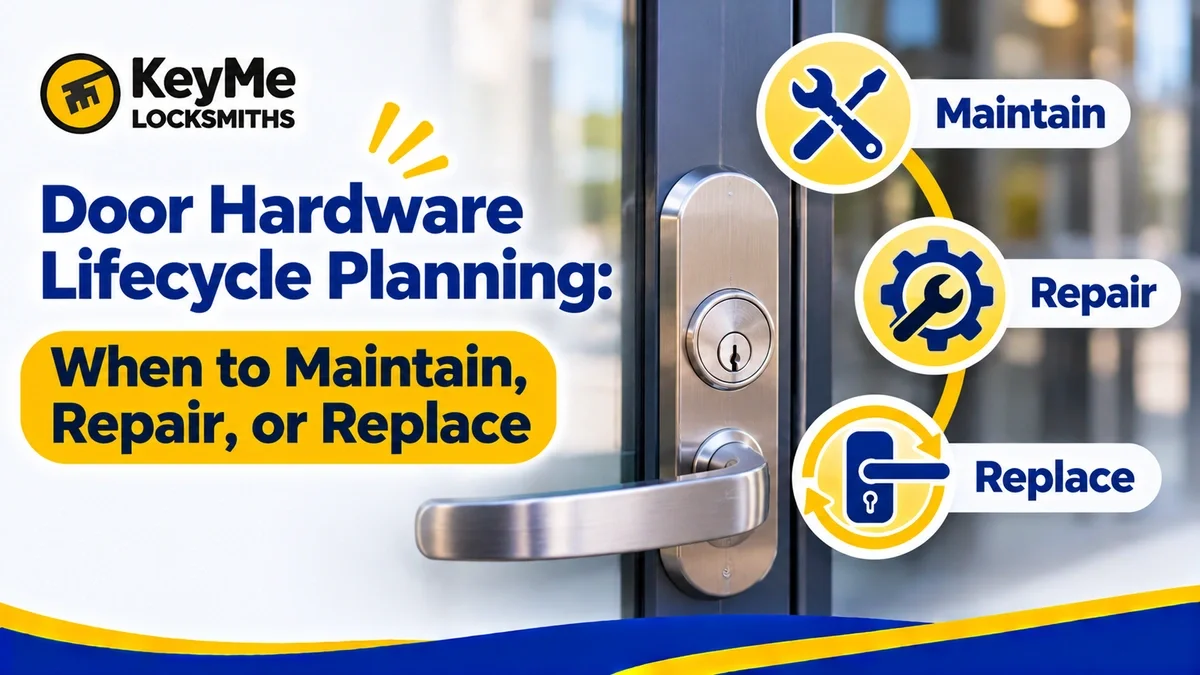
Door hardware should not be replaced simply because it reaches a certain age. A better lifecycle plan evaluates how heavily each opening is used, how the hardware is operating, how often it requires service, whether replacement parts remain available, and whether the opening still meets the building's operational and security needs. Maintain hardware that is functioning correctly, repair serviceable problems, and consider replacement when failures become recurring, components are damaged or unsupported, or the existing system no longer fits the opening's requirements.
Commercial door hardware can remain in service for years while performing thousands or even millions of operating cycles.
But not every door experiences the same conditions.
A rarely used storage-room door and a main office entrance may contain similar hardware while experiencing completely different:
- Traffic
- Wear
- Environmental exposure
- Operational demands
- Maintenance needs
That is why lifecycle planning should be based on condition and use, not a fixed calendar.
For facilities managing multiple entrances, offices, restricted rooms, or tenant spaces, a broader commercial locksmith strategy can help connect individual hardware decisions with the building's overall access and security needs.
Summary
- There is no universal replacement age for commercial door hardware.
- Maintenance should begin before hardware becomes difficult to operate.
- Repeated repairs can indicate that a component is approaching the end of its practical service life.
- Door alignment should be checked before assuming the lock or closer has failed.
- Cycle ratings describe standardized durability testing, not a guaranteed number of real-world operating years.
- High-traffic entrances usually deserve more frequent inspection than low-use interior doors.
- Locks, cylinders, closers, hinges, exit devices, and strikes can age differently on the same opening.
- A component may need replacement even when the rest of the door hardware remains usable.
- Replacement becomes more relevant when parts are unavailable, hardware is damaged, or the existing product no longer supports current access requirements.
- Fire-rated and egress doors require additional attention because hardware performance can affect life-safety functions.
- Maintenance records can help identify openings that repeatedly require service.
- A lifecycle program should prioritize critical openings rather than treating every door identically.
Best Way to Plan the Lifecycle of Door Hardware
A practical commercial door hardware program can follow five steps.
1. Inventory the Openings
Record the important hardware installed on each door.
That may include:
- Lockset
- Cylinder
- Door closer
- Hinges or pivots
- Exit device
- Strike
- Electrified hardware
- Access-control components
- Door operator
2. Classify the Door by Use
Identify whether the opening is:
- High traffic
- Moderate traffic
- Low traffic
- Exterior
- Interior
- Emergency egress
- Fire rated
- Security sensitive
- Employee only
- Public facing
3. Inspect Operation Regularly
Look for changes in:
- Closing
- Latching
- Locking
- Alignment
- Resistance
- Noise
- Loose hardware
- Visible damage
4. Track Repairs
Record:
- Date
- Component
- Problem
- Repair performed
- Repeat failure
- Replacement parts used
5. Escalate From Maintenance to Repair to Replacement
Do not wait for complete failure to decide what comes next.
A lifecycle plan should define when an issue moves from:
routine maintenance → corrective repair → component replacement
Maintenance, Repair, and Replacement Are Different Decisions
These terms are sometimes treated as interchangeable.
They are not.
Maintenance
Maintenance is intended to keep functioning hardware operating correctly.
Examples can include:
- Inspection
- Tightening appropriate fasteners
- Manufacturer-approved lubrication where applicable
- Cleaning
- Checking alignment
- Adjusting compatible hardware
- Testing operation
Repair
Repair addresses a specific problem while keeping the existing component in service.
Examples may include:
- Adjusting a closer
- Correcting strike alignment
- Replacing a serviceable part
- Repairing compatible lock hardware
- Replacing a worn cylinder while retaining the lock body
Replacement
Replacement removes a component that is no longer appropriate to keep in service.
Reasons can include:
- Damage
- Recurring failure
- Excessive wear
- Unsupported parts
- Changed building requirements
- Changed access needs
- Hardware no longer performing its intended function
The goal is not to replace hardware as early as possible.
It is to recognize when continued repair is no longer the most appropriate lifecycle decision.
For locks specifically, rekeying and replacing solve different problems. A key-control issue may require rekeying, while damaged or obsolete hardware may require replacement.
Need a Locksmith? We're here to help
Connect with a trusted local locksmith for fast, professional assistance when you need it most.
Do Door Locks Have a Standard Replacement Age?
No.
There is no universal rule such as:
Replace every commercial lock after 10 years.
The useful life of a lock depends on factors including:
- Frequency of use
- Hardware grade
- Door alignment
- Installation
- Environment
- Maintenance
- Key usage
- Abuse
- Corrosion
- Availability of replacement components
A heavily used entrance may accumulate far more operating cycles in a few years than a low-use office door accumulates over decades.
Age is useful context.
Operation is usually more important.
Understand What BHMA Cycle Ratings Mean
ANSI/BHMA standards subject builders hardware to durability testing.
Different hardware categories have different standards.
For example:
- ANSI/BHMA A156.1: Butts and hinges
- ANSI/BHMA A156.2: Bored and preassembled locks and latches
- ANSI/BHMA A156.3: Exit devices
- ANSI/BHMA A156.4: Door closers and pivots
- ANSI/BHMA A156.5: Cylinders and input devices
- ANSI/BHMA A156.13: Mortise locks
These tests help establish expected product-performance levels.
They are not maintenance calendars.
A Two-Million-Cycle Door Closer Does Not Mean "Replace at Two Million"
ANSI/BHMA A156.4-2024 evaluates door closers for:
- Cycle performance
- Operation
- Closing force
- Finish
- Other performance characteristics
Under the current standard, Grade 1 door closers are subjected to two million opening-and-closing cycles during durability testing.
That number should not be interpreted as:
"The closer automatically fails at cycle 2,000,001."
Nor should it mean:
"The closer is guaranteed to work until exactly two million cycles in every building."
The cycle test demonstrates standardized durability under defined test conditions.
Real-world lifecycle depends on the actual opening.
Usage Matters More Than Calendar Age
magine two identical door closers.
Door A
Main lobby entrance:
- Hundreds or thousands of operations per day
- Wind exposure
- Frequent deliveries
- Heavy public use
Door B
Interior storage room:
- A few operations per week
- Controlled environment
- Limited authorized users
Both closers could be the same age.
Their actual service histories are completely different.
A lifecycle program should therefore consider:
age + usage + condition + repair history
rather than age alone.
Build a Door Hardware Condition Rating
Facilities teams can use a simple internal classification.
Condition A: Normal
Hardware:
- Operates smoothly
- Latches correctly
- Shows no significant damage
- Has no recurring service issue
Action: Continue routine inspection and maintenance.
Condition B: Monitor
Hardware:
- Shows early wear
- Needs occasional adjustment
- Has minor operational changes
- Remains fully functional
Action: Maintain and monitor.
Condition C: Repair
Hardware:
- Binds
- Does not consistently latch
- Has loose or worn components
- Requires a correctable service action
Action: Diagnose and repair.
Condition D: Replacement Candidate
Hardware:
- Repeatedly fails
- Has structural damage
- Cannot maintain adjustment
- Uses unavailable components
- No longer meets operational requirements
Action: Evaluate replacement.
This provides a more useful lifecycle framework than simply listing installation dates.
Door Alignment Should Be Checked Before Replacing Hardware
One of the most important lifecycle principles is:
The hardware may not be the problem.
A lock can appear defective when the actual problem involves:
- Door sag
- Hinge wear
- Frame movement
- Strike alignment
- Weatherstripping
- Door deformation
For example:
If a deadbolt operates easily with the door open but binds when the door closes, the problem may involve alignment rather than the lock itself.
Replacing a functioning lock without correcting the opening can cause the same problem to return.
When the source of the problem is unclear, lock repair and installation service can help determine whether the issue is the lock, the surrounding hardware, or the opening itself.
Plan the Lifecycle of Locks and Latches
Commercial locks deserve attention when operation begins changing.
Watch for:
- Lever becoming loose
- Latch failing to retract smoothly
- Key becoming difficult to turn
- Lock requiring repeated adjustment
- Latch failing to engage the strike
- Internal components becoming unreliable
ANSI/BHMA A156.2 covers bored and preassembled locks and latches, while A156.13 covers mortise locks.
The appropriate response depends on whether the issue comes from:
- Lock body
- Cylinder
- Latch
- Door alignment
- Strike
- Lever or trim
Do not automatically replace the entire assembly when one serviceable component is responsible.
Plan Cylinders Separately From the Lock Body
A cylinder can have a different lifecycle from the lock it operates.
Cylinder replacement or rekeying may become appropriate because of:
- Key wear
- Access changes
- Lost keys
- Employee turnover
- Key-control concerns
- Cylinder damage
The lock body itself may still be functioning normally.
That is why facilities should distinguish between:
key-control lifecycle
and
hardware lifecycle
For compatible commercial systems, rekeying can change which keys operate the cylinder without replacing the complete locking device.
Door Closer Lifecycle Planning
Door closers deserve regular attention because their function affects how the opening closes and latches.
Watch for:
- Door slamming
- Door closing too slowly
- Door failing to latch
- Fluid leakage
- Closer arm becoming loose
- Door failing to close from the expected opening position
- Repeated adjustment requirements
ANSI/BHMA A156.4 specifically evaluates door-control performance in addition to durability.
A closer that repeatedly falls out of adjustment or no longer controls the door appropriately may be approaching the point where replacement deserves consideration.
Do Not Ignore a Leaking Door Closer
Visible fluid leakage can indicate internal closer problems.
Do not treat repeated adjustment as a permanent solution if the closer can no longer maintain appropriate operation.
The opening should be evaluated to determine whether:
- Closer needs service
- Mounting has loosened
- Door alignment is contributing
- Closer should be replaced
The complete door system matters.
Hinge Lifecycle Planning
Hinges support the weight and movement of the door.
Problems can affect nearly every other component.
Signs of hinge-related issues can include:
- Door sag
- Uneven gaps
- Door dragging
- Latch no longer aligning with strike
- Loose hinge leaves
- Excessive movement
- Visible wear
A sagging door can make:
- Locks bind
- Latches miss
- Closers struggle
- Exit devices operate poorly
Replacing a lock without addressing worn hinges can therefore miss the actual cause.
Exit Device Lifecycle Planning
Exit devices serve an especially important function because they support building egress.
ANSI/BHMA A156.3-2025 establishes performance requirements for exit devices, including:
- Cycle tests
- Operational tests
- Strength tests
- Material evaluation
- Security tests
Exit devices should be evaluated when there are symptoms such as:
- Bar does not move freely
- Latch does not retract correctly
- Door fails to latch after closing
- Trim becomes loose
- Device requires repeated service
- Components are visibly damaged
Because exit devices can be part of required egress systems, service should also account for applicable fire, life-safety, and building requirements.
Find a KeyMe Kiosk Near You
Need a spare key fast? Find a KeyMe kiosk near you to copy many house, office, and eligible car keys in just minutes.
Fire-Rated Openings Need Additional Attention
Door hardware on fire-rated openings cannot be managed only as ordinary convenience hardware.
The opening may include:
- Listed lock
- Listed exit device
- Door closer
- Fire-rated hinges
- Coordinator
- Automatic flush bolts
Changing one component without considering the entire rated assembly can create problems.
Facilities teams should verify that replacement hardware remains appropriate for the opening and applicable requirements.
Exterior Doors Often Need a Different Maintenance Schedule
Exterior openings face conditions that interior doors may not.
Examples include:
- Rain
- Humidity
- Salt
- Temperature changes
- Wind
- Dirt
- Repeated public use
Those conditions can accelerate:
- Finish degradation
- Corrosion
- Alignment changes
- Closer wear
- Hardware contamination
Exterior high-traffic entrances may therefore deserve more frequent inspection than interior office doors.
High-Traffic Doors Should Be Prioritized
Not every opening needs the same inspection frequency.
Potential high-priority doors include:
- Main entrance
- Employee entrance
- Loading dock
- Stairwell
- Emergency exit
- Restroom entrance
- High-volume tenant entrance
- Healthcare corridor
- School entry
A lifecycle program should prioritize doors based on:
traffic + security importance + life-safety function + service history
Use Repair History as a Replacement Signal
One repair does not necessarily indicate end of life.
Repeated repair of the same component is more meaningful.
For example:
First Service
Closer needs adjustment.
Second Service
Arm loosens.
Third Service
Closer begins leaking.
Fourth Service
Door no longer consistently latches.
At some point, repeated service becomes evidence that replacement should be evaluated.
A maintenance system should make those patterns visible.
Track More Than the Date of Installation
A useful door hardware record might include:
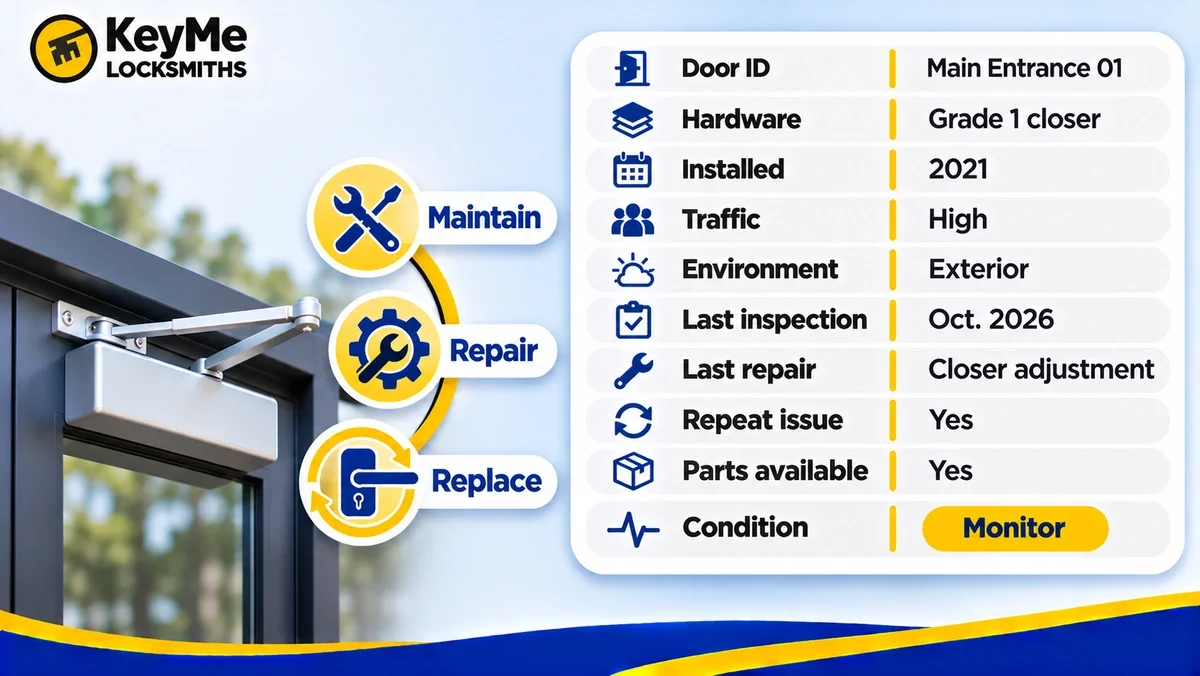
Over time, these records make lifecycle decisions much easier.
Parts Availability Matters
Hardware can remain physically usable while becoming difficult to support.
Replacement becomes more relevant when:
- Manufacturer discontinues product
- Repair kits are unavailable
- Compatible components cannot be obtained
- Original cylinder platform is unsupported
- Replacement trim no longer exists
Supportability should be included in lifecycle planning before a critical component fails.
Functional Obsolescence Can Matter More Than Physical Wear
A lock does not have to be broken to become obsolete.
Hardware may no longer support:
- New access-control requirements
- Updated key-control policies
- Electronic credentials
- Revised master-key hierarchy
- Accessibility needs
- Changed building use
For example:
A mechanical lock may still operate perfectly.
But if the building is converting the opening to electronic access, that hardware may no longer fit the operational plan.
Replacement can therefore be driven by function, not failure.
Security Requirements Can Change Over Time
A storage room may become:
- Server room
- Medication room
- Records room
- Cash-handling space
The existing hardware might still work mechanically while no longer providing the appropriate level of access control.
Whenever a room's function changes, reconsider:
- Lock function
- Cylinder
- Key control
- Credential access
- Door monitoring
- Hardware classification
If a building is changing who should be able to enter particular areas, the hardware decision should be coordinated with the broader access strategy rather than treated only as a lock replacement.
Master-Key Changes Can Affect Hardware Planning
Large facilities may also need to replace or reconfigure cylinders because the key system itself has changed.
Examples include:
- Building acquisition
- Tenant turnover
- Master-key redesign
- Restricted-key migration
- Lost high-level key
- Key-control breakdown
The mechanical lock body may remain usable while the cylinder system changes.
For properties with frequent tenant transitions, the same principle applies at a smaller scale: securing vacant rental units between tenants often starts with reviewing who still has working keys before deciding whether existing hardware itself needs replacement.
That is why hardware inventories should distinguish among:
lock body + cylinder + key system
When Should Door Hardware Be Maintained?
Maintenance is generally appropriate when the hardware:
- Functions normally
- Has no major physical damage
- Remains appropriately aligned
- Can be kept operating through routine service
- Still meets building requirements
Maintenance should be preventive rather than something performed only after a failure.
When Should Door Hardware Be Repaired?
Repair may be appropriate when:
- Problem is identifiable
- Component remains serviceable
- Replacement parts are available
- Issue has not become recurring
- Hardware still meets operational needs
Examples include:
- Strike realignment
- Closer adjustment
- Compatible component replacement
- Cylinder service
- Fastener correction
- Lock repair
The important question is whether the existing hardware can be restored to reliable operation without changing the entire opening.
When Should Door Hardware Be Replaced?
Replacement deserves consideration when:
- Hardware is physically damaged.
- Component repeatedly fails.
- Adjustment no longer holds.
- Required replacement parts are unavailable.
- Hardware no longer supports the building's security needs.
- Door use has changed significantly.
- Existing system cannot support new access requirements.
- Hardware is incompatible with other planned upgrades.
When the hardware itself is no longer appropriate to keep in service, lock replacement can address the affected component without assuming every lock in the building needs to change.
Replacement should solve a defined problem.
It should not be based solely on age.
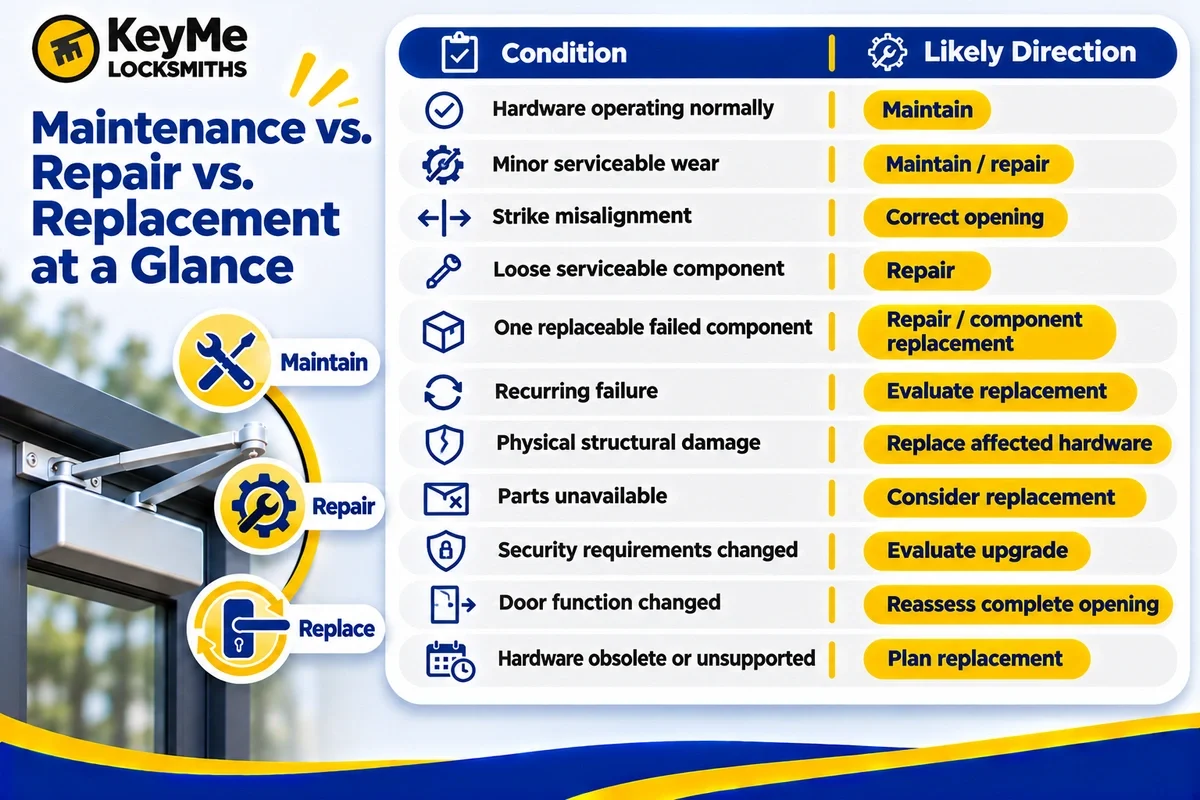
Maintenance vs. Repair vs. Replacement at a Glance
Build a Replacement Priority List
Large facilities rarely replace all hardware at once.
Instead, prioritize.
Priority 1: Life Safety
Examples:
- Exit devices
- Fire-rated doors
- Critical closers
- Emergency egress openings
Priority 2: Security
Examples:
- Main entrances
- Restricted areas
- Sensitive rooms
- High-level key-control openings
Priority 3: Operational Reliability
Examples:
- High-traffic staff entrances
- Loading docks
- Frequently used interior doors
Priority 4: Planned Modernization
Examples:
- Electronic access conversion
- Master-key migration
- Hardware standardization
This creates a manageable lifecycle plan rather than an emergency replacement program.
Copy Your Key from Anywhere - Right from Your Phone
Skip the kiosk and copy your key from home. Upload a clear photo of an eligible house or car key, and KeyMe will create a precise duplicate and mail it directly to your door.

Standardize Hardware Where Practical
Facilities with many doors can benefit from thoughtful standardization.
Potential benefits include:
- Easier parts inventory
- More consistent maintenance
- Simplified training
- Easier key-system planning
- Fewer incompatible components
That does not mean every door should use identical hardware.
Hardware still needs to match:
- Door function
- Traffic
- Security
- Egress
- Environment
The objective is controlled standardization rather than unnecessary variation.
Door Hardware Lifecycle Planning: The Bottom Line
The best door hardware lifecycle programs do not ask:
"How old is this lock?"
They ask:
"How is this opening performing?"
Evaluate:
- Usage
- Condition
- Alignment
- Maintenance history
- Repair frequency
- Parts availability
- Security requirements
- Life-safety function
- Future building plans
Then choose the appropriate response:
Maintain hardware that is performing properly.
Repair problems that are serviceable.
Replace hardware when damage, recurring failure, obsolescence, or changed requirements make continued service impractical.
That approach helps facilities plan hardware changes proactively instead of waiting for every component to fail.
References
- Builders Hardware Manufacturers Association. Hardware Highlights. Current directory of ANSI/BHMA standards covering locks, exit devices, closers, hinges, cylinders, mortise locks, and other builders hardware.
https://buildershardware.com/ANSI-BHMA-Standards/Hardware-Highlights - Builders Hardware Manufacturers Association. ANSI/BHMA A156.4-2024 Door Closers and Pivots. Current standard summary covering closer cycle, operational, closing-force, and finish testing, including the two-million-cycle durability requirement for Grade 1 door closers.
https://buildershardware.com/ANSI-BHMA-Standards/Hardware-Highlights/A1564-2024-Door-Closers-and-Pivots - Builders Hardware Manufacturers Association. ANSI/BHMA A156.3-2025 Exit Devices. Current standard summary covering cycle, operational, strength, material, and security testing for exit devices.
https://buildershardware.com/ANSI-BHMA-Standards/Hardware-Highlights/A1563-2025-Exit-Devices - Builders Hardware Manufacturers Association. ANSI/BHMA A156.2-2022 Locks and Latches. Current standard for bored and preassembled locks and latches.
https://buildershardware.com/ANSI-BHMA-Standards/Hardware-Highlights/A1562-2022-Locks-and-Latches