

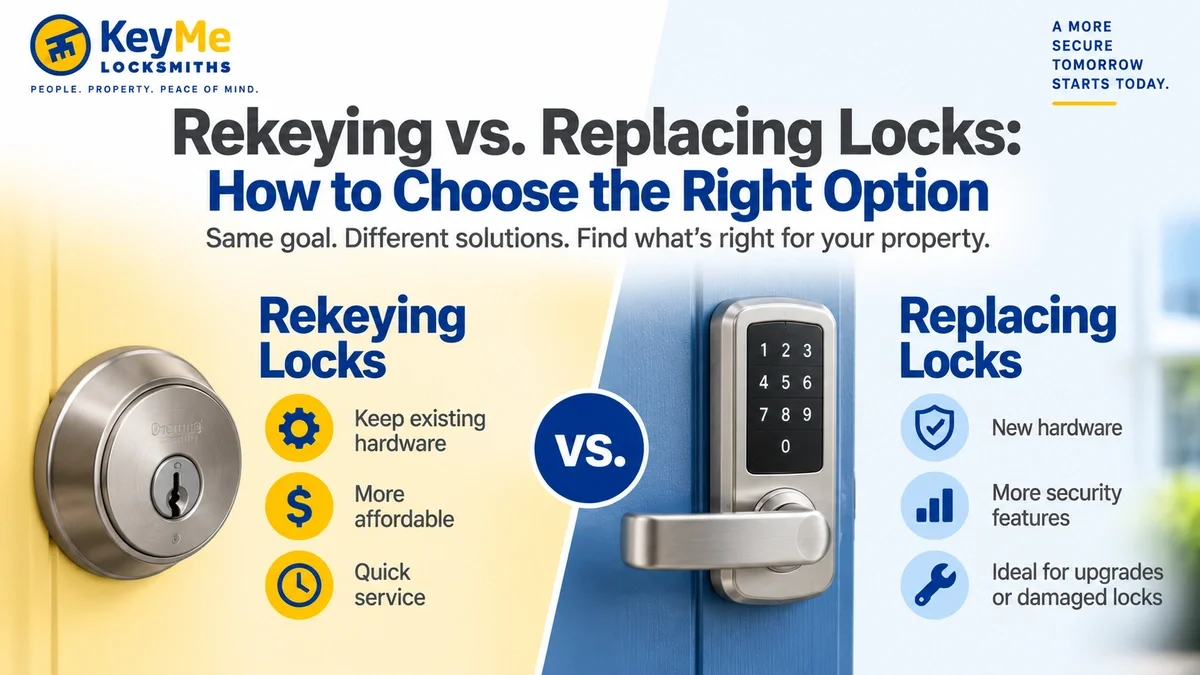
Rekeying and replacing a lock solve different problems. Rekeying changes which key operates an existing lock, while replacement installs different lock hardware. If your lock works properly and your main concern is controlling who has a working key, rekeying may be appropriate. If the hardware is damaged, unreliable, incompatible with your door, or no longer provides the features you need, replacement may make more sense.
There is also a third possibility homeowners sometimes overlook: repair.
A lock that sticks because the door and strike are misaligned may not need to be rekeyed or replaced. The underlying problem may be elsewhere in the opening.
The best decision therefore starts with two questions:
Does the existing hardware work correctly?
Do you need to change the hardware, or only change who has access?
Summary
- Rekeying changes the internal keying so previous mechanical keys no longer operate the compatible lock.
- Replacing removes existing hardware and installs different hardware.
- Repairing addresses a problem with otherwise serviceable lock or door hardware.
- Consider rekeying when the lock works properly but access needs to change.
- Consider replacement when the lock is damaged, repeatedly unreliable, incompatible with the door, or lacks features you need.
- A sticking deadbolt or difficult lock does not automatically require replacement.
- If a lock works with the door open but binds when the door closes, investigate door and strike alignment.
- Lost keys may create an access-control reason to rekey even when the lock itself works normally.
- Smart-lock upgrades generally involve replacement when existing mechanical hardware cannot provide the desired electronic features.
- Compare the condition of the entire opening before deciding what service is appropriate.
Rekeying vs. Replacing vs. Repairing
These services are related, but they are not interchangeable.
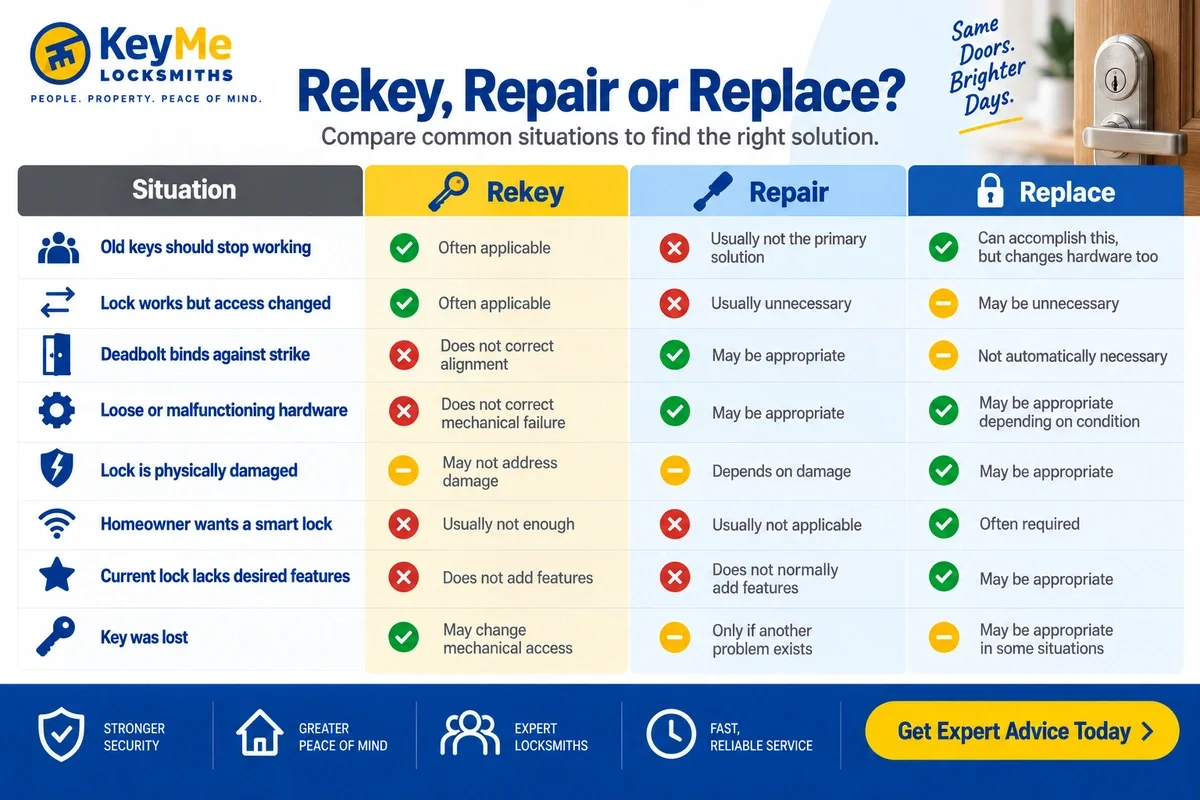
The correct choice depends on the actual objective.
"Rekeying, repairing, and replacing are three different answers to three different questions. Before changing hardware, identify whether the problem is access, mechanical operation, or the capabilities of the existing lock." - KeyMe Locksmiths
What Does Rekeying a Lock Actually Do?
During lock rekeying, the compatible cylinder is changed so a different key operates it.
The existing lock hardware can remain on the door.
The important result is that the previous keying changes.
Rekeying can be relevant when:
- A key has been lost.
- Someone who previously had access should no longer have it.
- A roommate or tenant has changed.
- Compatible locks should operate from a different key.
- A homeowner wants compatible doors keyed alike.
- The existing lock is functioning correctly and does not otherwise need replacement.
Rekeying is primarily an access-control change.
It does not inherently correct:
- Physical lock damage
- Door sag
- Misaligned strikes
- Worn handles
- Broken latches
- Incompatible hardware
Those conditions require their own diagnosis.
For a broader explanation of when household access should be changed, see How Often Should You Change Your Home's Locks?.
Need a Locksmith? We're here to help
Connect with a trusted local locksmith for fast, professional assistance when you need it most.
What Happens When a Lock Is Replaced?
Lock replacement means changing the physical locking hardware.
Depending on the opening, replacement might involve a:
- Deadbolt
- Knob
- Lever
- Cylinder
- Handleset
- Electronic lock
- Smart lock
- Other compatible locking device
Replacement allows the homeowner to change more than the working key.
It can also change:
- Hardware design
- Lock type
- Keyway
- Access method
- Smart capabilities
- Appearance
- Hardware configuration
That makes replacement relevant when the existing hardware itself no longer fits the homeowner's needs.
When Rekeying May Be the Appropriate Choice
The Lock Works, but Old Keys Should Stop Working
This is the clearest rekeying scenario.
If the lock operates properly and you simply want a different mechanical key to control access, replacing the entire lock may not be necessary.
A Key Was Lost
Losing a key does not mean the lock mechanically failed.
The concern is whether someone could potentially use the missing key.
Depending on the circumstances and compatible hardware, rekeying can change which key operates the lock.
For a detailed response plan, see What to Do After Losing Your House Keys.
Someone's Access Has Changed
A former roommate, tenant, contractor, household worker, or other authorized person may once have had a legitimate key.
If that access should end, rekeying may be one way to change the mechanical access without replacing otherwise functioning hardware.
You Want Compatible Locks to Use One Key
Depending on the cylinders and keyways, compatible locks may sometimes be keyed alike.
That can reduce the number of keys needed for different exterior doors.
A locksmith should confirm compatibility rather than assuming different locks can automatically share a key.
For consumers unfamiliar with terms such as cylinder, keyway, and keyed alike, see Locksmith Terms Explained.
When Replacement May Be the Appropriate Choice
The Lock Is Physically Damaged
Visible damage can affect whether existing hardware remains serviceable.
Examples may include:
- Damaged cylinder
- Broken lock body
- Severely damaged trim
- Failed internal components
- Hardware damaged during an attempted break-in
If the damage is related to a break-in, see How a Locksmith Helps After a Break-In.
The Lock Repeatedly Malfunctions
One serviceable problem does not automatically justify replacement.
Repeated failures deserve a broader evaluation.
If the same lock continues to malfunction after appropriate repairs, replacement may eventually be considered based on the hardware's condition and the cause of the recurring problem.
You Want Different Features
Rekeying changes the keying.
It does not turn a conventional deadbolt into a keypad or connected smart lock.
If you want:
- Keypad entry
- App-based management
- Electronic access codes
- Smart-home integration
- Another type of lock
different hardware may be required.
For help understanding the tradeoffs, see Smart Lock vs. Traditional Lock.
Existing Hardware No Longer Fits the Door or Project
Renovations can change:
- Doors
- Frames
- Door thickness
- Hardware preparation
- Intended use
Existing locks may not always remain appropriate after those changes.
If you're planning construction work, see Working With a Locksmith During Renovations.
When Repair Should Be Considered First
The choice is not always rekey or replace.
Consider a lock that becomes difficult to operate.
Possible causes include:
- Door misalignment
- Strike alignment
- Loose hardware
- Worn key
- Latch problem
- Cylinder problem
- Door movement
ALOA identifies worn keys, worn locks, lubrication needs, and door alignment among common sources of lock problems.
A useful diagnostic test is to operate the lock while the door is open.
If the deadbolt moves smoothly when open but binds when the door is closed, the opening may have an alignment issue.
Replacing the cylinder alone would not correct that.
For more troubleshooting examples, see The Most Common Home Lock Problems.
KeyMe also offers lock repair and installation for supported hardware.
Does Rekeying Make a Lock More Secure?
Rekeying changes which mechanical key operates the lock.
It should not be treated as a general hardware upgrade.
If the existing lock is worn, damaged, or otherwise unsuitable, changing its keying does not transform it into different hardware.
Security evaluations should consider:
- Lock condition
- Door
- Frame
- Strike
- Hardware installation
- Cylinder
- Applicable lock certification
- Access requirements
If your concern involves the hardware itself rather than who has a key, evaluate the complete opening before choosing rekeying.
Find a KeyMe Kiosk Near You
Need a spare key fast? Find a KeyMe kiosk near you to copy many house, office, and eligible car keys in just minutes.
Does Replacing a Lock Automatically Improve Security?
Not necessarily.
Replacement creates the opportunity to choose different hardware, but the result depends on:
- Product selected
- Certification
- Door compatibility
- Strike
- Frame
- Installation
- Alignment
A new lock installed on a poorly aligned or unsuitable opening does not automatically correct every door-security issue.
When comparing residential products, look at the specific model rather than relying only on the manufacturer name. For an example of model-level comparison, see Schlage vs. Kwikset: An Objective Comparison for Homeowners.
What If You've Just Bought a House?
Buying a home creates a specific access-control situation because the new owner may not know how many copies of the existing keys were made over the life of the property.
However, that deserves its own process rather than treating every new home as a generic rekey-versus-replace decision.
If you've recently closed on a property, see How Lock Rekeying Works for New Homeowners for a post-closing access checklist.
The condition of the existing hardware should still determine whether rekeying, repair, or replacement is appropriate.
What If the Key Is Lost but the Lock Is Damaged Too?
Multiple issues can exist at once.
For example:
- You lost the only working key.
- The lock was already difficult to operate.
- The handle is loose.
- The door is misaligned.
In that situation, simply rekeying may not address everything.
Tell the locksmith about both the access issue and the mechanical symptoms so the complete opening can be evaluated.
What About Smart Locks?
Smart locks change the comparison because they can combine electronic access with mechanical locking hardware.
Depending on the model, a smart lock may offer:
- PIN codes
- Mobile-app access
- Remote management
- Digital credentials
- Physical backup key
- Smart-home integration
If you already have a smart lock and only need to change electronic users, you may be able to change credentials through the supported system rather than replacing the hardware.
If you're converting from a traditional mechanical lock to smart access, lock replacement or new lock installation may be required.
Always follow the manufacturer's procedures for electronic credentials and ownership changes.
Copy Your Key from Anywhere - Right from Your Phone
Skip the kiosk and copy your key from home. Upload a clear photo of an eligible house or car key, and KeyMe will create a precise duplicate and mail it directly to your door.

Can Every Lock Be Rekeyed?
No.
Whether rekeying is possible depends on the hardware.
Factors can include:
- Cylinder type
- Keyway
- Lock design
- Condition
- Manufacturer
- Existing key system
Some electronic or specialized locks use access methods that differ significantly from conventional pin-tumbler rekeying.
A locksmith can inspect the hardware and determine what options are supported.
Best Way to Decide Between Rekeying, Repairing, and Replacing
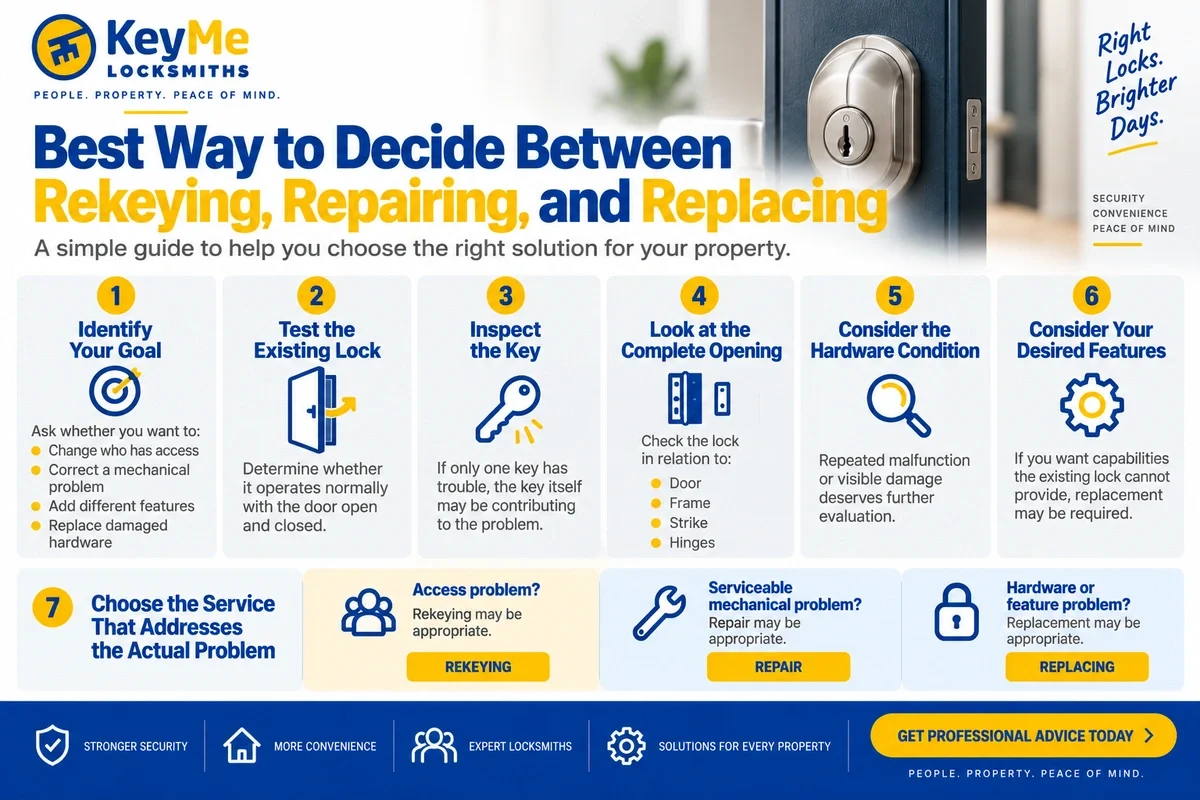
1. Identify Your Goal
Ask whether you want to:
- Change who has access
- Correct a mechanical problem
- Add different features
- Replace damaged hardware
2. Test the Existing Lock
Determine whether it operates normally with the door open and closed.
3. Inspect the Key
If only one key has trouble, the key itself may be contributing to the problem.
4. Look at the Complete Opening
Check the lock in relation to:
- Door
- Frame
- Strike
- Hinges
5. Consider the Hardware Condition
Repeated malfunction or visible damage deserves further evaluation.
6. Consider Your Desired Features
If you want capabilities the existing lock cannot provide, replacement may be required.
7. Choose the Service That Addresses the Actual Problem
Access problem: Rekeying may be appropriate.
Serviceable mechanical problem: Repair may be appropriate.
Hardware or feature problem: Replacement may be appropriate.
"The most useful question isn't simply, 'Should I rekey or replace this lock?' It's, 'What am I trying to change?' Once you separate access, mechanical condition, and desired features, the appropriate options become much clearer." - KeyMe Locksmiths
Rekeying and Replacement Solve Different Problems
The key distinction is straightforward:
Rekeying changes access.
Repair addresses a serviceable problem.
Replacement changes hardware.
Those categories can overlap, but they should not be treated as interchangeable.
If the existing lock works correctly and only the authorized key needs to change, rekeying may be worth evaluating.
If the hardware has a serviceable mechanical problem, lock repair may address the actual cause.
If the hardware is damaged, incompatible, repeatedly unreliable, or lacks features you want, lock replacement may be appropriate.
For homeowners who have just purchased a property, the next question is slightly different: how do you take control of all the home's existing access? See How Lock Rekeying Works for New Homeowners for that move-in-specific process.
References
- Associated Locksmiths of America (ALOA). Common Lock Issues. Consumer guidance addressing worn keys, worn locks, lubrication, latches, and door-alignment problems.
https://www.aloa.org/consumers/commonlockissues - Associated Locksmiths of America (ALOA). Should I Change My Locks? Consumer guidance addressing key control and situations where homeowners may consider changing lock access.
https://www.aloa.org/consumers/changeyourlocks - Builders Hardware Manufacturers Association (BHMA). Residential Locksets and Latches. Information on performance considerations and standards applying to residential locking hardware.
https://buildershardware.com/