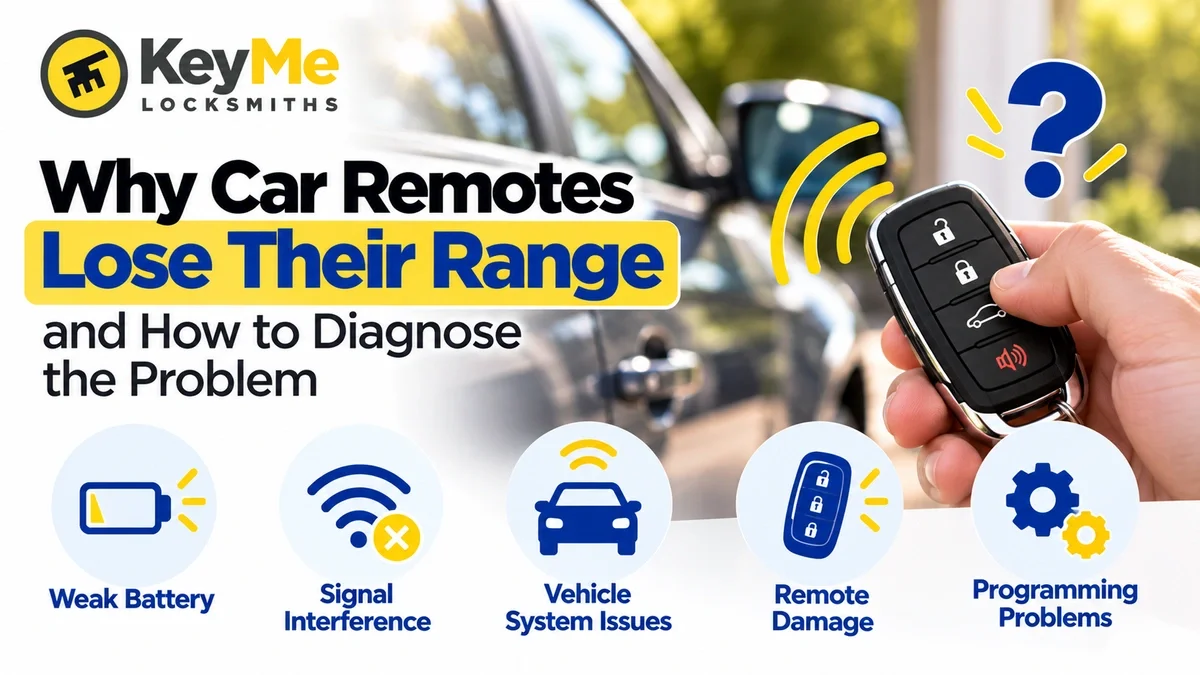
If your car remote only works when you stand closer to the vehicle than you used to, the most likely explanations are a weakening fob battery, radio-frequency interference, physical or electrical damage inside the remote, or a problem with the vehicle's receiver. The pattern of the range loss can help identify which one is more likely.
A remote that gradually loses distance everywhere presents a different problem from one that works normally at home but poorly in a particular parking garage.
Summary
- Reduced range means the remote still works, but from a shorter distance than it previously did.
- A weakening fob battery is one of the first things to consider when range declines gradually.
- Poor range in only one location points more strongly toward environmental interference.
- If one fob has reduced range but a spare works normally, focus on the affected remote.
- If multiple remotes lose range around the same time, the vehicle receiver or electrical system deserves more attention.
- Drops, moisture, battery-contact problems, and internal antenna damage can affect transmission.
- Remote lock and unlock range is not exactly the same issue as passive entry or push-to-start detection.
- Replacing the entire fob should not be the first assumption without narrowing down where the problem originates.
Best Way to Diagnose Reduced Car Remote Range
Start by determining whether the problem follows the remote, the location, or the vehicle.
Use these three comparisons:
Test 1: Try the Remote in Different Locations
If it performs normally in some places but poorly in others, environmental interference may be involved.
Test 2: Compare It With a Spare Remote
If the spare works from noticeably farther away under the same conditions, the primary fob becomes the stronger suspect.
Test 3: Watch for Other Vehicle Electrical Symptoms
If both remotes suddenly have poor range and the vehicle is also showing unusual electrical behavior, investigate the vehicle side rather than assuming two fobs failed together.
These comparisons are more useful than automatically replacing parts.
"Reduced remote range is a symptom, not a diagnosis. Comparing the affected fob with another location and another known-good key can quickly narrow down where the problem is coming from." - KeyMe Locksmiths
Need a Locksmith? We're here to help
Connect with a trusted local locksmith for fast, professional assistance when you need it most.
What Does It Mean When a Car Remote Loses Range?
A remote has lost range when you must stand closer to the vehicle for a command that previously worked from farther away.
You might notice:
- Lock only responds near the vehicle
- Unlock requires multiple button presses
- Trunk release becomes less consistent
- Response is delayed
- Remote performance varies from day to day
The important part is the change from the remote's normal behavior.
Different vehicle and remote systems have different intended operating distances, so there is no single distance that every remote should reach.
A change in your own fob's normal performance is more diagnostically useful than comparing it with another make or model.
1. The Key Fob Battery Is Getting Weak
A weakening battery is one of the most straightforward explanations for gradual range loss.
Remote buttons require battery power to transmit their commands.
As available battery power declines, you may notice:
- Shorter operating distance
- More button presses
- Delayed responses
- Intermittent operation
- Eventually, wireless remote functions may stop responding altogether.
This is different from certain passive transponder functions that may operate differently depending on the type of key.
For a full explanation of what changes when fob power is depleted, see What Happens if My Key Fob Battery Dies?.
2. Radio Interference Is Affecting the Signal
Wireless key systems operate in radio-frequency environments that can vary considerably by location.
Other signals, large structures, or nearby electronic equipment can sometimes interfere with reliable communication.
A useful clue is location dependence.
For example:
- Remote works normally at home
- Remote range becomes poor in one parking garage
- Performance returns after leaving the area
That pattern is very different from a battery or damaged fob that performs poorly almost everywhere.
Potentially challenging environments can include:
- Parking structures
- Dense commercial areas
- Areas near strong transmitters
- Industrial settings
- Locations with substantial metal infrastructure
If performance changes drastically when the vehicle moves, do not assume the fob itself has permanently failed.
3. The Remote Has Been Dropped or Damaged
A key fob does not need a cracked exterior to have internal damage.
Repeated drops can affect components such as:
- Circuit board
- Antenna
- Battery contacts
- Button contacts
- Internal connections
Moisture can also affect electronic components even when the case appears intact.
A strong diagnostic clue is timing.
If the range changed shortly after the fob was:
- Dropped
- Crushed
- Exposed to moisture
- Opened for a battery change
that event may be relevant.
4. The Battery Contacts Are Not Making Consistent Contact
A fresh battery does not automatically rule out a power problem.
The battery still has to make reliable electrical contact inside the fob.
Possible clues include:
- Remote works after the case is pressed
- Performance changes after a battery replacement
- Fob works intermittently despite a new battery
- Battery moves inside the housing
- Remote behavior changes when handled
This can make a fob appear to have a radio or programming issue when the real problem is inconsistent power delivery.
5. The Remote's Internal Antenna May Be Damaged
The remote uses internal electronics to transmit its radio signal.
Damage to an antenna or related circuitry may reduce transmission performance without stopping the remote completely.
That can produce a pattern where:
- Every button still works
- Vehicle responds normally at very close range
- Useful distance is much shorter than before
This differs from a completely dead remote because communication still occurs.
6. The Vehicle Receiver May Be the Problem
Sometimes the remote is transmitting correctly but the vehicle is not receiving the signal as reliably as before.
Possible vehicle-side contributors can include:
- Receiver or antenna issue
- Electrical problem
- Low vehicle battery voltage
- Control-module problem
- Communication issue
This becomes more plausible if multiple fobs behave similarly with the same vehicle.
If one fob works well and another does not, the affected remote deserves more attention.
If both develop the same range problem, the shared component is the vehicle.
7. A Weak Vehicle Battery Can Change Electronic Behavior
Modern vehicle access systems depend on both sides of the communication link.
The remote has its own battery, but the vehicle also needs adequate electrical power for receivers and control modules to function normally.
If reduced remote range appears alongside symptoms such as:
- Dim lights
- Slow or unusual starting behavior
- Electrical warnings
- Irregular power-lock operation
- Multiple electronic features behaving strangely
do not evaluate the remote in isolation.
8. Passive Entry and Remote Buttons Are Different Tests
Drivers sometimes use "range" to describe several different behaviors.
These can include:
- How far away lock/unlock buttons work
- Whether passive entry detects the key near the door
- Whether the vehicle detects the key inside the cabin
- Whether push-to-start authorization succeeds
Those systems are related, but they are not identical.
This article specifically focuses on remote button operating distance.
If the broader issue is that your smart key signal appears weaker across remote entry, passive detection, and vehicle recognition, see Why Car Key Signals Lose Strength Over Time.
9. The Fob and Vehicle May Need Communication Evaluation
If a fresh battery does not restore normal range and physical damage is not obvious, there may be a deeper communication issue.
Possible areas include:
- Remote electronics
- Vehicle receiver
- Key synchronization
- Programming
- Vehicle module communication
Do not assume that reprogramming is automatically required simply because the distance has changed.
Programming issues often produce broader recognition or functionality problems rather than an isolated range change.
The exact symptoms matter.
Find a KeyMe Kiosk Near You
Need a spare key fast? Find a KeyMe kiosk near you to copy many house, office, and eligible car keys in just minutes.
What Does Your Range Pattern Tell You?
The way the problem behaves can be as useful as the problem itself.
Range Declines Gradually Everywhere
Consider:
- Fob battery
- Fob wear
- Internal damage
Range Is Bad Only in Certain Locations
Consider:
- Radio interference
- Environmental conditions
One Fob Has Poor Range and the Spare Is Normal
Focus more heavily on:
- Primary fob battery
- Internal primary-fob damage
- Battery contacts
- Antenna
Both Fobs Suddenly Have Poor Range
Consider:
- Vehicle receiver
- Vehicle electrical system
- Environment
Remote Buttons Work Only Beside the Vehicle
This suggests a substantial decline in useful communication distance and deserves further evaluation.
What If the Remote Suddenly Stops Working Completely?
Complete failure is a different symptom from reduced range.
If the remote went from normal operation to no response at all, possibilities include:
- Fully depleted battery
- Internal damage
- Battery contact problem
- Loss of communication
- Vehicle-side electrical issue
If this happens away from home, see What to Do if Your Key Fob Stops Working in a Parking Lot.
When Does Reduced Range Become a Bigger Problem?
Pay closer attention when shortened range is accompanied by:
- Key Not Detected warnings
- Passive entry failure
- Push-to-start recognition problems
- Complete remote failure
- Multiple keys behaving abnormally
- Other vehicle electrical symptoms
At that point, the issue extends beyond simple convenience.
A dedicated recognition warning should be diagnosed separately. See Key Not Detected Warning: Causes and Fixes.
When Might the Remote Need Replacement?
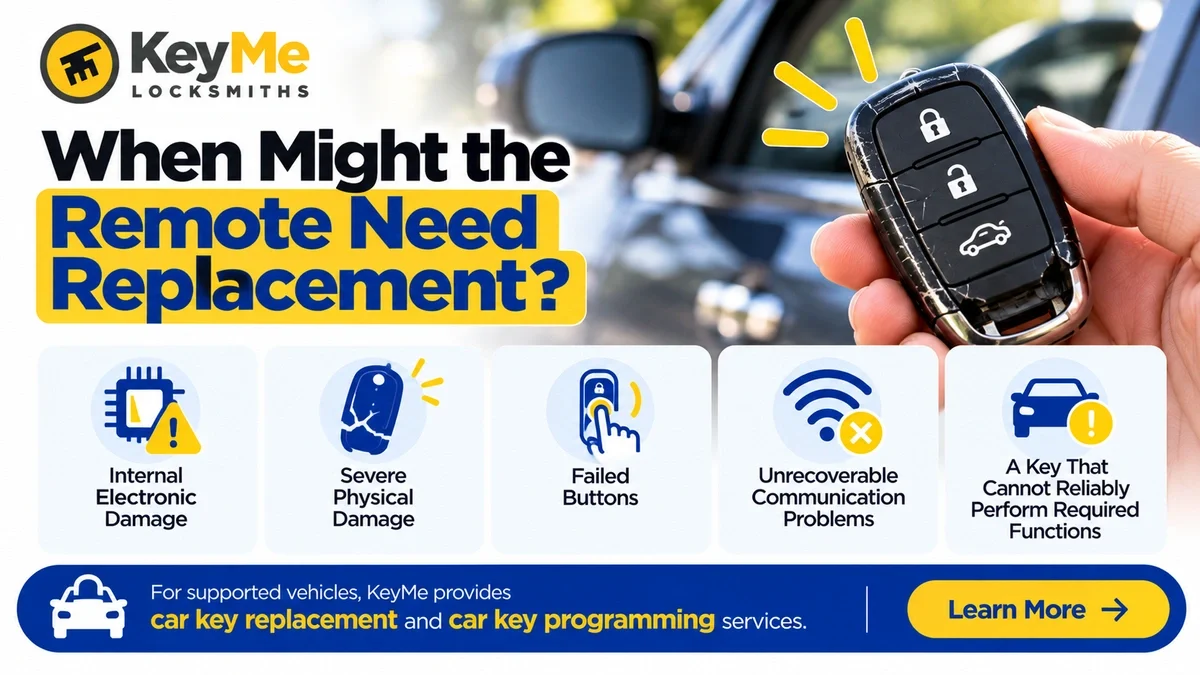
Reduced range alone does not prove that the complete remote needs replacement.
Replacement becomes more relevant when there is evidence of:
- Internal electronic damage
- Severe physical damage
- Failed buttons
- Unrecoverable communication problems
- A key that cannot reliably perform required functions
If the remote still works and the cause has not been identified, diagnose the battery, environment, fob, and vehicle before assuming replacement is necessary.
For supported vehicles, KeyMe provides car key replacement and car key programming services.
Copy Your Key from Anywhere - Right from Your Phone
Skip the kiosk and copy your key from home. Upload a clear photo of an eligible house or car key, and KeyMe will create a precise duplicate and mail it directly to your door.
Why Car Remotes Lose Their Range: The Bottom Line
A car remote that only works from closer than before is giving you a useful diagnostic clue.
Start by asking:
- Is the change gradual?
- Does it happen everywhere?
- Does the spare behave the same way?
- Did the fob recently experience damage or a battery change?
- Are other vehicle electronics behaving normally?
A gradual range decline in one remote points toward a different problem from two remotes suddenly losing range in one location.
The key is to identify whether the pattern follows the fob, environment, or vehicle.
References
- KeyMe Locksmiths. Why Car Key Signals Lose Strength Over Time. Broader guidance on smart-key signal degradation, passive entry, vehicle detection, interference, and key-to-vehicle communication.
https://key.me/article/why-car-key-signals-lose-strength-over-time - KeyMe Locksmiths. What Happens if My Key Fob Battery Dies? Explanation of how fob battery power affects remote functions and vehicle communication.
https://key.me/article/what-happens-if-my-key-fob-battery-dies - KeyMe Locksmiths. Key Not Detected Warning: Causes and Fixes. Guidance on smart-key recognition failures involving battery power, interference, vehicle power, and communication.
https://key.me/article/key-not-detected-warning-causes-and-fixes - KeyMe Locksmiths. What to Do if Your Key Fob Stops Working in a Parking Lot. Guidance for sudden fob failure away from home.
https://key.me/article/what-to-do-if-your-key-fob-stops-working-in-a-parking-lot