

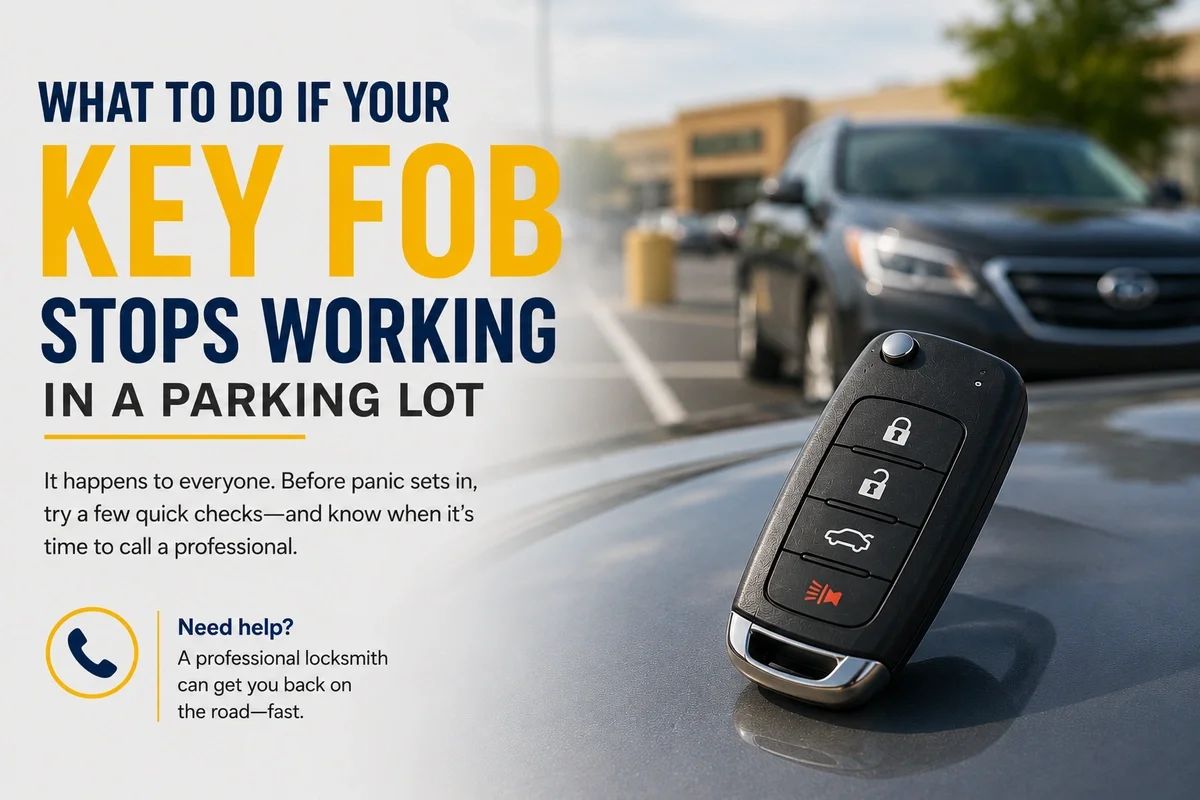
If your key fob suddenly stops working in a parking lot or parking garage, first determine exactly what has failed: the remote buttons, passive entry, vehicle key detection, or the vehicle's electrical system. A weak fob battery, location-specific radio interference, fob damage, or a vehicle-side problem can produce similar symptoms.
If you cannot unlock or start the vehicle normally, check the owner's manual or manufacturer instructions for any vehicle-specific backup access or starting procedure. Some vehicles use a mechanical emergency key or provide another manufacturer-designed procedure for a weak or unresponsive fob.
If those options do not resolve the problem, an automotive locksmith may be able to evaluate the key and access problem for supported vehicles.
Summary
- Identify whether the fob will not unlock the doors, the vehicle cannot detect the key, or the vehicle itself is not responding.
- A suddenly unresponsive fob does not automatically mean the fob needs replacement.
- A weak or depleted fob battery is one possible cause.
- Parking garages and other locations can sometimes introduce radio interference.
- If a spare fob works normally, the problem may be isolated to the primary fob.
- If neither fob works, consider vehicle-side conditions as well as the keys.
- If the vehicle has little or no electrical response, the vehicle battery may be relevant.
- Some vehicles provide manufacturer-designed backup access or starting procedures.
- KeyMe's recorded service data shows that modern automotive key problems commonly extend beyond physical key damage into programming, vehicle recognition, remote communication, and authentication.
- If the fob has been losing range gradually rather than failing suddenly, see Why Car Key Signals Lose Strength Over Time.
Start Here: What Exactly Stopped Working?
"My key fob stopped working" can describe several different problems.
Before deciding what to do next, identify the exact symptom.
Ask:
- Do the remote lock and unlock buttons respond?
- Does passive entry work?
- Can you open the vehicle another authorized way?
- Does the vehicle display a "Key Not Detected" or similar message?
- Can the vehicle be started?
- Do the interior lights and other electronics respond?
- Does another authorized fob work?
These distinctions can help separate a fob problem from a vehicle-side electrical or communication problem.
KeyMe's first-party automotive service data reinforces the importance of this symptom-first approach. An analysis of thousands of KeyMe automotive key transactions found recurring issues involving vehicle recognition, lock and unlock communication, button functionality, ignition authentication, and programming. Programming-related problems represented the largest individual troubleshooting category in the dataset.
The data reflects KeyMe's recorded programming, duplication, replacement, and customer-support activity. It is not a national survey of all drivers, but it shows why "my key doesn't work" is not a single technical diagnosis.
"A key fob that stops responding does not immediately tell you which component failed. Start with the symptom: can the vehicle unlock, can it detect the key, and are the vehicle's electrical systems responding? Those observations help separate a fob issue from a broader vehicle problem." - KeyMe Locksmiths
Need a Locksmith? We're here to help
Connect with a trusted local locksmith for fast, professional assistance when you need it most.
1. If the Remote Buttons Won't Unlock the Car
Pressing the unlock button without a response is one of the most obvious key-fob problems.
Possible causes can include:
- Weak or depleted fob battery
- Fob damage
- Radio interference
- Vehicle receiver or communication issue
- Vehicle battery or electrical issue
KeyMe's recorded service data includes lock and unlock communication failures as a recurring troubleshooting category, alongside customer-reported button problems.
That matters because an unlock failure can originate at several points in the communication between the fob and vehicle.
Avoid assuming the fob itself has permanently failed based on one unsuccessful attempt.
Look at what else the vehicle is doing.
If lights, locks, displays, and other electrical functions are also unresponsive, the problem may extend beyond the key fob.
2. If the Vehicle Says "Key Not Detected"
A "Key Not Detected" message points toward communication between the vehicle and key.
The exact meaning and backup procedure vary by manufacturer and vehicle.
Possible factors can include:
- Weak fob battery
- Fob position
- Communication interference
- Fob damage
- Vehicle-side detection problems
- An authentication or programming issue
Vehicle-recognition problems are another recurring category in KeyMe's recorded automotive service data. The first-party analysis includes situations in which vehicles fail to recognize, authenticate, or communicate properly with otherwise functional-looking keys.
That distinction is increasingly important because a modern vehicle key may combine mechanical access, remote functions, transponder authentication, proximity detection, and other electronic functions.
If your vehicle provides a manufacturer-designed backup detection or starting procedure, follow the instructions for your specific make, model, and year.
For deeper troubleshooting, see Key Not Detected Warning: Causes and Fixes.
3. If You Can Unlock the Vehicle but It Won't Start
Remote entry and vehicle starting are related, but they are not necessarily the same electronic function.
A vehicle may:
- Respond to remote buttons but fail to detect the key for starting
- Allow mechanical entry while displaying a key-detection warning
- Detect the key inconsistently
- Accept one electronic function but not another
- Have a separate vehicle-side condition preventing starting
KeyMe's recorded service data shows this distinction in real-world troubleshooting. Programming-related issues are the largest individual troubleshooting category identified in KeyMe's analysis, and ignition-recognition and vehicle-authentication problems also appear in the service records.
A key can therefore perform one function without necessarily performing every function expected by the vehicle.
Check the owner's manual for the appropriate starting procedure when the fob battery is weak or the key is not detected normally.
If the vehicle requires further key evaluation, car key programming may be relevant for supported vehicles depending on the actual diagnosis.
4. If Nothing Electrical in the Vehicle Responds
Suppose the fob does nothing, but neither do the interior lights, displays, power locks, or other electrical systems.
That pattern is different from a vehicle that responds normally except to one key fob.
The vehicle battery or another electrical issue may need consideration.
This is why replacing a fob battery should not be treated as a universal solution whenever a vehicle fails to unlock electronically.
Look at the whole symptom pattern.
5. Try Another Authorized Fob if One Is Available
A spare key can be useful diagnostically.
Primary Fob Fails, Spare Works
That pattern directs more attention toward the primary fob.
Possible factors include:
- Fob battery
- Physical damage
- Internal electronic problem
- Another fob-specific issue
Neither Fob Works
That does not prove the vehicle is at fault, but it makes a single-fob failure less obvious.
Consider:
- Location-specific interference
- Vehicle battery condition
- Vehicle receiver or communication problems
- Whether both keys are experiencing a common issue
Comparing two authorized keys is often more informative than repeatedly pressing the same fob.
6. Consider Whether the Parking Location Is Affecting the Signal
Parking garages are particularly relevant to this article because a fob problem that appears in one location may not behave the same way elsewhere.
Modern key fobs depend on radio-frequency communication between the key and vehicle. Environmental radio activity and the surrounding physical environment can sometimes interfere with that communication.
KeyMe's recorded service and troubleshooting data includes signal-related symptoms such as:
- Lock and unlock functions working only near the vehicle
- Passive entry behaving intermittently
- Push-button-start systems failing to detect the fob
- Remote functions behaving differently depending on location
The data does not establish that every parking-garage failure is caused by interference. Instead, it shows why location is an important diagnostic clue.
Fob Works Normally Elsewhere but Not in One Parking Area
Environmental interference becomes more plausible.
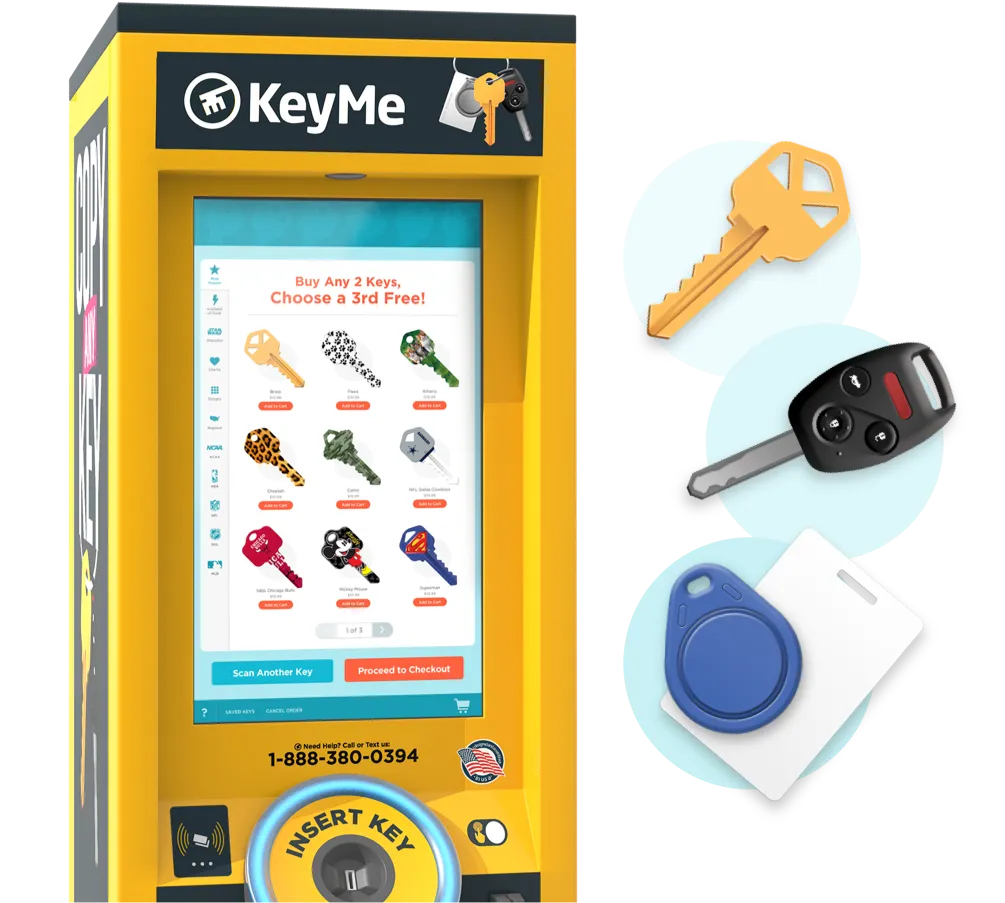
Find a KeyMe Kiosk Near You
Need a spare key fast? Find a KeyMe kiosk near you to copy many house, office, and eligible car keys in just minutes.
7. Look for a Manufacturer-Provided Mechanical Key
Some electronic vehicle keys include a mechanical emergency key.
Its design and purpose vary by vehicle.
Depending on the manufacturer, it may provide a way to access the vehicle when normal electronic unlocking is unavailable.
The location of the mechanical key and vehicle's mechanical key cylinder can differ significantly between makes and models.
Use the owner's manual or manufacturer instructions rather than assuming another vehicle's procedure applies to yours.
Mechanical entry also does not necessarily resolve a separate electronic starting problem.
8. Check the Manufacturer's Backup Starting Procedure
Some vehicles provide a specific procedure for situations in which normal electronic detection of the fob is unavailable or its battery is weak.
The exact procedure is vehicle-specific.
The owner's manual may explain:
- How the vehicle detects a weak-battery fob
- Whether a backup detection procedure exists
- What controls are involved
- What warning messages mean
Follow the manufacturer's instructions for the specific vehicle rather than relying on a generic procedure.
9. Consider Whether the Fob Was Recently Damaged
Think about what happened before the failure.
Was the fob:
- Dropped?
- Exposed to water?
- Crushed?
- Left in extreme conditions?
- Opened for a battery replacement?
- Working intermittently before today?
KeyMe's recorded troubleshooting data includes button failures and lock/unlock problems associated with aging fobs, physical damage, or internal wear.
A fob can also fail in layers. The vehicle may still recognize the electronic credential while the remote buttons stop responding, or the mechanical portion may remain usable while an electronic function becomes unreliable.
If the fob has visible damage or remains unreliable after leaving the location, further evaluation may be appropriate.
10. What If the Fob Battery Is Weak?
A weakening battery can cause symptoms such as:
- Reduced operating range
- Delayed response
- Intermittent button response
- Inconsistent passive-entry detection
- Vehicle-recognition warnings in some situations
KeyMe's automotive troubleshooting analysis identifies weakening batteries as an everyday source of intermittent key-fob problems.
However, battery symptoms can resemble other failures.
KeyMe's recorded service data also shows that when symptoms continue after a fresh battery, the problem may involve the fob electronics, vehicle receiver, or programming relationship between the key and vehicle.
If you replace the battery, use the type specified for the fob and follow manufacturer instructions.
If normal operation does not return, do not assume repeated battery replacement will solve the problem.
11. What If You're Locked Out?
If you cannot enter the vehicle using the normal key system or an applicable manufacturer-supported backup method, the situation has become a vehicle lockout.
KeyMe provides car lockout service and car locksmith services for supported vehicles.
If the physical key is inside the vehicle, see Locked Keys in Car.
Avoid improvised entry attempts that can affect the door, glass, weather sealing, or locking components.
12. What If the Key Itself Needs Replacement?
A key fob that cannot be restored to normal function may need further evaluation or replacement.
The process depends on:
- Vehicle make
- Model
- Year
- Key type
- Whether another working key exists
- Electronic functions
- Programming requirements
KeyMe provides car key replacement and car key programming for supported vehicles.
KeyMe Car Key Vans also provide in-person duplication and programming at participating retail locations for supported vehicles.
See Vehicle Keys for additional automotive key information.
Copy Your Key from Anywhere - Right from Your Phone
Skip the kiosk and copy your key from home. Upload a clear photo of an eligible house or car key, and KeyMe will create a precise duplicate and mail it directly to your door.
What Information Should You Gather Before Requesting Help?
If the problem is not resolved, useful information can include:
- Vehicle make
- Model
- Year
- Exact key or fob type
- Whether remote buttons respond
- Whether the vehicle displays "Key Not Detected"
- Whether you can enter the vehicle
- Whether the vehicle starts
- Whether another authorized key works
- Whether the fob was recently damaged
- Whether the problem occurs only in this location
Specific symptoms are more useful than simply saying, "My key doesn't work."
That approach also reflects KeyMe's first-party findings. The company's recorded service data includes different categories for programming, vehicle recognition, lock/unlock communication, button functionality, and ignition authentication because superficially similar customer complaints can involve different parts of the vehicle-access system.
Best Way to Handle a Key Fob Failure in a Parking Lot
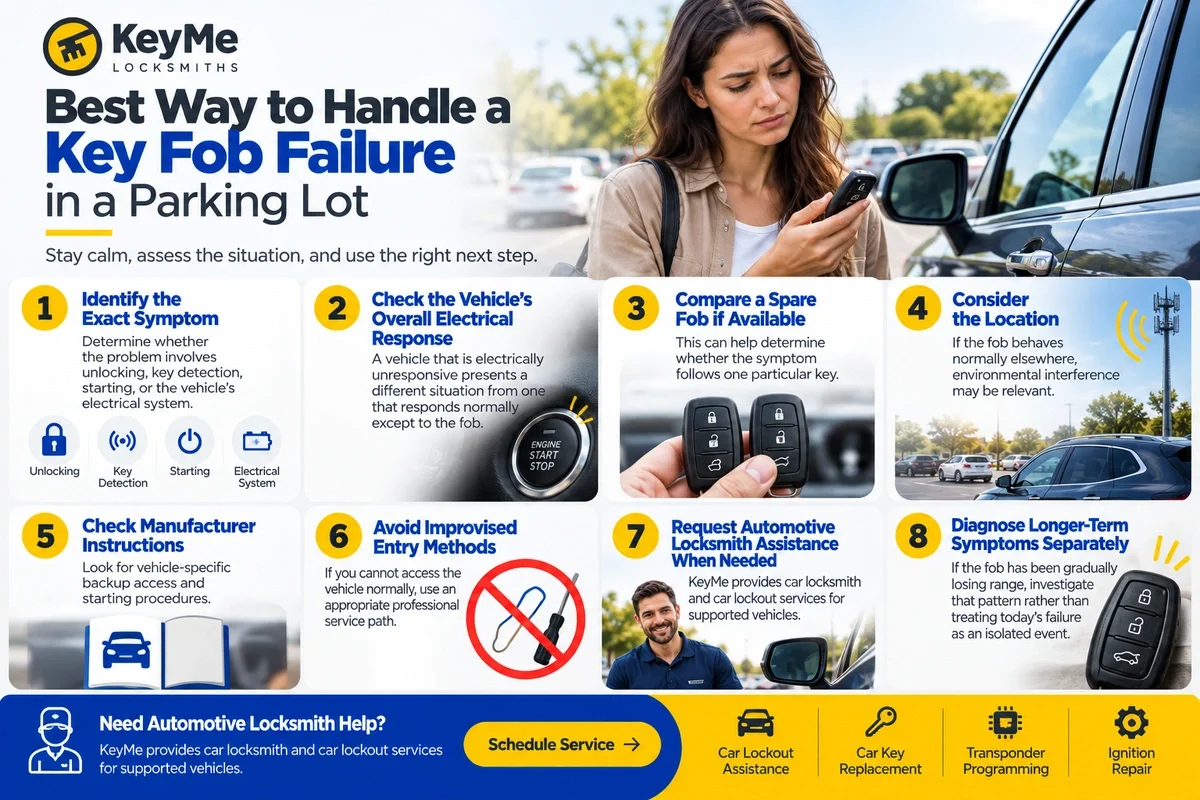
1. Identify the Exact Symptom
Determine whether the problem involves unlocking, key detection, starting, or the vehicle's electrical system.
2. Check the Vehicle's Overall Electrical Response
A vehicle that is electrically unresponsive presents a different situation from one that responds normally except to the fob.
3. Compare a Spare Fob if Available
This can help determine whether the symptom follows one particular key.
4. Consider the Location
If the fob behaves normally elsewhere, environmental interference may be relevant.
5. Check Manufacturer Instructions
Look for vehicle-specific backup access and starting procedures.
6. Avoid Improvised Entry Methods
If you cannot access the vehicle normally, use an appropriate professional service path.
7. Request Automotive Locksmith Assistance When Needed
KeyMe provides car locksmith and car lockout services for supported vehicles.
8. Diagnose Longer-Term Symptoms Separately
If the fob has been gradually losing range, investigate that pattern rather than treating today's failure as an isolated event.
Why Choose KeyMe Locksmiths?
KeyMe's automotive experience includes programming, duplication, replacement, and customer-support activity across thousands of recorded automotive key transactions.
KeyMe provides automotive key and locksmith services for supported vehicles, including:
- Car locksmith service
- Car lockout service
- Lost car key replacement
- Car key replacement
- Car key programming
- Vehicle key services
The appropriate service depends on whether the issue is a lockout, damaged or missing key, electronic key problem, or another vehicle-specific condition.
A Sudden Fob Failure Is a Symptom, Not a Diagnosis
A key fob that suddenly stops working in a parking lot can be frustrating, but the failure itself does not identify the cause.
KeyMe's analysis of thousands of recorded automotive key transactions reinforces that point. Modern key problems appear across programming, recognition, remote communication, button operation, and ignition authentication rather than one universal failure category.
Start by determining whether the problem involves the remote buttons, vehicle detection, starting system, or vehicle electrical system.
Then consider the fob battery, spare-key behavior, location, recent damage, and manufacturer-provided backup procedures.
If the issue is not sudden and your remote has instead been working from progressively shorter distances, continue with Why Car Key Signals Lose Strength Over Time.
References
- KeyMe Locksmiths. Proprietary Automotive Key Service and Troubleshooting Data. First-party analysis of thousands of recorded automotive key transactions involving programming, duplication, replacement, customer support, vehicle recognition, remote functionality, and authentication issues.
- National Highway Traffic Safety Administration (NHTSA). Vehicle Theft Prevention. Federal consumer information about modern vehicle security and electronic immobilizer technology.
https://www.nhtsa.gov/vehicle-safety/vehicle-theft-prevention - KeyMe Locksmiths. Vehicle Keys. KeyMe information about supported automotive key services.
https://key.me/vehicle-keys - KeyMe Locksmiths. Car Locksmith. Information about KeyMe automotive locksmith services.
https://key.me/car-locksmith