


Summary
- Residents can retain individual unit keys while authorized staff receive broader access according to their responsibilities.
- Properties can establish multiple access levels instead of relying on a single key that opens everything.
- Master keying can simplify maintenance, inspections, turnovers, and authorized emergency access.
- Lost master keys require a different response than lost resident keys because of the number of doors potentially affected.
- Key issuance, duplication, recovery, and auditing should be treated as part of the property's security program.
- Mechanical master keying can coexist with smart locks and electronic access control when a property uses a hybrid access strategy.
A master key system gives property managers and authorized staff access to multiple locks with designated higher-level keys while residents retain individual keys for their own units. For apartment communities, condominiums, student housing, and other multifamily properties, this creates a structured access hierarchy that can simplify maintenance, unit turnovers, inspections, and authorized emergency entry without giving every user access to every door.
The hardware is only part of the system, however. Effective master keying depends on careful access planning and disciplined key control. That operational side is especially important in multifamily housing, where property managers must coordinate resident access, employees, vendors, vacant units, common areas, and staff changes over the life of the property.
The Institute of Real Estate Management (IREM) emphasizes risk management and well-defined operating procedures as important parts of professional property management. Applied to physical access, that means properties should know who has keys, what those keys open, and what happens when someone's authorization changes.
For property managers, the goal isn't simply to create a key that opens more doors. It's to create an access system in which each person receives only the level of access their responsibilities require.
"A well-designed master key system isn't about giving everyone more access. It's about giving the right people the right level of access. The hardware establishes the hierarchy, but disciplined key control is what preserves it over time." — KeyMe Locksmiths
Why Master Key Systems Matter in Multifamily Housing
A single-family home may have only a handful of exterior locks. A multifamily community can have hundreds of residential doors plus offices, maintenance rooms, storage areas, amenities, utility spaces, and other controlled areas.
That scale creates a different access-management problem.
The National Apartment Association (NAA) provides operational resources for apartment owners and managers covering areas such as maintenance, risk management, resident operations, and property management. Those responsibilities regularly require authorized access to different parts of a community.
Without an organized access hierarchy, a maintenance technician could theoretically need a large collection of individual keys simply to perform routine work.
Master keying provides another approach.
Instead of organizing access around individual doors alone, the system can organize access around roles and responsibilities.
For example:
- A resident key can operate one apartment.
- A maintenance key can provide access to a designated group of units or service areas.
- A building-level master can operate locks within one building.
- A higher-level key can provide authorized management access across several buildings.
The exact hierarchy should reflect how the property actually operates.
What Is a Master Key System?
A master key system is a planned group of compatible locks in which different keys have different levels of authority.
A standard lock is generally configured around one operating key pattern. A master-keyed cylinder is configured so more than one authorized key can operate it.
Across an entire property, those relationships form an access hierarchy.
A simplified apartment example might look like this:
Resident A key → Apartment A
Resident B key → Apartment B
Building master → Apartments A–Z in Building 1
Property-level master → Designated locks across multiple buildings
The resident keys remain different from one another. Resident A's key should not open Resident B's apartment simply because both locks belong to the same master key system.
This distinction is fundamental to understanding master keying: shared master access does not mean shared resident access.
Need a Locksmith? We're here to help
Connect with a trusted local locksmith for fast, professional assistance when you need it most.

The Four Common Levels of a Master Key Hierarchy
Large systems can become sophisticated, but most master key structures are built from several basic levels.
Change Keys
The change key is the everyday key issued for an individual lock or defined group of locks.
In an apartment community, this is typically the resident's unit key.
A resident's change key might operate:
- Their apartment entrance
- Another lock specifically keyed for that resident
- Other authorized spaces depending on the property's design
It does not automatically provide access to neighboring apartments.
Master Keys
A master key operates multiple cylinders that also have their own individual change keys.
For example, a maintenance supervisor responsible for one building might receive a master key capable of opening designated units within that building.
This can reduce the number of individual keys staff need to carry.
Grand Master Keys
A larger property may contain several master-key groups.
A grand master key sits above those groups and can operate locks across multiple master-key sections.
For example:
Building A → Master A
Building B → Master B
Building C → Master C
Regional/property access → Grand Master
This allows a property to preserve operational divisions while still maintaining higher-level authorized access.
Great Grand Master Keys
Very large campuses or portfolios can add another level above the grand master.
This isn't necessary for every multifamily community. In fact, adding hierarchy simply because the system permits it can create unnecessary complexity and increase the consequences of a high-level key being lost.
The system should be designed around actual operational needs rather than maximizing the number of access levels.
Why Access Hierarchy Matters
The principle behind good master key design is straightforward:
A person should receive the access necessary to perform their role—not automatically receive access to everything.
That principle aligns with broader property-management risk practices promoted through professional organizations such as IREM, where clearly defined responsibilities, controls, and operating procedures are central to effective management.
Consider two maintenance employees.
One services only Building A.
Another supervises maintenance across the entire property.
Giving both employees identical property-wide master keys would create broader access than the first employee's job requires.
A better-designed hierarchy might give:
- Technician → Building A maintenance access
- Supervisor → Buildings A, B, and C
- Property manager → Appropriate property-level access
This approach limits unnecessary access while preserving operational efficiency.
How Master Key Systems Simplify Maintenance
Maintenance is one of the clearest use cases for master keying in multifamily housing.
Technicians may need authorized access for:
- Work orders
- Preventive maintenance
- Appliance service
- Plumbing repairs
- HVAC service
- Unit inspections
- Turnover work
Without master keying, staff may need to retrieve the individual key for each apartment before beginning work.
A properly designed master system can reduce that administrative burden by assigning appropriate access to authorized maintenance personnel.
However, possessing a master key does not determine when staff are legally permitted to enter a resident's apartment.
Entry procedures still need to comply with:
- Applicable state and local law
- Lease requirements
- Property policies
- Notice requirements
- Emergency-entry rules
The master key provides the physical capability to enter. Property management policies determine when that capability should be used.
Master Key Systems During Tenant Turnover
Turnover is another area where a planned key system can simplify operations.
When a resident moves out, property management needs to reconsider who may still possess copies of the previous unit key.
Depending on the lock system and property policy, the unit may be rekeyed so that:
- The departing resident's key no longer operates the unit.
- The incoming resident receives a new operating key.
- Authorized master-level access remains part of the property's established hierarchy.
This is one reason rekeyable commercial-grade hardware can be valuable in multifamily environments. The property may be able to change resident-level access without replacing the entire lock each time occupancy changes.
The NAA's property-management resources emphasize the operational importance of consistent turnover and maintenance processes. Lock and key procedures should be incorporated into that same turnover workflow rather than treated as an afterthought.
A turnover checklist should identify:
- Keys returned by the departing resident
- Known additional copies
- Whether the unit should be rekeyed
- Keys issued to the incoming resident
- Changes to electronic credentials, when applicable
- Updates required in the property's key records
Find a KeyMe Kiosk Near You
Need a spare key fast? Find a KeyMe kiosk near you to copy many house, office, and eligible car keys in just minutes.
Emergency Access Requires Planning
Multifamily managers occasionally need authorized access because of urgent property conditions.
Examples can include:
- Active water leaks
- Fire-related situations
- Mechanical failures affecting other units
- Conditions requiring emergency maintenance
- Authorized welfare-related entry
A master key system can make physical access more manageable because authorized staff do not need to locate an individual unit key before responding.
But emergency capability should not be confused with unrestricted access.
Properties should establish written procedures governing:
- Who may carry high-level keys
- Where backup master keys are stored
- Who can authorize their use
- How emergency access is documented
- How keys are returned after use
The physical key should support the property's emergency procedure—not replace it.
Key Control Is as Important as the Locks
A sophisticated lock cylinder cannot compensate for poor key management.
The Associated Locksmiths of America (ALOA) provides professional locksmith and security resources emphasizing the importance of qualified locksmith practices and appropriate security planning. For a multifamily master key system, one of the most important practical applications is maintaining control over high-level credentials.
Property managers should be able to answer:
- How many master keys exist?
- Who currently has each one?
- When was each key issued?
- Can additional copies be made without authorization?
- What happens when an employee leaves?
- What is the procedure if a key is lost?
- When were key records last reviewed?
If those questions cannot be answered, the property has a key-control problem regardless of how sophisticated the cylinders are.
Create a Master Key Authorization Policy
Properties should establish written procedures before distributing master keys.
The policy can define:
- Which positions qualify for master access
- Which level of access each position receives
- Who can authorize new keys
- How issuance is documented
- Whether employees may take keys off-site
- How keys are stored between shifts
- How lost keys must be reported
- What happens when employment ends
This turns key management into a repeatable process instead of relying on institutional memory.
Should Master Keys Be Duplicated?
Master keys should only be duplicated through the authorization process established by the property owner and the applicable key system.
Some commercial systems use restricted or controlled keyways specifically to make uncontrolled duplication more difficult.
Depending on the system, obtaining an additional key may require:
- Documented authorization
- An authorized locksmith
- A designated system administrator
- Manufacturer-controlled key blanks or procedures
For multifamily properties, this can be an important security feature.
The question isn't simply whether someone can copy a key. The more important question is whether the property can maintain a reliable record of who is authorized to obtain one.
Copy Your Key from Anywhere - Right from Your Phone
Skip the kiosk and copy your key from home. Upload a clear photo of an eligible house or car key, and KeyMe will create a precise duplicate and mail it directly to your door.

What Happens If a Resident Key Is Lost?
A lost resident key generally creates a localized concern.
Management can evaluate the affected unit and determine whether rekeying is appropriate based on the circumstances, lease requirements, and property policy.
A lost master key is different.
Because a master key may operate numerous doors, the potential exposure can be substantially broader.
What Happens If a Master Key Is Lost?
A lost master key should trigger the property's established incident-response process.
Management should document:
- Which key was lost
- Its access level
- The doors or buildings it operates
- Who had possession of it
- When and where it may have been lost
- Whether the key can be identified with the property
A commercial locksmith can then evaluate the system and help determine an appropriate response.
Depending on the key hierarchy and circumstances, that response could involve changes to affected cylinders or portions of the master key system.
This is also why properties should avoid distributing high-level keys more broadly than necessary: the greater a key's authority, the greater the potential impact if control of that key is lost.
Master Key Systems and Electronic Access Control
Mechanical master keying and electronic access control are not necessarily competing strategies.
Many multifamily communities use both.
Electronic access may be appropriate for:
- Building entrances
- Amenity spaces
- Fitness centers
- Parking facilities
- Staff-only areas
- Common-area doors
Mechanical keys may remain useful for:
- Individual units
- Backup access
- Utility rooms
- Mechanical spaces
- Doors where electronic hardware isn't appropriate
Electronic credentials offer a different type of management capability because access can often be changed without physically rekeying a cylinder.
Mechanical systems, however, do not depend on batteries, software, or network connectivity to operate.
A hybrid strategy can therefore allow property managers to use each technology where it makes operational sense.
When Should a Property Review Its Master Key System?
A master key plan shouldn't necessarily remain unchanged for the life of a building.
IREM's broader emphasis on ongoing property operations and risk management provides a useful principle here: access procedures should evolve as the property changes.
A review may be appropriate when:
- Buildings are added or acquired.
- Units undergo major renovation.
- Property staffing changes.
- Maintenance responsibilities are reorganized.
- Master keys cannot be accounted for.
- Locks or commercial door hardware are being replaced.
- The property changes management companies.
- Electronic access control is introduced.
- Existing access levels no longer reflect employee responsibilities.
A locksmith can review the current hierarchy and determine whether it still matches the property's operational structure.
Best Practices for Multifamily Property Managers
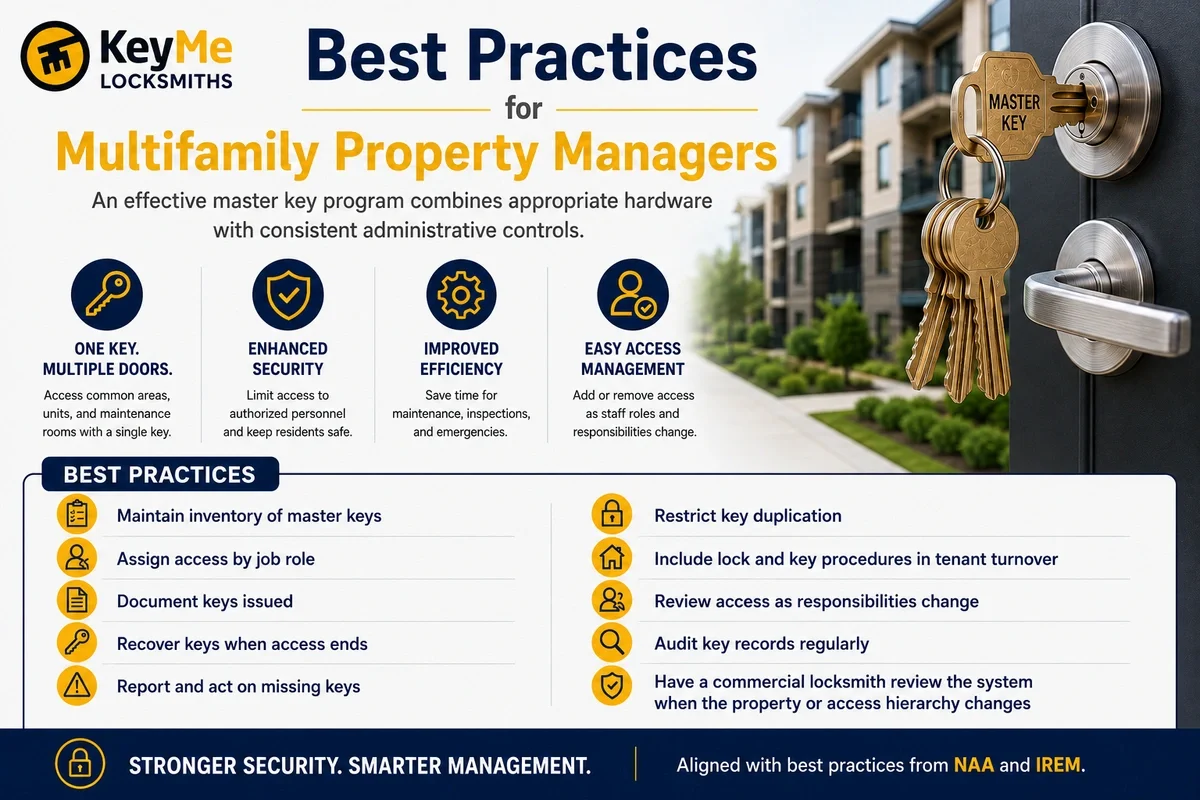
An effective master key program combines appropriate hardware with consistent administrative controls. Property managers should:
- Maintain a current inventory of high-level keys.
- Assign master access according to job responsibilities.
- Document every master key issued.
- Recover keys promptly when employment or vendor access ends.
- Establish an immediate reporting process for missing keys.
- Restrict duplication according to the property's authorization policy.
- Include lock and key procedures in the tenant-turnover process.
- Review access privileges as staff responsibilities change.
- Periodically audit key records against keys actually in circulation.
- Have a commercial locksmith review the system when the property or access hierarchy changes substantially.
These practices connect the physical security of the lock system with the operational controls emphasized in professional property-management guidance from organizations such as NAA and IREM.
How KeyMe Locksmiths Supports Multifamily Properties
A master key system needs to reflect the property's doors, staffing structure, resident access requirements, and long-term management needs.
KeyMe Locksmiths connects property managers with commercial locksmith professionals for services that may include:
- Master key system planning
- Rekeying
- Lock replacement
- Commercial lock installation
- Lock repair
- Commercial door hardware
- Authorized key duplication
- Security evaluations
- Support for mechanical and electronic locking environments
For eligible non-restricted keys, KeyMe's Online Key Copying service can also provide another duplication method: users submit an image of a supported key, the key is produced at a central facility, and the finished duplicate is shipped to the requested address. Whether that method is appropriate for a multifamily property should depend on the property's key-control policies and the eligibility of the particular key.
"The strongest master key plans start with the property's operations. Before deciding which key should open which door, determine who actually needs access, under what circumstances, and how that authorization will be tracked over time." — KeyMe Locksmiths
Build the System Around the Property, Not Just the Locks
A master key system can make a multifamily property easier to operate, but its real value comes from combining the lock hierarchy with disciplined access management.
NAA's multifamily management resources reinforce the importance of consistent operational processes. IREM's property-management guidance places risk management and defined procedures at the center of professional operations. ALOA provides the locksmith and security expertise relevant to implementing and maintaining the physical locking system.
Together, those principles point to the same practical conclusion: good multifamily key management requires both appropriate hardware and strong administrative control.
Property managers should know who has access, why they have it, what their key opens, and what happens when that authorization ends.
When the physical master key system is designed around those answers, it can support maintenance, turnover, emergency response, and day-to-day property operations without sacrificing the controlled access residents expect.
References
- Associated Locksmiths of America (ALOA). Locksmith and security industry resources. https://www.aloa.org/
- National Apartment Association (NAA). Multifamily housing and property management resources. https://naahq.org/
- Institute of Real Estate Management (IREM). Property management education, operations, and risk management resources. https://www.irem.org/
- KeyMe Locksmiths. Commercial locksmith and key duplication service information. https://key.me/commercial-office-spaces