

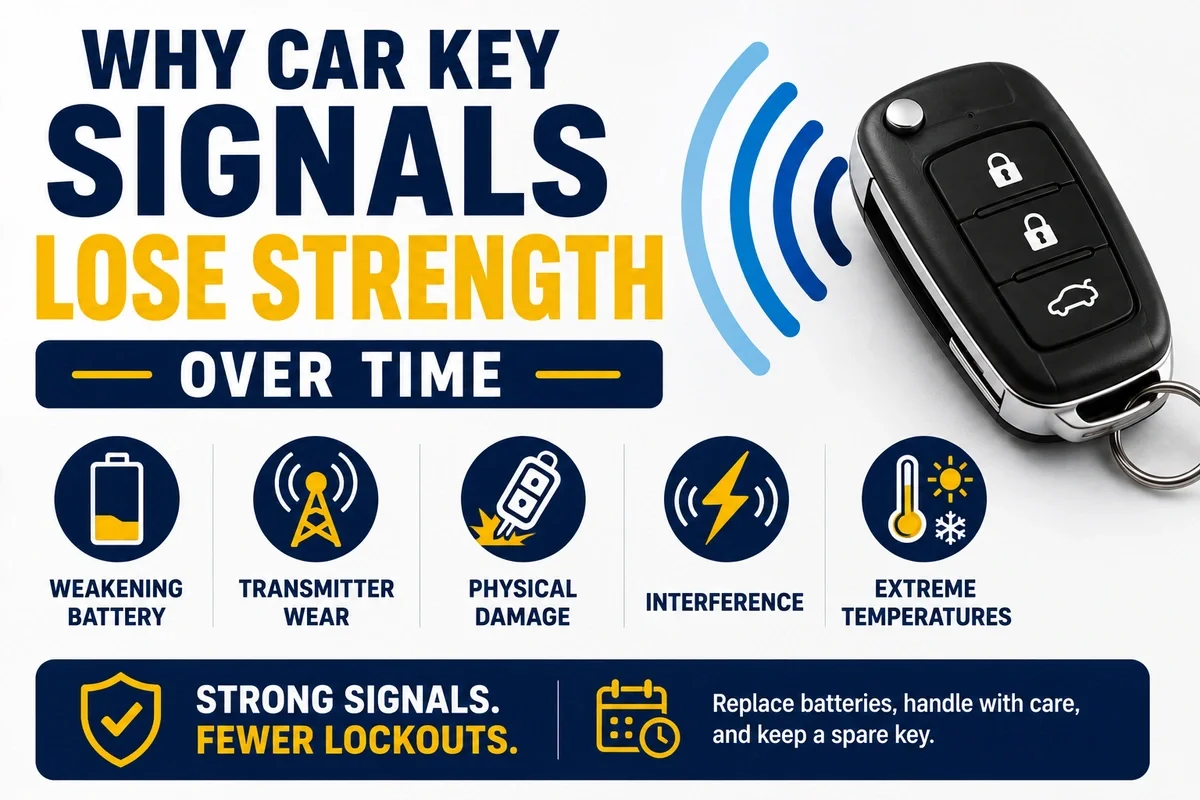
If your car key fob only works when you stand closer to the vehicle than you used to, the reduced range can be associated with a weakening fob battery, interference, damage or wear inside the fob, or a vehicle-side communication issue. The pattern matters: gradual range loss everywhere points toward a different set of possibilities than poor performance in only one location.
Reduced range can be an early warning because the fob may continue working even as its performance becomes less consistent.
KeyMe's first-party automotive service data supports treating these symptoms as part of a larger communication system rather than assuming every reduced-range problem is simply a dead batter
Summary
- Gradually shrinking range is different from a fob that suddenly stops working.
- A weakening fob battery is one common explanation for reduced remote range.
- Delayed or intermittent button response can accompany range changes.
- KeyMe's recorded service data includes lock/unlock communication failures as a recurring automotive troubleshooting category.
- KeyMe records also include remotes working only near the vehicle, intermittent passive entry, vehicle-detection problems, and location-dependent remote behavior.
- If one fob has poor range and another works normally, focus first on the affected fob.
- If multiple fobs behave similarly, vehicle-side conditions deserve consideration.
- Range that changes dramatically by location may point toward radio interference.
- A new battery does not automatically resolve every range problem.
- If the fob suddenly stops working while you're away from home, use What to Do If Your Key Fob Stops Working in a Parking Lot.
What Does "Losing Range" Mean?
A car remote has lost range when you need to be closer to the vehicle for a function that previously worked from farther away.
You might notice:
- Unlock only works close to the car
- Lock button requires several presses
- Remote response is delayed
- Trunk release becomes inconsistent
- Passive entry does not recognize the key as reliably
- Performance varies from day to day
The important distinction is change over time.
A fob that has always operated from a particular distance is different from one whose useful range has noticeably decreased.
What KeyMe's Recorded Service Data Shows
KeyMe's proprietary automotive key analysis is based on service and troubleshooting data from thousands of automotive key transactions involving vehicle key programming, duplication, replacement, and customer-support interactions.
Within that recorded service population, KeyMe identified recurring issues involving:
- Lock and unlock communication
- Vehicle recognition
- Remote-button functionality
- Ignition authentication
- Programming
Programming-related problems represented the largest individual troubleshooting category in the dataset.
KeyMe's service records also include signal-related symptoms particularly relevant to declining fob range, including remote functions that work only near the vehicle, passive entry that becomes intermittent, push-button-start systems that fail to detect the fob, and remote performance that changes depending on location.
These findings describe KeyMe's recorded service activity. They should not be interpreted as percentages of all drivers or all vehicles nationwide.
What they do show is that communication problems are a real part of modern automotive key troubleshooting.
"Reduced key-fob range is most useful as a diagnostic clue when you look at the pattern. Does one fob behave differently from another? Does the problem happen everywhere or only in one location? Did the change happen gradually or suddenly? Those comparisons help separate battery, fob, environmental, and vehicle-side possibilities." - KeyMe Locksmiths
Need a Locksmith? We're here to help
Connect with a trusted local locksmith for fast, professional assistance when you need it most.
1. A Weakening Fob Battery Can Reduce Range
A weakening battery is one of the first things to consider when a remote still works but only from shorter distances.
As available battery power declines, wireless performance can become less consistent.
Possible symptoms include:
- Reduced range
- Intermittent button response
- Multiple button presses
- Delayed response
- Inconsistent passive entry
- Key-detection warnings on applicable vehicles
KeyMe's recorded automotive troubleshooting data includes weakening batteries as an everyday source of intermittent fob behavior. The same analysis also shows why battery troubleshooting should not automatically end the diagnostic process.
If symptoms continue after a fresh battery, the issue may instead involve the fob's electronics, vehicle receiver, or programming relationship between the key and vehicle.
Do not rely on a universal replacement interval.
Battery life varies with:
- Fob design
- Battery type
- Vehicle
- Frequency of use
- Passive-entry behavior
- Storage conditions
- Environmental conditions
Follow the vehicle or key manufacturer's instructions when selecting and replacing the battery.
2. Multiple Button Presses Can Be an Early Clue
A remote should not gradually train you to accept abnormal behavior.
If unlocking once required one button press but increasingly requires several, pay attention to the change.
Ask:
- Is the response delayed?
- Does standing closer help?
- Do all buttons behave similarly?
- Does another authorized fob respond normally?
- Does the problem occur everywhere?
KeyMe's troubleshooting data includes customer-reported button failures as well as lock/unlock communication problems.
The distinction matters.
A button can have a physical or internal electronic problem, while a functioning button can also send a signal that the vehicle does not receive or process as expected.
Those observations provide more useful diagnostic information than repeatedly pressing the button until it eventually works.
3. Compare the Primary Fob With a Spare
If you have another authorized fob, comparison can be extremely useful.
One Fob Has Reduced Range
If the spare works normally from the expected distance while the primary fob does not, attention shifts toward the affected fob.
Possible causes include:
- Weak battery
- Battery-contact issue
- Physical damage
- Internal electronics
- Another fob-specific condition
Both Fobs Have Similar Reduced Range
If multiple authorized fobs develop the same behavior, do not automatically assume both keys failed in the same way.
The vehicle-side receiver, electrical system, or surrounding environment may deserve consideration.
This does not diagnose the vehicle by itself, but it changes the troubleshooting direction.
4. Location-Specific Interference Can Mimic Weak Range
Wireless performance can vary by location.
Other radio-frequency activity and the surrounding physical environment can interfere with communication between a key and vehicle.
This pattern also appears in KeyMe's recorded automotive troubleshooting data. Signal-related reports include remote functions behaving differently depending on location.
The diagnostic distinction is important.
Range Is Poor Everywhere
Consider the fob battery, fob condition, and vehicle-side communication.
Range Is Poor in One Particular Location
Environmental interference becomes more plausible.
For example, if the fob consistently works normally at home but has difficulty in one parking structure, that pattern is different from a remote that has gradually lost range everywhere.
KeyMe's service data does not establish that interference caused any individual driver's problem. Instead, location-dependent performance is one of several signal-related patterns recorded during real-world troubleshooting.
If the fob suddenly becomes unusable while you're parked away from home, see What to Do If Your Key Fob Stops Working in a Parking Lot.
5. Physical Damage Can Affect Fob Performance
A fob does not have to be visibly destroyed to have an internal problem.
Consider whether it has been:
- Dropped repeatedly
- Exposed to moisture
- Crushed
- Opened incorrectly
- Damaged around the battery compartment
- Subjected to other physical stress
Internal components can include:
- Battery contacts
- Buttons
- Circuitry
- Antenna components
- Housing that keeps components positioned correctly
KeyMe's recorded troubleshooting data includes button failures, worn internal switches, loose battery contacts, damaged circuit boards, water exposure, and other physical fob concerns.
This is another reason reduced range should not automatically be attributed to the battery.
If the change began after a specific physical incident, that history is relevant.
6. Battery Contacts Can Matter Too
Replacing the battery addresses the battery itself.
It does not automatically correct:
- Bent contacts
- Corrosion
- Contamination
- Loose internal connections
- Housing damage
If a fresh, correctly specified battery does not change the symptom, the next step should not simply be repeated battery replacement.
The fob may require further evaluation.
7. Passive Entry and Remote Buttons Are Not the Same Test
Modern smart keys can perform multiple functions.
Depending on the vehicle, the same key may support:
- Remote lock/unlock buttons
- Passive entry
- Push-button starting
- Trunk or liftgate access
- Electronic vehicle authentication
- Other vehicle-specific functions
These systems may not behave identically when communication becomes inconsistent.
KeyMe's recorded service data reflects this layered behavior. The company's automotive troubleshooting records include lock/unlock communication problems, vehicle-recognition failures, button issues, and ignition-authentication problems as distinct concerns.
For example, a driver might notice that remote buttons still work but passive entry has become less reliable.
Another vehicle may unlock from the remote while still reporting that the key is not detected for another function.
Treat each symptom as a clue rather than assuming one successful function proves the entire key system is normal.
Find a KeyMe Kiosk Near You
Need a spare key fast? Find a KeyMe kiosk near you to copy many house, office, and eligible car keys in just minutes.
8. What Does "Key Not Detected" Have to Do With Range?
A "Key Not Detected" message can indicate that the vehicle is not communicating with the key as expected.
A weak fob battery can be one possible factor, but it is not the only explanation.
If the warning becomes more frequent alongside:
- Reduced remote range
- Intermittent passive entry
- Delayed response
then the symptoms may be related.
Vehicle recognition is a significant theme in KeyMe's first-party automotive analysis. Recorded issues include vehicles failing to recognize, authenticate, or communicate properly with keys that may appear physically normal.
For deeper troubleshooting, see Key Not Detected Warning: Causes and Fixes.
9. Vehicle-Side Receiver Problems Can Look Like Fob Problems
The key is only one half of wireless communication.
The vehicle must also receive and process the signal.
Vehicle-side conditions can therefore produce symptoms that resemble a weak remote.
This becomes more relevant when:
- Multiple fobs behave similarly
- Correct battery replacement does not change the symptom
- The problem occurs consistently across locations
- Other vehicle electronic symptoms appear
KeyMe's recorded service data includes both key-side and vehicle-recognition problems, reinforcing why modern automotive key troubleshooting increasingly involves the entire vehicle-access system rather than the physical key alone.
Vehicle-specific diagnosis may be necessary before concluding that the key itself needs replacement.
10. Does Temperature Affect Key Fob Performance?
Environmental conditions can affect batteries and electronics, but temperature should be interpreted as part of a pattern rather than used as an automatic diagnosis.
Ask:
- Does the symptom occur only under certain conditions?
- Does normal operation return later?
- Is the battery already aging?
- Does another fob behave the same way?
A repeated pattern is more informative than a single unusual event.
11. What If Replacing the Battery Doesn't Restore the Range?
Do not assume a second or third battery will necessarily produce a different result.
First confirm:
- Correct battery type
- Correct installation
- Battery contacts are positioned normally
- Housing is properly assembled
Then compare the symptoms again.
KeyMe's first-party analysis specifically notes that when symptoms continue after a fresh battery, possible areas for further evaluation include the fob electronics, vehicle receiver, and programming relationship between the key and vehicle.
That is especially relevant because programming-related issues represent the largest individual troubleshooting category in KeyMe's recorded automotive service dataset.
That does not mean a programming problem is the most likely explanation for every reduced-range complaint. The dataset contains a broader population of automotive key service and support interactions, not only range complaints.
It does show why a persistent electronic key problem should not automatically be reduced to "the battery must still be bad."
12. Does Reduced Range Mean the Fob Needs Replacement?
Not automatically.
Reduced range is a symptom.
The underlying cause may involve:
- Battery
- Physical fob condition
- Interference
- Internal electronics
- Vehicle-side communication
- Another vehicle-specific issue
Car key replacement should therefore be treated as one possible service path after the actual problem is identified, not the default response to every range change.
13. Could the Fob Need Programming?
Programming and signal range are separate concepts.
A key that is properly authorized to the vehicle can still experience battery, hardware, or communication problems.
Likewise, not every range problem is solved by car key programming.
However, programming deserves consideration when the broader symptoms involve vehicle recognition or electronic authorization.
KeyMe's first-party service analysis found programming-related problems generated more troubleshooting activity than any other individual category in the dataset.
Examples recorded in the analysis include:
- A mechanically correct key that does not start the vehicle
- Remote functions that do not pair as expected
- A newly created key rejected by the vehicle
- A key that works mechanically but fails electronically
- Partial programming behavior
Those are different from simple range loss, but they illustrate why modern vehicle keys need to be evaluated as electronic credentials as well as physical keys.
14. Why You Should Check Your Spare Fob Too
A spare key that sits unused for a long period should not automatically be assumed to be ready when needed.
Periodically verify:
- Remote buttons respond
- Physical key components are intact
- Battery compartment is in normal condition
- Vehicle recognizes the key as expected
KeyMe's first-party analysis also identifies keeping spare keys functional as a practical takeaway from its service records.
A backup key is most useful when its condition is known before the primary key develops a problem.
How to Tell Whether the Problem Follows the Fob or Vehicle
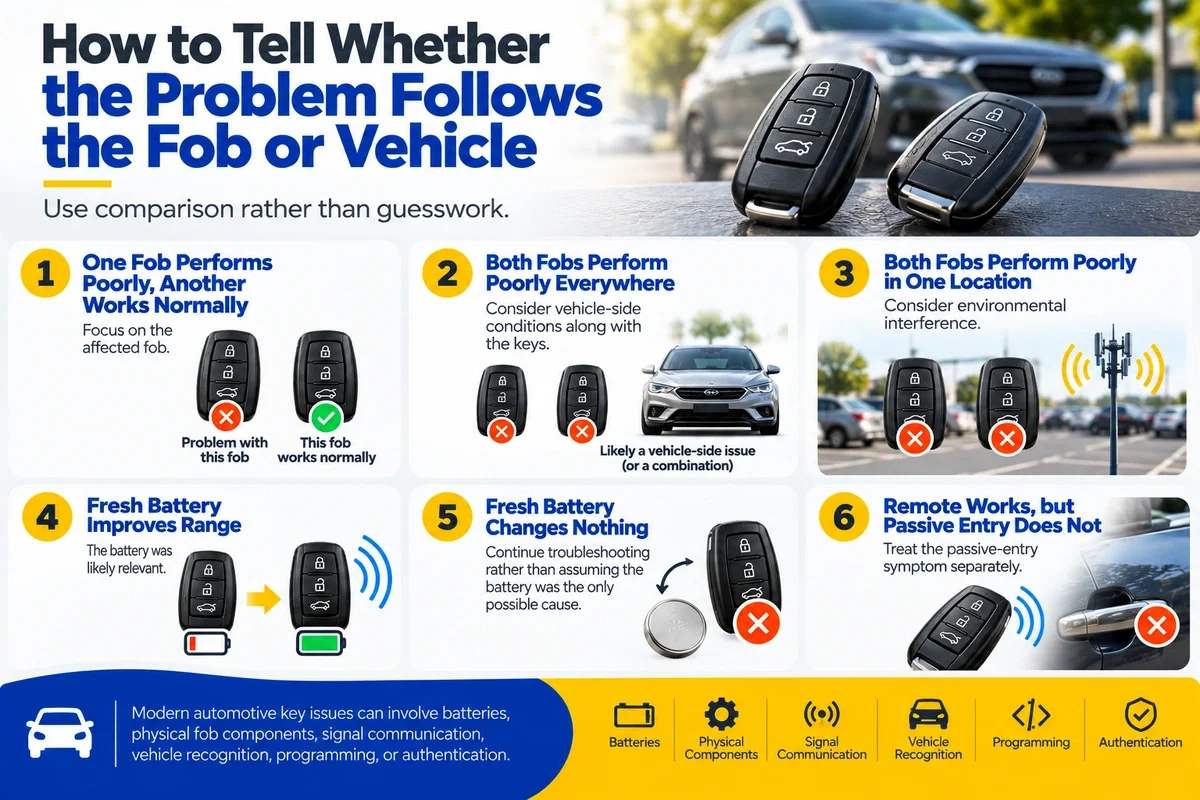
Use comparison rather than guesswork.
One Fob Performs Poorly, Another Works Normally
Focus on the affected fob.
Both Fobs Perform Poorly Everywhere
Consider vehicle-side conditions along with the keys.
Both Fobs Perform Poorly in One Location
Consider environmental interference.
Fresh Battery Improves Range
The battery was likely relevant.
Fresh Battery Changes Nothing
Continue troubleshooting rather than assuming the battery was the only possible cause.
Remote Works, but Passive Entry Does Not
Treat the passive-entry symptom separately.
This pattern-based approach aligns with what KeyMe sees in its recorded service activity: modern automotive key complaints can involve batteries, physical fob components, signal communication, vehicle recognition, programming, or authentication.
Copy Your Key from Anywhere - Right from Your Phone
Skip the kiosk and copy your key from home. Upload a clear photo of an eligible house or car key, and KeyMe will create a precise duplicate and mail it directly to your door.
Best Way to Respond to Declining Key Fob Range
1. Confirm the Pattern
Determine whether the range has actually decreased over time.
2. Compare Another Authorized Fob
See whether the behavior follows one particular key.
3. Compare Locations
Determine whether the symptom occurs everywhere or only in specific places.
4. Evaluate the Battery
Use the correct battery and manufacturer instructions.
5. Consider the Fob's Physical History
Drops, moisture, or housing damage can be relevant.
6. Recheck Performance
Determine whether battery replacement changed the symptom.
7. Consider Vehicle-Side Conditions
If multiple fobs behave similarly, the vehicle may need evaluation.
8. Address the Problem Before the Fob Becomes Unreliable
Reduced range can provide an opportunity to investigate while the key still functions.
Why Choose KeyMe for Vehicle Key Services?
KeyMe's first-party automotive findings are drawn from recorded service activity across thousands of automotive key transactions, including programming, duplication, replacement, and customer-support interactions.
That service experience includes modern automotive key problems involving mechanical keys, remote functions, programming, vehicle recognition, and electronic authentication.
KeyMe provides several automotive key service paths for supported vehicles, including:
KeyMe Car Key Vans also provide in-person duplication and programming at participating retail locations for supported vehicles.
The appropriate service depends on whether the problem involves duplication, programming, a damaged or missing key, a lockout, or another vehicle-specific condition.
Declining Range Is an Early Diagnostic Clue
A car key fob does not have to stop working completely before it deserves attention.
KeyMe's analysis of thousands of recorded automotive key transactions shows how varied modern key problems have become. Programming is the largest individual troubleshooting category in that dataset, while vehicle-recognition failures, lock/unlock communication problems, button concerns, and ignition-authentication issues also appear throughout KeyMe's recorded service activity.
For a driver experiencing reduced range, the important lesson is not that one of those categories automatically explains the problem.
It is that the fob is part of a larger vehicle-access system.
If you increasingly need to stand closer to the vehicle, press buttons multiple times, or deal with inconsistent passive entry, compare:
One fob vs. another.
One location vs. every location.
Before vs. after battery replacement.
Remote buttons vs. passive entry.
Those comparisons can help distinguish a battery issue from physical fob damage, interference, or a vehicle-side communication problem.
If the problem changes from gradual decline to a sudden failure while you're away from home, see What to Do If Your Key Fob Stops Working in a Parking Lot.
References
- KeyMe Locksmiths. Proprietary Automotive Key Service and Troubleshooting Data. First-party analysis of thousands of recorded automotive key transactions involving programming, duplication, replacement, customer support, signal behavior, vehicle recognition, remote functionality, and authentication issues.
- Federal Communications Commission (FCC). Radio Frequency Safety and Consumer Information. Federal background information about radio-frequency technology and wireless communications.
https://www.fcc.gov/engineering-technology/electromagnetic-compatibility-division/radio-frequency-safety/faq/rf-safety - National Highway Traffic Safety Administration (NHTSA). Vehicle Theft Prevention. Federal consumer information about vehicle security and electronic immobilizer systems.
https://www.nhtsa.gov/vehicle-safety/vehicle-theft-prevention - KeyMe Locksmiths. Vehicle Keys. Information about KeyMe automotive key services.
https://key.me/vehicle-keys - KeyMe Locksmiths. Car Key Programming. Information about supported vehicle key programming services.
https://key.me/car-key-programming