

A "Key Not Detected" warning means your vehicle cannot verify or communicate with your key fob. In most cases, the issue is caused by a weak key fob battery, signal interference, a low vehicle battery, a damaged key, or a communication problem between the key and the vehicle's electronic security system.
Unlike traditional metal keys, modern smart keys continuously exchange encrypted information with your vehicle before allowing it to unlock the doors or start the engine. If that communication is interrupted—even for a moment—the vehicle may display a "Key Not Detected" message and prevent the engine from starting.
Fortunately, many of the most common causes can be identified quickly, and not every warning means you'll need a replacement key.
Summary
- A "Key Not Detected" warning usually indicates a communication problem between your smart key and the vehicle—not necessarily a failed key.
- Weak key fob batteries, low vehicle batteries, radio-frequency interference, and damaged key fobs are among the most common causes.
- Some issues are intermittent and may only occur in certain locations or environmental conditions.
- Simple troubleshooting steps, such as replacing the key fob battery or checking the vehicle battery, may resolve the problem before professional service is needed.
- If multiple keys stop working or the warning continues after replacing the battery, a professional automotive locksmith can diagnose whether the issue involves the key, the vehicle, or the immobilizer system.
How Modern Key Detection Systems Work
Today's push-to-start vehicles rely on sophisticated electronic security systems rather than traditional mechanical keys.
Instead of inserting a key into the ignition, your vehicle continuously looks for an authorized smart key nearby.
When you approach the vehicle, several systems begin communicating:
- The smart key
- Passive entry antennas
- Interior detection antennas
- The immobilizer
- The Body Control Module (BCM)
- The Engine Control Module (ECM)
Only after these systems verify that an authorized key is present will the vehicle allow the engine to start.
This electronic authentication happens in fractions of a second and is designed to help prevent unauthorized vehicle operation.
"Modern smart keys don't simply unlock a vehicle—they participate in an encrypted conversation with multiple vehicle systems before the engine is ever allowed to start." — KeyMe Locksmiths
Why Choose KeyMe Locksmiths?
Modern vehicle key problems aren't always caused by the key itself. Electronic communication issues can involve the key fob, immobilizer, vehicle battery, antennas, or onboard control modules.
KeyMe Locksmiths provides automotive locksmith services designed to diagnose and resolve a wide range of key and vehicle access issues.
Depending on your vehicle, available services may include:
- Smart key replacement
- Key fob programming
- Transponder programming
- Vehicle lockout assistance
- Lost key replacement
- Ignition key replacement
- Emergency automotive locksmith service
For supported vehicles, KeyMe Locksmiths also offers online ordering through online key copying technology and retail-based car key van services at select locations.
"Electronic key systems are made up of several components working together. Successful diagnosis means identifying which component has stopped communicating—not simply assuming the key needs to be replaced." — KeyMe Locksmiths
What Does "Key Not Detected" Actually Mean?
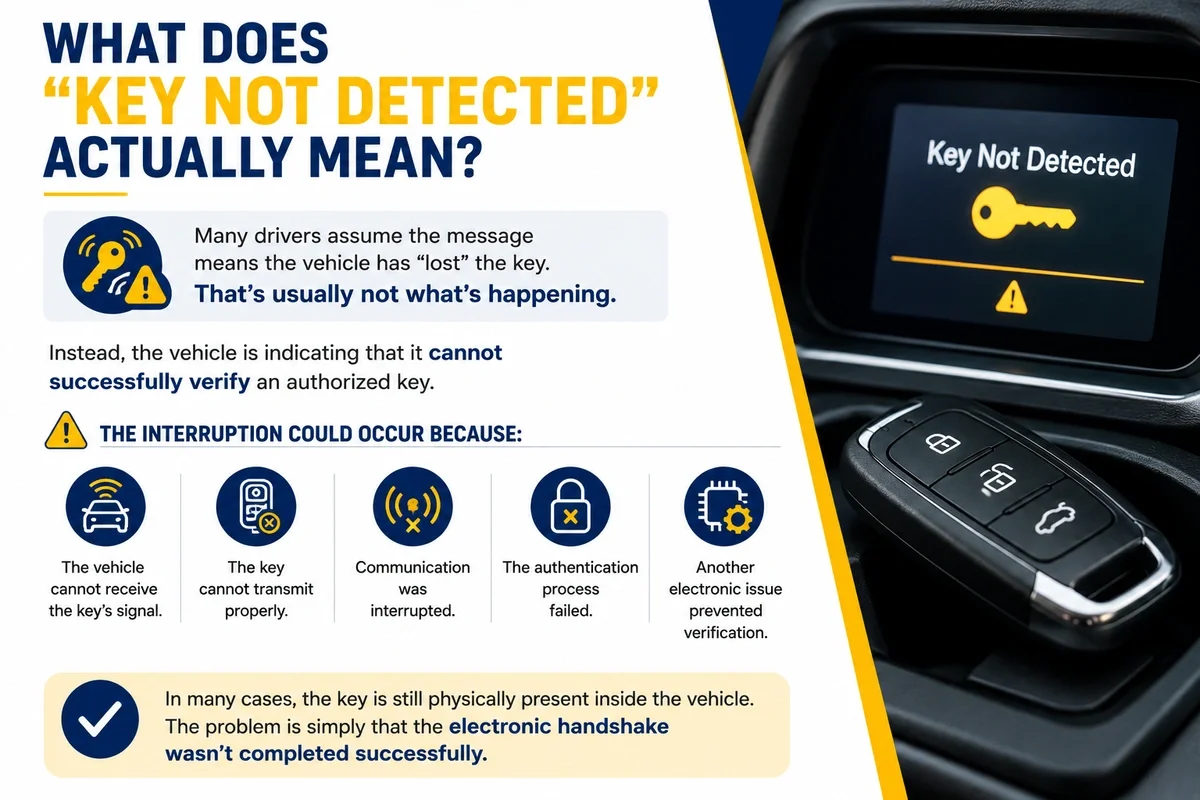
Many drivers assume the message means the vehicle has "lost" the key.
That's usually not what's happening.
Instead, the vehicle is indicating that it cannot successfully verify an authorized key.
The interruption could occur because:
- The vehicle cannot receive the key's signal.
- The key cannot transmit properly.
- Communication was interrupted.
- The authentication process failed.
- Another electronic issue prevented verification.
In many cases, the key is still physically present inside the vehicle.
The problem is simply that the electronic handshake wasn't completed successfully.
Need a Locksmith? We're here to help
Connect with a trusted local locksmith for fast, professional assistance when you need it most.
The Most Common Causes of "Key Not Detected"
1. Weak or Dead Key Fob Battery
This is by far the most common cause.
Most smart keys use small lithium coin-cell batteries that gradually lose capacity over time.
As battery voltage decreases, the key may:
- Unlock inconsistently
- Require multiple button presses
- Need to be held closer to the vehicle
- Trigger intermittent "Key Not Detected" warnings
Eventually, the signal becomes too weak for reliable communication.
Replacing the battery is often the first—and simplest—step.
2. Radio Frequency Interference
Smart keys communicate using low-power radio signals.
Nearby electronic devices can sometimes interfere with that communication.
Potential sources include:
- Parking garages
- Airport structures
- Cell towers
- Radio transmitters
- Industrial equipment
- Large metal buildings
If the warning appears only in certain locations, interference may be contributing to the problem.
Unlike a damaged key, interference usually disappears once the vehicle is moved to another location.
3. Weak Vehicle Battery
The vehicle's battery powers the electronic systems responsible for recognizing your key.
If battery voltage drops too low, components responsible for authentication may not function consistently.
Possible symptoms include:
- Multiple dashboard warnings
- Slow engine cranking
- Flickering interior lights
- Intermittent key recognition
Although the smart key may be working normally, insufficient vehicle voltage can interrupt the authentication process.
"Drivers often focus on the key because of the dashboard message, but the vehicle's own electrical system plays an equally important role in recognizing and authorizing that key." — KeyMe Locksmiths
4. Damaged Smart Key
Smart keys contain sensitive electronic components.
Damage caused by:
- Water exposure
- Repeated drops
- Extreme temperatures
- Cracked housings
- Internal circuit failure
may prevent the key from communicating reliably with the vehicle.
Sometimes the buttons continue working while the transponder or proximity functions become unreliable.
Because these systems operate independently, a partially functioning key doesn't necessarily mean every electronic component is working correctly.
5. The Key Has Lost Synchronization
Although less common, certain events may require the key to be reprogrammed or resynchronized with the vehicle.
This can occur after:
- Key replacement
- Certain vehicle repairs
- Module replacement
- Immobilizer updates
- Security system resets
Professional diagnostic equipment is typically required to restore communication.
6. Passive Entry Antenna Problems
Many push-to-start vehicles use several antennas located throughout the cabin.
These antennas detect whether an authorized key is inside the vehicle.
If one of these antennas malfunctions, the vehicle may report:
- "Key Not Detected"
- "No Key Found"
- "Key Not Present"
even though the key is physically inside the cabin.
Diagnosing antenna problems requires specialized testing because the symptoms often resemble key failure.
Less Common Causes of a "Key Not Detected" Warning
Although battery issues account for many key detection problems, they're not the only possible cause. Modern vehicles rely on dozens of electronic components working together, and a fault in any one of them can interrupt communication between the key and the vehicle.
Understanding these less common issues can help explain why replacing the key fob battery doesn't always solve the problem.
A Failing Push-to-Start Button
On push-button start vehicles, the start button itself is part of the authentication process.
If the button or its internal electronics begin to fail, the vehicle may struggle to recognize the key even when it's functioning normally.
Possible symptoms include:
- Intermittent "Key Not Detected" messages
- Multiple button presses required
- Delayed engine response
- Dashboard messages that appear inconsistently
Because these symptoms closely resemble key failure, proper diagnosis is important before replacing the key.
Body Control Module (BCM) Issues
The Body Control Module manages many electronic systems throughout the vehicle, including door locks, passive entry, alarm functions, and key authentication.
If the BCM develops a software or hardware problem, communication between the smart key and the vehicle may become unreliable.
Drivers may notice:
- Multiple electronic warning messages
- Remote locking problems
- Interior lighting issues
- Intermittent key detection
Since the BCM communicates with several other vehicle modules, diagnosing these issues typically requires professional scan tools.
Software or Firmware Updates
Vehicle manufacturers occasionally release software updates that improve system performance or address known electronic issues.
In some situations, key detection problems may appear after:
- Module replacement
- Battery replacement
- Electrical repairs
- Vehicle software updates
While these situations are relatively uncommon, they can affect how the vehicle recognizes programmed keys.
Internal Key Fob Damage
A smart key can appear perfectly normal while suffering from internal damage.
Repeated drops, moisture exposure, or years of vibration may damage:
- Circuit boards
- Battery contacts
- Solder joints
- Internal antennas
- Electronic components
Unlike a dead battery, these problems usually cannot be resolved by simply replacing the battery.
"Smart keys experience thousands of vibrations, temperature changes, and impacts throughout their lifetime. Damage isn't always visible from the outside, which is why testing is often more reliable than visual inspection alone." — KeyMe Locksmiths
Step-by-Step Troubleshooting
Before assuming the key needs to be replaced, there are several safe troubleshooting steps you can try.
These checks won't solve every problem, but they can often identify the most common causes.
Step 1: Replace the Key Fob Battery
Even if the remote still locks and unlocks the vehicle, the battery may no longer provide enough power for reliable proximity detection.
Many smart keys use common lithium coin-cell batteries that gradually lose capacity over time.
Replacing the battery is inexpensive and often resolves intermittent detection problems.
Step 2: Try Your Spare Key
If you have a second programmed key, test it.
This comparison provides valuable diagnostic information.
- If the spare works normally, the original key is likely the problem.
- If both keys produce the same warning, the issue may involve the vehicle rather than the key itself.
Step 3: Check the Vehicle Battery
A weak vehicle battery affects much more than engine starting.
Low voltage can interfere with:
- Passive entry systems
- Immobilizer communication
- Control modules
- Dashboard electronics
- Push-button start systems
If you've recently noticed slow cranking or other electrical issues, the vehicle battery should also be evaluated.
Step 4: Move the Vehicle (If Possible)
If the warning appears only in one location, radio-frequency interference may be disrupting communication.
Consider whether you're parked:
- Inside a parking garage
- Near large electrical equipment
- Adjacent to communication towers
- Near industrial facilities
If the warning disappears after moving to another location, interference may have contributed to the issue.
Step 5: Remove Other Electronic Devices
Although uncommon, certain electronic devices carried near the smart key can interfere with communication.
Examples include:
- Additional vehicle keys
- RFID access cards
- Electronic badges
- Wireless transmitters
Separating these items from the smart key may improve communication in some situations.
Step 6: Look for Patterns
Instead of focusing only on when the warning appears, pay attention to how it appears.
Ask yourself:
- Does it happen only in cold weather?
- Only after the vehicle sits overnight?
- Only when using one particular key?
- Only after replacing the battery?
- Only in certain parking locations?
Patterns often provide valuable clues about the underlying cause.
"The dashboard message tells you communication failed—but understanding when it fails is often what leads to the correct diagnosis." — KeyMe Locksmiths
Find a KeyMe Kiosk Near You
Need a spare key fast? Find a KeyMe kiosk near you to copy many house, office, and eligible car keys in just minutes.
Why the Warning May Come and Go
Many drivers are surprised when the warning disappears on its own.
Intermittent problems are common because electronic communication depends on multiple variables.
The warning may appear only when:
- Battery voltage drops temporarily
- Signal strength weakens
- Environmental interference increases
- Internal electronics warm or cool
- Vehicle antennas receive inconsistent signals
This doesn't necessarily mean the problem has resolved itself.
In many cases, intermittent warnings become more frequent over time as the underlying issue gradually worsens.
What Not to Do
A "Key Not Detected" warning rarely improves by repeatedly pressing buttons or attempting to force the system.
Avoid:
- Repeatedly pressing the Start button dozens of times
- Replacing multiple expensive components without diagnosis
- Assuming the key is always the problem
- Ignoring intermittent warnings for weeks or months
- Attempting to disassemble the smart key beyond battery replacement
Modern vehicle security systems are interconnected, and replacing the wrong component often increases repair costs without solving the underlying issue.
What If Both Keys Stop Working?
If every programmed key suddenly displays the same warning, the problem is less likely to involve the keys themselves.
Possible causes include:
- Vehicle battery problems
- Passive antenna failure
- Immobilizer issues
- Body Control Module faults
- Wiring problems
- Electronic control module communication failures
Because multiple keys are affected simultaneously, attention typically shifts toward diagnosing the vehicle rather than replacing additional keys.
How Automotive Locksmiths Diagnose "Key Not Detected"
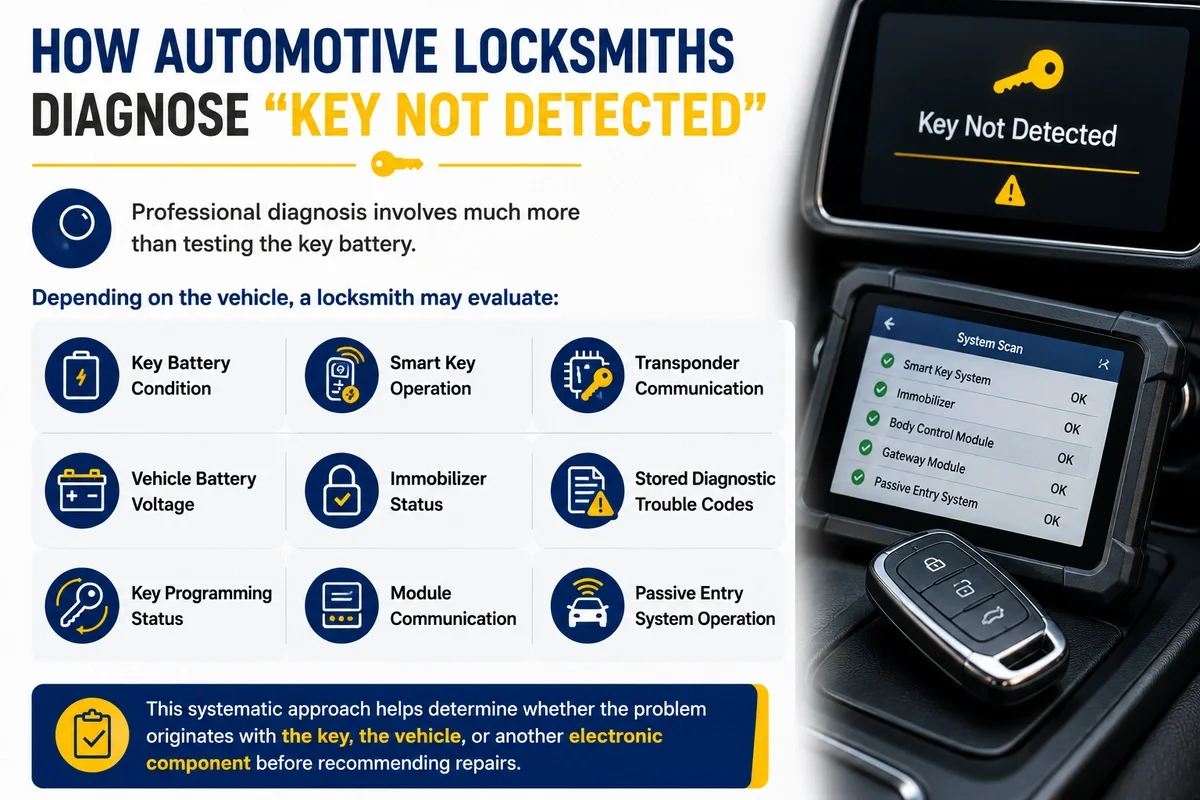
Professional diagnosis involves much more than testing the key battery.
Depending on the vehicle, a locksmith may evaluate:
- Key battery condition
- Smart key operation
- Transponder communication
- Vehicle battery voltage
- Immobilizer status
- Stored diagnostic trouble codes
- Key programming status
- Module communication
- Passive entry system operation
This systematic approach helps determine whether the problem originates with the key, the vehicle, or another electronic component before recommending repairs.
Can You Prevent a "Key Not Detected" Warning?
While no electronic system is completely immune to failure, many "Key Not Detected" issues develop gradually and can be reduced through routine maintenance and early attention to warning signs.
Simple preventive habits can help improve the reliability of both your smart key and your vehicle's electronic access system.
Replace the Key Fob Battery Before It Fails
Many drivers don't think about the key fob battery until the vehicle stops recognizing the key.
However, declining battery performance is often gradual. Long before the battery dies completely, you may notice:
- Reduced remote range
- Delayed lock or unlock response
- Intermittent "Key Not Detected" messages
- The need to hold the key closer to the vehicle
Replacing the battery at the first sign of reduced performance can help prevent unexpected starting problems.
Protect Your Smart Key from Physical Damage
Although smart keys are designed for everyday use, they contain sensitive electronic components.
To help extend their lifespan:
- Avoid dropping the key onto hard surfaces.
- Protect it from water and excessive moisture.
- Don't leave it in extremely hot vehicles for extended periods.
- Replace cracked or damaged key shells promptly.
External damage that appears minor can sometimes affect internal antennas or circuit boards responsible for vehicle communication.
Pay Attention to Early Warning Signs
Many electronic key problems don't appear all at once.
Watch for changes such as:
- Inconsistent push-button starting
- Dashboard messages that appear occasionally
- Shorter remote operating range
- Multiple attempts required before the vehicle recognizes the key
- Intermittent passive entry problems
Addressing these symptoms early may help prevent a complete loss of key recognition later.
"Electronic access systems rarely fail without warning. Intermittent behavior is often the vehicle's first indication that communication is becoming less reliable." — KeyMe Locksmiths
Keep Your Vehicle Battery Healthy
The smart key is only one half of the communication process.
A weak or aging vehicle battery can affect:
- Immobilizer operation
- Passive entry antennas
- Body Control Module communication
- Push-button start performance
Routine battery testing—particularly before winter or long road trips—can help identify problems before they affect vehicle operation.
Keep a Spare Programmed Key
One of the easiest ways to reduce stress during a key-related problem is to have a second programmed key available.
A spare key can help you:
- Confirm whether the issue involves the original key or the vehicle.
- Avoid being stranded if one key stops working.
- Simplify future key replacement.
- Reduce the likelihood of emergency locksmith service.
Creating a spare while you still have a working key is often simpler than replacing every key after they've all been lost.
Copy Your Key from Anywhere - Right from Your Phone
Skip the kiosk and copy your key from home. Upload a clear photo of an eligible house or car key, and KeyMe will create a precise duplicate and mail it directly to your door.
Replacement Key or Reprogramming?
When a "Key Not Detected" warning appears repeatedly, many drivers assume they need an entirely new key.
That's not always the case.
Depending on the diagnosis, the solution may involve:
Replacing the Key Fob Battery
If communication problems are caused by low battery voltage, replacing the battery may restore normal operation.
Reprogramming the Existing Key
If communication between the vehicle and the key has been interrupted, professional programming may restore proper authentication without replacing the key itself.
Replacing the Smart Key
Replacement may be recommended if the key has:
- Water damage
- Internal electronic failure
- Physical damage
- Failed transponder components
- Non-repairable circuit board damage
Repairing the Vehicle
Sometimes the smart key is functioning normally.
Instead, the issue may involve:
- Passive entry antennas
- Vehicle wiring
- The immobilizer
- The Body Control Module
- Other electronic control systems
Proper diagnosis helps determine which component actually requires service.
How Automotive Locksmiths Resolve "Key Not Detected" Problems
Professional automotive locksmiths use specialized diagnostic equipment to evaluate both the key and the vehicle.
Depending on the symptoms, service may include:
- Smart key testing
- Key battery replacement
- Replacement key creation
- Smart key programming
- Transponder programming
- Immobilizer diagnostics
- Vehicle lockout assistance
- Electronic system verification
Rather than replacing components one at a time, a systematic diagnosis helps identify the root cause before repairs begin.
"The warning on the dashboard is only the starting point. Effective diagnosis means understanding why communication failed—not simply replacing the first component that seems suspicious." — KeyMe Locksmiths
Restore Reliable Vehicle Access
A "Key Not Detected" warning doesn't automatically mean your smart key has failed. In many cases, the problem stems from a simple communication issue, a weak battery, or another component within the vehicle's electronic security system.
Understanding how smart keys, immobilizers, and passive entry systems work together makes it easier to recognize early warning signs, troubleshoot common issues safely, and know when professional diagnosis is appropriate.
Whether the solution involves replacing a battery, reprogramming a key, or diagnosing a more complex electronic issue, addressing the warning early can help prevent unexpected starting problems and restore confidence every time you get behind the wheel.
KeyMe Locksmiths provides automotive locksmith services for vehicle lockouts, smart key replacement, key programming, and ignition-related issues. For supported vehicles, customers can also take advantage of online key ordering through mobile key scanning technology and retail-based car key van services at select locations.
References
- National Highway Traffic Safety Administration (NHTSA). Vehicle Theft Prevention. https://www.nhtsa.gov/vehicle-safety/theft-prevention (Supports discussion of immobilizer systems and electronic vehicle security.)
- SAE International. Automotive Electronics and Vehicle Access Systems. https://www.sae.org/ (Supports information regarding smart key communication, passive entry systems, and electronic vehicle architecture.)
- Federal Communications Commission (FCC). Radio Frequency Devices. https://www.fcc.gov/engineering-technology (Supports general information about radio-frequency communication and interference affecting wireless devices.)
- KeyMe Locksmiths service information for automotive locksmith services, smart key programming, online key ordering, and retail-based car key van services.