

A locksmith can play an important role before, during, and after a home renovation, especially when a project affects exterior doors, locks, smart access, contractor keys, or the way different entrances will be used. Involving a locksmith early can help homeowners determine which existing locks can remain, whether new doors require different hardware, how contractors will access the property, and whether the locks should be rekeyed when the project is complete.
Renovations often bring more people into a home than normal. Contractors, subcontractors, designers, inspectors, delivery teams, and other service providers may all require access. At the same time, doors may be replaced, moved, repaired, or left temporarily unsecured while work is underway.
A locksmith can help homeowners manage those changes without treating every renovation as a complete lock replacement project.
Summary
- Talk to a locksmith early if the renovation includes exterior doors, new entry points, door replacement, smart locks, or significant access changes.
- Decide how contractors and subcontractors will enter the property before construction begins.
- Avoid distributing permanent household keys more widely than necessary.
- Existing locks may sometimes be rekeyed or reused rather than replaced.
- New doors need compatible locks, strikes, door preparation, and other hardware.
- BHMA maintains separate performance standards for many categories of builders hardware, including residential locks, commercial locks, cylinders, hinges, closers, exit devices, and electronic locking systems.
- If contractors received keys that will remain active after construction, consider rekeying when the project ends.
- Finish the renovation with a security walkthrough that covers physical keys, electronic credentials, door alignment, locks, and spare keys.
Why a Locksmith Belongs in the Renovation Plan
Home renovations often focus on contractors, architects, electricians, plumbers, and designers. Locksmiths may not enter the conversation until someone discovers that the new front door does not work with the old lock or that several contractors now have permanent keys.
Planning earlier can help avoid those situations.
A locksmith may be useful when a renovation involves:
- Replacing exterior doors
- Adding an entrance
- Moving an existing doorway
- Installing new locks
- Changing door hardware
- Adding smart locks
- Changing garage-to-house access
- Creating a home office with separate access
- Renovating a rental or multifamily property
- Changing which keys operate different areas
The National Association of Home Builders recommends establishing a clearly written scope of work when hiring a remodeler and maintaining strong communication throughout the project. Thinking through locks and property access as part of that scope can help prevent access decisions from becoming an afterthought.
"Renovation changes how people move through a property. A locksmith can help homeowners think beyond the new lock itself and consider the door, frame, hardware, keying, and who should have access while construction is happening." - KeyMe Locksmiths
Before Renovation: Identify Which Doors Are Changing
Start by reviewing the project's effect on entry points.
Ask:
- Is the front door being replaced?
- Is a patio door becoming a hinged exterior door?
- Is a new garage entrance being added?
- Are exterior doors being moved?
- Are existing frames being rebuilt?
- Will the renovation introduce smart locks?
- Will any doors change from residential-style to heavier-duty hardware?
This matters because locks are installed into a larger door opening.
The Builders Hardware Manufacturers Association develops ANSI-approved standards for numerous categories of hardware, including locks, cylinders, hinges, door closers, exit devices, electrified locking systems, and other door components. BHMA also notes that the performance of installed hardware can be affected by installation, door and frame construction, maintenance, and environmental conditions.
In other words, choosing a good lock is only part of the job.
The new door and its hardware need to work together.
Need a Locksmith? We're here to help
Connect with a trusted local locksmith for fast, professional assistance when you need it most.
Decide Whether Existing Locks Can Stay
Renovation does not automatically mean replacing every lock.
A locksmith can evaluate the existing hardware and help determine whether it can be:
- Reused
- Repaired
- Rekeyed
- Moved to another opening
- Replaced
For example, an existing deadbolt may still be in good condition but no longer match the finish or preparation of the new door.
In another home, the existing lock may be serviceable and only need rekeying after construction.
If the hardware is worn or incompatible with the renovated opening, lock replacement may make more sense.
Ask Your Locksmith
"Which existing locks can stay, and which actually need to be replaced because of the renovation?"
That keeps the recommendation tied to the condition and compatibility of the hardware.
Coordinate New Doors With Lock Hardware
One common renovation mistake is choosing the door and lock separately without confirming that they are compatible.
A locksmith or door-hardware professional may need to consider:
- Door thickness
- Backset
- Bore preparation
- Edge preparation
- Lock type
- Strike location
- Frame construction
- Handing, where applicable
- Existing keyway
- Smart lock compatibility
BHMA's standards reflect how many different components can be involved in a complete door opening. Its current standards include separate performance requirements for residential locksets, commercial locks, cylinders, multipoint locks, hinges, door closers, and electrified locking systems.
If the renovation includes a completely new exterior opening, professional lock installation can help ensure the lock is appropriate for the new door.
Create a Contractor Access Plan Before Work Starts
Renovations can create an unusual access situation.
People who may need entry include:
- General contractors
- Subcontractors
- Electricians
- Plumbers
- Painters
- Flooring installers
- Designers
- Inspectors
- Cleaning teams
- Delivery personnel
That does not mean everyone needs a permanent copy of the homeowner's everyday key.
Before work begins, decide:
- Who actually needs independent entry?
- Who can enter only when another authorized person is present?
- Will contractors receive a physical key?
- Can temporary electronic credentials be used?
- When will contractor access end?
- Who is responsible for collecting keys?
NAHB recommends establishing clear communication and documenting the renovation process. Applying the same discipline to property access can make the project easier to manage.
Should You Give Contractors a House Key?
Sometimes a contractor genuinely needs independent access.
If you decide to provide a physical key, think about what that key opens.
A single household key might operate:
- Front door
- Back door
- Garage entry
- Storage areas
- Other exterior doors
Before handing it over, consider whether the contractor needs access to all of those openings.
For a larger renovation, a locksmith may be able to discuss other keying approaches depending on the existing hardware.
The goal is not to make contractor access difficult. It is to avoid providing broader or longer-lasting access than the project requires.
Find a KeyMe Kiosk Near You
Need a spare key fast? Find a KeyMe kiosk near you to copy many house, office, and eligible car keys in just minutes.
Smart Locks Can Help With Temporary Access
A renovation may be a useful time to consider electronic access if the homeowner already planned to upgrade the entry system.
Depending on the lock and platform, supported smart locks may allow homeowners to use:
- Temporary access codes
- Individual user credentials
- Time-limited access
- Mobile access
- Access removal after work ends
These functions vary by manufacturer and model.
If you are selecting electronic locking hardware, compatibility and physical performance still matter. ANSI/BHMA A156.25 covers performance requirements for electrified locking systems and coordinates those electronic functions with the underlying mechanical hardware requirements.
Electronic access should therefore be evaluated as both a technology choice and a door-hardware choice.
Do Not Forget Temporary Construction Conditions
The finished door is not the only security concern.
During renovation, a property may temporarily have:
- A removed door
- An unfinished frame
- Temporary plywood covering
- A door that does not yet latch
- Hardware removed for painting or refinishing
- An exterior opening awaiting final installation
Talk with the contractor about how the property will be secured at the end of each workday.
If a permanent lock cannot yet be installed, determine what temporary security measures are appropriate for the stage of construction.
A locksmith may be able to help when temporary access or lock hardware needs to transition into the finished system.
Renovations Can Expose Existing Door Problems
Removing trim, replacing flooring, adjusting framing, or installing a new door can reveal problems that were already developing.
A locksmith may identify:
- Misaligned strikes
- Loose hinges
- Worn cylinders
- Deadbolts that do not fully extend
- Damaged frames
- Locks previously installed incorrectly
- Doors that have shifted
- Hardware that no longer suits the opening
This is why replacing only the visible lock is not always the right answer.
BHMA specifically notes that real-world lock performance can be influenced by factors including installation and door and frame construction.
If the problem is limited to the existing hardware, KeyMe offers lock repair and installation.
"Renovation is often when homeowners finally see the entire opening instead of only the lock. If the frame has moved, the strike is misaligned, or the new door is prepared differently, the locksmith needs to account for those conditions before recommending hardware." - KeyMe Locksmiths
Choose Hardware Based on the Door's New Purpose
Renovations sometimes change how a space is used.
For example:
Garage conversion: An interior or garage-area opening may become an important exterior entrance.
Home office renovation: A room may need different privacy or access requirements.
Accessory dwelling unit: Separate occupants may require independent access.
Rental conversion: A homeowner may need to think differently about resident, owner, and maintenance access.
New patio entrance: Exterior hardware must now be selected for an opening that did not exist previously.
The correct lock should reflect the door's new function, not simply replicate whatever hardware was there before.
Copy Your Key from Anywhere - Right from Your Phone
Skip the kiosk and copy your key from home. Upload a clear photo of an eligible house or car key, and KeyMe will create a precise duplicate and mail it directly to your door.

Ask About Lock Ratings and Standards
If you are already purchasing new doors and hardware, renovation is a good time to understand what you are buying.
BHMA's current residential lockset standard, ANSI/BHMA A156.39-2025, establishes requirements covering security, durability, and finish for bored residential locksets and latches. BHMA's certification program uses independent laboratory testing to determine whether products meet applicable standards.
For homeowners, the practical takeaway is simple:
Compare specific products and certifications, not just brand names or appearance.
Ask your locksmith or contractor:
- Which standard applies to this hardware?
- Is this hardware certified?
- Is it appropriate for an exterior residential door?
- Does the hardware match how frequently this opening will be used?
What If You Want One Key for the Renovated Home?
A renovation is often when homeowners notice that different doors use several unrelated keys.
You may have:
- One key for the front door
- Another for the back
- Another for the garage entrance
- Another for a renovated addition
If compatible hardware is being retained or installed, ask whether the locks can be configured so an appropriate set uses the same key.
This can sometimes be accomplished through rekeying rather than replacing otherwise suitable hardware.
Compatibility depends on the cylinders, keyways, and specific lock systems.
Plan for Key Duplication Near the End, Not the Beginning
Avoid creating a large number of permanent keys before the final keying arrangement is established.
During a renovation, you may still decide to:
- Replace a lock
- Change a cylinder
- Rekey several doors
- Change which doors share a key
- Remove contractor access
Once the final configuration is established, create only the authorized copies the household needs.
KeyMe offers key duplication and key cutting for many supported keys, along with KeyMe kiosks for compatible key-copy needs.
For eligible supported keys, KeyMe's mobile key scanning option also allows an authorized user to submit a key image, which is processed and cut at a central facility before the finished key is shipped to the requested address.
Should You Rekey After the Renovation?
If permanent keys were distributed during construction and you cannot confidently account for all of them, the end of the project is a logical time to evaluate rekeying.
ALOA's consumer guidance emphasizes the importance of controlling existing keys when occupancy or access changes. It notes that rekeying can be appropriate when prior key holders may still possess working copies.
The same principle can apply after renovation.
Consider rekeying if:
- Contractors received permanent house keys.
- Keys were passed among several subcontractors.
- A key was lost during construction.
- You are unsure how many copies were made.
- Temporary access needs have ended.
- You want to establish a final household key arrangement.
Rekeying is not automatically necessary after every project.
If no permanent keys were distributed and access remained controlled, there may be nothing to change.
Remove Temporary Electronic Access Too
Physical keys are only half of the access audit when smart locks are involved.
At the end of the renovation:
- Remove temporary contractor codes.
- Remove users who no longer need access.
- Review administrator accounts.
- Check remaining authorized users.
- Test the homeowner's credentials.
- Test mechanical backup keys.
- Follow manufacturer instructions for the system.
A project is not fully handed back to the homeowner if temporary construction credentials still work unnecessarily.
Perform a Final Door and Lock Walkthrough
Before considering the renovation complete, inspect every affected opening.
Check:
- Does the door close without excessive force?
- Does the latch engage normally?
- Does the deadbolt extend completely?
- Does the key turn smoothly?
- Is the strike properly aligned?
- Are handles and levers secure?
- Do smart locks recognize the correct users?
- Have temporary credentials been removed?
- Are contractor keys accounted for?
- Do backup keys operate correctly?
This is particularly important because renovation work can affect alignment even when the lock itself was never changed.
Best Way to Work With a Locksmith During a Renovation
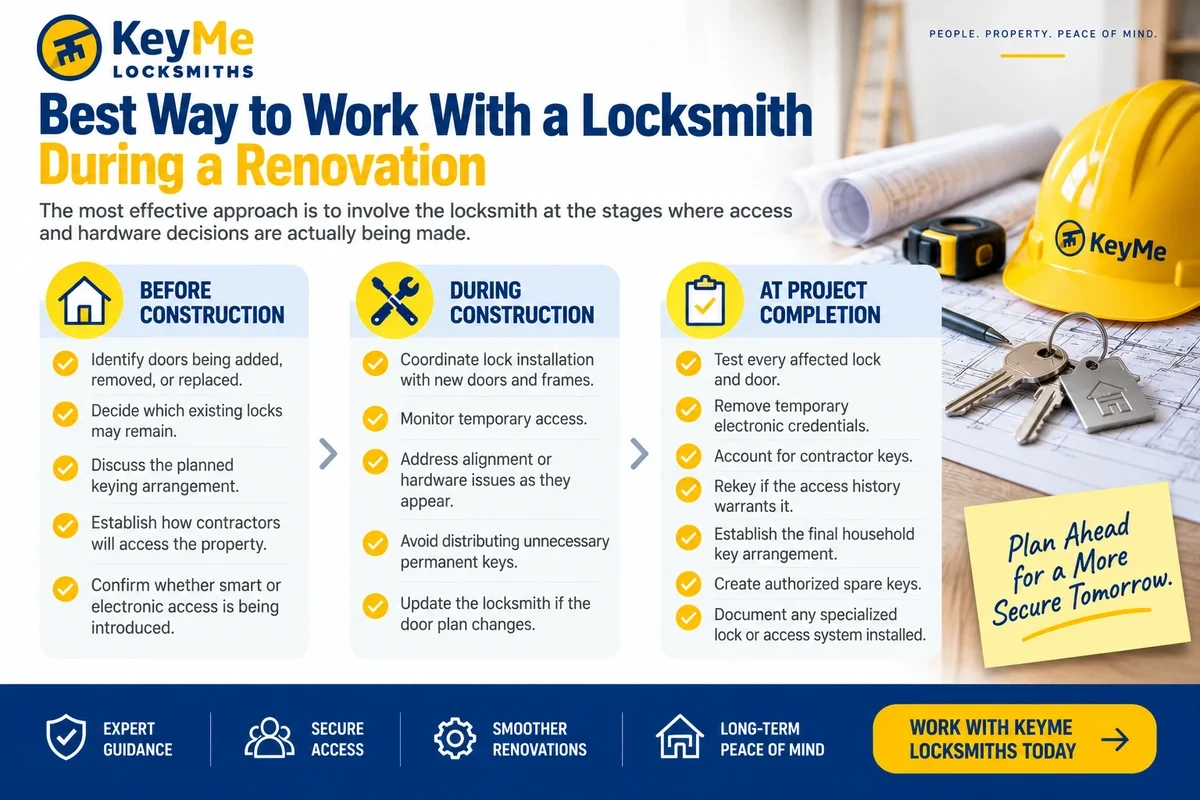
The most effective approach is to involve the locksmith at the stages where access and hardware decisions are actually being made.
Before Construction
- Identify doors being added, removed, or replaced.
- Decide which existing locks may remain.
- Discuss the planned keying arrangement.
- Establish how contractors will access the property.
- Confirm whether smart or electronic access is being introduced.
During Construction
- Coordinate lock installation with new doors and frames.
- Monitor temporary access.
- Address alignment or hardware issues as they appear.
- Avoid distributing unnecessary permanent keys.
- Update the locksmith if the door plan changes.
At Project Completion
- Test every affected lock and door.
- Remove temporary electronic credentials.
- Account for contractor keys.
- Rekey if the access history warrants it.
- Establish the final household key arrangement.
- Create authorized spare keys.
- Document any specialized lock or access system installed.
This turns locksmith service into part of the renovation process rather than a last-minute repair call.
When to Call a Locksmith During Renovation
Consider involving a locksmith when:
- An exterior door is being replaced.
- A new exterior opening is being created.
- Existing locks do not fit the new door.
- Several doors need to use the same key.
- Contractor access needs to be controlled.
- Smart locks are being introduced.
- Locks or cylinders are damaged.
- Door and strike alignment is causing lock problems.
- Keys have been lost during construction.
- The final property needs to be rekeyed.
- A rental or commercial renovation requires more complex access management.
Relevant KeyMe services include:
Finish the Renovation With an Access Handoff
A renovation changes more than the way a home looks.
It can also change how people enter it, which doors are used most often, which locks remain, and who has had access during weeks or months of construction.
NAHB recommends clear contracts, communication, documentation, and careful contractor management during remodeling. BHMA's standards demonstrate that locks are only one part of a broader door-hardware system, and ALOA's consumer guidance reinforces the importance of restoring key control when previous key holders may still have access.
For homeowners, the final step should therefore be an access handoff:
- Know which keys work.
- Know who has them.
- Remove temporary credentials.
- Test every affected door.
- Rekey when access needs to change.
- Then create the authorized spares the household actually needs.
If you need professional help with the process, KeyMe offers residential locksmith services, lock installation, lock repair, lock replacement, rekeying, and key duplication.
References
- National Association of Home Builders (NAHB). Checklist for Finding and Hiring a Builder or Remodeler. Consumer guidance on selecting a remodeler, written contracts, communication, insurance, references, and project planning.
https://www.nahb.org/Other/Consumer-Resources/Checklist-for-Finding-and-Hiring-a-Builder-or-Remodeler - National Association of Home Builders and National Association of the Remodeling Industry. Guidance for Working With Remodelers. 2025 consumer guidance covering contractor vetting, written scopes, permits, documentation, insurance, and project planning.
https://www.nahb.org/news-and-economics/press-releases/2025/11/nahb-and-nari-offer-guidance-for-working-with-remodelers - Builders Hardware Manufacturers Association (BHMA). ANSI/BHMA A156 Standards and Hardware Highlights. Current standards covering locks, cylinders, hinges, door closers, exit hardware, access-control products, and other builders hardware.
https://buildershardware.com/ANSI-BHMA-Standards/Hardware-Highlights - Builders Hardware Manufacturers Association. ANSI/BHMA A156.39-2025 Residential Locksets and Latches. Residential lockset performance requirements covering security, durability, and finish.
https://buildershardware.com/ANSI-BHMA-Standards/Hardware-Highlights/A15639-2025-Residential-Locksets-and-Latches - Builders Hardware Manufacturers Association. ANSI/BHMA A156.25-2023 Electrified Locking Systems. Performance requirements for electrified locking systems and related mechanical locking hardware.
https://buildershardware.com/ANSI-BHMA-Standards/Hardware-Highlights/A15625-2023-Electrified-Locking-Systems - Associated Locksmiths of America (ALOA). Should I Change My Locks? Consumer guidance addressing rekeying, existing hardware, construction keying, and controlling access when previous key holders may possess working keys.
https://www.aloa.org/consumers/changelocks