DIY lock replacement can be reasonable when you are swapping a standard residential lock for compatible hardware on a door that is already properly prepared and aligned. A locksmith becomes more useful when the problem is not fully understood, the door or strike is misaligned, the existing hardware is damaged or nonstandard, or the job involves smart locks, commercial hardware, master-key systems, or higher-security cylinders.
The difference is not simply:
DIY = simple
Locksmith = difficult
The better question is:
Do you already know the problem and have compatible hardware, or does the opening still need to be diagnosed?
That distinction matters because many apparent "lock problems" actually involve the door, frame, strike, hinges, or installation.
Summary
DIY lock replacement may make sense when:
- You are replacing a standard residential bored lock or deadbolt.
- The replacement hardware is directly compatible.
- Door thickness and backset match the new lock.
- The existing door and frame are in good condition.
- The deadbolt moves freely with the door open and closed.
- The strike is properly aligned.
- Manufacturer instructions are clear.
- No master-key, restricted-key, or commercial system is involved.
A locksmith may make more sense when:
- The existing lock binds or operates inconsistently.
- The door has to be pushed, pulled, or lifted to lock.
- The strike or door frame is misaligned.
- Existing holes do not match the new hardware.
- The lock is mortise, interconnected, commercial, or high security.
- The door or frame is damaged.
- The system is master keyed.
- Rekeying may solve the problem without replacement.
- A smart lock does not operate correctly after installation.
- You are unsure whether the lock itself is actually the cause.
Best Way to Decide Between DIY and a Locksmith
Before removing the old hardware, answer these questions:
- What type of lock is installed now?
- Is the new lock designed for the same door preparation?
- Does the current lock work smoothly with the door open?
- Does it still work smoothly with the door closed?
- Is the door aligned with the strike?
- Is the frame damaged?
- Are you changing only the hardware, or also the keying system?
- Does the new lock require electronics, calibration, or special setup?
- Is the opening part of a larger master-key or access-control system?
- Are there building, fire, lease, HOA, or property-management requirements?
If you can confidently answer those questions and the replacement is truly like-for-like, DIY may be practical.
If several answers are unclear, the job may be more than a simple lock swap.
First, Identify What Kind of Lock You Have
Not every lock installs the same way.
Common residential types include:
- Bored cylindrical locks
- Tubular deadbolts
- Handlesets
- Keypad locks
- Smart deadbolts
- Mortise locks
- Interconnected locks
A typical residential bored deadbolt is much easier to replace than a mortise lock built into the edge of the door.
The Builders Hardware Manufacturers Association maintains different ANSI/BHMA standards for different hardware categories, which reflects the fact that locks are not one interchangeable product type.
BHMA's Hardware Highlights directory includes separate standards for:
- Bored locks
- Mortise locks
- Interconnected locks
- Cylinders
- Exit devices
- Closers
- Hinges
- Other door hardware
The first DIY question should therefore be:
Am I replacing the same type of hardware with compatible hardware?
Need a Locksmith? We're here to help
Connect with a trusted local locksmith for fast, professional assistance when you need it most.
When DIY Lock Replacement Is Most Straightforward
DIY is generally most practical when you are doing a direct replacement on a standard residential opening.
For example:
- Existing residential deadbolt
- New residential deadbolt
- Same standard door preparation
- Compatible backset
- Compatible door thickness
- Properly aligned strike
- Undamaged door and frame
Schlage's current installation guidance describes residential deadbolt replacement as a project homeowners can perform when the door is properly drilled and aligned.
Its installation guide specifically recommends checking door preparation before installation and testing the deadbolt after installation to ensure it extends and retracts smoothly with both the door open and closed. (schlage.com)
That is a good framework for deciding whether a project is actually simple.
Door Preparation Matters More Than It Looks
A lock is designed to fit specific door dimensions.
Common variables include:
- Door thickness
- Backset
- Main bore diameter
- Edge bore
- Strike location
- Bolt depth
- Existing screw holes
Schlage's residential door-preparation guidance, for example, lists specific dimensional requirements for standard hardware and notes that some incompatible dimensions may require more substantial door work. (schlage.com)
If the new lock does not match the existing door preparation, the project changes.
It may require:
- Redrilling
- Enlarging holes
- Modifying the edge preparation
- Repositioning the strike
- Repairing old holes
- Replacing damaged material
At that point, the job is no longer simply:
Remove old lock → install new lock.
Door Alignment Is One of the Biggest DIY Decision Points
Before replacing a lock, test the existing hardware with the door open.
Then test it with the door closed.
If It Works Smoothly With the Door Open
The lock mechanism may be functioning correctly.
If It Binds With the Door Closed
The issue may involve:
- Strike alignment
- Door sag
- Hinges
- Weatherstripping
- Frame movement
- Seasonal expansion
- Improper door fit
Kwikset's current smart-lock troubleshooting guidance recommends exactly this comparison: operate the lock with the door open and then closed. If resistance appears only when the door is closed, Kwikset identifies alignment between the bolt and strike as a likely issue.
This is important because replacing the lock without fixing the alignment can simply transfer the same problem to the new hardware.
Signs the Door May Be the Real Problem
Watch for:
- You have to pull the door toward you to turn the deadbolt.
- You have to push hard on the door to lock it.
- You need to lift the handle or door.
- The latch hits the strike instead of entering it.
- The deadbolt works perfectly while the door is open.
- The problem changes with the weather.
- The door rubs the frame.
- Gaps around the door look uneven.
Schlage's installation guidance specifically recommends that a properly aligned door should lock without requiring you to push, pull, or lift it. (schlage.com)
A new lock does not correct a sagging door.
When a Locksmith Adds Value: Diagnosis
One of the biggest differences between DIY and professional service is diagnosis.
If you already know:
"This deadbolt is damaged and I am installing a compatible replacement."
DIY may be reasonable.
If the question is:
"Why is this door getting harder to lock?"
the first task is diagnosis, not replacement.
Potential causes can include:
- Worn key
- Worn cylinder
- Internal lock damage
- Loose hardware
- Strike misalignment
- Door sag
- Frame movement
- Improper installation
A locksmith can evaluate the opening before deciding whether the correct solution is:
- Adjustment
- Repair
- Rekeying
- Cylinder replacement
- Full lock replacement
That can help avoid replacing functioning hardware when the actual problem is elsewhere.
Rekeying May Solve the Problem Without Replacing the Lock
Homeowners sometimes choose replacement because their real goal is:
"I don't want the old key to work anymore."
That does not necessarily require new hardware.
Rekeying changes the internal keying of compatible locks so the old key no longer operates them.
It may make sense after:
- Moving into a home
- Losing a key
- Changing tenants
- Ending a relationship with someone who had a copy
- Uncertain key distribution
For the full distinction, see Rekeying vs. Replacing Your Locks.
If the hardware itself is still functioning properly, replacing the entire lock may solve a problem that could instead be handled through rekeying.
DIY Smart Lock Installation Requires an Extra Check
Many smart locks are specifically designed for homeowner installation.
But the smart features add another variable:
The motor now has to move the deadbolt consistently.
A human can sometimes compensate for poor alignment by pulling on the door while turning a key.
A motor cannot make that judgment.
Kwikset warns that deadbolt and strike misalignment can cause smart locks to jam or fail to lock properly. Its current troubleshooting documentation also notes that needing to push, pull, or lift the door can indicate excess load on the deadbolt.
Before installing a smart lock, make sure the existing deadbolt moves freely.
When DIY Smart Lock Installation Makes Sense
DIY can be reasonable when:
- Door preparation matches the new lock.
- Existing deadbolt moves freely.
- Strike is aligned.
- Door thickness is supported.
- Backset is compatible.
- Manufacturer instructions are followed.
- Required smart-home infrastructure is understood.
For broader product comparisons, see Best Smart Lock Brands.
Find a KeyMe Kiosk Near You
Need a spare key fast? Find a KeyMe kiosk near you to copy many house, office, and eligible car keys in just minutes.
When a Smart Lock Installation Needs More Help
Consider professional evaluation when:
- Motor repeatedly stalls.
- Deadbolt binds.
- Existing bore is incompatible.
- Strike must be relocated.
- Door is warped or sagging.
- Old hardware left damaged holes.
- New lock sits crooked.
- The lock works only when the door is open.
- You are changing from a nonstandard lock type.
The problem may be mechanical rather than electronic.
What About High-Security Locks?
High-security systems can involve more than installing a stronger deadbolt.
Depending on the product, they may include:
- Restricted keyways
- Patented key systems
- UL 437 cylinders
- ANSI/BHMA A156.30 high-security cylinders
- Authorized key distribution
- Master-key hierarchy
- Specialized cylinder formats
For these systems, professional planning can be more important because the key-management structure is part of the security.
See Best High-Security Lock Brands for the distinctions among high-security platforms.
What About Master-Keyed Locks?
If your property is part of a master-key system, replacing one cylinder independently can affect the overall key hierarchy.
That is especially relevant in:
- Multifamily properties
- Commercial buildings
- Hotels
- Offices
- Institutional properties
Do not assume a replacement cylinder can simply be keyed like the old one without understanding the system.
A commercial locksmith may need to preserve:
- Change-key operation
- Master-key access
- Grand-master hierarchy
- Restricted-key rules
What About Commercial Door Hardware?
Commercial hardware can be substantially different from residential hardware.
It may involve:
- Mortise locks
- Exit devices
- Interconnected locks
- Door closers
- Restricted cylinders
- Master-key systems
- Fire-rated openings
- Electronic access control
Commercial openings can also be subject to building, egress, accessibility, or fire requirements.
A DIY residential deadbolt guide should not be treated as a general installation guide for commercial hardware.
KeyMe provides commercial locksmith services for supported properties.
What BHMA Standards Tell You
The Builders Hardware Manufacturers Association develops ANSI standards covering many types of door hardware.
For example, ANSI/BHMA A156.2-2022 covers bored and preassembled locks and latches.
The standard evaluates areas including:
- Operation
- Durability
- Strength
- Security
- Dimensional requirements
BHMA's testing reinforces an important point:
A lock is an engineered component designed to operate within a properly prepared opening.
The lock itself is not the entire door system.
Lock Grade Does Not Tell You Whether DIY Is Appropriate
A homeowner might assume:
Grade 1 = professional installation required
or:
Grade 3 = DIY installation
That is not how grading works.
Grade describes product performance within the applicable standard.
Installation complexity depends on:
- Door preparation
- Lock type
- Compatibility
- Existing hardware
- Alignment
- Building requirements
For a detailed explanation, see Grade 1 vs. Grade 2 vs. Grade 3 Locks.
What About Reusing the Existing Strike?
Do not assume that the old strike is automatically appropriate for the new lock.
The replacement manufacturer may specify:
- New strike
- Reinforcement plate
- Specific screws
- Minimum bolt depth
Schlage's installation materials note that some products require included reinforcement components to maintain their tested performance level.
Follow the instructions for the exact replacement hardware.
Do Not Overtighten Lock HardwareDo Not Overtighten Lock Hardware
More torque does not automatically mean a better installation.
Overtightening can:
- Bind internal components
- Distort trim
- Place stress on the mechanism
- Interfere with key or thumbturn operation
Kwikset's troubleshooting guidance specifically lists overtightened mounting hardware as one possible cause of improper smart-lock operation.
Use manufacturer instructions rather than tightening hardware as much as physically possible.
When DIY Should Stop
Stop and reconsider the project if you encounter:
- Significant door-frame damage
- Split wood
- Unknown lock type
- Mortise case
- Fire-rated commercial door
- Restricted-key system
- Master-key system
- Access-control wiring
- Severe misalignment
- Existing holes that do not fit the new lock
- Repeated failure after correct installation
Continuing to modify the opening without understanding the cause can create a larger repair problem.
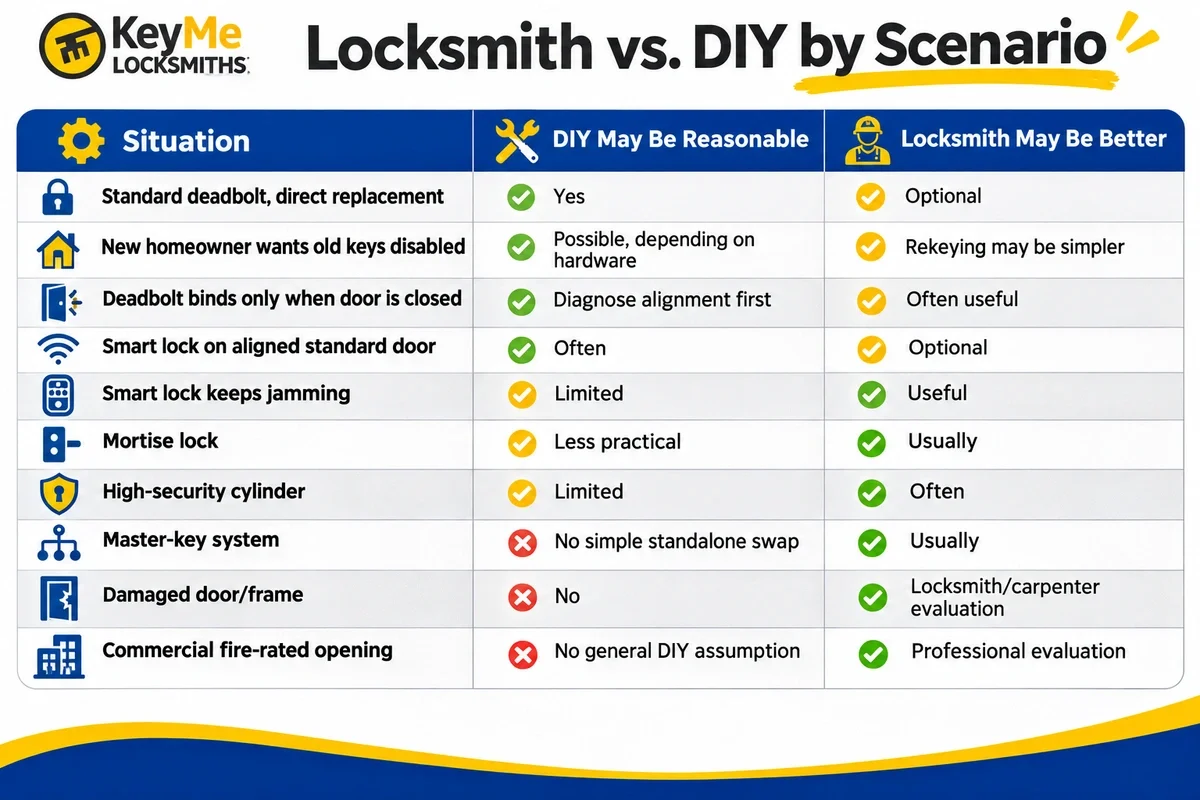
Locksmith vs. DIY by Scenario
When a Locksmith Is Especially Useful
Professional help is most valuable when:
You Do Not Know What Is Wrong
Diagnosis comes first.
The Door Is Misaligned
A new lock alone may not solve the issue.
The Hardware Is Nonstandard
Commercial and specialty products can require specific preparation.
You Need Rekeying
The hardware may not need replacement at all.
You Need Multiple Locks Coordinated
A locksmith can help establish consistent keying across supported locks.
A High-Security or Master-Key System Is Involved
System-level planning matters.
When DIY Is a Reasonable Choice
DIY can make sense when:
- You understand the existing hardware.
- Replacement is compatible.
- Door is properly prepared.
- Lock operates smoothly.
- Manufacturer documentation is clear.
- No broader key system is involved.
The important part is knowing when a "simple replacement" has stopped being simple.
Copy Your Key from Anywhere - Right from Your Phone
Skip the kiosk and copy your key from home. Upload a clear photo of an eligible house or car key, and KeyMe will create a precise duplicate and mail it directly to your door.

Locksmith vs. DIY Lock Replacement: The Bottom Line
DIY lock replacement makes the most sense when:
The problem is known.
The replacement is compatible.
The door is already properly prepared and aligned.
A locksmith becomes more valuable when:
The problem needs diagnosis.
The opening needs adjustment.
The hardware is specialized.
The replacement affects a larger key system.
The key decision is not simply whether you can remove a few screws.
It is whether replacing the lock alone is actually the correct solution.
For supported residential needs, KeyMe provides lock replacement, lock installation, and lock repair and installation.
References
- Builders Hardware Manufacturers Association. ANSI/BHMA A156.2-2022 Locks and Latches. Current standard covering bored and preassembled locks, including operational, durability, strength, security, and dimensional testing.
https://buildershardware.com/ANSI-BHMA-Standards/Hardware-Highlights/A1562-2022-Locks-and-Latches - Builders Hardware Manufacturers Association. Hardware Highlights. Current directory of ANSI/BHMA standards for locks, cylinders, interconnected locks, mortise hardware, closers, exit devices, hinges, and other door components.
https://buildershardware.com/ANSI-BHMA-Standards/Hardware-Highlights - Schlage. How to Install a Deadbolt Lock. Manufacturer guidance on door preparation, installation, testing, and strike alignment for residential deadbolts.
https://www.schlage.com/en/blog/product_updates/how-to-install-a-deadbolt-lock.html - Schlage. Door Prep Checklist. Manufacturer guidance on backset, door thickness, bore preparation, door condition, and alignment before residential hardware installation.
https://www.schlage.com/en/blog/product_updates/install-door-hardware-with-ease-with-this-door-prep-checklist.html - Kwikset. How Do I Check Door Alignment for My Smart Lock? Current guidance on testing locks with the door open and closed and identifying strike/deadbolt alignment problems.
https://www.kwikset.com/support/answers/how-do-i-check-door-alignment-for-my-smart-lock - Kwikset. SmartCode Deadbolt Troubleshooting. Manufacturer guidance addressing alignment, door handing, latch compatibility, strike position, bolt depth, and mounting issues.
https://www.kwikset.com/support/answers/on-my-smartcode-deadbolt-the-lock-beeps-the-keypad-flashes-red-and-the-door-cannot-lock - KeyMe Locksmiths. Rekeying vs. Replacing Your Locks. Guidance on deciding whether the keying or the hardware itself needs to change.
https://key.me/article/rekeying-vs-replacing-your-locks - KeyMe Locksmiths. Best Smart Lock Brands. Comparison of current smart-lock brands, access methods, connectivity, and hardware considerations.
https://key.me/article/best-smart-lock-brands - KeyMe Locksmiths. Best High-Security Lock Brands. Comparison of higher-security mechanical key systems and certifications.
https://key.me/article/best-high-security-lock-brands - KeyMe Locksmiths. Grade 1 vs. Grade 2 vs. Grade 3 Locks. Explanation of ANSI/BHMA lock grades and performance classifications.
https://key.me/article/grade-1-vs-grade-2-vs-grade-3-locks