

A home security red flag is not always a broken lock. Some of the most important warning signs involve access that is poorly understood or no longer controlled, such as unknown copies of house keys, old smart-lock credentials, missing keys that were never addressed, or exterior doors whose locking setup no longer matches how the household uses the property.
A lock can operate perfectly and still be part of an access system that deserves attention.
That is the key distinction between a lock problem and a home entry security concern.
This guide focuses on the second category: issues homeowners may overlook even when doors still open, close, and lock normally.
If you're troubleshooting a lock that sticks, binds, or will not operate correctly, see The Most Common Home Lock Problems.
Summary
- You do not know how many copies of your house keys exist.
- You never rekeyed or otherwise reviewed access after moving into the property.
- A lost exterior key was never addressed.
- Former roommates, contractors, household employees, or other previous users may still have active access.
- Old smart-lock PINs, app users, or administrator credentials remain active.
- Spare keys are kept in obvious exterior hiding places.
- Exterior doors use locks you cannot identify or keying you do not understand.
- A deadbolt cannot fully extend into the frame.
- Hardware shows signs of physical damage or prior force.
- Nobody in the household knows the backup plan if a smart lock or electronic credential is unavailable.
- Security planning should focus on understanding and controlling access rather than simply replacing every lock.
Need a Locksmith? We're here to help
Connect with a trusted local locksmith for fast, professional assistance when you need it most.
1. You Don't Know How Many House Keys Exist
Most households accumulate keys gradually.
Copies may have been provided to:
- Relatives
- Neighbors
- Roommates
- Contractors
- Cleaners
- Pet sitters
- Babysitters
- Property managers
- Previous household members
There is nothing unusual about providing an authorized key when someone needs access.
The red flag occurs when nobody knows which keys are still in circulation or who has them.
A functioning lock cannot distinguish between a key currently authorized by the homeowner and an old copy that still matches the same cylinder.
What to Consider
Create a simple inventory:
- Who currently needs a key?
- Which copies can be accounted for?
- Which doors does each key operate?
- Are there former authorized users whose access should end?
If the hardware still works properly but old mechanical keys should stop operating it, rekeying may be worth evaluating.
For the broader decision between rekeying and changing hardware, see Rekeying vs. Replacing Your Locks.
"A lock can be working exactly as designed while the homeowner still lacks control over who has a matching key. Mechanical condition and access control are two different questions." - KeyMe Locksmiths
2. You Never Reviewed Access After Moving In
Buying a house gives you ownership of the property.
It does not automatically give you a complete history of every key previously made.
Even when the seller returns every known key, previous copies may have been legitimately created over the years.
A new homeowner may also inherit:
- Smart locks
- Keypad codes
- Garage access
- Detached-building keys
- Mechanical backup keys
The important step is not automatically replacing every lock.
It is establishing a new access baseline.
Inventory the home's entrances, identify the hardware, review the available keys and credentials, and decide how access should work under the new household.
For a full post-closing process, see How Lock Rekeying Works for New Homeowners.
3. A Lost House Key Was Never Addressed
Losing a key is not a mechanical lock failure.
The lock may continue to operate perfectly.
The question is whether the missing key could still provide access.
Consider:
- Where the key was lost
- Whether it was attached to identifying information
- Which doors it opens
- Whether another person could associate it with the property
- Whether the key has since been recovered
The appropriate response depends on those circumstances.
If the missing key creates an access concern, rekeying compatible locks may be one option.
For a detailed response plan, see What to Do After Losing Your House Keys.
4. Someone Who No Longer Needs Access Still Has a Key
Access needs change.
A key may have been appropriately issued to someone who no longer requires it.
Examples include:
- Former roommate
- Former tenant
- Contractor after a renovation
- Former cleaner
- Previous caregiver
- Household employee
- Other temporary authorized user
The issue is not that the person should never have had the key.
The issue is whether the access is still appropriate today.
When access ends, decide whether:
- The key was returned.
- Other copies may exist.
- Compatible locks should be rekeyed.
- Electronic access should also be removed.
If contractors have keys during construction, Working With a Locksmith During Renovations provides a more detailed access-planning framework.
5. Old Smart-Lock Codes or Users Are Still Active
Smart locks create access credentials that are easy to overlook because they are not physical objects sitting on a keyring.
Depending on the product, access might exist through:
- PIN
- App account
- Mobile credential
- Smart-home platform
- Temporary user
- Administrator account
- Physical backup key
Review electronic access after:
- Moving
- Roommate changes
- Household staffing changes
- Renovation
- Guest stays
- Contractor work
Follow the manufacturer's process for the specific lock.
Deleting one PIN may not remove every other type of access associated with the device.
Don't Forget the Physical Backup
A smart lock with a conventional key cylinder may still have mechanical keys in circulation.
Changing digital users does not necessarily change which physical keys operate the cylinder.
For more on the tradeoffs between electronic and mechanical access, see Smart Lock vs. Traditional Lock.
6. Your Spare Key Is Hidden Somewhere Obvious
A spare key is only useful if the right person can access it when needed.
But storing it in an obvious location near the door can undermine the reason for controlling keys in the first place.
Examples of predictable locations include:
- Under a doormat
- On top of the door frame
- In an obvious nearby object
- Immediately beside the entrance
A better backup strategy depends on the household.
Possibilities can include leaving an authorized spare with a trusted person or using another controlled method appropriate for the home.
The important question is:
Who should be able to retrieve the spare?
Not simply:
Where can we hide it?
Find a KeyMe Kiosk Near You
Need a spare key fast? Find a KeyMe kiosk near you to copy many house, office, and eligible car keys in just minutes.
7. You Don't Know What Your Exterior Keys Actually Open
Some homeowners inherit or accumulate a large key ring without a clear understanding of the system.
You may have separate keys for:
- Front door
- Back door
- Garage-to-house entrance
- Detached garage
- Shed
- Side gate
Different keys are not automatically a security problem.
The red flag is not understanding the access arrangement at all.
That makes it harder to answer basic questions such as:
- Which key was lost?
- Which locks need attention?
- Which spare should a family member receive?
- Can compatible locks use the same key?
- Which doors use specialized hardware?
For terminology such as keyway, keyed alike, cylinder, and master key, see Locksmith Terms Explained.
8. Your Deadbolt Does Not Fully Extend
This is one of the places where mechanical operation and broader security condition intersect.
A deadbolt is intended to extend into the door frame.
If it cannot fully extend when the door is closed, investigate the opening.
Possible reasons include:
- Strike misalignment
- Door sag
- Frame movement
- Hardware issue
Do not simply assume a different lock will solve the problem.
For symptom-by-symptom diagnosis, see The Most Common Home Lock Problems.
When replacement hardware is being considered, BHMA's current ANSI/BHMA A156.40-2025 standard evaluates residential deadbolts for durability, security, and finish.
9. Exterior Lock Hardware Shows Physical Damage
Visible damage deserves attention even if the lock still operates.
Look for:
- Cracked hardware
- Bent components
- Damaged cylinder
- Loose trim
- Evidence of force
- Severely deteriorated hardware
The correct next step depends on the extent and location of the damage.
Some hardware may be repairable.
Other conditions may justify lock replacement.
If damage followed unauthorized entry or an attempted break-in, see How a Locksmith Helps After a Break-In.
10. You Have No Backup Plan for Electronic Access
A smart lock can be useful, but every household should understand what happens when the usual electronic access method is unavailable.
Ask:
- What if the batteries are depleted?
- What if a phone is unavailable?
- What if the app cannot be accessed?
- Does the lock have a mechanical backup key?
- Who has that key?
- Has the backup method ever been tested?
The answer varies by manufacturer and model.
Do not wait until someone is locked outside to learn how the specific product handles backup access.
11. Different Household Members Use Informal Workarounds
Workarounds can indicate that the current access system no longer fits the household.
Examples include:
- Everyone sharing one key
- Passing keys through hiding places
- Leaving doors unlocked for another person
- Sharing one smart-lock account instead of creating supported users
- Keeping an exterior key accessible because nobody has a spare
Those habits can develop gradually.
Rather than working around the access system, evaluate whether the household needs:
- Additional authorized keys
- Different keying
- Electronic access
- A more intentional backup plan
For supported keys, KeyMe offers key duplication.
12. Your Home Has Changed but the Access Plan Hasn't
The way a property is used can change significantly.
Examples include:
- New roommate
- Adult child begins coming and going independently
- Home office gains a separate entrance
- Basement becomes occupied
- Accessory dwelling unit is created
- Household hires regular help
- Renovation adds an exterior door
The old access arrangement may no longer fit the new use.
That does not mean every change requires different locks.
It means the homeowner should reconsider:
Who needs access to which entrance?
If a renovation has changed the physical openings or access pattern, see Working With a Locksmith During Renovations.
What Is Not Automatically a Home Security Red Flag?
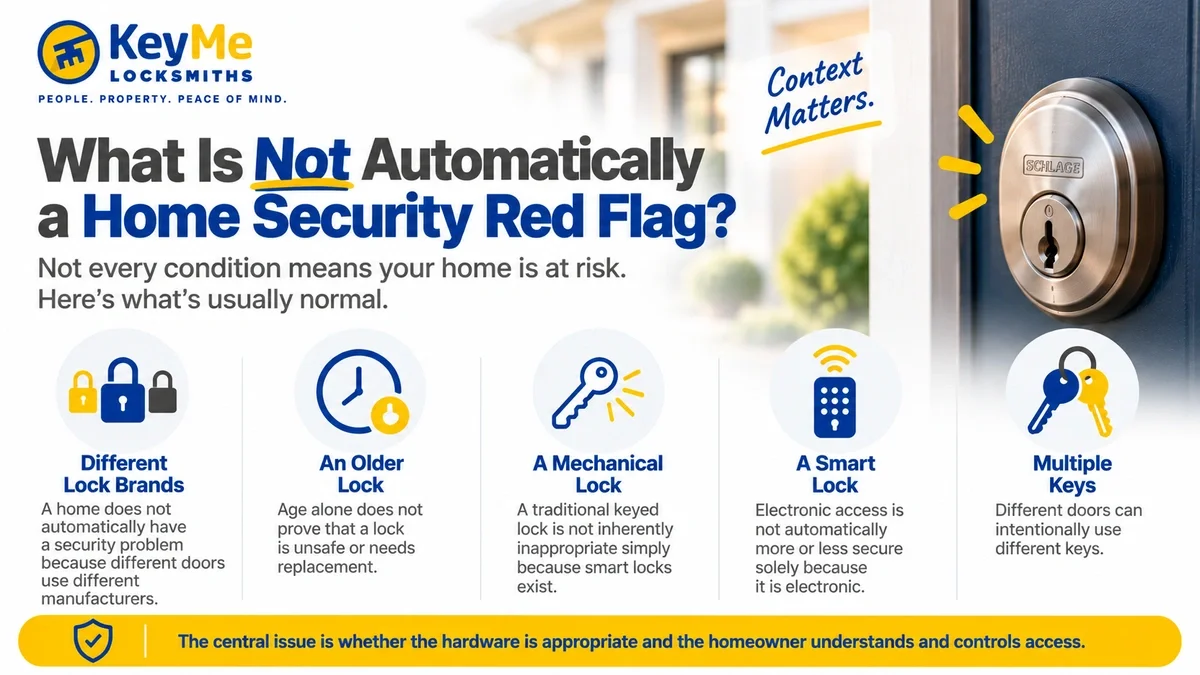
Different Lock Brands
A home does not automatically have a security problem because different doors use different manufacturers.
An Older Lock
Age alone does not prove that a lock is unsafe or needs replacement.
A Mechanical Lock
A traditional keyed lock is not inherently inappropriate simply because smart locks exist.
A Smart Lock
Electronic access is not automatically more or less secure solely because it is electronic.
Multiple Keys
Different doors can intentionally use different keys.
The central issue is whether the hardware is appropriate and the homeowner understands and controls access.
Should Every Exterior Door Use the Same Key?
Not necessarily.
Keyed-alike locks can simplify household access when compatible hardware is intentionally configured that way.
Separate keys can also be appropriate.
For example, a detached building may intentionally use a different key.
The decision should reflect:
- Hardware compatibility
- Who needs access
- Household preferences
- Desired separation between spaces
If you want compatible locks to use one key, a locksmith can determine whether rekeying can support that arrangement.
Copy Your Key from Anywhere - Right from Your Phone
Skip the kiosk and copy your key from home. Upload a clear photo of an eligible house or car key, and KeyMe will create a precise duplicate and mail it directly to your door.
Should You Replace Older Locks as a Security Upgrade?
Not simply because they are old.
Start by evaluating:
- Physical condition
- Reliability
- Certification where known
- Door compatibility
- Key-control needs
- Desired features
BHMA's current standards for residential locksets and deadbolts include durability, security, and finish requirements, providing one way to compare new hardware when replacement is appropriate.
Best Way to Review Home Entry Security
Instead of immediately buying new hardware, conduct an access review.
1. Inventory Exterior Entrances
Include:
- Front door
- Back door
- Garage entry
- Side entrances
- Basement
- Detached structures
- Keyed gates
2. Inventory Mechanical Keys
Determine who has them and which doors they open.
3. Review Lost or Unreturned Keys
Decide whether any active keys cannot be accounted for.
4. Review Electronic Users
Check current PINs, app users, administrators, and temporary credentials.
5. Inspect Physical Hardware
Look for visible damage and confirm deadbolts and latches operate as intended.
6. Review Spare-Key Storage
Make sure backup access is controlled intentionally.
7. Check Whether the Current Setup Matches the Household
Access arrangements should reflect who lives in the property today.
8. Address the Actual Red Flag
Depending on the issue, that might mean:
- Removing a digital credential
- Creating an authorized spare
- Rekeying
- Repairing hardware
- Replacing damaged hardware
- Changing household access procedures
"Home entry security is easier to manage when you know exactly who has access, how they get in, and what happens when that access should change. The lock is important, but so is the system around it." - KeyMe Locksmiths
Home Security Starts With Knowing Who Has Access
A useful home entry review goes beyond asking whether the front door locks.
Ask:
Who has a mechanical key?
Which old keys may still exist?
Which digital credentials are active?
Where are the spares?
Do all exterior doors lock as intended?
Does the current access system still fit the household?
Some red flags can be addressed by changing procedures.
Others may involve rekeying, lock repair, or lock replacement.
The important thing is to identify the actual concern instead of assuming every home security question requires new hardware.
If the issue is a specific mechanical symptom such as sticking, binding, loose hardware, or difficulty turning a key, see The Most Common Home Lock Problems.
KeyMe offers residential locksmith services, lock rekeying, lock repair and installation, lock replacement, lock installation, and key duplication.
References
- Associated Locksmiths of America (ALOA). Common Lock Issues. Consumer guidance covering door alignment, worn keys, lock wear, and other physical lock conditions relevant when an entry-security concern also involves malfunctioning hardware.
https://www.aloa.org/consumers/commonlockissues - Builders Hardware Manufacturers Association. ANSI/BHMA A156.39-2025 Residential Locksets and Latches. Current performance requirements for residential locksets and latches, including durability, security, and finish.
https://buildershardware.com/ANSI-BHMA-Standards/Hardware-Highlights/A15639-2025-Residential-Locksets-and-Latches - Builders Hardware Manufacturers Association. ANSI/BHMA A156.40-2025 Residential Deadbolts. Current residential deadbolt standard covering durability, security, finish, and product performance.
https://buildershardware.com/ANSI-BHMA-Standards/Hardware-Highlights/A15640-2025-Residential-Deadbolts