

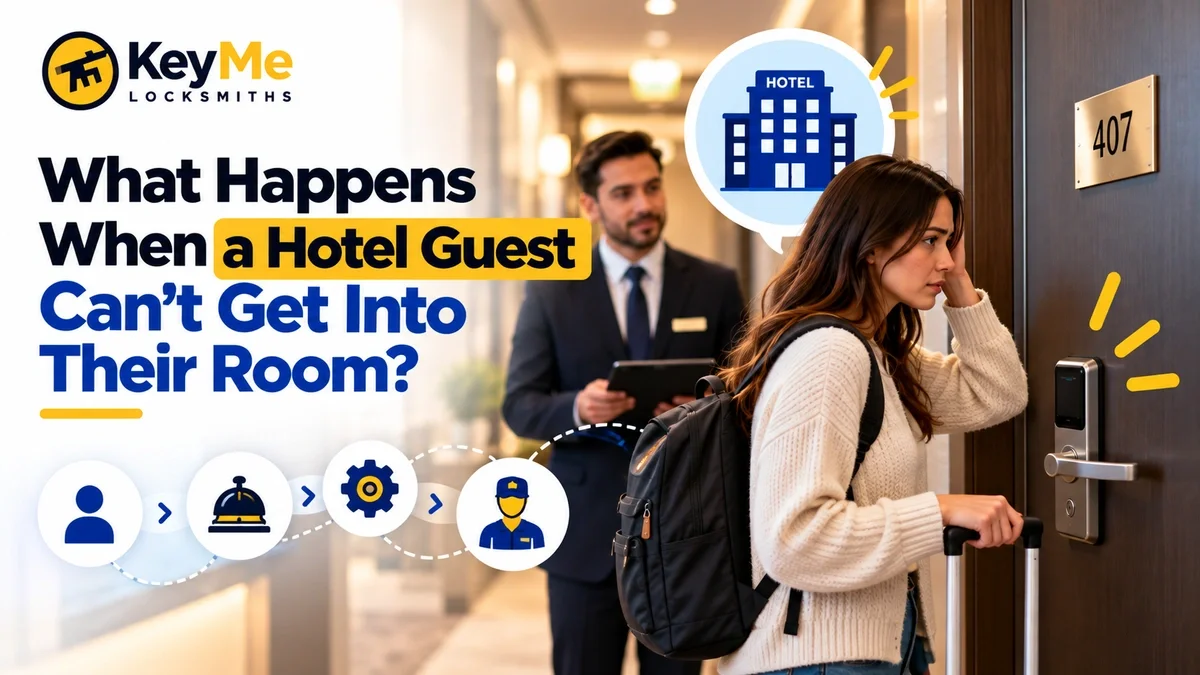
When a hotel guest cannot get into their room, the first step is usually to contact the front desk or hotel security, not call a locksmith directly.
Hotel staff control room-access authorization and may be able to verify the guest, check the credential, issue another key card, restore mobile access, or determine whether the problem is actually at the door.
A failed room key does not automatically mean the lock is broken. The problem may involve:
- An expired credential
- Deactivated key card
- Mobile-key setup
- Lock battery
- Electronic reader
- Door alignment
- Latch
- Lock hardware
- Another part of the hotel's access system
A locksmith becomes more relevant when the problem involves the physical lock, cylinder, latch, mechanical override, commercial door hardware, or another issue that hotel staff cannot resolve through normal access-control procedures.
Summary
- Guests who cannot enter their room should generally contact hotel staff first.
- Knowing the room number alone does not establish authorization to enter.
- A failed key card or mobile key does not automatically indicate a defective lock.
- Hotels can often issue, update, deactivate, or replace electronic credentials through their access-management systems.
- Multiple valid credentials failing at the same door can indicate a hardware, battery, alignment, or system problem.
- Hotel engineering or maintenance should inspect the complete opening when credential troubleshooting does not restore access.
- Recurring problems with the same room, floor, or hardware model should be tracked rather than treated as unrelated guest complaints.
- Back-of-house lockouts require different access procedures from guest-room lockouts.
- Professional commercial locksmith service may be appropriate when the physical lock or door hardware requires specialized diagnosis or service.
Best Way to Handle a Hotel Guest Lockout
A useful response follows this sequence:
- Identify exactly what is not working.
- Verify that the person requesting access is authorized.
- Check the room assignment and credential status.
- Issue or restore an authorized credential when appropriate.
- Test the door again.
- If valid credentials continue to fail, inspect the physical opening and electronic lock.
- Escalate specialized hardware problems to the appropriate access-system provider or commercial locksmith.
- Document recurring problems for maintenance follow-up.
This sequence separates two very different questions:
Should this person have access?
and
Why is the door not granting that authorized access?
Both matter.
What Is a Hotel Guest Lockout?
A hotel guest lockout occurs when an authorized guest cannot gain normal access to an assigned room or another hotel-controlled area.
Possible scenarios include:
- Key card no longer works
- Mobile key is unavailable
- Credential has expired
- Guest changed rooms
- Electronic lock does not respond
- Lock battery is low
- Door is mechanically binding
- Guest left the card or phone inside
- Access system no longer recognizes the credential
To the guest standing in the hallway, those situations may all look the same.
The door does not open.
Operationally, they require different responses.
"When a hotel guest says, 'My key doesn't work,' that is the symptom, not the diagnosis. The problem could be the credential, electronic lock, battery, latch, door alignment, or another component of the access system." - KeyMe Locksmiths
Need a Locksmith? We're here to help
Connect with a trusted local locksmith for fast, professional assistance when you need it most.
Hotel Lockouts Are Access-Control Problems First
Hotels manage access differently from most homes because room occupancy changes constantly.
The property must be able to determine:
- Who is currently authorized
- Which room that person can enter
- When access begins
- When access ends
- Whether a credential remains active
- Whether access should be revoked
Modern hotel systems may use:
- RFID cards
- NFC
- Bluetooth
- Mobile credentials
- Electronic locks
- Centralized access-management software
Vingcard hotel-lock technology, for example, supports technologies including RFID, NFC, and Bluetooth Low Energy.
That is why many hotel lockouts begin as credential and authorization problems, rather than traditional mechanical-key problems.
Why a Hotel Key Card Might Stop Working
A key card that worked earlier can stop working for several reasons.
Possible causes include:
- Credential expiration
- Room reassignment
- Credential deactivation
- Physical card damage
- Reader malfunction
- Electronic lock problem
- Battery issue
- Door alignment
- Latch or strike problem
The first question should usually be whether the credential remains valid.
If hotel staff can confirm that the credential is inactive or associated with the wrong room, the problem may be resolved without touching the lock hardware.
If the credential appears valid but the door still does not open, the investigation moves closer to the lock and opening.
Why Mobile Keys Can Fail Too
Mobile access removes the physical card, but it does not remove every possible point of failure.
A digital key can depend on:
- Compatible phone
- Hotel app
- Guest account
- Reservation
- Credential activation
- Bluetooth or NFC
- Electronic reader
- Lock
- Property access system
Hilton's Digital Key guidance explains that Digital Key is associated with a particular device and that guests may still request a physical room key.
Marriott's Mobile Key guidance also maintains physical key-card access alongside Mobile Key and applies registration requirements to shared digital access.
The important diagnostic point is:
A mobile-key failure can originate with the phone, account, credential, software, reader, lock, or door.
Do not assume the physical lock has failed simply because the phone will not open the room.
Verify the Guest Before Restoring Access
Hotels need to restore legitimate guest access without issuing credentials to unauthorized people.
Knowing:
- The guest's name
- A room number
- A companion's name
- Details about the room
does not automatically establish authorization.
Hotel procedures vary, but verification may involve:
- Reservation details
- Registered guest information
- Identification
- Digital account authentication
- Property-specific security procedures
Hilton notes that guests may still need to visit the front desk for identification when using Digital Key.
Marriott's Mobile Key sharing procedures similarly require the recipient to meet registration requirements.
Guest frustration should not cause staff to bypass established access-control procedures.
What the Front Desk Can Usually Check First
Depending on the hotel's system and staff permissions, the front desk may be able to:
- Verify the guest
- Confirm the assigned room
- Check credential status
- Issue another key card
- Replace a damaged credential
- Disable a missing credential
- Restore supported mobile access
- Correct a room assignment
- Escalate to engineering or security
This is why the front desk is normally the appropriate first point of contact.
One failed credential usually does not justify calling a locksmith.
A Replacement Card That Also Fails Is an Important Clue
Suppose the front desk issues a valid replacement card and the room still does not open.
Now the problem deserves a different investigation.
Possible areas include:
- Reader
- Battery
- Electronic lock
- Lock communication
- Latch
- Strike
- Handle
- Door alignment
- Mechanical components
A useful diagnostic pattern is:
One Credential Fails
Investigate the credential first.
Several Valid Credentials Fail at the Same Door
Investigate the opening or electronic hardware more closely.
That distinction helps avoid replacing or repairing hardware when the actual problem is simply an invalid card.
It also helps avoid repeatedly issuing new cards when the door itself is malfunctioning.
Inspect the Complete Hotel Room Opening
When credential troubleshooting does not resolve the problem, maintenance should look beyond the reader.
A room entrance can include:
- Electronic reader
- Batteries
- Lock body
- Lever
- Latch
- Strike
- Hinges
- Door
- Frame
- Mechanical override cylinder
- Access-control electronics
For example, a valid electronic credential may successfully tell the lock to unlock while a misaligned latch still prevents the door from opening correctly.
Likewise, a guest may describe a hardware problem as:
- "The card won't work."
- "The handle is stuck."
- "I have to pull the door."
- "The light turns green but it won't open."
- "It works after several tries."
Those details help distinguish credential problems from physical door problems.
Find a KeyMe Kiosk Near You
Need a spare key fast? Find a KeyMe kiosk near you to copy many house, office, and eligible car keys in just minutes.
When Hotel Engineering or Maintenance Should Get Involved
Hotel engineering or maintenance becomes more relevant when:
- Replacement credentials fail
- Lock batteries generate alerts
- Reader response is inconsistent
- Door does not close correctly
- Latch binds
- Lever is loose
- Door must be pushed or pulled to unlock
- Mechanical backup access does not operate normally
- Same room generates repeated complaints
Maintenance records should capture what was observed rather than simply marking the issue "key card fixed."
The actual cause matters if the same problem returns.
When Does a Hotel Need a Locksmith?
Professional locksmith support may be appropriate when the problem involves specialized lock or door hardware that cannot be addressed through normal hotel maintenance procedures.
Examples may include:
- Mechanically jammed lock
- Damaged cylinder
- Broken mechanical key
- Latch that will not retract
- Damaged commercial hardware
- Lock requiring replacement
- Broken key inside a cylinder
- Mechanical keying problem
- Back-of-house lock issue
- Repeated hardware failures with an unclear cause
KeyMe provides services including:
- Commercial locksmith services
- Lock repair and installation
- Lock replacement
- Lock installation
- Rekeying
- Broken key extraction
For qualifying urgent commercial access problems, emergency locksmith service may also be relevant.
Hotel Guest Lockouts Are Different From Home Lockouts
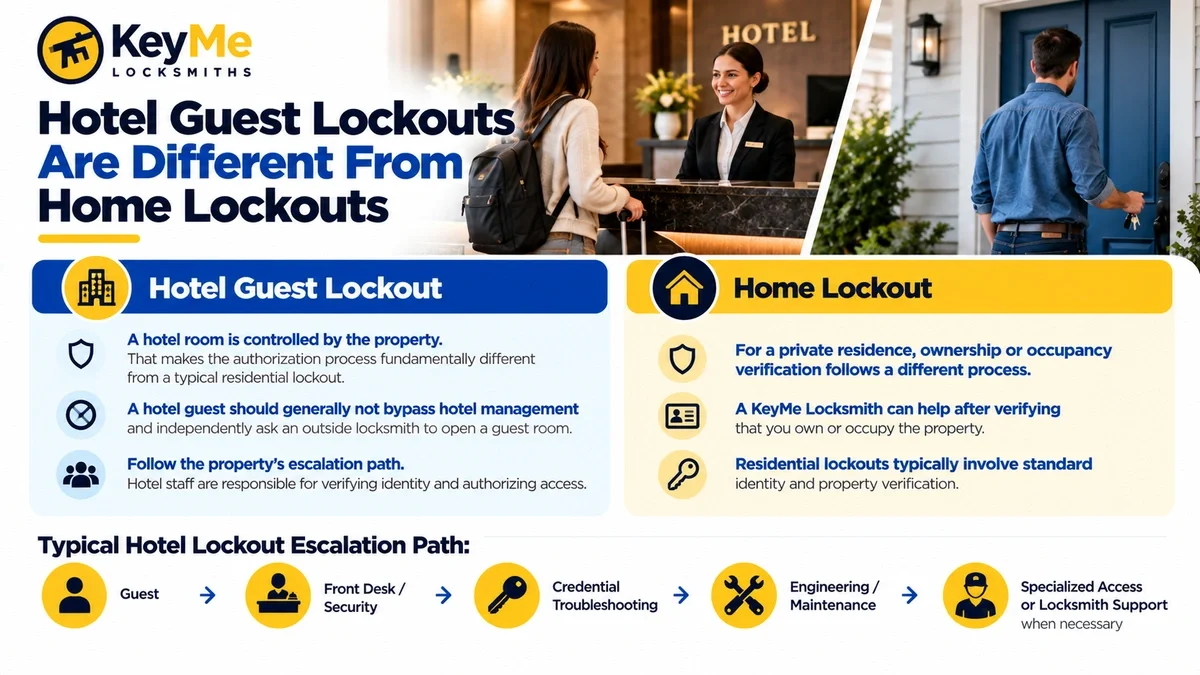
A hotel room is controlled by the property.
That makes the authorization process fundamentally different from a typical residential lockout.
A hotel guest should generally not bypass hotel management and independently ask an outside locksmith to open a guest room.
The normal escalation path should be:
Guest → front desk/security → credential troubleshooting → engineering/maintenance → specialized access or locksmith support when necessary
For a private residence, ownership or occupancy verification follows a different process.
What If the Guest Left the Key Card Inside?
This often does not indicate a lock problem at all.
If the guest is properly verified, the property may be able to issue another authorized credential according to hotel procedures.
The hotel is restoring access, not necessarily repairing the door.
Do not replace a functioning electronic lock simply because a guest left a credential inside.
What If the Guest Lost the Key Card?
A missing credential creates an access-control issue.
Depending on the hotel's system, staff may be able to:
- Cancel the missing card
- Issue another credential
- Review the guest assignment
- Update access according to property procedures
Modern electronic systems can make this different from losing a traditional mechanical room key.
The physical lock may not need to change at all.
The important task is controlling whether the missing credential continues to provide access.
What If the Guest Lost the Phone Containing the Mobile Key?
Treat the problem as both:
- Guest verification
- Digital credential management
The response may involve disabling the existing mobile credential and establishing another approved method of access.
Hilton notes that its Digital Key is associated with the device on which it was requested and provides a process for disabling the previous key when a guest changes devices.
Hotel brands and access platforms differ, so properties should follow their supported procedures.
What If the Door Unlocks Electronically but Will Not Open?
This is a particularly useful diagnostic scenario.
Suppose:
- The guest presents a valid credential.
- The reader indicates successful authorization.
- The door still cannot be opened normally.
That may shift attention away from the credential and toward:
- Latch
- Strike
- Lever
- Door alignment
- Door pressure
- Mechanical lock components
Repeatedly issuing cards will not solve a mechanical opening problem.
This is where coordination between front desk and maintenance becomes important.
What If Several Rooms Have the Same Problem?
Multiple similar complaints can signal a property-wide issue.
Track failures by:
- Floor
- Building or wing
- Lock model
- Installation date
- Battery history
- Door type
- Credential type
- Reported symptom
For example:
Several Rooms Report Battery Warnings
The property may need to review battery-maintenance procedures.
Several Doors of the Same Model Have Loose Levers
Comparable hardware may deserve inspection.
One Floor Has Frequent Card-Reader Complaints
The property may need to investigate equipment, configuration, or another shared factor.
One Room Generates Repeated Lockouts
The opening deserves a deeper review instead of another isolated credential reset.
This type of trend analysis is more useful than counting lockouts alone.
Use Guest Lockout Records as Maintenance Data
Hotels already document many operational incidents.
Guest lockout records can become useful maintenance information if they include enough detail.
Consider recording:
- Room
- Date and time
- Credential type
- Reported symptom
- Whether guest verification was completed
- Whether credential was active
- Whether replacement credential worked
- Reader behavior
- Battery condition
- Hardware finding
- Repair completed
- Locksmith involvement
- Repeat incident status
This allows the hotel to distinguish:
A guest who misplaced a card
from
a room with a recurring access problem.
Those should not create identical maintenance records.
Copy Your Key from Anywhere - Right from Your Phone
Skip the kiosk and copy your key from home. Upload a clear photo of an eligible house or car key, and KeyMe will create a precise duplicate and mail it directly to your door.
Build Guest-Room Locks Into Preventive Maintenance
Guest-room locks should be part of the property's broader maintenance program.
A useful inspection may include:
- Reader operation
- Battery condition
- Lever
- Latch
- Strike
- Door alignment
- Hinges
- Door closing
- Mechanical cylinder where present
- Mechanical backup access
- Electronic credential response
The objective is not to prevent every guest lockout.
Some lockouts result from:
- Lost cards
- Phones left inside
- Room changes
- Credential expiration
Preventive maintenance instead targets problems involving the door and lock system itself.
For a broader framework on planned hardware inspection, see Preventive Lock Maintenance Programs: A Guide for Property Managers.
"If the same room repeatedly generates access complaints, the useful question is no longer just 'How do we get this guest inside?' It becomes 'Why does this opening keep creating the same problem?'" - KeyMe Locksmiths
Back-of-House Lockouts Require a Different Process
Hotels also contain spaces that are not guest rooms.
Examples include:
- Engineering rooms
- Housekeeping closets
- Offices
- Storage rooms
- Kitchens
- Mechanical spaces
- Staff entrances
- Restricted operational areas
These spaces may use:
- Mechanical keys
- Commercial cylinders
- Master-key systems
- Electronic credentials
- Different access levels
A staff lockout should therefore follow the property's employee-access procedures.
For compatible mechanical systems, KeyMe commercial locksmith services may support repair, replacement, rekeying, or other commercial lock needs.
Master Keys and Higher-Level Credentials Need Stronger Controls
Hotels may maintain mechanical or electronic credentials that provide access to multiple rooms or areas.
Those credentials can create a larger security exposure if lost or misused.
Policies should address:
- Who may possess them
- What they open
- How issuance is recorded
- Where they are stored
- How returns are documented
- What happens when one is missing
- How access is revoked
- Who can authorize replacements
Mechanical master-key planning and electronic permission management are related, but they are not the same system.
For broader mechanical key-control planning, see Master Key Management for Multifamily Properties.
How Hotels Can Reduce Repeated Guest Access Problems
A good hotel lockout program combines front-desk procedures and maintenance.
Useful practices include:
- Train staff to separate credential problems from hardware problems.
- Verify guests according to property procedures.
- Track rooms with repeated complaints.
- Include electronic locks in preventive maintenance.
- Follow manufacturer guidance for battery service.
- Test doors after hardware repairs.
- Verify mechanical backup access.
- Document locksmith work.
- Review patterns by room and hardware model.
- Maintain clear escalation procedures.
The strongest process is not:
"Issue another key every time."
It is:
Determine why access failed, resolve the current incident, and document anything that could indicate a recurring problem.
How KeyMe Locksmiths Can Support Hotels
KeyMe may be able to support hotel properties when an access problem moves beyond routine guest credential administration and into commercial lock or door hardware.
Relevant services can include:
- Commercial locksmith services
- Lock repair and installation
- Lock replacement
- Lock rekeying
- Lock installation
- Broken key extraction
- Emergency locksmith services
The appropriate service depends on the hotel's hardware, access platform, authorization procedures, and underlying cause of the problem.
References
- Vingcard: Vingcard Essence Hotel Lock
- Hilton: How to Use Your Digital Key
- Marriott International: How Do I Share My Mobile Key?
- KeyMe Locksmiths: Commercial Locksmith Services
- KeyMe Locksmiths: Lock Repair and Installation
- KeyMe Locksmiths: Lock Replacement
- KeyMe Locksmiths: Preventive Lock Maintenance Programs: A Guide for Property Managers