

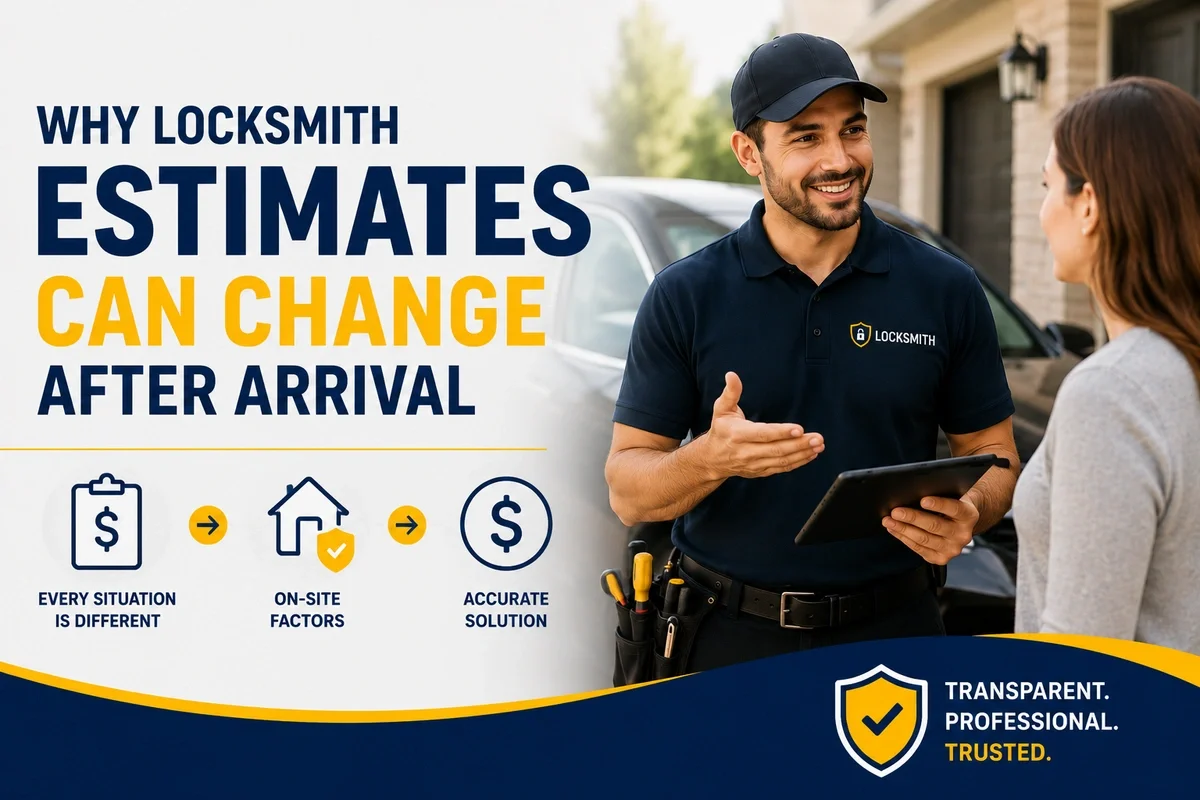
A locksmith service estimate can change after arrival because the initial service request is based on information available before the technician can physically inspect the lock, door, key, hardware, or vehicle. An on-site assessment may identify a different lock type, damaged hardware, a door or frame problem, electronic components, vehicle-specific key requirements, or additional service needs that were not apparent beforehand.
The important distinction is between the problem as initially described and the condition identified after inspection.
A request that begins as "I'm locked out" can involve more than one underlying cause. A request for a replacement vehicle key can also change once the exact key technology and vehicle requirements are identified.
Summary
- An initial estimate is based on the service information available before arrival.
- Physical inspection can reveal that the actual problem differs from the initial description.
- A lockout can involve damaged or malfunctioning hardware rather than only inaccessible keys.
- Door, frame, latch, and strike problems can affect what initially appears to be a lock problem.
- Smart and electronic locks introduce mechanical and electronic components that may need separate evaluation.
- A broken key inside a lock can change a straightforward access request into an extraction and hardware-assessment issue.
- Automotive key service depends on the vehicle and the key technology involved.
- On-site assessment can identify separate repair or replacement needs in addition to the originally requested service.
- A revised scope should distinguish the original service from additional work identified during inspection.
- Before work begins, understand what was found and what service is being recommended.
Why the On-Site Assessment Matters
A phone, online, or app-based service request can provide important information, but it cannot always establish the complete condition of an opening.
The customer may know the symptom:
"The key won't turn."
"I'm locked out."
"The deadbolt is stuck."
"I need a new car key."
But a symptom is not necessarily the complete diagnosis.
ALOA's consumer guidance illustrates this distinction for residential locks. Difficult operation can be associated with weather, door alignment, worn or poorly duplicated keys, hardware maintenance, or lock wear.
"The description that gets a locksmith to the door is not always the same as the diagnosis made at the door. An on-site assessment allows the technician to identify the hardware, evaluate its condition, and separate the original access problem from additional mechanical or electronic issues." - KeyMe Locksmiths
Need a Locksmith? We're here to help
Connect with a trusted local locksmith for fast, professional assistance when you need it most.
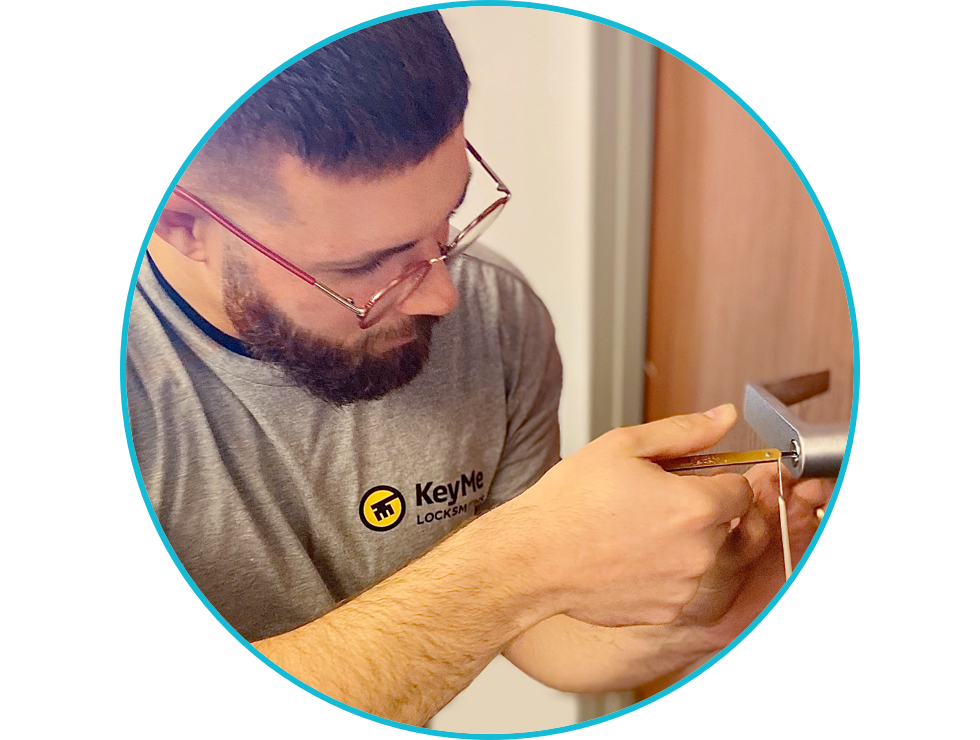
1. The Initial Description May Not Capture the Full Problem
Customers generally describe what they can observe.
For example:
Initial description:
"My front door won't unlock."
The technician may find:
- The key is damaged.
- The cylinder is malfunctioning.
- The deadbolt is binding.
- The door is misaligned.
- The strike is affecting operation.
- Multiple issues are present.
The initial description was not necessarily inaccurate. It simply described the symptom rather than the underlying condition.
This is why an on-site assessment can change the understood service scope.
2. A Lockout Can Turn Out to Be a Hardware Problem
Consider two customers who are both locked out.
Customer A
The lock operates normally, but the authorized key is unavailable.
Customer B
The key is present, but the lock will not operate because the hardware is malfunctioning.
Both customers may initially describe themselves as "locked out," but the underlying service needs are different.
If inspection identifies a mechanical problem, lock repair may need to be evaluated separately from restoring access.
For more on the professional assessment process during a lockout, see How Do Locksmiths Open Doors?.
3. The Hardware May Be Different From What Was Expected
The exact lock or door hardware may not be known when service is first requested.
A technician may encounter:
- Keyed knob or lever
- Deadbolt
- Smart lock
- Electronic lock
- Commercial lock
- Master-keyed cylinder
- High-security hardware
- Specialty door hardware
Different systems can require different service approaches.
For residential hardware, ANSI/BHMA maintains separate performance standards for residential locksets and latches and residential deadbolts. The current A156.39-2025 standard for residential locksets and latches covers performance areas including durability, security, and finish.
Identifying the actual hardware is therefore an important part of determining the appropriate service.
4. The Lock May Be Damaged Rather Than Simply Locked
Physical inspection can reveal damage that was not visible or identifiable before arrival.
Examples can include:
- Loose hardware
- Damaged cylinder
- Worn latch
- Damaged deadbolt
- Broken internal component
- Evidence of a previous unsuccessful repair
- Physical damage around the opening
If the hardware itself needs attention, the visit may involve evaluating lock repair or lock replacement rather than only addressing the originally reported access problem.
The distinction matters because restoring access and correcting damaged hardware are not automatically the same service.
5. The Door or Frame May Be Contributing
A customer may reasonably assume a difficult lock means the lock itself is failing.
That is not always the case.
ALOA identifies poor door alignment as a common contributor to lock problems. Hinges, frame movement, and weatherstripping can affect how the latch or bolt interacts with the strike.
That creates a useful diagnostic comparison:
Lock operates normally with door open, but not closed:
The opening or alignment deserves attention.
Lock operates poorly with door open and closed:
The lock, key, or hardware may require further evaluation.
If the on-site assessment identifies a door-related issue, the service required may differ from what was expected when the problem was initially described as a "bad lock."
6. A Broken Key Can Change the Service Scope
A broken key creates another service category.
A customer may initially report a lockout and only later identify that part of the key remains inside the cylinder.
That can require broken key extraction and an assessment of the lock's condition.
The technician may need to determine:
- Whether a fragment remains inside
- Whether the cylinder was damaged
- Whether the lock operated normally before the break
- Whether another working key exists
- Whether an underlying lock problem contributed to the situation
Broken-key extraction and lock repair are related, but they are not automatically the same service.
7. Smart Locks Can Involve More Than One System
A smart-lock problem can involve both physical and electronic components.
Depending on the lock, an assessment may need to distinguish among:
- Mechanical lock hardware
- Latch or deadbolt
- Door alignment
- Keypad
- Electronic credential
- App-based access
- Power or battery condition
- Mechanical backup cylinder
A customer might report that "the smart lock won't open," but that statement does not identify which component is responsible.
An on-site assessment can therefore change the understood service from a general electronic-access problem to a mechanical lock or door-hardware issue, or the reverse.
BHMA maintains separate standards covering numerous mechanical and electrified hardware categories, including electrified locking devices under ANSI/BHMA A156.25.
Find a KeyMe Kiosk Near You
Need a spare key fast? Find a KeyMe kiosk near you to copy many house, office, and eligible car keys in just minutes.
8. A Rekey Request Can Reveal a Repair or Replacement Need
A customer may request rekeying because access needs to change.
That assumes the existing compatible hardware is otherwise appropriate to remain in service.
Inspection may instead identify:
- Damaged hardware
- Excessive wear
- A malfunctioning component
- Incompatible hardware
- Another condition requiring separate attention
In that situation, the service discussion can expand beyond rekeying.
For a fuller comparison, see Rekeying vs. Replacing Locks.
9. Previous Repair Attempts Can Affect What Is Found
The condition encountered on arrival may also reflect work that happened before the locksmith was called.
For example, hardware may have been:
- Partially disassembled
- Physically altered
- Forced
- Reinstalled incorrectly
- Modified during an earlier repair attempt
That can change the condition being assessed.
When requesting service, tell the provider about relevant prior work or attempted repairs when known.
The technician can then evaluate the hardware as it currently exists rather than assuming it is in its original condition.
10. Vehicle Key Type Can Change the Service Required
"Car key" can refer to several different technologies.
Depending on the vehicle, a key can involve:
- Mechanical cutting
- Transponder functionality
- Remote functions
- Electronic authorization
- Proximity or smart-key functionality
NHTSA explains that some vehicle immobilizing systems incorporate computer chips in ignition keys, illustrating why a modern vehicle key may perform an electronic security function in addition to having a physical form.
That means a request for a replacement vehicle key cannot always be defined solely by the physical appearance of the key.
The vehicle itself matters.
For supported vehicles, the appropriate service may involve car key replacement, car key programming, or both.
11. Cutting and Programming Are Different Functions
This distinction is particularly important for modern automotive keys.
Cutting creates the appropriate mechanical key geometry where a physical blade is involved.
Programming or electronic authorization addresses the vehicle's electronic key system where applicable.
NHTSA describes immobilizer technology that can use coded electronic keys to authorize normal vehicle activation.
As a result, identifying the exact vehicle and key system can change the service understood before arrival.
A key that mechanically operates a door is not necessarily performing every electronic function required by the vehicle.
12. Additional Work May Be Discovered During the Original Service
Sometimes the originally requested service remains appropriate, but the assessment identifies a second problem.
For example:
Original service: lockout
Additional finding: damaged lock
Or:
Original service: broken-key extraction
Additional finding: worn cylinder
Or:
Original service: rekey
Additional finding: malfunctioning latch
Those findings should be understood separately.
The discovery of another problem does not make it part of the original service by definition.
13. Replacement Hardware or Components May Be Identified
Some hardware conditions cannot be fully understood until the opening is physically inspected.
The assessment may determine that:
- Existing hardware can remain
- A component needs repair
- A component needs replacement
- The complete lock should be evaluated for replacement
If lock replacement or lock installation becomes relevant, that represents a change from a service request that originally assumed the existing hardware would remain.
Real-World Examples of Scope Changes
Scenario 1: House Lockout Becomes a Lock-Repair Issue
Reported: Resident cannot unlock the door.
Assessment: The authorized key is available, but the lock itself is malfunctioning.
What changed: The problem is not simply unavailable access. The hardware needs evaluation.
Scenario 2: Rekey Request Reveals Damaged Hardware
Reported: Customer wants existing access changed.
Assessment: The lock has a separate mechanical problem.
What changed: Rekeying addresses key access, while damaged hardware requires a separate service decision.
Scenario 3: Lockout Includes a Broken Key
Reported: Customer is locked out.
Assessment: A key fragment remains inside the cylinder.
What changed: Broken key extraction becomes part of the service discussion.
Scenario 4: "Bad Lock" Turns Out to Involve Door Alignment
Reported: Deadbolt is difficult to operate.
Assessment: Lock works with the door open but binds when the door is closed.
What changed: The opening, not only the lock, needs evaluation.
Scenario 5: Vehicle Key Requires Electronic Service
Reported: Replacement car key needed.
Assessment: Vehicle uses an electronically authorized key system.
What changed: Mechanical duplication alone may not represent the complete service.
Scenario 6: Smart-Lock Problem Is Mechanical
Reported: Electronic lock is not working correctly.
Assessment: Electronic credential responds, but the physical bolt is binding against the opening.
What changed: The issue involves mechanical hardware or alignment rather than only electronic access.
Best Way to Understand a Changed Locksmith Service Scope
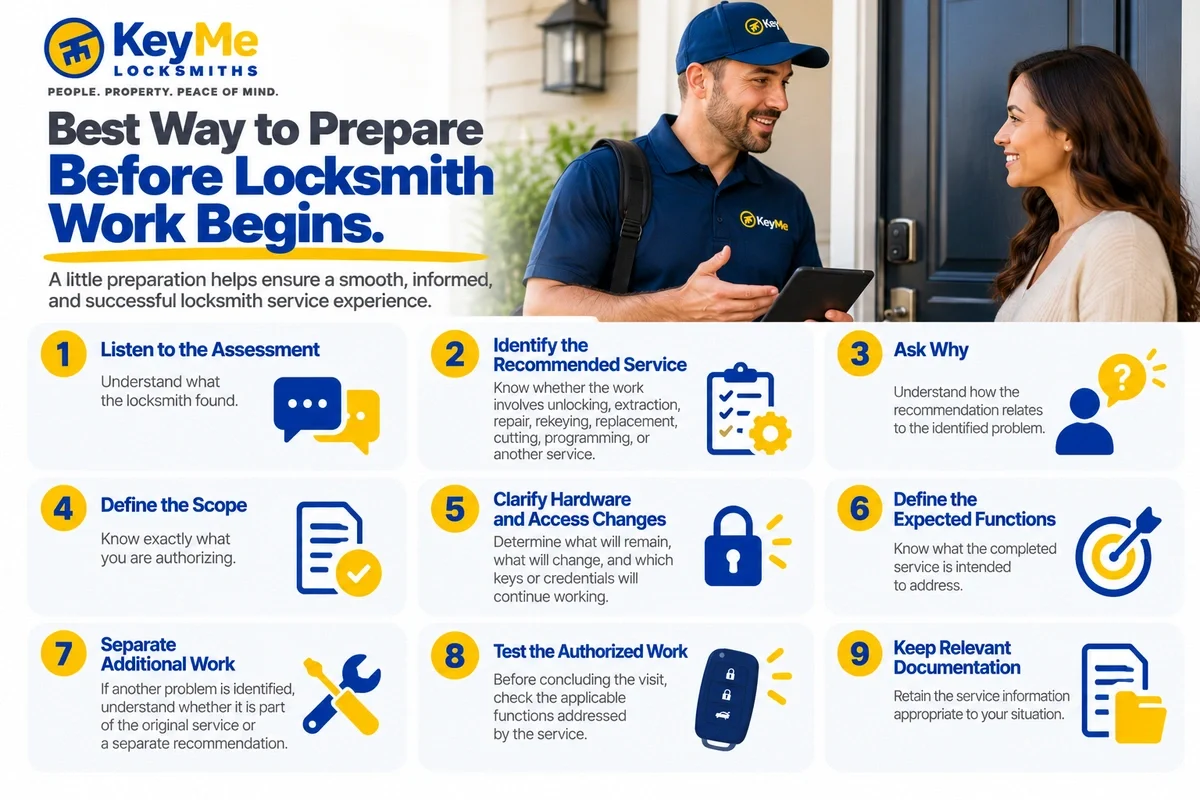
1. Start With the Original Request
Identify what service was initially understood.
2. Review the On-Site Finding
Understand what the physical assessment revealed.
3. Separate Symptoms From Diagnosis
"I'm locked out" is a symptom.
"Damaged cylinder" is a finding.
Those descriptions are not interchangeable.
4. Identify the Actual Hardware
Determine whether the service involves residential, commercial, electronic, automotive, or specialty hardware.
5. Separate the Original Service From Additional Findings
Ask whether a newly identified repair or replacement is part of the original service or a separate recommendation.
6. Understand the Revised Scope Before Work Begins
Once the actual condition has been identified, the next stage is authorization.
Use Questions to Ask Before Locksmith Work Begins to clarify the recommended service before approving it.
Copy Your Key from Anywhere - Right from Your Phone
Skip the kiosk and copy your key from home. Upload a clear photo of an eligible house or car key, and KeyMe will create a precise duplicate and mail it directly to your door.
Why Choose KeyMe Locksmiths?
KeyMe provides access to locksmith services for supported residential, commercial, emergency, and automotive needs.
Depending on the situation, relevant services can include:
- Emergency locksmith service
- Lock repair
- Rekeying
- Lock replacement
- Broken key extraction
- Car locksmith service
- Car key replacement
- Car key programming
An on-site assessment helps identify which service actually matches the condition found.
Assessment Comes Before the Final Scope
A service request starts with the information available at the time.
An on-site assessment adds information that may not have been available earlier:
What hardware is actually installed?
Is the lock functioning normally?
Is the door contributing?
Is there physical damage?
Is a broken key involved?
Does the vehicle use electronic key authorization?
Is there a second problem beyond the original request?
Those findings can change the service that is appropriate for the condition actually present.
Once the assessment is complete, the next step is understanding the recommendation before authorizing work.
References
- Associated Locksmiths of America (ALOA). Common Lock Issues. Consumer guidance on door alignment, weather, worn keys, lock wear, and other conditions that can affect lock operation.
https://www.aloa.org/consumers/commonlockissues - Builders Hardware Manufacturers Association (BHMA). ANSI/BHMA A156.39-2025 Residential Locksets and Latches. Current residential lockset and latch performance standard covering durability, security, finish, and other requirements.
https://buildershardware.com/ANSI-BHMA-Standards/Hardware-Highlights/A15639-2025-Residential-Locksets-and-Latches - Builders Hardware Manufacturers Association (BHMA). Hardware Highlights. Current standards library covering residential, commercial, and electrified builders hardware categories.
https://buildershardware.com/ANSI-BHMA-Standards/Hardware-Highlights - National Highway Traffic Safety Administration (NHTSA). Vehicle Theft Prevention. Current consumer information explaining vehicle anti-theft technologies, including immobilizing systems that can incorporate computer chips in ignition keys.
https://www.nhtsa.gov/vehicle-safety/vehicle-theft-prevention