
America's Most Replaced Car Keys: What KeyMe's Nationwide Data Reveals About Vehicle Ownership, Lost Keys, and the Future of Automotive Access
The Most Common Replacement Keys in America Belong to Some of the Least Surprising Cars But for Reasons Most Drivers Never Consider
When people think about replacement car keys, they often imagine luxury vehicles with expensive smart fobs and sophisticated security systems.
The data tells a different story.
An analysis of proprietary KeyMe Locksmiths vehicle key replacement activity shows that America's most commonly replaced keys overwhelmingly belong to mainstream vehicles: Toyota Camrys, Toyota Corollas, Honda Civics, Honda Accords, and Ford F-150s. In fact, several individual model-year combinations generated more than 2,000 replacement events on their own.
The surprising takeaway isn't which vehicles appear at the top.
It's why they appear there.
As one of the nation's largest locksmith and key replacement networks, KeyMe sees replacement demand across thousands of vehicle configurations and millions of drivers. This provides a unique view into how Americans actually use and lose their vehicle keys.
The patterns reveal a fascinating intersection of vehicle longevity, smart-key adoption, consumer behavior, and automotive technology.
The Most Replaced Car Keys in America
Top Vehicle Model-Year Combinations
Based on KeyMe replacement activity, the highest-volume replacement requests include:
Chart 1: Most Replaced Vehicle Keys
|
Rank |
Vehicle |
|
1 |
2007 Toyota Camry |
|
2 |
2010 Toyota Corolla |
|
3 |
2012 Honda Civic |
|
4 |
2011 Toyota Camry |
|
5 |
2009 Toyota Camry |
|
6 |
2008 Honda Civic |
|
7 |
2013 Honda Civic |
|
8 |
2010 Ford F-150 |
|
9 |
2007 Honda Civic |
|
10 |
2009 Toyota Corolla |
Source: KeyMe proprietary replacement-key activity data.
"The biggest surprise isn't which vehicles appear at the top of the list, it's how consistently the same models appear year after year," says a KeyMe Locksmiths automotive key specialist. "What we're really seeing is the intersection of vehicle longevity and human behavior. The cars Americans keep the longest are also the cars most likely to experience key loss over time."
That pattern becomes even clearer when examining which manufacturers dominate replacement activity nationwide.
Toyota Owns the Replacement-Key Landscape
One pattern stands out immediately.
Toyota appears repeatedly throughout the highest-volume replacement rankings.
- Camry
- Corolla
- RAV4
- Tacoma
- Sienna
This isn't evidence of a vehicle problem.
It's evidence of a vehicle success story.
Toyota vehicles remain on the road longer than most vehicles in America. When a vehicle survives for 15, 20, or even 25 years, the odds of key loss, key wear, ownership changes, and spare-key disappearance increase dramatically.
From a locksmith perspective, longevity creates replacement demand.
The longer a vehicle remains active, the more opportunities exist for key-related incidents.
The Sweet Spot: Vehicles Built Between 2005 and 2015
One of the strongest findings in the dataset is the dominance of vehicles produced roughly between 2005 and 2015.
This period represents a unique moment in automotive technology.
These vehicles are:
- Old enough to have experienced years of ownership turnover
- Old enough for spare keys to disappear
- New enough to contain transponder technology
- Common enough to remain heavily represented on American roads
In locksmith operations, this decade often represents the highest replacement-demand segment.
Not because the keys fail.
Because the owners eventually do what most drivers do:
They lose them.
Why Honda Civics Generate So Many Replacement Requests
The Honda Civic appears repeatedly among the most replaced keys in America, including 2007, 2008, 2012, and 2013 model years.
Several factors drive this demand:
Long Ownership Cycles
Civics frequently stay within families for years.
Many experience:
- Student ownership
- Multi-driver households
- Secondary commuter duty
- Hand-me-down ownership
Every ownership transition increases the likelihood that at least one original key disappears.
Small-Key Syndrome
Locksmiths often observe that compact vehicles frequently have keys attached to smaller keychains, increasing the likelihood of accidental loss compared with larger key rings.
The Ford F-150 Effect
America's best-selling truck also appears prominently in replacement demand.
The Ford F-150's position near the top of the rankings is especially notable because trucks experience different usage patterns than passenger cars.
F-150 owners commonly:
- Share vehicles among employees
- Use trucks for work and personal transportation
- Carry keys across job sites
- Maintain older trucks longer than many passenger vehicles
Operationally, work-truck environments create more opportunities for key loss than traditional commuting alone.
The Rise of the Transponder Era
Many of the highest-volume vehicles belong to the first generation of mass-market transponder adoption.
These vehicles introduced:
- Embedded security chips
- Electronic authentication
- Anti-theft immobilizers
For consumers, the transition seemed minor.
For locksmiths, it changed everything.
A replacement was no longer just a piece of metal.
"Modern vehicle keys are essentially miniature computers," says a KeyMe vehicle technology expert. "When drivers think about replacing a key, they often picture cutting a piece of metal. Today's replacement process frequently involves encrypted communication, vehicle-specific programming, and sophisticated anti-theft systems that didn't exist a generation ago."
The key now had to communicate electronically with the vehicle.
This technological shift dramatically increased the importance of professional replacement services.
America's Hidden Spare-Key Problem
The replacement data reveals a common pattern seen daily by locksmiths across the country.
Most drivers do not lose all their keys at once.
"One of the most common situations we see is a driver who lost a spare key years ago and never replaced it," says a KeyMe locksmith operations specialist. "The remaining key works fine until it's misplaced, damaged, or locked inside the vehicle. That's when a preventable inconvenience turns into an urgent replacement situation."
They lose the spare first.
Years later, they lose the only remaining working key.
By that point, what could have been a routine duplicate becomes a full replacement event.
This pattern appears repeatedly across high-volume models.
Vehicles that remain in service for ten years or more frequently arrive at replacement with only one surviving key or none at all.
Smart Keys Are Changing Replacement Behavior
The newest vehicles in the dataset reveal a second trend.
Replacement demand is steadily migrating toward smart-key platforms.
Modern keys may include:
- Push-button start functionality
- Proximity unlock systems
- Encrypted authentication
- Wireless communication modules
- Remote vehicle controls
While these systems improve convenience, they also introduce additional failure points.
A modern key is no longer just a key.
It's a mobile security device.
Why Drivers Lose Keys More Often Than They Think
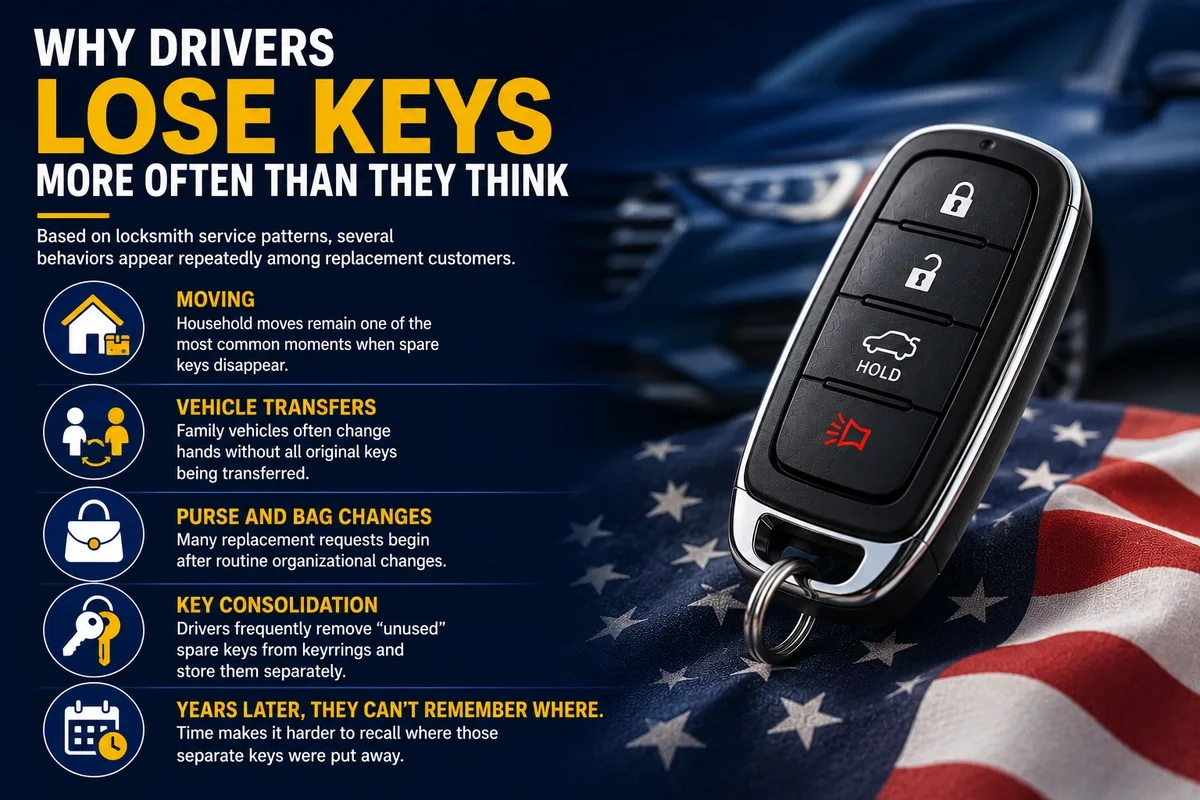
Based on locksmith service patterns, several behaviors appear repeatedly among replacement customers.
Moving
Household moves remain one of the most common moments when spare keys disappear.
Vehicle Transfers
Family vehicles often change hands without all original keys being transferred.
Purse and Bag Changes
Many replacement requests begin after routine organizational changes.
Key Consolidation
Drivers frequently remove "unused" spare keys from keyrings and store them separately.
Years later, they cannot remember where.
Original Observation: Reliability Creates Replacement Demand
One of the most interesting findings in the KeyMe data is somewhat counterintuitive.
The vehicles generating the most replacement requests are often among the most durable vehicles on the road.
- Toyota Camry
- Toyota Corolla
- Honda Civic
- Honda Accord
- Ford F-150
These vehicles don't appear because owners experience more problems.
They appear because owners keep them.
A vehicle that survives for two decades naturally accumulates more opportunities for lost keys than one traded in every three years.
From a locksmith perspective, reliability itself becomes a replacement-key driver.
What Drivers Can Learn From the Data
The easiest replacement event to avoid is the emergency replacement.
Three simple steps dramatically reduce risk:
Maintain Two Working Keys
Never rely on a single key.
Test Spare Keys Twice Per Year
Many drivers discover a dead backup only when they need it.
Replace Missing Spares Immediately
Waiting until the last key is gone creates the most complex replacement scenario.
Why KeyMe Has a Unique View of Vehicle Key Trends
KeyMe supports vehicle key replacement and duplication across a broad range of makes, models, and key technologies nationwide.
In addition to locksmith services, KeyMe operates car key duplication vans at select retail locations where trained specialists can cut and program compatible vehicle keys on-site.
KeyMe also supports technology-driven key duplication solutions designed to help consumers create backup keys before emergencies occur.
The scale of these operations provides visibility into replacement patterns that emerge across thousands of communities and millions of drivers.
Frequently Asked Questions
Why do replacement requests cluster around certain model years?
Vehicle age plays a major role in replacement demand. After roughly 10 to 15 years of ownership, vehicles have often changed hands, accumulated multiple drivers, and experienced years of everyday use. By that point, original spare keys are frequently missing, creating higher replacement demand than either brand-new or very old vehicles.
Do replacement trends reflect vehicle reliability?
Not necessarily. In fact, the opposite is often true.
Many of the vehicles generating the highest replacement demand—including the Toyota Camry, Toyota Corolla, Honda Civic, and Honda Accord—are known for long service lives. Vehicles that remain on the road longer naturally create more opportunities for keys to be lost, damaged, or separated from their original owners.
Are physical keys disappearing?
Not anytime soon.
While smartphone-based digital keys continue to expand, the vast majority of vehicles on American roads still rely on traditional keys, transponder systems, or smart fobs. Because vehicles remain in service for many years, locksmiths will continue supporting multiple generations of key technology simultaneously.
What happens when drivers lose their last working key?
The replacement process typically becomes more involved because there is no existing key available to duplicate or verify. Depending on the vehicle, replacement may require additional programming, security verification, or vehicle-specific procedures.
This is one reason automotive security professionals recommend maintaining at least two working keys whenever possible.
Which drivers are most likely to need a replacement key?
Based on common replacement patterns, higher-risk groups include:
- Multi-driver households
- College students
- Families with hand-me-down vehicles
- Fleet and work-truck operators
- Owners of vehicles more than 10 years old
These situations create more opportunities for keys to be shared, misplaced, or lost over time.
Will key replacement become more complex in the future?
Most signs point to yes.
Vehicle manufacturers continue adding advanced security features, encrypted authentication systems, and smartphone integration. While these technologies improve security and convenience, they also increase the technical sophistication required to create and program replacement credentials.
What is the most overlooked way to avoid a future lockout?
Replace a missing spare immediately.
Many drivers assume they will eventually get around to making a backup key, but replacement data consistently suggests that years often pass between losing a spare and losing the last remaining key. The lowest-stress replacement event is the one completed before it's urgently needed.
About KeyMe Locksmiths
KeyMe Locksmiths is a leading provider of local locksmith services and key copy kiosks across 50 states and the District of Columbia. Proud to serve over 5 million customers, KeyMe Locksmiths cuts over 10 million keys annually. With more than 8,000 self-service kiosks in major retailers, an e-commerce platform delivering over 10,000 keys weekly, and a nationwide locksmith network, KeyMe Locksmiths provides fast, reliable solutions for residential, commercial, and vehicle needs. KeyMe Locksmiths is committed to delivering exceptional service backed by a 100% money-back guarantee. KeyMe Locksmiths also operates one of the nation’s leading retail media networks, connecting consumers to other brands seeking to advertise in-store and delivering over 2B monthly impressions.