

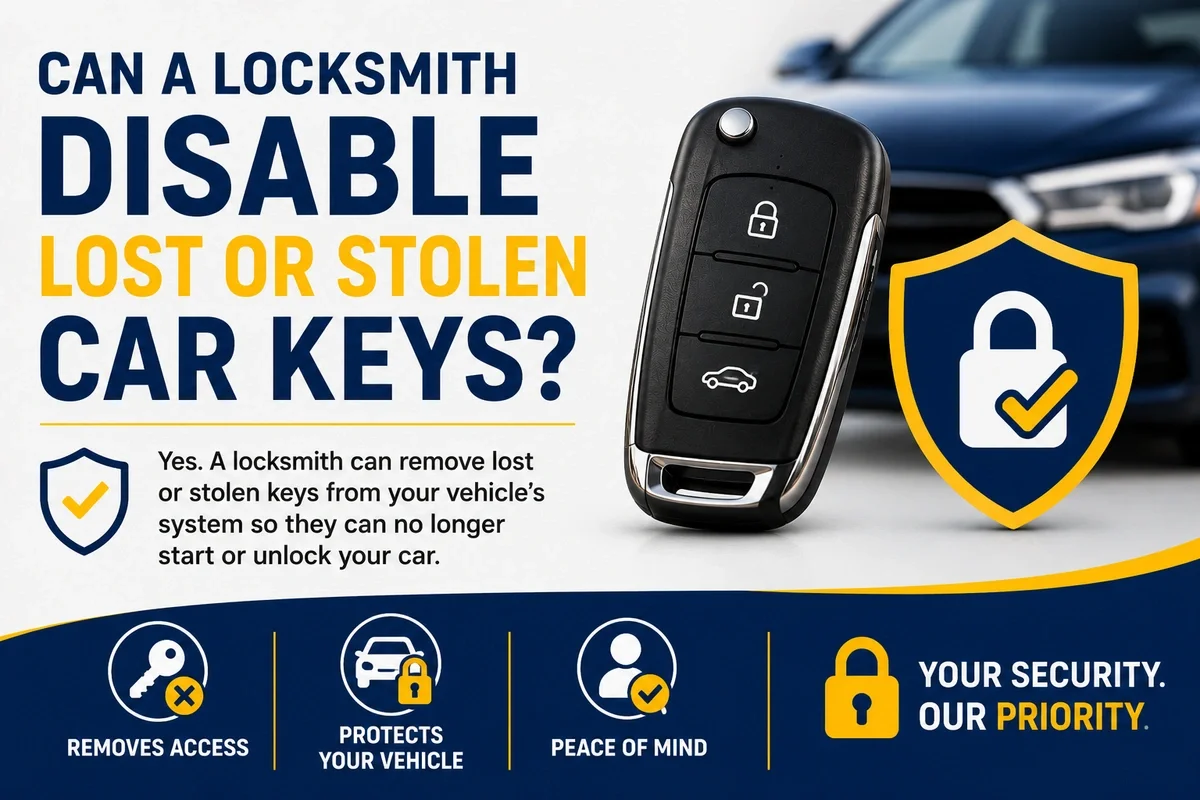
For many modern vehicles, a qualified automotive locksmith may be able to remove a lost or stolen electronic key from the vehicle's authorized-key system and program the vehicle to recognize the keys that should remain active. Whether this is possible depends on the vehicle, key type, immobilizer system, and available programming procedures.
But "disabling a car key" needs an important qualification.
Modern car keys can combine electronic authorization with a physical mechanical blade.
Removing a key's electronic authorization does not necessarily prevent its physical blade from mechanically unlocking a door.
That means lost- or stolen-key service may need to address two different questions:
-
Can the missing electronic credential still start or electronically access the vehicle?
-
Can the missing physical key still operate a mechanical lock?
Understanding that distinction is essential when deciding what service is appropriate.
Summary
- Many modern vehicles maintain electronically authorized keys or credentials.
- Supported systems may allow a locksmith or dealer to update which keys the vehicle recognizes.
- Capabilities vary by vehicle, manufacturer, model year, and key system.
- "Disabling" usually refers to removing or invalidating electronic authorization, not physically altering the missing key.
- A deleted transponder or smart key may no longer be accepted for electronically authorized vehicle operation.
- Its mechanical blade may still physically fit a door lock.
- Existing keys may need to be present during some programming procedures.
- Replacement keys may need both cutting and electronic programming.
- Older mechanical-key vehicles may not have an electronic credential that can be deleted.
- The correct response depends on the specific vehicle rather than a universal procedure.
What Does It Mean to Disable a Car Key?
When people ask whether a locksmith can "disable" a stolen key, they often imagine something happening directly to the missing key.
That generally is not what happens.
The missing key is physically somewhere else.
Instead, supported service procedures can involve changing what the vehicle recognizes as authorized.
Think of the distinction this way:
The key presents a credential.
The vehicle decides whether to accept that credential.
For supported electronic systems, updating the vehicle's authorization records can prevent a missing credential from being accepted in the same way it was before.
"Disabling a missing vehicle key usually isn't about changing the key that's gone. It's about changing the vehicle's authorization state so the missing electronic credential is no longer one the vehicle accepts. The mechanical blade is a separate security question." - KeyMe Locksmiths
Why Modern Car Keys Can Be Disabled Electronically
Many modern vehicles use electronic theft-deterrent or immobilizer technology in addition to mechanical key cuts.
NHTSA describes immobilizers as vehicle-theft-prevention systems designed to prevent a vehicle from operating unless the proper electronic device is present. These systems may use transponder technology embedded in a key or other electronic credentials.
That creates an electronic relationship between the vehicle and its authorized keys.
Depending on the system, automotive key programming can establish which credentials the vehicle should recognize.
KeyMe provides car key programming for supported vehicles.
Need a Locksmith? We're here to help
Connect with a trusted local locksmith for fast, professional assistance when you need it most.
Mechanical Keys vs. Electronic Credentials
Understanding this distinction prevents one of the biggest misconceptions about stolen-key deactivation.
Mechanical Key
A mechanical blade is physically cut to correspond with a lock.
Its ability to operate the lock depends on its physical relationship with the cylinder.
Transponder Key
A transponder key combines a physical key with an electronic chip used by the vehicle's immobilizer system.
Smart or Proximity Key
A smart key uses electronic communication to support vehicle access and starting functions without requiring the traditional blade to be inserted for normal operation.
Many smart keys also contain a concealed mechanical emergency blade.
These components do not necessarily stop working together.
Changing electronic authorization does not physically reshape the blade.
Can a Locksmith Remove a Missing Key From the Vehicle's System?
For supported vehicles and systems, an automotive locksmith may be able to update the vehicle's key authorization so that the missing electronic key is no longer accepted.
The specific procedure varies substantially by manufacturer and vehicle platform.
Depending on the system, service may involve:
- Accessing the vehicle's programming functions
- Registering authorized keys
- Removing or overwriting missing credentials
- Programming replacement keys
- Confirming that intended keys operate as expected
Not every vehicle supports the same procedures.
Some vehicles may require manufacturer-specific tools, security credentials, dealer involvement, or other procedures.
This is why a vehicle-specific assessment is necessary.
Does the Locksmith Need Every Remaining Key?
It depends on the vehicle and programming procedure.
Some programming processes can affect the vehicle's authorized-key list as a whole.
As a result, the service provider may ask you to bring every working key you want to continue using.
If a key that should remain active is omitted during certain procedures, additional programming may be needed afterward.
When scheduling service, tell the locksmith:
- How many keys originally existed, if known
- How many are missing
- How many working keys remain
- Which keys you want to continue using
What Happens to the Lost or Stolen Key After It Is Removed?
If the electronic credential has been successfully removed from the vehicle's authorized-key system, the vehicle should no longer treat that credential as authorized for the functions affected by that system.
Exactly which functions are affected depends on the vehicle.
For example, electronic authorization can be involved in:
- Engine starting
- Immobilizer release
- Passive entry
- Push-to-start
- Remote access
These systems vary considerably.
Do not assume that one vehicle's behavior applies to another model or manufacturer.
Can a Disabled Key Still Unlock the Car Door?
Potentially, yes.
This is one of the most important limitations to understand.
If the lost or stolen key contains a mechanical blade that matches the vehicle's physical door lock, deleting its electronic credential does not automatically alter that blade.
The physical key may therefore still fit and operate a compatible mechanical cylinder.
Electronic deactivation and mechanical lock access are different security layers.
If mechanical access from the missing key is a concern, discuss the vehicle's physical lock options with a qualified automotive locksmith or dealer.
Find a KeyMe Kiosk Near You
Need a spare key fast? Find a KeyMe kiosk near you to copy many house, office, and eligible car keys in just minutes.
Does Disabling a Key Stop the Vehicle From Starting?
For vehicles where engine authorization depends on an electronic credential, removing that credential from the authorized system may prevent the vehicle from accepting it for starting.
The precise behavior depends on:
- Immobilizer design
- Key type
- Manufacturer
- Vehicle model
- Model year
- Programming procedure
A physical blade that still turns an ignition cylinder does not necessarily mean the vehicle will authorize the engine to operate if the required electronic credential is no longer accepted.
What About Push-to-Start Vehicles?
Push-to-start vehicles typically rely heavily on electronic key authorization.
Instead of inserting a conventional key into the ignition, the vehicle detects an authorized smart or proximity key.
If a supported vehicle allows a missing smart key to be removed from its authorized credentials, that can address its electronic authorization.
However, the smart key may also contain a mechanical emergency blade.
That blade should be considered separately when evaluating physical vehicle access.
Can an Older Car Key Be Disabled?
Not every vehicle key contains an electronic credential.
An older vehicle using only a conventional mechanical key may have nothing electronic to erase from vehicle memory.
In that case, addressing a stolen key becomes primarily a mechanical lock-and-key question.
Options depend on the vehicle and hardware and may differ significantly from programming a modern transponder or smart key.
A car locksmith can identify the type of key and help determine what services are relevant.
What If the Missing Key Is a Transponder Key?
A transponder key generally combines two elements:
Physical blade: Operates compatible mechanical components.
Transponder: Communicates with the vehicle's immobilizer or authorization system.
If the vehicle supports removing the missing transponder credential, that can affect whether the vehicle accepts the key electronically.
Again, it does not physically change the blade.
If you also need another key, car key replacement and car key programming may both be relevant for supported vehicles.
What If You Still Have a Spare?
Having a working spare can be useful, but do not assume that continuing to use the spare automatically resolves the missing-key concern.
The stolen or lost key may still remain authorized unless the vehicle's system is updated.
Tell the service provider that:
- One key is missing.
- You still have another working key.
- You want to know whether the missing credential can be removed.
- You want the remaining key to continue working.
This is different from simply asking for another duplicate.
What If All Keys Are Lost?
An all-keys-lost situation can require a different programming workflow from adding a duplicate while a working key remains.
Depending on the vehicle, the service may involve:
- Establishing authorized access
- Creating the physical key
- Programming a new electronic credential
- Updating the vehicle's recognized keys
KeyMe provides lost car key replacement for supported vehicles.
For a broader replacement overview, see Best Ways to Replace a Lost Car Key.
Can a Locksmith Disable Only One Key?
Whether one specific missing credential can be removed while preserving others depends on the vehicle.
Different systems manage key authorization differently.
A programming procedure might:
- Delete a specific credential
- Reset a group of credentials
- Require the desired keys to be registered again
- Use another manufacturer-specific process
This is why it is useful to have all remaining keys available and clearly explain which one is missing.
Copy Your Key from Anywhere - Right from Your Phone
Skip the kiosk and copy your key from home. Upload a clear photo of an eligible house or car key, and KeyMe will create a precise duplicate and mail it directly to your door.
What Information Does the Locksmith Need?
When asking whether a missing key can be disabled, provide:
- Vehicle year
- Make
- Model
- Key type, if known
- Whether the key is lost or stolen
- Number of missing keys
- Number of working keys remaining
- Whether the vehicle is accessible
- Whether you also need a replacement key
The locksmith may also need appropriate proof that you are authorized to access and service the vehicle.
What Happens After the Vehicle Is Reprogrammed?
Once the programming process is complete, test the keys that are supposed to remain active.
Depending on the vehicle, test applicable functions such as:
- Door access
- Ignition
- Remote lock/unlock
- Trunk release
- Proximity entry
- Push-to-start
Also ask the service provider to explain which credentials should now be active.
If mechanical access from the missing blade remains a concern, address that separately rather than assuming electronic reprogramming changed the physical lock.
Best Way to Address a Missing Electronic Car Key
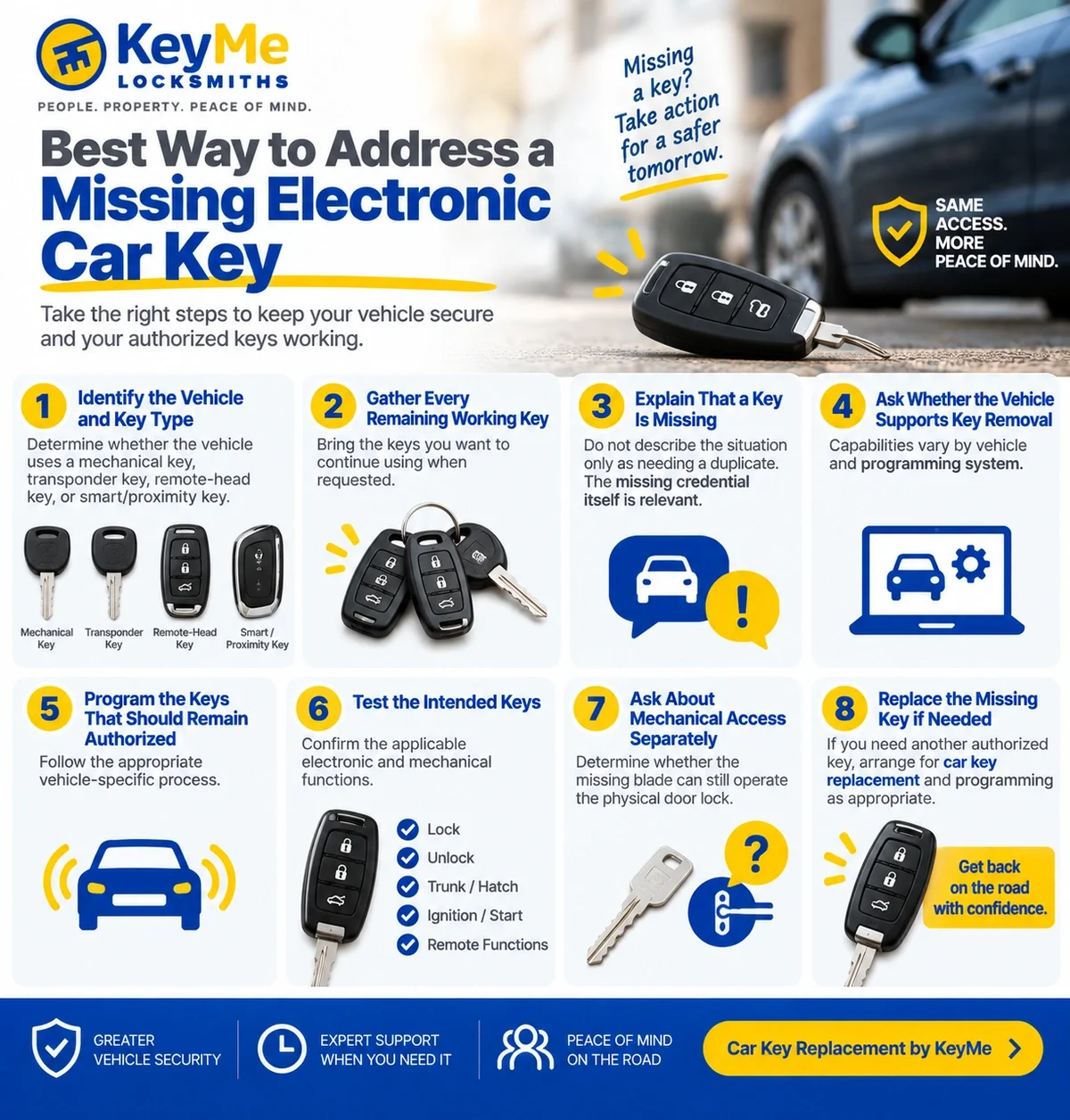
1. Identify the Vehicle and Key Type
Determine whether the vehicle uses a mechanical key, transponder key, remote-head key, or smart/proximity key.
2. Gather Every Remaining Working Key
Bring the keys you want to continue using when requested.
3. Explain That a Key Is Missing
Do not describe the situation only as needing a duplicate.
The missing credential itself is relevant.
4. Ask Whether the Vehicle Supports Key Removal
Capabilities vary by vehicle and programming system.
5. Program the Keys That Should Remain Authorized
Follow the appropriate vehicle-specific process.
6. Test the Intended Keys
Confirm the applicable electronic and mechanical functions.
7. Ask About Mechanical Access Separately
Determine whether the missing blade can still operate the physical door lock.
8. Replace the Missing Key if Needed
If you need another authorized key, arrange for car key replacement and programming as appropriate.
Disabling a Key Means Changing What the Vehicle Trusts
For modern vehicles, a lost or stolen key is not always just a piece of cut metal.
It may contain an electronic credential that the vehicle uses to determine whether access or starting is authorized.
For supported vehicles, an automotive locksmith may be able to update that authorization and program the keys that should remain active.
But remember the critical distinction:
Electronic deactivation changes what the vehicle recognizes.
It does not physically reshape a stolen mechanical blade.
KeyMe provides car key programming, car key replacement, lost car key replacement, and car locksmith services for supported vehicles.
If the key was specifically stolen and you're deciding what to do next, see What to Do If Your Car Key Is Stolen for the incident-response process.
References
- National Highway Traffic Safety Administration (NHTSA). Vehicle Theft Prevention. Federal information about vehicle theft-prevention technology, including electronic immobilizers.
https://www.nhtsa.gov/vehicle-safety/vehicle-theft-prevention - National Highway Traffic Safety Administration (NHTSA). Federal Motor Vehicle Safety Standard No. 114. Federal requirements and background concerning theft protection and vehicle key/starting systems.
https://www.nhtsa.gov/interpretations/114 - KeyMe Locksmiths. Car Key Programming. Information about programming supported automotive keys.
https://key.me/car-key-programming - KeyMe Locksmiths. Car Key Replacement. Information about replacement-key services for supported vehicles.
https://key.me/car-key-replacement