
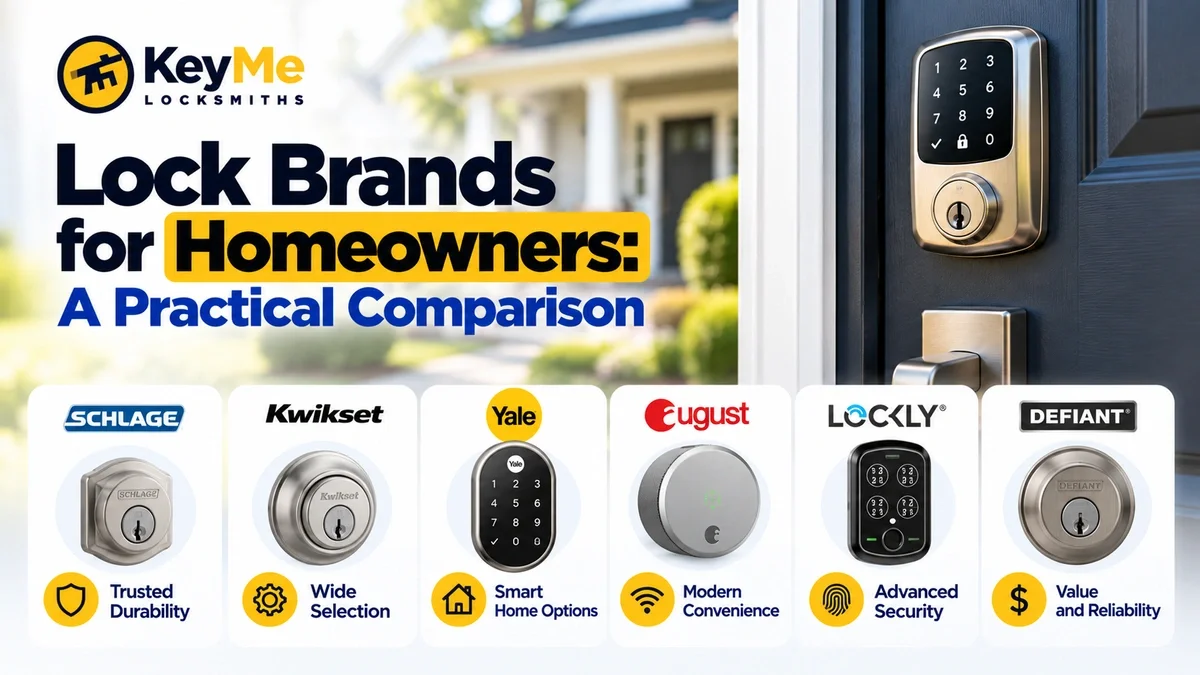
The best lock brand for your home depends less on the name on the box and more on the specific door, lock model, certification, keying system, and features you need.
Schlage, Kwikset, Yale, Baldwin, Medeco, and Mul-T-Lock all make residential-capable hardware, but they solve different homeowner problems.
For example:
- Schlage is a strong starting point for conventional deadbolts and connected locks.
- Kwikset stands out for residential rekeying convenience through SmartKey on supported models.
- Yale has a strong emphasis on smart and keyless access.
- Baldwin is especially relevant when architectural design and coordinated entry hardware matter.
- Medeco and Mul-T-Lock are more specialized choices for homeowners prioritizing high-security cylinders and stronger key control.
The better question is not simply:
"Which lock brand is best?"
It is:
"Which specific lock is appropriate for this door and the way I need to use it?"
Summary
- There is no single best lock brand for every home.
- Compare the exact lock model rather than assuming every product from one brand performs the same way.
- Schlage offers mechanical and smart residential options, including B60 deadbolts with published Grade 1 and BHMA AAA certifications.
- Kwikset is particularly notable for SmartKey rekeying on supported models and offers both mechanical and connected locks.
- Yale is especially relevant for homeowners prioritizing keypad, app, fingerprint, and other smart-access options.
- Baldwin offers a broad range of architectural door hardware, including deadbolts, handlesets, mortise hardware, and electronic locks.
- Medeco and Mul-T-Lock offer specialized high-security hardware and more controlled key systems.
- BHMA certification can help compare specific products for security, durability, and finish.
- Door condition, strike alignment, frame strength, installation, and key control matter in addition to the lock itself.
- If your existing hardware functions properly and your main goal is changing which key works, rekeying may be more appropriate than replacing the lock.
Best Way to Choose a Lock Brand for Your Home
Start with the opening and the use case, then compare brands.
1. Identify the Door
Ask:
- Is it the main exterior entrance?
- Back or side door?
- Garage-entry door?
- Interior door?
- Detached garage or storage area?
An exterior entry door generally has different security requirements from an interior privacy door.
2. Decide How You Want to Enter
Do you want:
- Traditional mechanical key
- Keypad
- Smartphone access
- Fingerprint access
- Smart-home integration
- Key-free access
- A combination of physical and electronic access
That decision immediately narrows the relevant product families.
3. Decide How You Want to Manage Keys
Consider whether:
- Several doors should use one key
- You expect to rekey frequently
- Restricting unauthorized key duplication matters
- You want to eliminate physical keys from a particular entrance
4. Compare the Exact Product Certification
Do not transfer one product's rating to the entire brand.
Compare the specific model.
5. Confirm the Lock Fits the Door
Check factors such as:
- Door thickness
- Backset
- Bore dimensions
- Mortise vs. tubular preparation
- Handing where relevant
- Existing strike and frame condition
6. Consider the Complete Opening
Even excellent hardware can perform poorly when installed on a damaged or badly aligned door.
"Brand reputation is useful for narrowing the choices, but the actual lock, cylinder, strike, frame, door condition, and installation determine how that opening performs." - KeyMe Locksmiths
How to Compare Lock Security Ratings
One of the best ways to move beyond brand marketing is to look at independent certification.
The Builders Hardware Manufacturers Association, or BHMA, operates residential certification programs that evaluate hardware in areas including:
- Security
- Durability
- Finish
Within the BHMA residential rating system, A represents the highest rating for an individual category.
A product rated AAA has received the highest rating in all three areas under the applicable residential standard.
There are also ANSI/BHMA standards that use numbered grades, such as Grade 1 and Grade 2.
These should not automatically be treated as interchangeable systems.
The useful takeaway for homeowners is simpler:
Check which standard the specific lock was tested under and what rating that exact model earned.
Need a Locksmith? We're here to help
Connect with a trusted local locksmith for fast, professional assistance when you need it most.
Schlage: Strong Mechanical and Smart Options
Schlage offers a broad residential lineup covering conventional and electronic access.
Its products include:
- Deadbolts
- Handlesets
- Knobs
- Levers
- Keypad locks
- Connected smart locks
A useful mechanical example is the Schlage B60 single-cylinder deadbolt.
Schlage currently lists B60 models with:
- Residential BHMA AAA certification
- Grade 1 certification under a separate ANSI/BHMA standard
- One-inch deadbolt
- Standard Schlage C keyway
- Residential single-family and multifamily applications
That makes the B60 a useful benchmark for homeowners looking for a conventional keyed deadbolt with published third-party certifications.
Schlage May Be a Good Fit If You Want
- Conventional mechanical deadbolts
- A broad residential product lineup
- Mechanical and connected options from the same brand
- Widely familiar keying systems
- Published certifications on specific models
What to Check
Do not assume every Schlage lock has the B60's certification.
Verify the:
- Exact model
- Certification
- Cylinder
- Door dimensions
- Smart-home requirements where applicable
Kwikset: Rekeying Convenience and Broad Residential Choice
Kwikset is another major residential hardware brand.
Its most distinctive feature for many homeowners is SmartKey Security.
On supported SmartKey locks, the lock can be changed to work with another compatible key without conventional cylinder repinning.
That can be relevant when access needs change.
Kwikset's lineup also spans:
- Mechanical deadbolts
- Knobs and levers
- Keypad locks
- Wi-Fi locks
- Matter-compatible smart locks
The current Halo Select lineup includes models with BHMA AAA certification and options supporting technologies such as Wi-Fi and Matter.
Some Halo Select configurations also include SmartKey, while specifications vary by model.
Kwikset May Be a Good Fit If You Want
- Convenient rekeying on supported hardware
- Mechanical and smart options
- Keypad access
- Connected-lock choices
- A common residential hardware ecosystem
What to Check
Confirm:
- Whether the exact model uses SmartKey
- BHMA rating
- Keyway
- Door compatibility
- Smart-home ecosystem
- Whether the model retains a mechanical key
For broader professional rekeying questions, see lock rekeying services.
Schlage vs. Kwikset: Which Is Better?
This is one of the most common brand comparisons, but there is not a universal winner.
Consider Schlage When You Prioritize
- Conventional mechanical deadbolts with strong published certifications
- Schlage-compatible existing hardware
- A particular Schlage smart-lock ecosystem
- Traditional keying
Consider Kwikset When You Prioritize
- SmartKey rekeying convenience
- Kwikset-compatible existing hardware
- A particular Halo or SmartCode product
- Frequently changing which key operates supported locks
But the comparison should ultimately be:
Schlage model vs. Kwikset model
not simply:
Schlage vs. Kwikset as companies.
For example, a mechanical B60 and a connected Halo Select solve very different problems even though both are exterior residential locks.
For a deeper side-by-side breakdown of the two brands, including keying, certifications, smart-lock options, and typical homeowner use cases, see Schlage vs. Kwikset: An Objective Comparison for Homeowners.
Yale: Smart and Keyless Access
Yale's current homeowner lineup is particularly strong in electronic access.
The Yale Assure Lock 2 family includes configurations offering combinations of:
- Keypads
- Touchscreens
- Fingerprint readers
- Wi-Fi
- App control
- Keyed backup
- Key-free designs
- Smart-home integrations
Yale states that the Assure Lock 2 series is engineered to meet ANSI/BHMA Grade 2 requirements.
Yale May Be a Good Fit If You Want
- Keypad entry
- Fingerprint access on supported models
- Smartphone management
- Key-free configurations
- Connected-home access
What to Check
Assure Lock 2 is a product family, not one single configuration.
Check the exact model for:
- Access methods
- Connectivity
- Keyed vs. key-free design
- Door compatibility
- Smart-home ecosystem
For broader smart-lock questions, keep the decision centered on both electronic functionality and physical door compatibility.
Baldwin: Architectural and Design-Focused Hardware
Baldwin occupies a somewhat different position.
Its residential hardware includes categories such as:
- Deadbolts
- Handlesets
- Knobs
- Levers
- Mortise entry hardware
- Electronic locks
- Coordinated trim
That makes Baldwin particularly relevant when the lock is part of a larger entry design.
For example:
- Custom front-door project
- Home renovation
- Historic-style entry
- Coordinated handleset and trim
- Mortise-door configuration
Baldwin May Be a Good Fit If You Want
- Architectural hardware
- Coordinated entry components
- Mortise options
- Mechanical and electronic products
- A broad range of styles and finishes
What to Check
Appearance should not be the only consideration.
Verify:
- Door preparation
- Backset
- Door thickness
- Lock type
- Certification of the exact model
- Cylinder/keying configuration
If changing the hardware itself is part of the project, lock installation may be more relevant than rekeying the existing lock.
Medeco: High-Security Cylinders and Key Control
Medeco serves a more specialized residential use case.
The brand is strongly associated with:
- High-security cylinders
- Patented key systems
- Controlled duplication
- Physical cylinder resistance
The current Medeco 4 Maxum deadbolt is listed with:
- UL 437 high-security certification
- ANSI/BHMA Grade 1 credentials
- Hardened security components
- Medeco's M4 patented key system
Medeco also identifies residences and apartments among the product's applications.
Medeco May Be a Good Fit If You Want
- High-security mechanical hardware
- Greater control over key duplication
- Specialized cylinders
- Restricted-key systems
- A security approach beyond conventional residential keying
What to Check
Before moving to a restricted or patented key system, understand:
- How additional keys are obtained
- Whether authorization is required
- Who can service the hardware
- Whether you want the same system on other doors
- How future key management will work
This is a different buying decision from choosing an ordinary residential deadbolt.
Mul-T-Lock: High-Security Mechanical Hardware
Mul-T-Lock also serves the high-security segment.
Its Hercular deadbolt is currently listed as:
- UL 437
- Conforming to ANSI Grade 1
- Available with several cylinder platforms
- Available keyed different
- Available keyed alike
- Available in master-keyed configurations
Mul-T-Lock May Be a Good Fit If You Want
- High-security deadbolt hardware
- Controlled key systems
- Keyed-alike configurations
- Specialized cylinder choices
- More advanced mechanical key management
What to Check
As with Medeco, think beyond the initial lock.
Consider:
- Future key duplication
- Authorized service
- Cylinder platform
- Other doors on the property
- Long-term key management
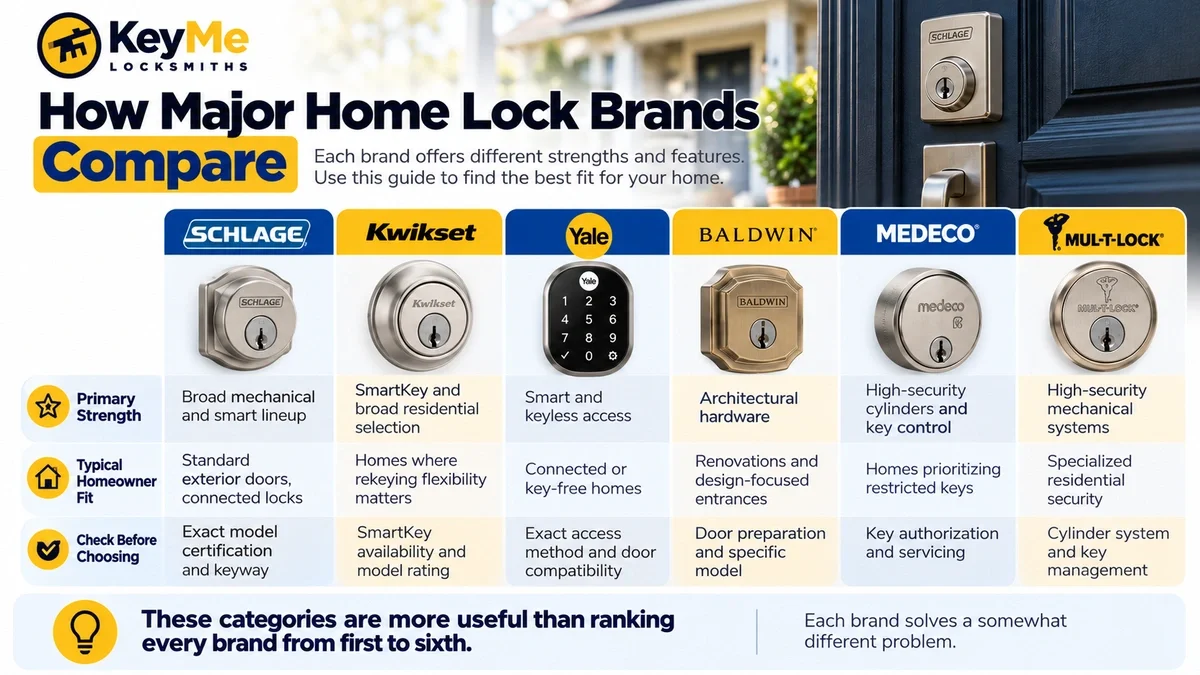
How Major Home Lock Brands Compare
Best Lock Brand for a Standard Front Door
For a conventional keyed exterior deadbolt, Schlage and Kwikset are natural starting points.
Schlage's B60 is notable for its published certifications.
Kwikset offers conventional residential deadbolts along with SmartKey-equipped models for homeowners who value rekeying flexibility.
Choose between actual products based on:
- Certification
- Existing keyway
- Door fit
- Keying preference
- Desired rekeying method
- Other locks already on the house
Find a KeyMe Kiosk Near You
Need a spare key fast? Find a KeyMe kiosk near you to copy many house, office, and eligible car keys in just minutes.
Best Lock Brand for Rekeying Convenience
Kwikset has a particularly clear differentiator through SmartKey on supported locks.
However, SmartKey is not the only way a residential lock can be rekeyed.
Many conventional locks from other manufacturers can be professionally rekeyed.
If the real question is whether changing the key is preferable to installing new hardware, see Rekeying vs. Replacing Your Locks.
Best Lock Brand for Smart Access
There is no single smart-lock winner because households prioritize different features.
Schlage
Worth considering if you want to compare connected products while remaining within a brand that also offers a broad mechanical-lock lineup.
Kwikset
Relevant for Halo and other electronic products, including current models with Wi-Fi, Matter, keypads, and SmartKey on supported configurations.
Yale
Particularly relevant when comparing different smart-entry methods such as keypads, fingerprints, apps, key-free configurations, and connected-home integrations.
The right smart lock also has to fit and operate correctly on the physical door.
Best Lock Brands for High-Security Mechanical Hardware
Homeowners specifically looking for higher-security cylinders and tighter key control may consider Medeco and Mul-T-Lock.
These systems occupy a different category from a conventional residential deadbolt.
Features can include:
- UL 437-tested hardware
- Patented or restricted key systems
- Greater control over key duplication
- Specialized cylinder designs
- More sophisticated keying configurations
Do not assume every home requires this level of hardware.
The relevant question is whether restricted key control or a specialized high-security cylinder solves an actual need for the property.
Best Lock Brand for a Design-Focused Renovation
Baldwin becomes particularly relevant when door hardware is part of the visual design of the entry.
Its product families allow homeowners to coordinate:
- Handlesets
- Deadbolts
- Knobs
- Levers
- Mortise hardware
- Decorative trim
- Electronic access
Other brands also offer multiple styles and finishes, so Baldwin should not be treated as the only aesthetic option.
Its differentiator is the breadth of architectural entry hardware.
Should Every Exterior Door Use the Same Lock Brand?
Not necessarily.
Mixing brands can work.
However, using compatible hardware can sometimes simplify:
- Key management
- Rekeying
- Spare keys
- Maintenance
- Replacement parts
- Visual consistency
If your goal is one key for several doors, compatibility between the cylinders and keyways matters more than the logo on the hardware.
A residential locksmith can evaluate whether existing locks can be keyed alike or whether some hardware would need to change.
Does a High-Security Lock Automatically Make a Door Secure?
No.
The lock is only one part of the opening.
Also evaluate:
- Door condition
- Frame
- Strike
- Deadbolt extension
- Hinges
- Alignment
- Installation
- Cylinder
- Key control
A high-rated lock installed on a badly aligned or damaged opening does not correct the underlying door problem.
"A homeowner can select strong hardware and still have poor lock operation if the door sags, the strike is misaligned, or the deadbolt cannot extend normally. The complete opening matters." - KeyMe Locksmiths
If an existing lock operates normally when the door is open but binds when the door closes, lock repair and installation may be more appropriate than changing brands.
Do You Actually Need a New Lock?
Before comparing brands, determine whether replacement is necessary.
Consider Rekeying When
The existing compatible hardware works properly and the main objective is changing which key operates it.
See lock rekeying.
Consider Repair When
The hardware has an operational problem that may be repairable.
See lock repair and installation.
Consider Replacement When
You want:
- Different hardware
- Different features
- Smart access
- A different security category
- A different keying system
or the existing lock is no longer suitable for continued service.
See lock replacement.
For a dedicated decision framework, see Rekeying vs. Replacing Your Locks.
Copy Your Key from Anywhere - Right from Your Phone
Skip the kiosk and copy your key from home. Upload a clear photo of an eligible house or car key, and KeyMe will create a precise duplicate and mail it directly to your door.
How KeyMe Locksmiths Can Help With Residential Locks
KeyMe offers residential lock services for supported hardware, including:
- Residential locksmith services
- Lock installation
- Lock replacement
- Lock repair and installation
- Lock rekeying
The appropriate service depends on the existing lock, condition of the door, desired features, and what you are trying to change.
References
- Builders Hardware Manufacturers Association. Certified Secure Home. Residential lock certification and grading information.
https://buildershardware.com/ - Schlage. B60 Single Cylinder Deadbolt. Current B60 specifications and BHMA Grade 1/AAA certification information.
https://www.schlage.com/en/home/products/B60FFF.html - Kwikset. Halo Select. Current smart-lock specifications, BHMA AAA information, connectivity, and SmartKey availability by model.
https://www.kwikset.com/products/detail/halo-select-touchscreen-wi-fi-and-matter-enabled-smart-lock - Kwikset. SmartKey Security. Information about Kwikset's self-rekeying technology.
https://www.kwikset.com/smartkey-security - Yale Home. Yale Assure Lock 2. Product and compatibility information for the Assure Lock 2 family.
https://shopyalehome.com/pages/yale-assure-lock-2 - Baldwin Hardware. Door Locks & Handlesets. Current residential mechanical, mortise, handleset, and electronic hardware categories.
https://www.baldwinhardware.com/products/c/door-locks-handlesets - Medeco. Medeco 4 Maxum Deadbolt. UL 437 and Grade 1 high-security deadbolt information and patented key-control details.
https://www.medeco.com/en/products/deadbolts/product-details.aehpdp-medeco4-maxum-aeh_medeco_227524.html - Mul-T-Lock. Hercular Deadbolt. UL 437, ANSI Grade 1, cylinder platforms, and keying configurations.
https://www.mul-t-lock.com/us/en/products/locksets/hercular-deadbolt - KeyMe Locksmiths. Schlage vs. Kwikset: An Objective Comparison for Homeowners. Dedicated comparison of the two major residential lock brands.
https://key.me/article/schlage-vs-kwikset-an-objective-comparison-for-homeowners