
The Most Common Household Keys Americans Duplicate
The Biggest Key Trend in America Isn't About Emergencies. It's About Everyday Access.
When most people think about key duplication, they imagine replacing a lost key or preparing for a lockout.
The data tells a different story.
KeyMe duplication data shows that household keys remain the dominant category of key-copying activity nationwide. Across multiple retail channels, traditional house keys generate significantly more duplication activity than vehicle keys, RFID credentials, and specialty keys. At Walmart alone, dispensed brass house keys generated more than 107,000 transactions, while painted house keys accounted for nearly 40,000 additional transactions. Similar patterns appear across other retail locations nationwide.
The findings reveal something larger than duplication volume.
Americans aren't simply replacing keys. They're creating access.
Every duplicated key represents a decision about who can enter a home, retrieve mail, access a storage unit, open a gate, or share responsibility within a household. Taken together, these patterns offer a unique window into how American households manage security, convenience, and trust.
Key Findings
Household Keys Dominate Duplication Activity
KeyMe transaction data shows overwhelming demand for traditional residential keys, particularly standard brass house keys and painted house keys.
Family Access Drives More Duplication Than Emergencies
Many duplication requests are proactive rather than reactive, reflecting household expansion, shared responsibilities, and backup planning.
Front Doors Remain the Primary Access Point
The majority of duplicated household keys are tied to primary residential entry points.
Mailboxes, Storage Units, and Padlocks Reflect Shared Access Needs
Secondary access points increasingly require multiple trusted users.
Americans Are Managing More Access Points Than Ever
Modern households frequently coordinate access across homes, garages, package rooms, storage units, gates, mailboxes, and other secured spaces.
Chart: Household Key Duplication Is Dominated by Traditional House Keys
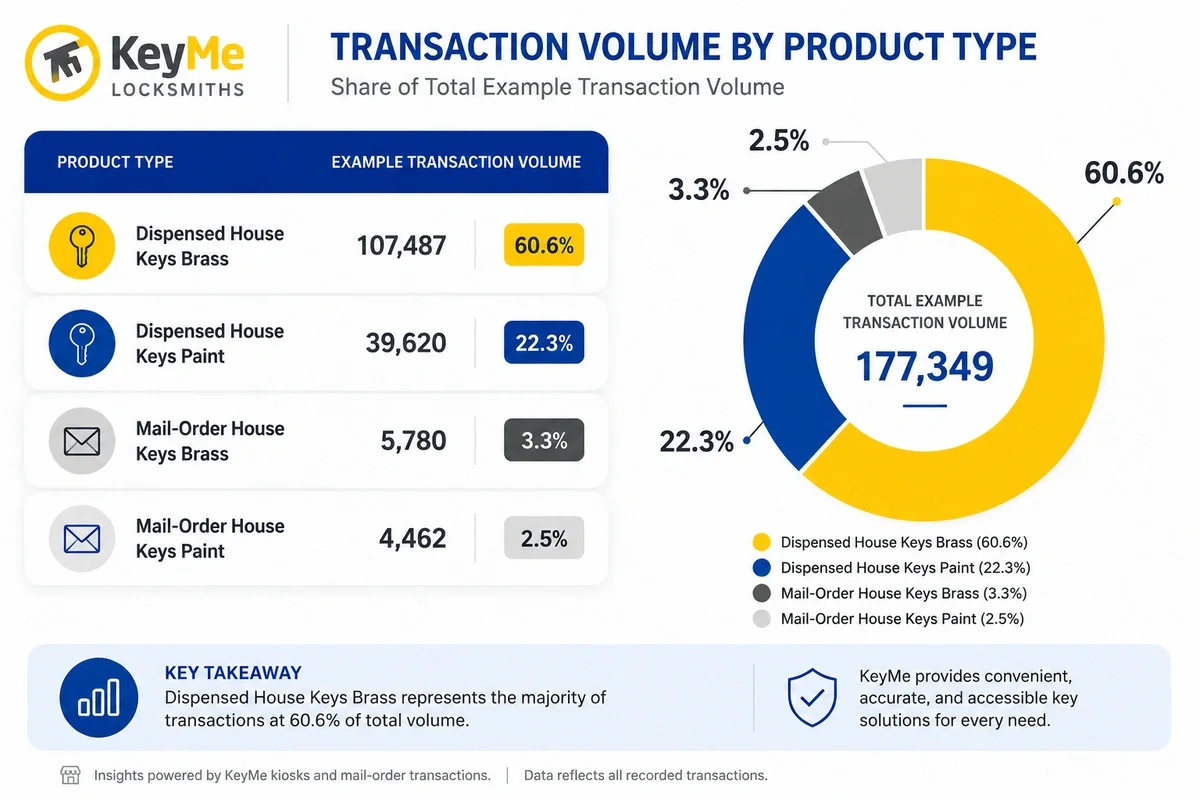
Source: KeyMe transaction data.
Why Front-Door Keys Dominate Duplication
Front-door keys continue to represent the foundation of household access in America.
Unlike many other keys, residential keys are rarely used by just one person. A single household may require access for spouses, children, roommates, relatives, dog walkers, cleaners, babysitters, caregivers, or trusted neighbors.
From a locksmith operations perspective, the front door is not simply a lock. It is the primary access hub for the household.
"What surprises many people is that most house-key duplication isn't driven by lockouts or lost keys," says a KeyMe residential locksmith specialist. "It's driven by life changes. Someone moves in, a child reaches an age where they need independent access, or a family wants a trusted backup key with a relative. The duplicate key is often a reflection of how the household itself is changing."
This helps explain why standard brass house keys continue to generate the highest duplication volume nationwide. They serve the most universal access need in American homes.
The Hidden Meaning Behind Painted Keys
One of the more interesting findings in the data is the substantial volume of painted key duplication.
Painted house keys account for tens of thousands of transactions across retail channels.
At first glance, this may appear cosmetic.
In practice, it reflects household organization.
Many people use color-coded keys to distinguish between:
- Front doors
- Back doors
- Garage entries
- Mailboxes
- Storage units
- Rental properties
- Family member key sets
Color becomes a practical access-management tool.
For households managing multiple keys that look nearly identical, a visual distinction helps reduce mistakes and confusion.
Mailbox Keys Reveal an Overlooked Access Trend
Mailbox keys rarely receive much attention until someone needs one.
Yet locksmiths frequently see duplication requests tied to residential mail access.
Why?
Because mailboxes are often shared.
A couple may both want access to incoming mail. Adult children may help aging parents manage bills and correspondence. Roommates may need independent access. Property managers and tenants often require separate copies.
Unlike front-door keys, mailbox keys tend to be duplicated only after a need emerges.
This creates a common pattern: households operate with a single mailbox key until inconvenience forces duplication.
Storage Units and Padlocks Reflect a More Mobile America
Storage-unit keys, gate keys, and padlock keys tell a different story.
These keys often emerge during major life transitions:
- Moving
- Downsizing
- College relocations
- Seasonal storage
- Shared garages
- Outdoor sheds
- Recreational equipment storage
Unlike household keys, these access points frequently involve people who do not live together.
A storage unit may require access for siblings, adult children, movers, business partners, or caretakers.
As Americans become increasingly mobile, duplication of these keys often reflects coordination rather than convenience.
The Family-Sharing Effect
One of the strongest behavioral patterns behind household key duplication is shared family access.
Many duplicate keys are created when responsibilities change.
Examples include:
- Teenagers gaining independence
- Adult children helping elderly parents
- Couples combining households
- Caregivers requiring regular access
- Neighbors holding emergency backup keys
"A copied house key is often less about security and more about responsibility," says a KeyMe locksmith operations expert. "We regularly see duplication requests tied to caregiving, co-parenting arrangements, elderly family members, pet care, and other situations where access needs to be shared safely among trusted people."
The duplicated key becomes a practical tool for coordinating daily life.
The Rise of Backup Behavior
The data shows substantial demand for both kiosk-generated duplicates and mail-order key duplication.
These represent two distinct consumer mindsets.
Immediate Duplication
"I need another key today."
Planned Duplication
"I want a backup before I need one."
The second behavior is increasingly important.
Many consumers are moving away from emergency-driven duplication and toward preventative access planning.
KeyMe's mobile key scanning service supports this trend by allowing customers to upload a key image for duplication and delivery without visiting a store. This creates opportunities for proactive backup creation before a key is lost or damaged.
Common Household Key Mistakes
Across millions of key-related interactions, several patterns appear repeatedly.
Keeping Every Spare Key Together
Many households unintentionally store all backup keys in one location, eliminating the value of redundancy.
Waiting Until Only One Key Remains
The most common duplication regret occurs when a household realizes there is only a single working key left.
Failing to Track Shared Keys
Over time, people forget who received copies and when.
Neglecting Secondary Access Points
Mailbox, shed, garage, and storage-unit keys are often overlooked until they become urgently needed.
What This Says About American Households
Perhaps the most important finding is not about keys at all.
It's about access.
The modern household is no longer defined by a single front door and a hidden spare key.
Today's households manage:
- Front doors
- Back doors
- Garages
- Mailboxes
- Gates
- Storage units
- Apartment buildings
- Package rooms
- Shared family access
"Household access has become significantly more distributed than it was a generation ago," says a KeyMe consumer access analyst. "People are managing front doors, garages, package rooms, storage units, gates, mailboxes, and shared family access points. The duplication patterns reflect a shift from simple ownership toward coordinated access management."
The data suggests that key duplication increasingly functions as household infrastructure rather than emergency preparedness.
In other words, Americans are not simply copying keys.
They're managing access.
Frequently Asked Questions
Why do so many people duplicate keys instead of sharing the original?
Sharing a single key often creates logistical problems. Multiple household members may need access at the same time, making duplication a more practical solution than passing one key back and forth.
What life events most commonly trigger key duplication?
Many duplication requests follow major household transitions such as moving, adding a roommate, welcoming a new family member, helping an aging parent, combining households, or renting storage space.
Are Americans managing more keys than they used to?
In many cases, yes.
Modern households frequently maintain access to multiple locations, including homes, garages, package rooms, storage units, mailboxes, community amenities, and secondary properties.
Why are mailbox and storage-unit keys duplicated even though they are used less often than front-door keys?
These keys often support shared responsibilities. Mail retrieval, moving logistics, storage access, and family coordination frequently require multiple trusted people to access the same location.
What can households learn from duplication trends?
The strongest lesson is that access planning matters. Households that think proactively about backup keys, shared access, and emergency access tend to experience fewer disruptions when keys are misplaced or responsibilities change.
How do people usually realize they need another key?
Most duplication decisions begin with inconvenience rather than emergencies. Someone gets locked out of a mailbox, waits for another family member to come home, or realizes only one person can access an important location.
What do duplication patterns reveal about American households?
More than anything, they reveal a shift toward shared access management. The strongest trend visible in the data is not security-related—it's coordination among the growing number of people who participate in everyday household life.
Methodology
This analysis is based on proprietary KeyMe household key duplication activity across retail and mail-order channels nationwide. Findings were reviewed through the lens of locksmith operations, residential access trends, and consumer key-duplication behavior to identify the patterns shaping how Americans manage household access today.
About KeyMe Locksmiths
KeyMe Locksmiths is a leading provider of local locksmith services and key copy kiosks across 50 states and the District of Columbia. Proud to serve over 5 million customers, KeyMe Locksmiths cuts over 10 million keys annually. With more than 8,000 self-service kiosks in major retailers, an e-commerce platform delivering over 10,000 keys weekly, and a nationwide locksmith network, KeyMe Locksmiths provides fast, reliable solutions for residential, commercial, and vehicle needs. KeyMe Locksmiths is committed to delivering exceptional service backed by a 100% money-back guarantee. KeyMe Locksmiths also operates one of the nation’s leading retail media networks, connecting consumers to other brands seeking to advertise in-store and delivering over 2B monthly impressions.