

If you lose your house keys, first determine whether you are locked out and whether someone who finds the missing key could reasonably connect it to your home.
Retrace your recent movements, check whether you have another authorized way inside, account for spare keys, and consider where and how the key disappeared. A loose, unmarked key lost far from home presents a different access-control question from keys stolen with a wallet, ID, mail, or anything else identifying your address.
If you decide that the missing key should no longer operate your home, rekeying may be an option when the existing lock is compatible and functioning properly. If the lock itself is damaged, unreliable, or no longer appropriate for the door, the decision becomes broader. See Rekeying vs. Replacing Your Locks for that separate hardware decision.
Summary
- Determine whether you are locked out or still have another authorized way into the home.
- Retrace your steps before assuming the key is permanently gone.
- Consider where the key was lost and whether anything with it identifies your home.
- Treat stolen keys differently from keys that were simply misplaced.
- Account for spare keys and copies previously given to other people.
- If you no longer want the missing key to work, rekeying may be appropriate for compatible locks.
- A lost key does not automatically mean the physical lock needs to be replaced.
- If the lock was already damaged or malfunctioning, evaluate the hardware separately.
- Renters should contact their landlord or property manager before altering building-owned locks.
- Once the immediate issue is resolved, create a more deliberate spare-key and key-control plan.
Best Way to Handle Lost House Keys
The best response is to work through the problem in this order:
- Determine whether you can still enter your home.
- Search the most likely places for the missing key.
- Identify where the key may have been lost.
- Determine whether the key can be associated with your address.
- Decide whether the key was misplaced or stolen.
- Account for other copies and spare keys.
- Decide whether the missing key should continue to operate the lock.
- Address any separate lock or door problem.
- Update your spare-key and access plan for the future.
The important distinction is between finding the key, regaining access, and deciding whether the missing key still represents acceptable access to your home.
Those are related problems, but they are not the same problem.
Need a Locksmith? We're here to help
Connect with a trusted local locksmith for fast, professional assistance when you need it most.
Step 1: Determine Whether You Are Locked Out
Losing a house key does not always mean you are locked out.
If You Can Still Get Inside
You may have:
- Another household member with a key
- A secure spare key
- Another authorized entrance
- Another copy stored somewhere accessible
If you can enter normally, you have more time to assess what happened and whether the missing key creates an access concern.
If You Are Locked Out
Your immediate problem is restoring authorized access.
Avoid forcing doors, windows, or locks in ways that could damage the property or create an unsafe situation.
A professional locksmith may be able to help with a home lockout after appropriate authorization is established.
ALOA, a professional locksmith association, lists emergency lockout service, creating keys when keys are lost, and changing or rekeying locks among the services locksmiths may provide.
For a broader lockout response checklist, see What to Do When You're Locked Out.
Step 2: Retrace Your Steps
Before changing anything, check whether the key is simply misplaced.
Think through the last places where you remember having it.
Check:
- Pockets
- Handbags
- Backpacks
- Vehicle seats and consoles
- Coat pockets
- Desks
- Entry tables
- Kitchen counters
- Laundry areas
- Gym bags
- Workspaces
- Friends' or relatives' homes
Then reconstruct your recent route.
Consider contacting:
- Stores
- Restaurants
- Gyms
- Offices
- Rideshare drivers
- Hotels
- Schools
- Other businesses you recently visited
If the key may have been dropped in a public location, ask whether the location has a lost-and-found process.
The purpose of this step is not only to recover the key. It also helps you understand where the key may now be.
That information becomes important when you evaluate access risk.
Step 3: Consider Where the House Key Was Lost
Not all lost-key situations have the same implications.
Ask:
If someone found this key, how easily could they connect it to my home?
A Key Lost Without Identifying Information
Suppose you lose a single, unmarked key while traveling across town.
The finder may have no obvious way to determine:
- Who owns it
- What property it belongs to
- Which door it operates
That does not make the key irrelevant, but it provides important context.
A Key Lost Near Your Home
A house key lost:
- On your driveway
- Outside your apartment building
- Near your mailbox
- On your street
- In a nearby parking area
may be easier to associate with a nearby property.
A Key Lost With Identifying Information
The situation deserves more attention if the missing key was attached to or lost alongside something that could identify you or your home.
Examples include:
- Driver's license
- Wallet
- Purse
- Mail showing your address
- Luggage tag
- Apartment identifier
- Employee information that could lead to your identity
- Clearly labeled key ring
The point is not that finding an identifiable key means someone will attempt to use it.
It means you have less control over who possesses a working credential and more information linking that credential to the property.
Step 4: Determine Whether the Keys Were Lost or Stolen
A misplaced key and a stolen key are not exactly the same incident.
Misplaced Keys
You know the keys are missing, but there is no clear reason to believe someone intentionally took them.
Examples:
- Keys fell from a pocket
- You left them somewhere
- You cannot remember where you placed them
- They disappeared during a normal day of errands
Stolen Keys
There is evidence or a reasonable basis to believe someone intentionally obtained them.
Examples:
- Purse or backpack stolen
- Wallet and keys taken together
- Keys removed from a known location
- Vehicle or property broken into and keys taken
- Keys taken with documents identifying your residence
If your keys were stolen with identifying information, the access-control question becomes more immediate because the person possessing the keys may also know where they are used.
If other property was stolen, follow any appropriate law-enforcement, insurance, building-management, or identity-protection procedures relevant to the broader incident.
Step 5: Account for Spare Keys and Other Copies
A lost key can also reveal a larger key-control issue.
Ask yourself who else currently has copies.
That might include:
- Spouse or partner
- Children
- Roommates
- Family members
- Neighbor
- Housekeeper
- Pet sitter
- Babysitter
- Contractor
- Former roommate
- Former partner
- Previous tenant
- Property manager
You may discover that the missing key is not the only copy whose location is uncertain.
That matters because securing residential access is not just about the one key you lost. It is about understanding which working copies are currently in circulation.
ALOA makes a similar point in its guidance for people moving into a home. It notes that it can be difficult to know whether all prior keys have actually been turned over and recommends rekeying when control over existing keys is uncertain.
The scenario is different from losing your own key, but the access-control principle is useful: a working key you cannot account for is still a working credential.
Step 6: Decide Whether the Missing Key Should Stop Working
After you understand how and where the key disappeared, decide whether you are comfortable with it continuing to operate your door.
If not, changing the key relationship may be appropriate.
Rekeying
For compatible mechanical locks, rekeying changes which key operates the existing lock.
That can allow the lock hardware to remain while making the previous key unusable.
ALOA explains that whether an existing lock can remain and be rekeyed depends on the lock's condition and suitability. In some situations existing locks can be used, while other situations may require different hardware.
That distinction is important.
Losing a key creates an access-control question. It does not automatically mean the lock itself has failed.
If your lock works properly and the primary goal is simply to stop the missing key from operating it, rekeying may be relevant.
If you are trying to decide whether the hardware itself should remain, see Rekeying vs. Replacing Your Locks.
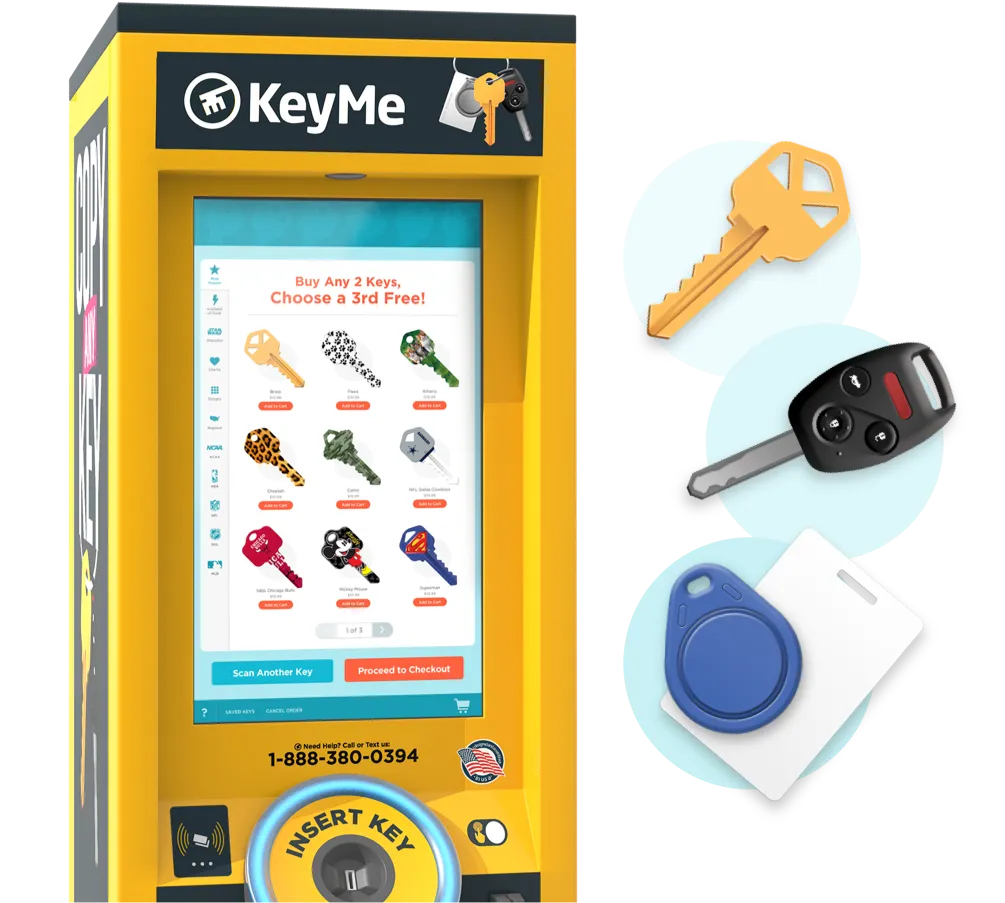
Find a KeyMe Kiosk Near You
Need a spare key fast? Find a KeyMe kiosk near you to copy many house, office, and eligible car keys in just minutes.
Step 7: Check Whether the Lock Has a Separate Problem
Sometimes losing a key happens at the same time as an unrelated lock problem.
Before deciding what service you need, consider whether the lock was already showing symptoms such as:
- Key difficult to insert
- Key difficult to turn
- Deadbolt sticking
- Lock feeling loose
- Latch not lining up
- Door requiring pressure to lock
- Visible hardware damage
Those symptoms are different from the security question created by the missing key.
For example:
Lost key + healthy lock:
The main issue may be controlling which key can operate the lock.
Lost key + malfunctioning lock:
You may have both an access-control problem and a hardware problem.
The latter situation deserves a broader evaluation.
See Rekeying vs. Replacing Your Locks for the full rekey, repair, and replacement decision framework.
Step 8: What If You Lost Your Only House Key?
If no working key remains, you have two separate needs:
- Regain authorized access.
- Establish how the lock should operate afterward.
Depending on the lock and situation, a locksmith may be able to assist with entry and then evaluate the available options for restoring key access.
ALOA identifies both lockout assistance and creating keys when keys are lost among services locksmiths may provide.
Once you are back inside, do not assume the problem is finished simply because you can access the property again.
You still need to decide whether the missing key should remain valid.
Step 9: What If You Rent?
If you lose a key to an apartment or rental property, contact your landlord, leasing office, or property manager before making changes to building-owned locks.
Rental properties may have:
- Building key policies
- Master-key systems
- Management access requirements
- Shared entrances
- Electronic credentials
- Lease requirements affecting lock changes
ALOA specifically advises renters to check with the rental office before changing apartment locks because management may require the lock to remain compatible with an existing master-key system or may need an operating key.
That makes independent hardware replacement different for renters than for many homeowners.
If you are locked out of a rental, you may also have a building-specific process for after-hours or emergency access.
Step 10: Review Garage, Gate, and Secondary Access
House keys are sometimes carried with other access credentials.
If the missing key ring also contained keys for:
- Detached garage
- Storage shed
- Side gate
- Mailbox
- Building common areas
- Home office
- Interior restricted spaces
identify those separately.
ALOA's home-security guidance recommends considering garage and storage-building locks when evaluating residential key control because they may provide access to other parts of the property or valuable belongings.
Do not assume securing the front door addresses every credential that was lost.
Step 11: Consider Other Access Methods
Some homes use more than one type of access.
You might have:
- Mechanical keys
- Keypad codes
- Smart locks
- Garage remotes
- Mobile-app credentials
- Building access fobs
Losing a mechanical house key does not necessarily affect those other credentials.
Likewise, changing a keypad code does not stop a missing mechanical key from operating a key cylinder.
Treat each credential according to what it actually controls.
This is particularly important for smart locks that still include a mechanical key override.
Should You Replace the Locks After Losing House Keys?
Not automatically.
This is where many lost-key articles become unnecessarily confusing.
The decision is not simply:
Lost key = replace lock.
Instead, separate two questions.
Question 1: Should the Missing Key Continue to Work?
If not, rekeying may solve that access-control problem for compatible hardware.
Question 2: Should the Existing Hardware Remain?
That depends on issues such as:
- Lock condition
- Hardware compatibility
- Damage
- Reliability
- Desired functionality
- Whether you want a different type of lock
ALOA similarly states that whether existing locks can be rekeyed or need replacement depends on the condition and suitability of the locks.
For that decision, use Rekeying vs. Replacing Your Locks.
This article intentionally does not duplicate that comparison because the immediate lost-key question is what to do after access credentials go missing.
What If You Find the Key Later?
Finding a previously lost key changes the situation, but consider where it has been in the meantime.
Ask:
- Where was it found?
- Was it in a controlled location?
- Could another person have possessed it?
- Had you already changed which key operates the lock?
- Is there any reason to believe copies could have been made?
If the key simply fell behind furniture inside your home, that is different from a key recovered after being missing in a public place.
Again, the important question is whether you can reasonably account for possession of the key.
Preventing Future Lost-Key Problems
Once the immediate incident is resolved, reduce the chance that the next lost key becomes another access emergency.
Keep a Secure Spare
A spare can help with a future lockout, but it should be stored somewhere appropriate rather than somewhere obvious or easily accessible to unauthorized people.
Know How Many Copies Exist
Keep a basic household record of who has keys.
This becomes particularly useful when:
- Roommates change
- Contractors finish work
- Housekeepers change
- Family members move
- A spare goes missing
Have a Key-Return Process
If you give a temporary key to someone, decide when it should be returned.
That may include:
- Contractor
- Pet sitter
- Cleaner
- Short-term guest
- House sitter
Avoid Identifying the Home on the Key Ring
Consider whether the information attached to your keys makes it easier for a finder to identify the property they operate.
Consider Alternative Access Where Appropriate
Some homeowners use keypad or smart-lock access to reduce their dependence on a single physical key.
That is a broader hardware and lifestyle decision, not something you necessarily need to change because of one lost key.
If you are evaluating new hardware, see Rekeying vs. Replacing Your Locks.
Copy Your Key from Anywhere - Right from Your Phone
Skip the kiosk and copy your key from home. Upload a clear photo of an eligible house or car key, and KeyMe will create a precise duplicate and mail it directly to your door.

When to Call a Locksmith After Losing House Keys
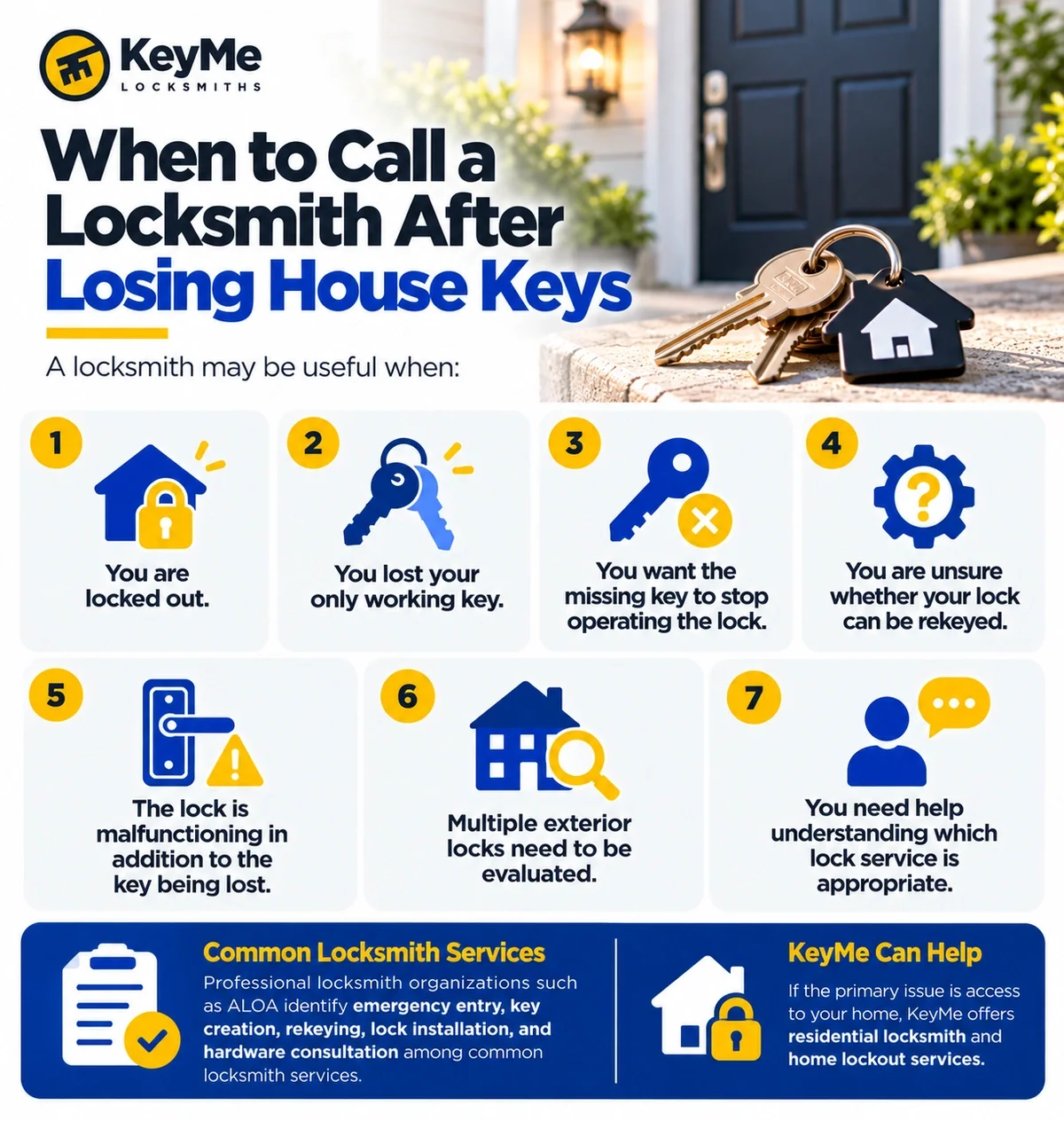
A locksmith may be useful when:
- You are locked out
- You lost your only working key
- You want the missing key to stop operating the lock
- You are unsure whether your lock can be rekeyed
- The lock is malfunctioning in addition to the key being lost
- Multiple exterior locks need to be evaluated
- You need help understanding which lock service is appropriate
Professional locksmith organizations such as ALOA identify emergency entry, key creation, rekeying, lock installation, and hardware consultation among common locksmith services.
If the primary issue is access to your home, KeyMe offers residential locksmith and home lockout services.
How KeyMe Locksmiths Can Help
KeyMe Locksmiths supports residential lock and key needs, including situations involving lost house keys.
Depending on the circumstances and existing hardware, relevant services may include:
- Home lockout service
- Rekeying
- Lock replacement
- Lock repair and installation
- Residential locksmith service
The appropriate service should follow the actual problem rather than assuming every lost key requires the same response.
"After a house key goes missing, separate the immediate access problem from the security decision. First determine whether you can get inside and where the key may have been lost. Then decide whether you're comfortable allowing that missing key to continue operating your home." - KeyMe Locksmiths
References
- ALOA: Should I Change My Locks?
- ALOA: What Services Does a Locksmith Provide?
- KeyMe Locksmiths: Home Lockout Service
- KeyMe Locksmiths: Residential Locksmith
- KeyMe Locksmiths: Rekey Lock Service
- KeyMe Locksmiths: Rekeying vs. Replacing Your Locks
- KeyMe Locksmiths: What to Do When You're Locked Out
- KeyMe Locksmiths: Lock Replacement