

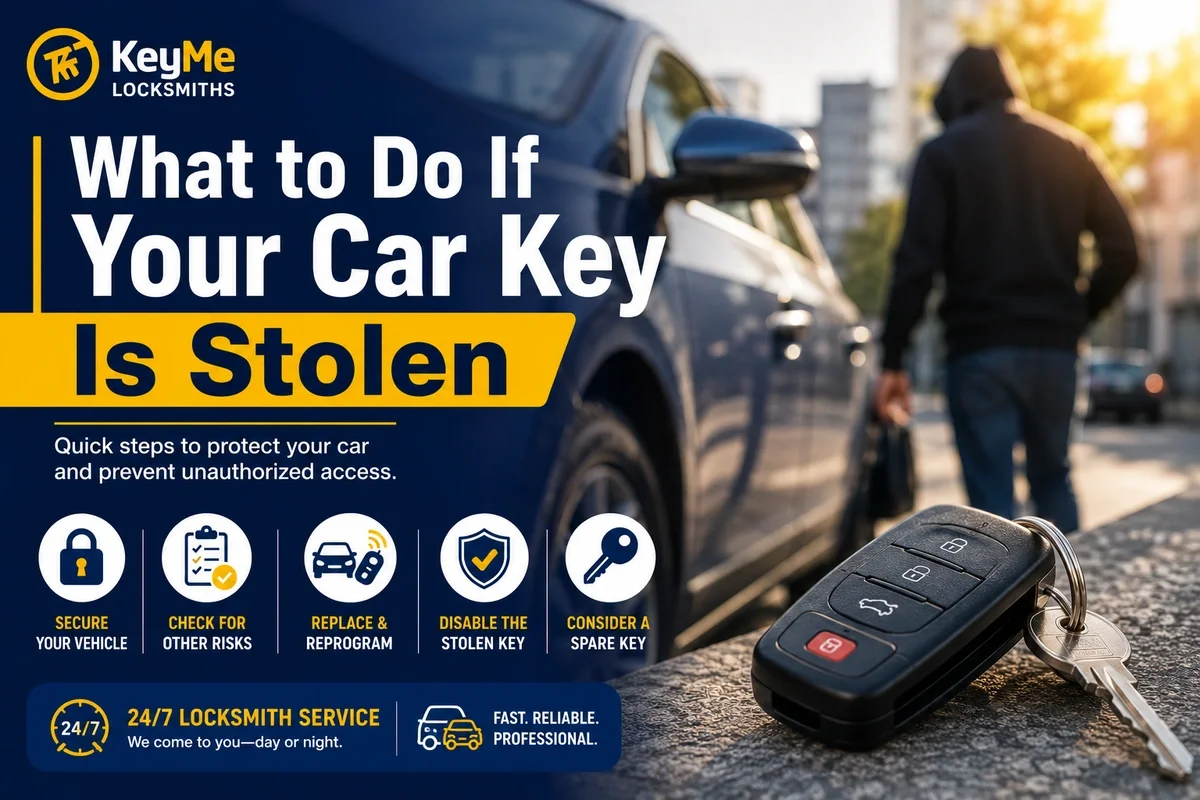
If your car key is stolen, first assess whether the person who took it can identify or locate your vehicle. Then secure the vehicle as appropriate, document the theft when necessary, and arrange for replacement key service. For vehicles with electronically authorized keys, ask whether the stolen key can be removed from the vehicle's authorized-key system.
A stolen car key should be treated differently from a key that is simply misplaced.
If someone intentionally took the key, the key may represent an ongoing vehicle-access concern. The situation can be more significant if the key was stolen along with your driver's license, registration, house keys, garage remote, work badge, or other items that connect the key to you or your vehicle.
The appropriate response depends on what was stolen, what type of key the vehicle uses, and whether the missing key can still provide mechanical or electronic access.
Summary
- Determine whether the key is misplaced or there is reason to believe it was stolen.
- Consider whether the person who took the key can identify or locate your vehicle.
- Review everything else that disappeared with the key.
- Contact law enforcement when the circumstances warrant reporting the theft.
- Consider relocating or otherwise securing the vehicle when appropriate.
- Contact an automotive locksmith or dealership to discuss the vehicle and key system.
- Ask whether the stolen electronic key can be removed from the vehicle's authorized-key system.
- Remember that electronic deactivation and mechanical door access can be separate issues.
- Arrange for a replacement if you no longer have sufficient working keys.
- Address other compromised access items, such as house keys, garage remotes, or building credentials, separately.
1. Determine Whether the Key Was Stolen
Before responding to a theft, make sure the circumstances reasonably point to one.
Retrace recent locations and check:
- Pockets
- Bags
- Home
- Office
- Vehicle surroundings
- Places where the key may have been set down
- Lost-and-found services where relevant
A misplaced key and a stolen key can ultimately require the same car key replacement, but their security implications are different.
A lost key may be sitting somewhere with no connection to your vehicle.
A stolen key may be in the possession of someone who intentionally took it.
"Replacing a stolen car key addresses the missing credential, but the broader question is what access the stolen key may still provide. The response should account for both the vehicle's electronic authorization system and any mechanical access associated with the physical key." - KeyMe Locksmiths
2. Determine What Else Was Stolen
This is one of the most important steps.
Was the car key taken by itself?
Or was it attached to or stored with:
- House keys
- Driver's license
- Vehicle registration
- Wallet
- Work identification
- Garage remote
- Apartment fob
- Mailbox key
- Storage key
- Other identifying information
The combination can change the situation.
For example, an unidentified vehicle key found by itself may provide little information about where the corresponding vehicle is parked.
A vehicle key stolen with documentation identifying the owner or vehicle can present a different concern.
Treat each compromised credential separately rather than assuming vehicle key replacement addresses everything that was stolen.
3. Consider Whether the Vehicle Can Be Identified
Think about what information the person who took the key may have.
Relevant questions include:
- Was the key stolen near the vehicle?
- Was it taken from inside the vehicle?
- Was the vehicle registration stolen too?
- Was identification containing your address taken?
- Did the person see which vehicle you were using?
- Is the vehicle normally parked at an identifiable residence or workplace?
This is a situational assessment rather than a reason to assume theft of the vehicle will occur.
The purpose is to determine what precautions are appropriate while the stolen key may remain usable.
Need a Locksmith? We're here to help
Connect with a trusted local locksmith for fast, professional assistance when you need it most.
4. Contact Law Enforcement When Appropriate
Depending on the circumstances, consider reporting the theft to local law enforcement.
A report may be particularly relevant when:
- Other property was stolen.
- A wallet or identification was taken.
- The key was taken during a break-in or other crime.
- The vehicle itself was entered or damaged.
- There is evidence someone intentionally targeted the vehicle.
If the vehicle has already been stolen, report the vehicle theft to law enforcement rather than treating the situation primarily as a key-replacement problem.
NHTSA's vehicle-theft guidance advises vehicle owners to contact police immediately if a vehicle is stolen and then contact their insurance company.
5. Secure the Vehicle Based on the Circumstances
If the stolen key can be connected to your vehicle, consider whether the vehicle should remain where it is.
Depending on the situation and available authorized access, that could mean moving the vehicle to another appropriate location or taking other reasonable security precautions.
Do not attempt to drive the vehicle if you do not have an authorized working key or cannot operate it normally.
If you are also locked out, KeyMe provides car lockout service for supported vehicles.
6. Identify the Type of Car Key That Was Stolen
The type of key helps determine what comes next.
Your vehicle may use a:
Traditional Mechanical Key
The physical cuts operate the vehicle's lock or ignition.
Transponder Key
The key contains an electronic transponder that must be recognized by the vehicle's immobilizer system.
Remote-Head Key
The key combines a physical blade with remote functions and may also contain a transponder.
Smart or Proximity Key
The vehicle can recognize an authorized electronic credential when it is near or inside the vehicle.
The terminology and technology vary by manufacturer.
NHTSA notes that modern vehicle theft-prevention systems can include immobilizers that use electronic devices, including transponder technology, to prevent unauthorized vehicle operation.
7. Contact an Automotive Locksmith or Dealer
Once you know the vehicle and key situation, contact a service provider that supports the vehicle.
Useful information can include:
- Year
- Make
- Model
- Key type, if known
- Whether you have another working key
- Whether the missing key was stolen or lost
- Whether the vehicle is currently accessible
- Whether other vehicle credentials were stolen
KeyMe provides car locksmith services, car key replacement, and car key programming for supported vehicles.
KeyMe Car Key Vans also provide in-person duplication and programming for supported vehicle keys at participating retail locations.
8. Ask Whether the Stolen Electronic Key Can Be Removed
For supported vehicles, a locksmith or dealer may be able to update the vehicle's authorized-key system so that a missing electronic credential is no longer accepted.
This is sometimes described as:
- Disabling the key
- Deleting the key
- Erasing the key
- Removing the key from memory
- Reprogramming the vehicle's authorized keys
The exact process and capabilities depend on the vehicle.
This is an important question when a key was stolen rather than simply damaged.
For the technical details, see Can a Locksmith Disable Lost or Stolen Car Keys?.
9. Understand That Electronic Deactivation May Not Address the Mechanical Blade
This distinction is critical.
A modern car key can contain both:
A mechanical component that physically fits a lock.
An electronic credential recognized by the vehicle.
Removing the electronic credential from the vehicle's authorized-key system may prevent the missing key from being recognized for electronically authorized functions.
That does not necessarily change the physical shape of the stolen blade.
If the stolen key includes a blade that can mechanically unlock the vehicle, discuss that concern with the automotive locksmith or dealer.
The appropriate response depends on the vehicle's lock and key system.
Find a KeyMe Kiosk Near You
Need a spare key fast? Find a KeyMe kiosk near you to copy many house, office, and eligible car keys in just minutes.
10. Replace the Missing Key
If you no longer have the number of working keys you need, arrange for car key replacement.
Depending on the vehicle, replacement can involve:
- Cutting the physical key
- Creating a transponder key
- Programming the electronic credential
- Configuring remote functions
- Supporting smart or proximity-key functions
Not every vehicle or key requires all of these steps.
For a broader replacement guide, see Best Ways to Replace a Lost Car Key.
11. Test the Keys That Should Still Work
After vehicle key service, confirm the expected functions of the keys you intend to keep using.
Depending on the vehicle and key type, that may include:
- Mechanical door access
- Ignition
- Lock/unlock buttons
- Trunk functions
- Proximity detection
- Push-to-start authorization
If multiple authorized keys are involved, understand which ones should remain active after programming.
12. Address Other Keys and Credentials That Were Stolen
A stolen key ring can affect more than the vehicle.
House Key
If a house key was stolen and can be connected to your residence, consider whether rekeying is appropriate.
For a detailed guide, see What to Do After Losing Your House Keys.
Garage Remote
Follow the garage-door opener manufacturer's procedure for removing or updating compromised remotes where supported.
Apartment or Building Credential
Notify the property manager or appropriate access administrator if an apartment fob, building credential, or controlled key was stolen.
Workplace Key or Badge
Report the missing credential according to your employer's access-control procedure.
Vehicle key programming does not address these separate credentials.
Best Way to Respond to a Stolen Car Key
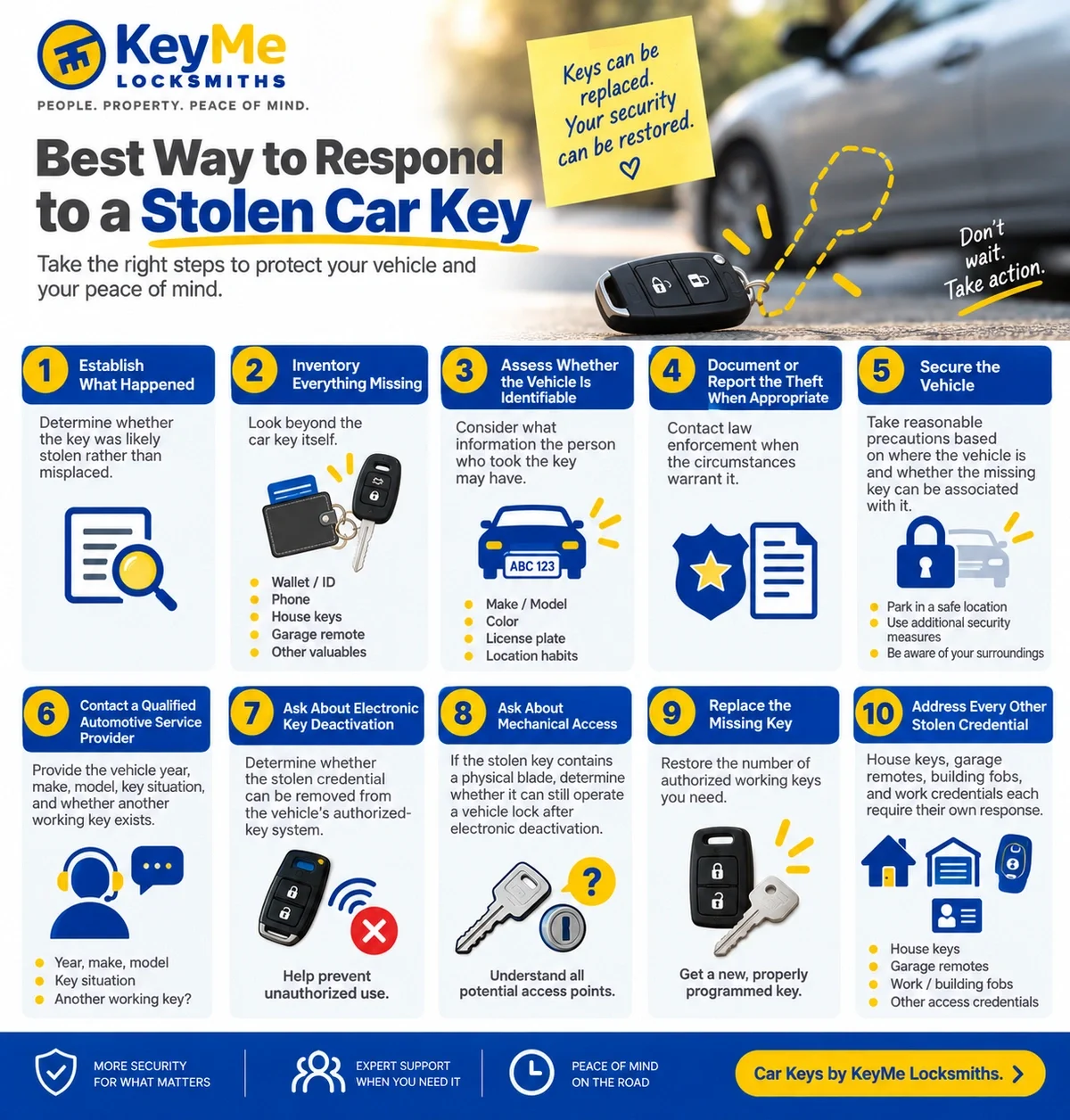
1. Establish What Happened
Determine whether the key was likely stolen rather than misplaced.
2. Inventory Everything Missing
Look beyond the car key itself.
3. Assess Whether the Vehicle Is Identifiable
Consider what information the person who took the key may have.
4. Document or Report the Theft When Appropriate
Contact law enforcement when the circumstances warrant it.
5. Secure the Vehicle
Take reasonable precautions based on where the vehicle is and whether the missing key can be associated with it.
6. Contact a Qualified Automotive Service Provider
Provide the vehicle year, make, model, key situation, and whether another working key exists.
7. Ask About Electronic Key Deactivation
Determine whether the stolen credential can be removed from the vehicle's authorized-key system.
8. Ask About Mechanical Access
If the stolen key contains a physical blade, determine whether it can still operate a vehicle lock after electronic deactivation.
9. Replace the Missing Key
Restore the number of authorized working keys you need.
10. Address Every Other Stolen Credential
House keys, garage remotes, building fobs, and work credentials each require their own response.
Copy Your Key from Anywhere - Right from Your Phone
Skip the kiosk and copy your key from home. Upload a clear photo of an eligible house or car key, and KeyMe will create a precise duplicate and mail it directly to your door.
A Stolen Key Is Both a Replacement and Access-Control Issue
A stolen car key raises two different questions:
How will you replace the missing key?
and
What access does the stolen key still provide?
For modern vehicles, that can mean considering both electronic authorization and mechanical access.
KeyMe provides car locksmith services, lost car key replacement, car key replacement, and car key programming for supported vehicles.
For the technical side of removing a missing electronic credential, continue with Can a Locksmith Disable Lost or Stolen Car Keys?.
References
- National Highway Traffic Safety Administration (NHTSA). Vehicle Theft Prevention. Federal consumer guidance on vehicle theft prevention, immobilizers, and what to do following vehicle theft.
https://www.nhtsa.gov/vehicle-safety/vehicle-theft-prevention - National Insurance Crime Bureau (NICB). Vehicle Theft Prevention. Consumer information on vehicle theft awareness and prevention.
https://www.nicb.org/prevent-fraud-theft/vehicle-theft - KeyMe Locksmiths. Car Key Replacement. Information about KeyMe replacement-key services for supported vehicles.
https://key.me/car-key-replacement - KeyMe Locksmiths. Car Key Programming. Information about programming supported automotive keys.
https://key.me/car-key-programming