
How Locksmiths Access Vehicle Key Codes
When drivers lose their only car key, many wonder how a locksmith can create a replacement without having the original. The answer often involves vehicle key codes—a set of manufacturer-specific information that helps locksmiths cut and, in some cases, program replacement keys accurately.
While every vehicle is different, professional automotive locksmiths use a combination of specialized tools, vehicle data, lock decoding techniques, and ownership verification procedures to access the information needed to create replacement keys.
KeyMe Locksmiths helps drivers with car key replacement, duplication, programming, and automotive locksmith services nationwide.
What Is a Vehicle Key Code?
A vehicle key code is a series of numbers, letters, or alphanumeric characters associated with a specific key pattern.
Depending on the vehicle, the key code may allow a locksmith to determine:
- Key cut depths
- Key spacing
- Blade configuration
- Manufacturer specifications
Think of it as a blueprint that helps create a properly cut key without needing an existing copy.
Why Key Codes Matter
Modern vehicle keys require precision.
Even minor cutting differences can cause:
- Difficulty turning the ignition
- Door lock problems
- Premature key wear
- Failure to operate correctly
Key codes help locksmiths produce keys that match the manufacturer's specifications rather than relying solely on visual duplication.
"Key codes provide important reference information that can help ensure replacement keys are cut accurately and consistently." — KeyMe Locksmiths
How Locksmiths Obtain Key Information
Professional locksmiths may use several methods depending on the vehicle and situation.
Manufacturer Key Code Databases
For some vehicles, authorized locksmiths can access key code information through industry databases and manufacturer-supported resources.
Access typically requires:
- Professional credentials
- Vehicle information
- Ownership verification
These systems are designed to support legitimate key replacement while helping protect vehicle security.
Decoding the Vehicle Lock
When key code information isn't available, locksmiths may decode the lock itself.
This process can involve examining:
- Door locks
- Ignition cylinders
- Trunk locks
Specialized tools help locksmiths determine the internal lock configuration needed to cut a working key.
Reading Existing Keys
If a working key is available, locksmiths can often use electronic key-reading equipment to identify:
- Cut depths
- Spacing measurements
- Blade specifications
This information helps create highly accurate duplicates.
Why Ownership Verification Is Required
Before accessing vehicle key information, locksmiths generally verify ownership.
This may include:
- Government-issued identification
- Vehicle registration
- Title documentation
- Proof of insurance
- VIN verification
According to the Associated Locksmiths of America (ALOA), ownership verification is a critical component of responsible automotive locksmith services.
What Role Does the VIN Play?
The Vehicle Identification Number (VIN) contains important information about the vehicle.
In some situations, the VIN helps locksmiths identify:
- Vehicle specifications
- Compatible key types
- Security system requirements
- Manufacturer records
However, the VIN alone is typically not enough to create a fully functioning key.
Additional verification and vehicle-specific information are often required.
Modern Vehicles Need More Than a Cut Key
For many newer vehicles, cutting the key is only part of the process.
Modern systems may also require:
- Transponder programming
- Smart key pairing
- Immobilizer registration
- Remote function programming
According to SAE International, vehicle security systems continue to evolve with increasingly sophisticated electronic authentication technologies.
As a result, replacement keys often need both mechanical and electronic configuration.
What Happens If All Keys Are Lost?
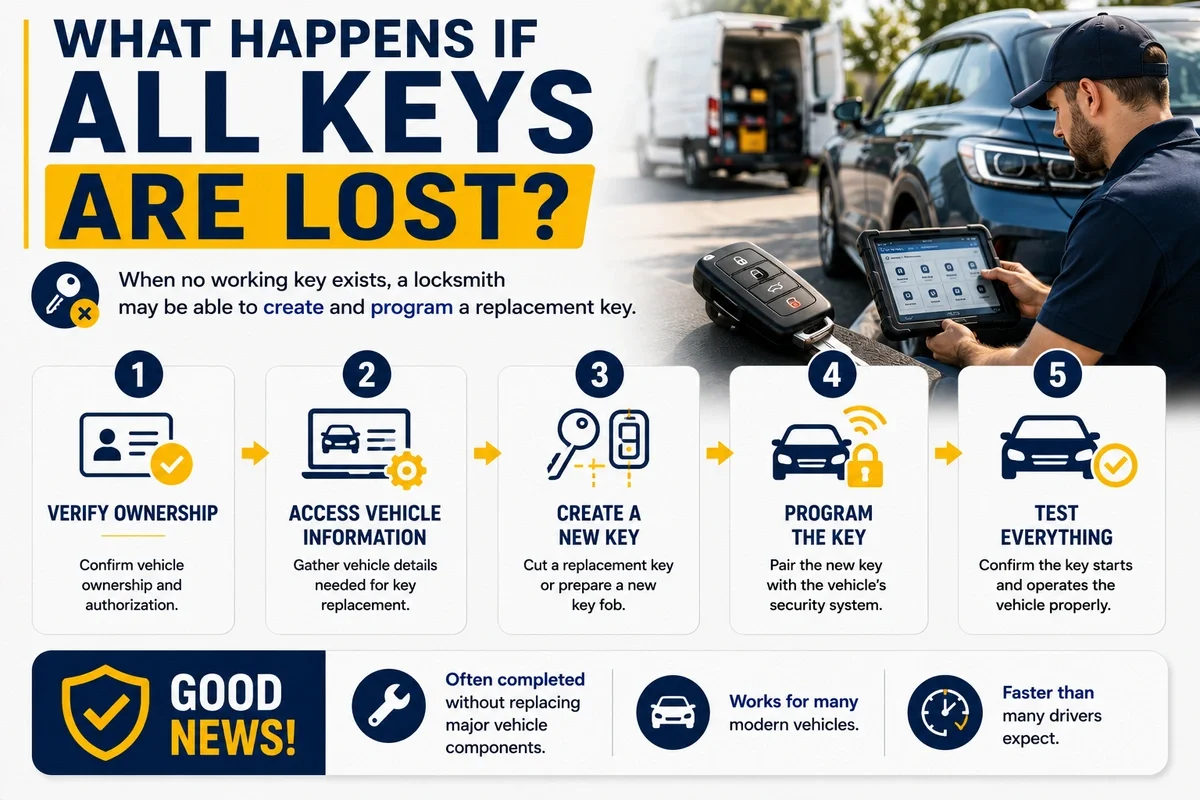
When no working key exists, locksmiths may need to:
- Verify ownership
- Access vehicle information
- Decode locks or retrieve key data
- Cut a replacement key
- Program electronic components
- Test vehicle operation
This process is often more involved than duplicating an existing key but can frequently be completed without replacing major vehicle components.
Why Some Vehicles Are More Complex
Not all vehicles handle key information the same way.
Factors that may increase complexity include:
- Push-to-start systems
- Encrypted smart keys
- Luxury vehicle security systems
- Secure gateway modules
- Manufacturer-specific programming requirements
These systems often require specialized diagnostic and programming equipment.
"As vehicle security technology advances, key replacement increasingly involves both locksmith expertise and electronic diagnostics." — KeyMe Locksmiths
Can Drivers Access Their Own Key Codes?
In most cases, vehicle owners do not have direct access to key code information.
Some manufacturers may provide limited information through:
- Dealerships
- Vehicle documentation
- Authorized service channels
However, many key code systems are intentionally restricted to help protect vehicle security.
Why Spare Keys Are Easier Than All-Key-Lost Situations
Creating a duplicate from an existing working key is often simpler than replacing a completely lost key.
Having a spare key available may:
- Simplify duplication
- Reduce programming requirements
- Avoid emergency situations
- Provide a backup during travel
KeyMe offers several solutions for supported vehicles, including:
- Self-service car key duplication kiosks
- Online key copying for eligible key types
- Car key vans providing in-person cutting and programming at select retail locations
Frequently Asked Questions
Are vehicle key codes the same as the VIN?
No. The VIN identifies the vehicle, while the key code relates to the key's physical cutting specifications.
Can key codes change over time?
The original key code typically remains the same unless lock components are replaced or modified.
Do all vehicles have key codes?
Most vehicles have some form of key specification information, though how it is stored and accessed varies by manufacturer.
Can worn locks affect replacement key accuracy?
Yes. Locks naturally wear over time, which is one reason locksmiths may inspect both the key information and the lock itself during replacement.
Why do some replacement keys require programming even after they're cut?
Many modern vehicles use transponders or smart key systems that must be electronically authenticated before the vehicle will start.
The Information Behind Every Replacement Key
Vehicle key replacement involves much more than cutting metal. Professional locksmiths use a combination of key codes, lock decoding techniques, vehicle data, and programming tools to create replacement keys that work with today's increasingly sophisticated security systems.
Explore car key replacement, key duplication, and programming solutions with KeyMe Locksmiths.
References
- Associated Locksmiths of America (ALOA) — Automotive Locksmith Resources
https://www.aloa.org/ - SAE International — Vehicle Security & Key Technology Standards
https://www.sae.org/ - National Highway Traffic Safety Administration (NHTSA) — Vehicle Security Information
https://www.nhtsa.gov/vehicle-safety/theft-prevention
About KeyMe Locksmiths
KeyMe Locksmiths is a leading provider of local locksmith services and key copy kiosks across 50 states and the District of Columbia. Proud to serve over 5 million customers, KeyMe Locksmiths cuts over 10 million keys annually. With more than 8,000 self-service kiosks in major retailers, an e-commerce platform delivering over 10,000 keys weekly, and a nationwide locksmith network, KeyMe Locksmiths provides fast, reliable solutions for residential, commercial, and vehicle needs. KeyMe Locksmiths is committed to delivering exceptional service backed by a 100% money-back guarantee. KeyMe Locksmiths also operates one of the nation’s leading retail media networks, connecting consumers to other brands seeking to advertise in-store and delivering over 2B monthly impressions.