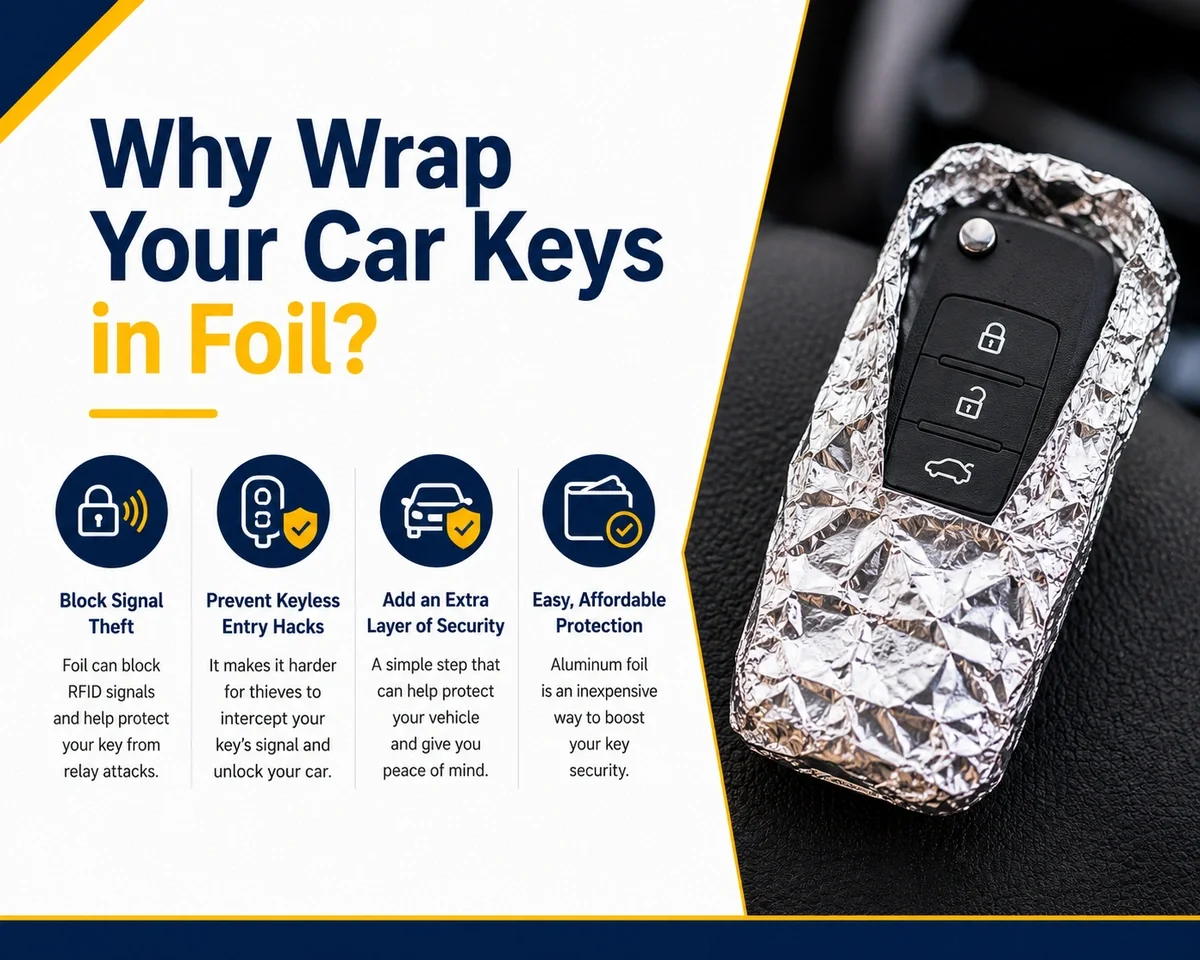
Some drivers wrap their key fobs in aluminum foil because it can reduce or block the wireless signals used by many keyless entry systems. The goal is to help protect against relay attacks—a type of vehicle theft where criminals attempt to extend the communication between your key fob and your vehicle to unlock the doors or start the engine. While aluminum foil may reduce signal transmission when it completely surrounds the key fob, it's not the most practical or consistent long-term solution. Purpose-built signal-blocking pouches, secure key storage, and good key management habits generally provide more reliable protection.
Summary
- Wrapping a key fob in aluminum foil may reduce or block its wireless signal, but the effectiveness depends on how completely the signal is shielded.
- Relay attacks target vehicles with proximity-based keyless entry systems by extending communication between the vehicle and the key.
- Signal-blocking Faraday pouches are designed specifically for this purpose and are generally more durable and consistent than foil.
- Keeping key fobs away from exterior doors and windows can also reduce the risk of signal interception.
- Understanding how your vehicle's Smart Key system works can help you choose the right security measures.
Why Choose KeyMe Locksmiths?
Modern vehicle keys combine mechanical components with sophisticated electronic security technology. KeyMe Locksmiths connects drivers with experienced automotive locksmith professionals who can assist with key replacement, Smart Key programming, replacement key fobs, vehicle lockouts, and other automotive key services.
Available services may include:
- Key fob replacement
- Smart Key programming
- Lost car key replacement
- Transponder key programming
- Vehicle lockout assistance
- Spare key creation
- Broken key extraction
For many supported vehicles, KeyMe also offers Car Key Vans at select retail locations that provide on-site key cutting and programming. For residential customers, Online Key Copying allows eligible house keys to be duplicated by securely uploading a key photo through the KeyMe app, with the finished key shipped directly to the customer.
"Modern key fobs are constantly balancing convenience and security. Features like passive entry make everyday driving easier, but they also rely on wireless communication that should be protected. Understanding how that communication works helps drivers make informed decisions about protecting their vehicles without relying on myths or one-size-fits-all solutions." — KeyMe Locksmiths
Need a Locksmith? We're here to help
Connect with a trusted local locksmith for fast, professional assistance when you need it most.
Why Modern Key Fobs Broadcast a Signal
Many newer vehicles use proximity-based Smart Keys.
Rather than inserting a physical key into the ignition, these systems detect when an authorized key is nearby.
Depending on the vehicle, the key may support:
- Passive door unlocking
- Push-button start
- Remote locking and unlocking
- Trunk or liftgate access
The convenience comes from short-range radio communication between the vehicle and the key.
That same communication is what relay attacks attempt to exploit.
What Is a Relay Attack?
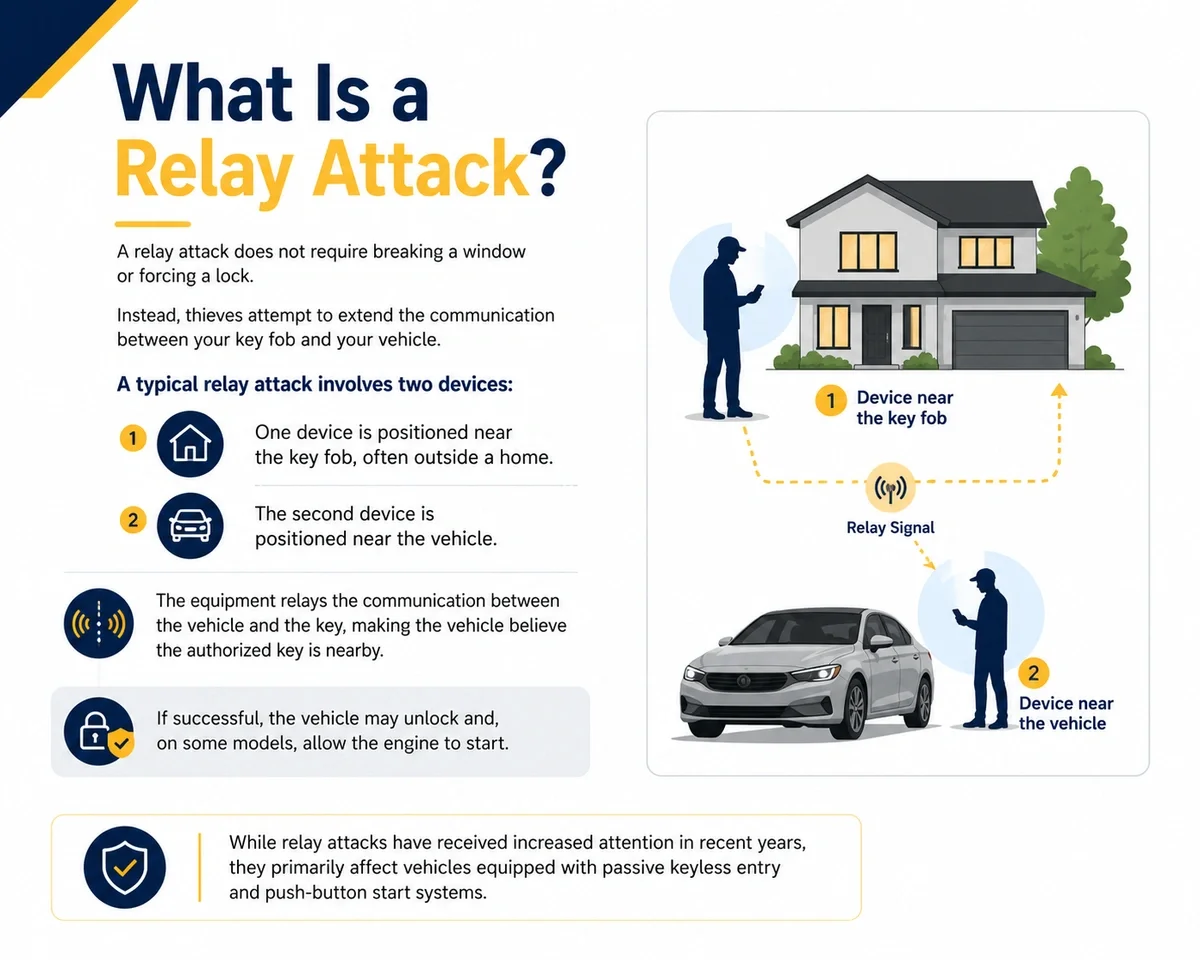
A relay attack does not require breaking a window or forcing a lock.
Instead, thieves attempt to extend the communication between your key fob and your vehicle.
A typical relay attack involves two devices:
- One device is positioned near the key fob, often outside a home.
- The second device is positioned near the vehicle.
The equipment relays the communication between the vehicle and the key, making the vehicle believe the authorized key is nearby.
If successful, the vehicle may unlock and, on some models, allow the engine to start.
While relay attacks have received increased attention in recent years, they primarily affect vehicles equipped with passive keyless entry and push-button start systems.
Does Aluminum Foil Actually Work?
Aluminum foil can reduce radio frequency signals when it completely surrounds the key fob.
However, its effectiveness depends on several factors:
- Complete coverage
- Number of foil layers
- Tears or gaps
- Signal strength
- Vehicle design
Even a small opening can allow radio signals to escape.
Because foil tears easily and must be wrapped correctly each time, it is generally considered a temporary solution rather than a dependable everyday practice.
Find a KeyMe Kiosk Near You
Need a spare key fast? Find a KeyMe kiosk near you to copy many house, office, and eligible car keys in just minutes.
Better Ways to Protect Your Key Fob
Use a Faraday Pouch
Signal-blocking pouches are specifically designed to prevent wireless communication between your key and the outside world.
Unlike household foil, these products are:
- Durable
- Reusable
- Consistent
- Designed specifically for RF shielding
Store Keys Away From Exterior Walls
Many relay attacks depend on reaching keys located near:
- Front doors
- Garage entrances
- Ground-floor windows
Keeping your keys farther inside your home may reduce the likelihood that a signal can be intercepted.
Review Your Vehicle's Smart Key Settings
Some manufacturers allow owners to adjust or disable certain passive entry features.
Depending on your vehicle, you may be able to configure:
- Passive unlocking
- Automatic proximity detection
- Smart Key settings
Consult your owner's manual to determine what options are available.
Keep a Spare Key Secure
If you own more than one key fob:
- Store the spare separately.
- Keep it in a secure location.
- Consider using a signal-blocking pouch for long-term storage.
Should You Wrap Your Spare Key in Foil?
If a signal-blocking pouch isn't available, wrapping a spare key completely in aluminum foil may reduce signal transmission.
However, foil should generally be viewed as a temporary measure rather than a permanent security solution because it:
- Can tear easily
- Must fully enclose the key
- Doesn't provide consistent protection if damaged
- Is inconvenient for everyday use
Purpose-built signal-blocking products remain the more practical long-term option.
Additional Ways to Protect Your Vehicle
Good vehicle security involves more than protecting the key.
Drivers can also:
- Lock the vehicle whenever it's unattended.
- Park in well-lit locations when possible.
- Keep software updated if the manufacturer provides updates.
- Avoid leaving valuables visible inside the vehicle.
- Create a spare key before losing the original.
A layered approach helps improve overall vehicle security.
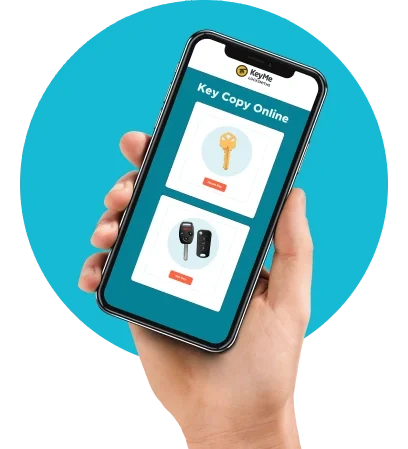
Copy Your Key from Anywhere - Right from Your Phone
Skip the kiosk and copy your key from home. Upload a clear photo of an eligible house or car key, and KeyMe will create a precise duplicate and mail it directly to your door.
Understanding the Foil Trick Helps You Make Better Security Decisions
Wrapping a key fob in aluminum foil may reduce wireless communication under the right conditions, but it's only one possible approach to protecting a keyless entry system. Understanding how Smart Keys and relay attacks work allows drivers to choose practical security measures that fit their vehicle and daily routine.
Whether that means using a signal-blocking pouch, adjusting Smart Key settings, or simply storing keys farther from entry points, a few simple habits can help reduce risk while preserving the convenience of modern vehicle technology.
References
- National Insurance Crime Bureau (NICB). Vehicle Theft Prevention Resources. https://www.nicb.org/
- National Highway Traffic Safety Administration (NHTSA). Vehicle Security Resources. https://www.nhtsa.gov/
- Federal Communications Commission (FCC). Radio Frequency Basics. https://www.fcc.gov/
- Associated Locksmiths of America (ALOA). Consumer Resources. https://www.aloa.org/
- KeyMe Locksmiths service information for automotive locksmith services, Car Key Vans, and Mobile Key Scanning.