A professional locksmith opens a locked door by first verifying authorization, then evaluating the lock, door, hardware, and reason access was lost. The technician selects an appropriate professional entry approach based on the specific opening and its condition, with the goal of restoring authorized access while avoiding unnecessary changes to serviceable hardware.
There is no single technique locksmiths use on every locked door.
A straightforward lockout involving serviceable residential hardware is different from a broken key, malfunctioning deadbolt, damaged door, electronic lock, commercial access-control system, or modern vehicle.
The professional process therefore begins with assessment, not with a universal opening method.
Summary
- Locksmiths should establish that the customer is authorized to access the property or vehicle.
- The technician evaluates the lock, door, frame, hardware, and circumstances before deciding how to proceed.
- Different lock designs require different professional approaches.
- A functioning lock with an unavailable key is different from a malfunctioning lock.
- Locksmiths may use non-destructive professional entry methods when appropriate for the hardware and situation.
- Damaged or failed hardware can require a different approach.
- Residential, commercial, electronic, and automotive lockouts involve different systems.
- Door alignment can sometimes make a lock appear to be malfunctioning.
- Restoring access does not automatically mean the lock must be rekeyed or replaced.
- Any repair, rekeying, or replacement need should be evaluated separately from the initial lockout.
Step 1: Establish Authorization
Before opening a locked property or vehicle, a professional locksmith needs to establish that the person requesting service has appropriate authority.
ALOA's Positive ID Policy instructs locksmiths handling lockouts to verify identification and inquire about the customer's authority to have the lock opened. The policy also recognizes that circumstances can require other reasonable evidence of authority.
Authorization may look different depending on whether the job involves:
- Owner-occupied home
- Rental property
- Apartment
- Commercial building
- Vehicle
- Property being managed on someone else's behalf
This is one reason a professional lockout service is more than simply opening a lock.
"Professional entry service starts with two questions: is the person requesting service authorized to enter, and what is actually preventing access? Only after those questions are answered does it make sense to determine the appropriate way to restore access." - KeyMe Locksmiths
Step 2: Identify What Caused the Lockout
The technician needs to understand why the customer cannot get in.
Common situations include:
- Key left inside
- Lost key
- Stolen key
- Broken key
- Key no longer operating the lock
- Deadbolt or latch malfunction
- Door alignment problem
- Electronic credential issue
- Damaged hardware
That distinction matters.
If the lock operates normally and the key is simply unavailable, the problem is primarily access.
If the correct key is present but the door still will not open, the opening may have a mechanical problem.
Need a Locksmith? We're here to help
Connect with a trusted local locksmith for fast, professional assistance when you need it most.
Step 3: Identify the Lock and Door Hardware
Next, the locksmith evaluates the actual opening.
For a residential door, that may involve identifying:
- Deadbolt
- Knob or lever lock
- Cylinder type
- Latch
- Strike
- Smart or electronic hardware
- Door and frame condition
Commercial openings can involve additional hardware and access-control components.
Vehicle lockouts involve vehicle-specific mechanical and electronic systems.
This identification step helps determine what professional approach is appropriate.
Step 4: Evaluate the Complete Door Opening
A locked door is a system.
The cylinder is only one component.
A locksmith may also need to consider:
- Latch
- Deadbolt
- Strike
- Door
- Frame
- Hinges
- Trim
- Electronic components
This becomes especially important when the customer has the correct key but cannot operate the door.
ALOA identifies poor door alignment as a common cause of apparent lock problems and notes that weather, worn keys, lock wear, and hardware condition can also affect operation.
The difference between a lock that operates normally with the door open and one that binds when the door is closed can be diagnostically useful.
Step 5: Determine Whether the Hardware Is Functioning Normally
Before treating the situation as a straightforward lockout, the locksmith determines whether the hardware itself appears serviceable.
Normal Lock, Key Unavailable
This is primarily an access problem.
Key Present, Lock Won't Operate
This can indicate a key, cylinder, latch, alignment, or other hardware problem.
Key Broken Inside the Lock
The service may involve broken key extraction as well as restoring access.
Door or Frame Affecting the Lock
The opening may require lock repair or another correction.
Damaged Lock
Repair or lock replacement may need to be evaluated separately.
Diagnosis prevents every lockout from being treated as though it has the same cause.
Step 6: Select an Appropriate Professional Entry Approach
Once the opening has been assessed, the locksmith determines an appropriate way to restore authorized access.
Professional approaches vary according to:
- Lock design
- Door type
- Hardware condition
- Key availability
- Electronic components
- Existing damage
- Property or vehicle type
At a high level, these approaches can fall into a few categories.
Non-Destructive Professional Entry
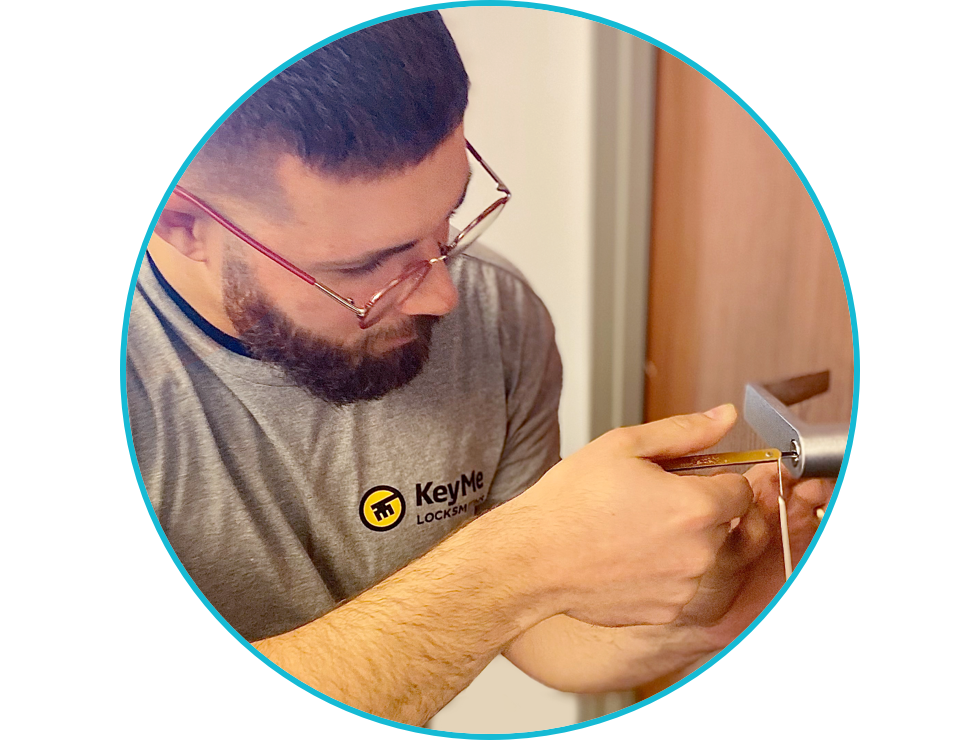
When the lock and circumstances support it, a locksmith may use professional methods intended to restore access while retaining serviceable hardware.
Whether this is appropriate depends on the lock and situation.
Mechanical Troubleshooting
Sometimes the primary problem is not that the lock is securely locked.
The latch may be binding.
The deadbolt may not be aligning with the strike.
A component may have failed.
In those situations, restoring access can involve diagnosing the malfunction rather than treating the job as a conventional lockout.
Hardware Removal When Necessary
If hardware is damaged, failed, or otherwise cannot be appropriately serviced in place, removal may become part of the professional process.
That does not mean hardware replacement is required in every lockout.
The technician should evaluate the condition of the specific opening.
Why Locksmiths Don't Use One Method for Every Door
Locks differ considerably.
Even within residential properties, a locksmith might encounter:
- Keyed knob
- Keyed lever
- Single-cylinder deadbolt
- Double-cylinder deadbolt
- Interconnected hardware
- Smart lock
- Electronic keypad
- Specialty lock
- Multiple locks on one opening
Commercial doors add another range of hardware.
Vehicles add another category entirely.
The professional skill is not simply knowing one way to open a door. It is understanding the hardware, identifying the cause of the access problem, and selecting an approach appropriate to that particular system.
How Residential Door Lockouts Are Evaluated
For a home, the technician generally needs to understand:
- What type of lock is installed
- Whether the customer has a key
- Whether the lock was operating normally before the lockout
- Whether the door is properly aligned
- Whether the hardware is damaged
- Whether an electronic component is involved
- Whether a broken key is present
Residential locksets and latches are covered by ANSI/BHMA A156.39-2025, which establishes performance requirements addressing areas including operation, durability, security, and finish.
BHMA also maintains a separate current residential standard, A156.40-2025, for deadbolts.
Those standards illustrate an important point: door hardware has defined operational and performance characteristics. A professional evaluation considers more than whether a key can be inserted.
KeyMe provides home lockout service for supported residential situations.
Find a KeyMe Kiosk Near You
Need a spare key fast? Find a KeyMe kiosk near you to copy many house, office, and eligible car keys in just minutes.
How Apartment Lockouts Can Differ
An apartment door introduces another question: who controls the hardware?
The resident may have authorization to enter the unit while the building owner or manager owns or administers the lock.
The locksmith may therefore need to consider:
- Resident authorization
- Property-management procedures
- Building-owned hardware
- Master-key systems
- Electronic building credentials
- Common-area access
A resident lockout and a malfunctioning building access system are not necessarily the same service problem.
For more information, see Emergency Locksmith Help for Apartment Lockouts.
How Commercial Door Lockouts Differ
Commercial properties can involve a broader range of door hardware and authorization structures.
The locksmith may encounter:
- Mechanical locks
- Master-key systems
- Electrified locking hardware
- Access-control systems
- Building-management procedures
- Doors subject to additional life-safety requirements
Authorization can also involve a property owner, business manager, facilities representative, or building administrator.
KeyMe provides commercial lockout service for supported situations.
What About Electronic and Smart Locks?
Electronic access does not eliminate the need for professional assessment.
A smart or electronic lock may involve:
- Mechanical locking hardware
- Electronic credential
- Keypad
- Mobile app
- Physical backup cylinder
- Power source
- Connected access system
The technician first needs to identify whether the problem involves the electronic credential, power, mechanical hardware, door condition, or another component.
BHMA's standards library separately identifies categories for residential mechanical locks and electrified locking systems, reflecting the different components that can exist in modern door hardware.
If electronic access is involved, manufacturer procedures and system administration may also affect the appropriate response.
How Do Locksmiths Handle Vehicle Lockouts?
Vehicle entry is its own specialty.
Modern vehicles can combine:
- Mechanical locks
- Remote entry
- Transponder keys
- Smart keys
- Proximity systems
- Electronic immobilizers
- Manufacturer-specific access systems
A car locksmith evaluates the vehicle and key situation before determining the appropriate service.
If the keys are locked inside, see Locked Keys in Car.
If no working vehicle key remains, lost car key replacement may be required in addition to resolving access.
KeyMe provides car lockout service for supported vehicles.
What If the Key Broke Inside the Lock?
A broken key changes the problem.
Instead of simply needing access, there may now be a key fragment inside the cylinder.
The locksmith evaluates:
- Whether a fragment is present
- Condition of the cylinder
- Condition of the remaining key
- Whether the lock was malfunctioning before the break
Broken key extraction may be required.
After extraction, the underlying reason for the break should also be considered.
If the key broke because the lock was becoming increasingly difficult to operate, restoring access does not necessarily resolve that underlying issue.
What If the Door Is Actually the Problem?
Sometimes the lock gets blamed for a problem elsewhere in the opening.
ALOA identifies poor door alignment as a common source of lock-operation problems. Hinges, frame movement, weather stripping, and other factors can prevent the latch or bolt from aligning properly with the strike.
A useful diagnostic distinction is whether the lock operates differently when the door is open versus closed.
If the hardware operates normally with the door open but binds when the door closes, the door, frame, or strike may require attention.
That can shift the service from basic lockout assistance toward lock repair.
Does a Locksmith Have to Replace the Lock After Opening the Door?
No.
Restoring access and replacing hardware are separate questions.
If the lock remains serviceable, replacement may not be relevant.
Replacement becomes a separate consideration when hardware is:
- Damaged
- Failed
- Unsuitable for continued use
- No longer appropriate for the customer's access needs
If replacement is appropriate, KeyMe provides lock replacement and lock installation.
Does a Lock Need to Be Rekeyed After a Lockout?
Not automatically.
Rekeying changes which mechanical key operates compatible lock hardware.
That can be useful when key control needs to change, such as when a key has been lost or should no longer provide access.
But if the key was simply locked inside and remains accounted for, the lockout itself does not automatically create a rekeying need.
For a deeper comparison, see Rekeying vs. Replacing Locks.
Copy Your Key from Anywhere - Right from Your Phone
Skip the kiosk and copy your key from home. Upload a clear photo of an eligible house or car key, and KeyMe will create a precise duplicate and mail it directly to your door.
What Happens After the Door Is Open?
Once authorized access has been restored, the technician can distinguish the original lockout from any additional hardware or key issue discovered during service.
Possible separate needs can include:
- Broken key extraction
- Lock repair
- Rekeying
- Lock replacement
- Replacement key service
None should be assumed simply because a lockout occurred.
The appropriate next step depends on the cause and condition found during the service.
Best Way to Understand Professional Door-Opening Service
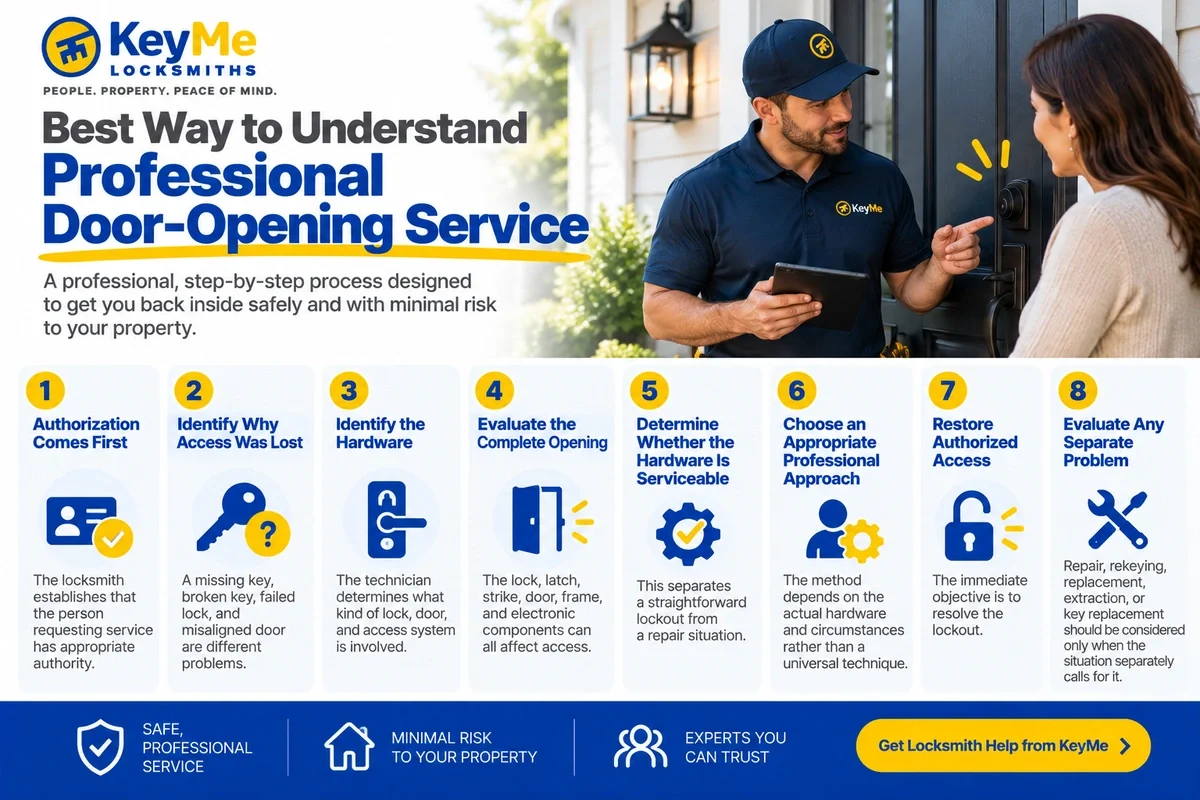
1. Authorization Comes First
The locksmith establishes that the person requesting service has appropriate authority.
2. Identify Why Access Was Lost
A missing key, broken key, failed lock, and misaligned door are different problems.
3. Identify the Hardware
The technician determines what kind of lock, door, and access system is involved.
4. Evaluate the Complete Opening
The lock, latch, strike, door, frame, and electronic components can all affect access.
5. Determine Whether the Hardware Is Serviceable
This separates a straightforward lockout from a repair situation.
6. Choose an Appropriate Professional Approach
The method depends on the actual hardware and circumstances rather than a universal technique.
7. Restore Authorized Access
The immediate objective is to resolve the lockout.
8. Evaluate Any Separate Problem
Repair, rekeying, replacement, extraction, or key replacement should be considered only when the situation separately calls for it.
Professional Entry Starts With Assessment
There is no single answer to "How does a locksmith open a door?" because there is no single locked-door situation.
A professional locksmith first establishes authorization and determines why the door will not open.
Then the technician evaluates the lock, door, hardware, and access system before selecting an appropriate professional approach.
That distinction matters because a lockout can actually be:
- A missing-key problem
- A broken-key problem
- A lock problem
- A door-alignment problem
- An electronic-access problem
- A straightforward case of an otherwise functional lock with the key inaccessible
KeyMe provides 24/7 locksmith services, including home lockout, commercial lockout, car lockout, broken key extraction, and lock repair for supported situations.
If you're currently locked out and haven't requested service yet, start with What to Do When You're Locked Out for the immediate steps to take before professional service begins.
References
- Associated Locksmiths of America (ALOA). Positive ID Policy. Professional guidance concerning identification and authorization for locksmith lockout services.
https://member.aloa.org/membersonly/ALOATechnicalStandardsPolicyver2.305012005.pdf - Associated Locksmiths of America (ALOA). Common Lock Issues. Consumer guidance concerning door alignment, weather, worn keys, hardware condition, and other causes of difficult lock operation.
https://www.aloa.org/consumers/commonlockissues - Builders Hardware Manufacturers Association (BHMA). ANSI/BHMA A156.39-2025, Residential Locksets and Latches. Current performance requirements for residential locksets and latches, including operation, durability, security, and finish.
https://buildershardware.com/ANSI-BHMA-Standards/Hardware-Highlights/A15639-2025-Residential-Locksets-and-Latches - Builders Hardware Manufacturers Association (BHMA). ANSI/BHMA A156.40-2025, Residential Deadbolts. Current performance requirements for residential deadbolts and deadlatches.
https://buildershardware.com/ANSI-BHMA-Standards/Hardware-Highlights/A15640-2025-Residential-Deadbolts