

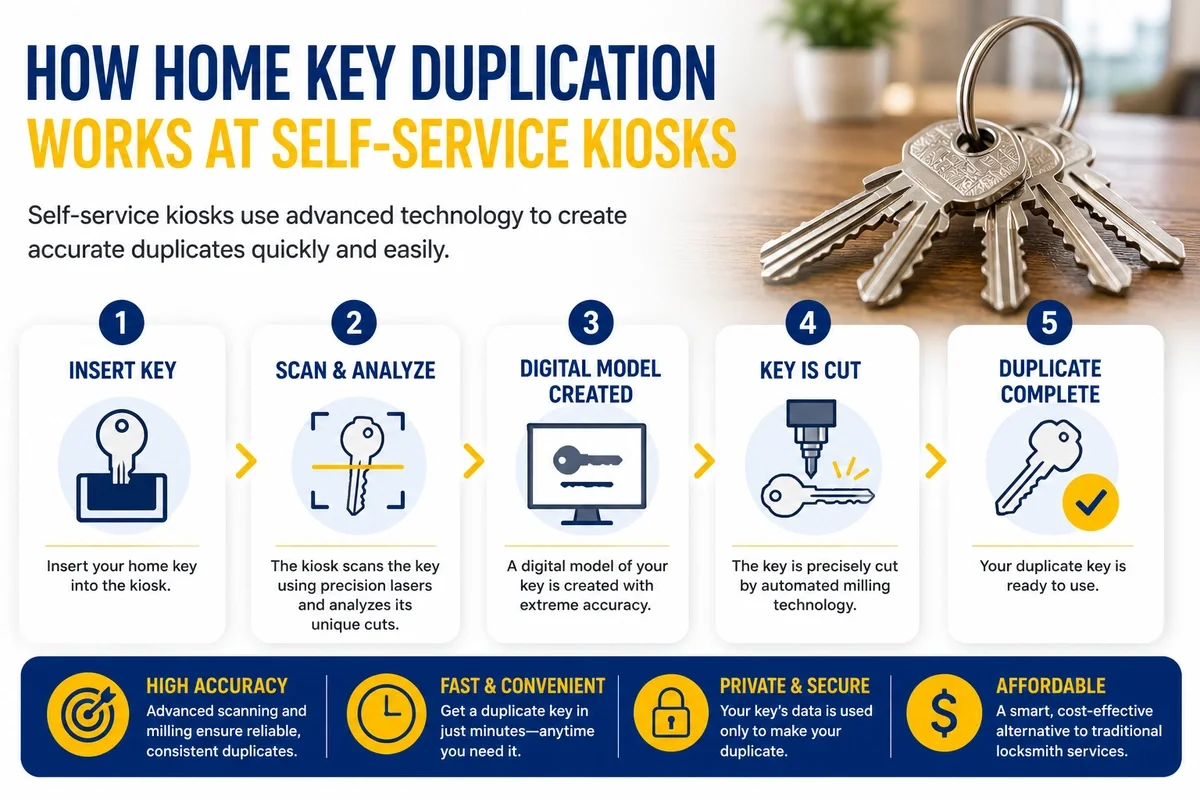
Home key duplication at a self-service kiosk begins by scanning a supported working key, identifying its physical characteristics, selecting a compatible key blank, and using automated equipment to create a duplicate based on that key's measured profile.
For a standard mechanical house key, the process is fundamentally about reproducing physical geometry. That makes it different from many automotive keys, which may also contain electronic transponders or require vehicle-specific programming.
If you are specifically evaluating whether a kiosk is appropriate for a car key, see Is It Safe to Use a Self-Service Kiosk for Car Key Duplication?.
Summary
- Bring a working key that accurately represents the lock you want the duplicate to operate.
- The kiosk scans the supported key's physical characteristics.
- The system determines whether the key type is eligible for duplication.
- A compatible blank is selected for supported keys.
- Automated cutting equipment creates the duplicate.
- The duplicate should be tested in the intended lock after it is made.
- A badly worn, bent, cracked, or unreliable source key deserves evaluation before duplication.
- Some restricted, proprietary, high-security, or electronically controlled keys may not be appropriate for ordinary self-service duplication.
- If the lock itself sticks or malfunctions, duplicating the key does not necessarily solve the underlying lock problem.
- Automotive key duplication involves a different compatibility and programming question.
Best Way to Duplicate a House Key at a Kiosk
Start with a good working source key.
Before copying it, check:
- Does it operate the intended lock normally?
- Is it straight?
- Is it free of cracks or significant damage?
- Does it insert and turn without unusual resistance?
- Is it an eligible key type?
- Are you authorized to make the duplicate?
The quality and condition of the source matter because duplication begins with information taken from that key.
ALOA notes that worn or poorly duplicated keys can cause lock-operation problems and that copying from an original key may sometimes correct issues caused by worn copies. ALOA: Common Lock Issues
Need a Locksmith? We're here to help
Connect with a trusted local locksmith for fast, professional assistance when you need it most.
Step 1: Insert the Source Key
The kiosk first needs to evaluate the key you want to duplicate.
For many supported home keys, this means inserting the original or source key into the scanning area.
Common mechanical keys may include keys used for:
- Front doors
- Back doors
- Side entrances
- Interior residential doors
- Apartments
- Condos
- Some mailboxes
- Some padlocks
- Some office doors
Not every key is eligible.
Restricted keyways, proprietary systems, specialized commercial keys, or keys containing electronic security features may follow different duplication rules.
For more detail, see What Types of Keys You Can and Can't Copy at a KeyMe Kiosk.
Step 2: The Kiosk Scans the Key
A modern KeyMe kiosk digitally evaluates the key rather than relying only on a person visually matching it with a blank.
The system analyzes physical features needed to identify and reproduce a supported key.
Depending on the key design, that can involve information such as:
- Key profile
- Blade dimensions
- Cut positions
- Cut depths
- Spacing
- Other geometry relevant to duplication
The goal is to create a digital representation that can guide the cutting process for an eligible key.
This is one of the key distinctions between automated kiosk duplication and traditional manual duplication.
Step 3: The System Determines Whether the Key Is Supported
Before a key can be duplicated, the system needs to determine whether an appropriate duplication path is available.
A key may not be supported because of:
- Keyway design
- Restricted duplication controls
- Proprietary hardware
- Electronic components
- Key condition
- Lack of a compatible blank
- Another technical limitation
This is an important part of the process.
A kiosk should not be viewed as a machine that can reproduce every object shaped like a key.
Different lock systems intentionally use different key designs and access controls.
ALOA notes that professional locksmith work extends from ordinary duplicate-key cutting to master-key systems, electronic access control, and specialized lock systems. ALOA: Locksmith Services
That broader range illustrates why not every credential follows the same duplication process.
Step 4: A Compatible Key Blank Is Identified
A duplicate needs the correct underlying key blank.
The blank must be physically compatible with the intended lock.
Two keys may look broadly similar while differing in:
- Blade profile
- Groove shape
- Width
- Thickness
- Shoulder or tip geometry
- Other manufacturer-specific features
A duplicate is not created simply by cutting the same visible pattern into any metal key.
The underlying blank has to match the lock system.
Step 5: The Key Is Cut
Once the system has identified a supported duplication path, automated cutting equipment produces the new key based on the measured key information.
This is the stage in which the physical cuts used by the lock are formed on the new blank.
For a typical mechanical house key, there is no vehicle immobilizer or transponder-programming step afterward.
That distinction matters because it keeps the subject separate from automotive duplication.
A standard home key is primarily a mechanical credential.
Step 6: Inspect the New Key
Before relying on the duplicate, look at it.
Check for obvious issues such as:
- Visible deformation
- Rough damage
- Incorrect-looking blank
- Cracks
- Other abnormal conditions
Do not intentionally alter the cuts to "fix" a duplicate yourself.
If something appears wrong, use the provider's support process rather than modifying the key.
Step 7: Test the Duplicate in the Intended Lock
A duplicate should be tested while the original working key is still available.
Insert it normally.
Confirm whether it:
- Enters fully
- Turns normally
- Operates the latch or deadbolt
- Can be removed normally
- Works without unusual force
Avoid forcing a key that does not operate properly.
ALOA identifies worn keys, worn locks, and door alignment among possible reasons a key or lock may be difficult to operate. ALOA: Common Lock Issues
That means a newly duplicated key that feels difficult to use should be evaluated rather than simply forced.
Why the Source Key Matters
A common misconception is that every working key is equally useful as a duplication source.
Consider two keys:
Key A
- Operates smoothly
- Is straight
- Shows limited wear
- Was made from a reliable source
Key B
- Requires wiggling
- Has visible wear
- Is slightly bent
- Was itself copied from another worn duplicate
Key A provides a better starting point.
ALOA specifically notes that key wear and duplication from worn keys can contribute to lock-operation issues. ALOA: Common Lock Issues
If your source key is already unreliable, determine whether the key, lock, or door is the actual problem before producing more copies.
Find a KeyMe Kiosk Near You
Need a spare key fast? Find a KeyMe kiosk near you to copy many house, office, and eligible car keys in just minutes.
What If the Key Is Worn?
Visible wear does not automatically mean duplication is impossible.
But it should prompt a question:
Does this key still accurately represent what the lock needs?
Warning signs include:
- Rounded cuts
- Thin or distorted blade
- Bent key
- Cracks
- Key requiring repeated attempts
- Heavy resistance
- Different behavior from another working key
If another better-condition original exists, it may be a more appropriate source.
If all copies behave poorly, the lock or door may need evaluation.
What If the Lock Is Difficult to Operate?
Do not assume another key will solve a lock problem.
ALOA identifies several causes of difficult lock operation, including:
- Poor door alignment
- Worn hardware
- Worn keys
- Weather-related movement
- Maintenance needs
A useful test is to compare:
- Original key vs. duplicate
- Door open vs. door closed
- One working key vs. another
If several good keys experience the same problem, the lock or opening deserves attention.
See Why Your Key Won't Turn in the Lock or residential locksmith services when appropriate.
Which Home Keys May Be Appropriate for Kiosk Duplication?
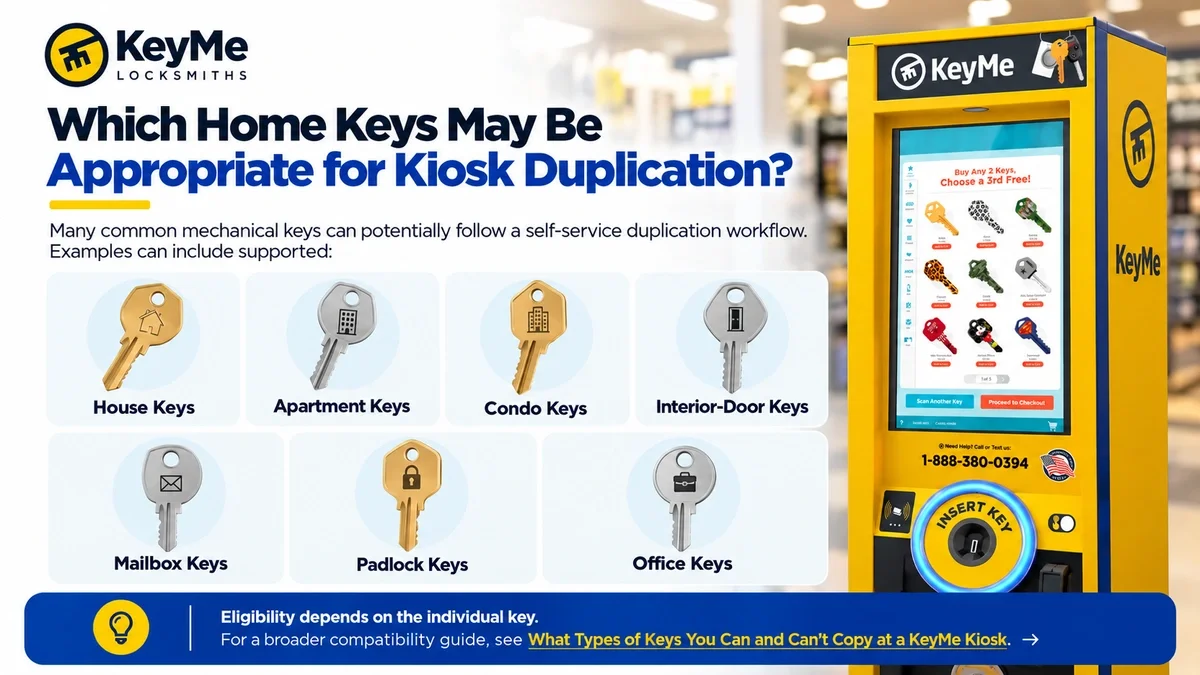
Many common mechanical keys can potentially follow a self-service duplication workflow.
Examples can include supported:
- House keys
- Apartment keys
- Condo keys
- Interior-door keys
- Mailbox keys
- Padlock keys
- Office keys
Eligibility depends on the individual key.
For a broader compatibility guide, see What Types of Keys You Can and Can't Copy at a KeyMe Kiosk.
Why Some Keys Should Not Be Treated Like Standard House Keys
Some keys are intentionally subject to additional access controls.
Examples may include:
- Restricted keyways
- Proprietary key systems
- High-security systems
- Master-keyed institutional systems
- Keys requiring authorization
- Electronic credentials
For those systems, the question is not merely whether the physical cuts can be reproduced.
Authorization and system design may also matter.
ALOA identifies complex master-key systems and electronic access-control systems as specialized areas of locksmith practice. ALOA: Locksmith Services
If you are unsure whether a key is restricted, check with the property manager, building owner, lock manufacturer, or appropriate locksmith before attempting duplication.
What About Apartment Keys?
Apartment residents should consider the building's key policies before making additional copies.
An apartment key may be:
- An ordinary mechanical change key
- Part of a master-key system
- Restricted by property policy
- Connected to a controlled access program
Do not assume that because a key physically resembles a standard house key, unrestricted duplication is appropriate.
For managed properties, follow the lease and property-management rules governing additional keys.
What About Digitally Saved Key Information?
Some KeyMe services allow eligible key information to be associated with an account for future supported duplication.
Treat saved key information as access-related data.
Use strong account-security practices and do not share account access with people who should not be able to manage your saved keys.
The important principle is the same as with a physical spare:
A key is a credential. Control who can use it.
Self-Service Kiosk vs. Online Key Copying
These are different workflows.
Self-Service Kiosk
You physically bring the supported source key to the kiosk for scanning and duplication.
Online Key Copying
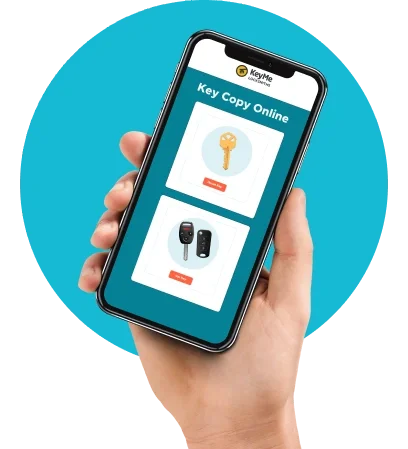
For eligible keys, KeyMe's online key-copying option allows the user to submit an image of a supported key remotely. The key is then produced through the applicable fulfillment process and shipped to the requested address.
Online key copying may be useful when an eligible key does not need to be duplicated at a kiosk.
Copy Your Key from Anywhere - Right from Your Phone
Skip the kiosk and copy your key from home. Upload a clear photo of an eligible house or car key, and KeyMe will create a precise duplicate and mail it directly to your door.
When a Locksmith Is the Better Path
A kiosk is a duplication tool.
A locksmith addresses a broader range of lock and access problems.
Professional help may be more appropriate when:
- You are locked out
- No working key remains
- A key is broken
- The lock is damaged
- The door is misaligned
- The lock needs rekeying
- The key belongs to a specialized system
- You need a new key generated rather than duplicated
- The source key is unreliable
ALOA lists duplicate-key cutting, creating keys when originals are lost, rekeying, emergency service, hardware repair, and master-key work among professional locksmith services. ALOA: Locksmith Services
Home Kiosks and Car Key Kiosks Solve Different Problems
The mechanical scanning and cutting concepts may appear similar, but the credential itself can be fundamentally different.
A typical house key may only need to operate a mechanical cylinder.
A vehicle key may need to:
- Match a mechanical lock
- Communicate with an immobilizer
- Operate remote functions
- Support proximity detection
- Be programmed to the vehicle
That is why automotive kiosk use deserves its own article.
See Is It Safe to Use a Self-Service Kiosk for Car Key Duplication?.
Why Choose KeyMe for Key Duplication
KeyMe provides multiple supported key-copying paths depending on the key and situation.
These include:
- Self-service kiosks for eligible keys
- Online key copying for eligible home keys
- KeyMe Car Key Vans for supported automotive keys
- Residential locksmith services
- Automotive locksmith services
"A successful duplicate starts with identifying the key correctly and using a source key that still represents the lock accurately. The kiosk can automate scanning and cutting, but the condition and eligibility of the original key still matter." - KeyMe Locksmiths
References
- ALOA Security Professionals Association: Common Lock Issues
- ALOA Security Professionals Association: What Services Does a Locksmith Provide?
- KeyMe Locksmiths: What Types of Keys You Can and Can't Copy at a KeyMe Kiosk
- KeyMe Locksmiths: What Is Online Key Copying and When Should You Use It?
- KeyMe Locksmiths: Residential Locksmith Services
- KeyMe Locksmiths: Why Your Key Won't Turn in the Lock