

A self-service kiosk can be an appropriate way to duplicate a supported car key when you still have a functioning original, but automotive key duplication is more complex than copying a standard mechanical house key.
The most important questions are not simply whether a kiosk can scan the key. You also need to know what type of vehicle key you have, whether the vehicle requires electronic authentication or programming, whether the original key works correctly, and whether the kiosk supports that year, make, model, and key system.
Modern vehicles may use mechanical keys, transponder chips, remote-head keys, proximity fobs, or smart keys. NHTSA notes that immobilizing anti-theft systems can incorporate computer chips into ignition keys to prevent unauthorized vehicle operation. NHTSA Vehicle Theft Prevention
That means a key can be physically cut correctly while still requiring electronic compatibility with the vehicle.
Summary
- A kiosk is best suited to planned duplication when you still have a working original key.
- Automotive key compatibility depends on the vehicle's year, make, model, and security system.
- Some car keys are purely mechanical, while others include transponders, remote functions, or proximity technology.
- A physically correct key may still require programming before the vehicle recognizes it.
- Lost-all-keys situations are different from making a spare.
- A damaged or malfunctioning original key should be diagnosed before it is used as the basis for another copy.
- Not every vehicle key is supported through the same duplication method.
- If a kiosk cannot support the key, another option may include automotive locksmith service or a KeyMe Car Key Van for supported vehicles.
- If you want to understand the kiosk process itself for standard house keys, see How Home Key Duplication Works at Self-Service Kiosks.
Best Way to Decide Whether to Use a Car Key Kiosk
Before attempting automotive duplication, identify four things:
- Do you still have a working original key?
- What type of key does the vehicle use?
- Does the vehicle require programming or electronic authentication?
- Is your specific vehicle/key combination supported?
If you cannot answer those questions, start with the vehicle's year, make, and model.
The right duplication method depends on the actual key system.
Car Keys Are Not All the Same
"Car key" can refer to several different technologies.
Traditional Mechanical Keys
Some vehicles use a mechanical blade that operates the lock and ignition without an electronic immobilizer credential.
For these keys, duplication primarily involves reproducing the correct physical key profile.
Transponder Keys
Transponder keys contain an electronic component that interacts with the vehicle's anti-theft system.
NHTSA explains that some immobilizing devices use computer chips in ignition keys to prevent thieves from bypassing the ignition. NHTSA Vehicle Theft Prevention
AAA similarly explains that a transponder key must establish the expected electronic connection with the vehicle before the engine will start. AAA: Smart Keys
That creates two separate requirements:
- The physical key must be correct.
- The vehicle must appropriately recognize the electronic credential.
Remote-Head Keys
A remote-head key may combine:
- Mechanical blade
- Transponder
- Lock button
- Unlock button
- Trunk button
- Panic button
A problem with one function does not necessarily mean every part of the key has failed.
Smart and Proximity Keys
Smart keys can communicate with a vehicle without being inserted into a traditional ignition.
AAA describes smart-key systems as using radio communication and vehicle antennas to recognize a nearby fob for features such as entry and engine starting. AAA: Smart Keys
These systems may require vehicle-specific programming or specialized service.
Car Keys Are Not All the Same
"Car key" can refer to several different technologies.
Traditional Mechanical Keys
Some vehicles use a mechanical blade that operates the lock and ignition without an electronic immobilizer credential.
For these keys, duplication primarily involves reproducing the correct physical key profile.
Transponder Keys
Transponder keys contain an electronic component that interacts with the vehicle's anti-theft system.
NHTSA explains that some immobilizing devices use computer chips in ignition keys to prevent thieves from bypassing the ignition. NHTSA Vehicle Theft Prevention
AAA similarly explains that a transponder key must establish the expected electronic connection with the vehicle before the engine will start. AAA: Smart Keys
That creates two separate requirements:
- The physical key must be correct.
- The vehicle must appropriately recognize the electronic credential.
Remote-Head Keys
A remote-head key may combine:
- Mechanical blade
- Transponder
- Lock button
- Unlock button
- Trunk button
- Panic button
A problem with one function does not necessarily mean every part of the key has failed.
Smart and Proximity Keys
Smart keys can communicate with a vehicle without being inserted into a traditional ignition.
AAA describes smart-key systems as using radio communication and vehicle antennas to recognize a nearby fob for features such as entry and engine starting. AAA: Smart Keys
These systems may require vehicle-specific programming or specialized service.
When a Self-Service Car Key Kiosk Makes the Most Sense
A kiosk is most appropriate when you are planning ahead and already possess a functioning key.
Examples include:
- You have one working vehicle key and want another.
- The original key works correctly in all expected functions.
- Your vehicle/key combination is supported.
- The required duplication or programming process is available through that service path.
The key distinction is duplication versus replacement.
If you already possess a functioning key, you are usually trying to create another authorized credential.
If no working key remains, the service problem is different.
Need a Locksmith? We're here to help
Connect with a trusted local locksmith for fast, professional assistance when you need it most.
When a Kiosk Is Not the Same as Car Key Replacement
Suppose you have lost your only vehicle key.
There is no functioning source key available to duplicate.
The service may instead require:
- Vehicle identification
- Ownership or authorization verification
- Identification of the correct key type
- Mechanical key generation where applicable
- Electronic programming
- Vehicle-specific security procedures
AAA recommends gathering information such as the VIN, year, make, model, and proof of ownership when a vehicle key must be replaced. AAA: What to Do When You Lose Your Car Keys
For supported vehicles, see car key replacement.
Why Programming Matters
A common mistake is assuming that if a new key fits the ignition, the duplication process is complete.
For vehicles using electronic authorization, physical cutting and programming are separate concepts.
Cutting
Creates the physical profile of a key blade.
Programming
Establishes the electronic relationship needed by a supported vehicle-security system.
AAA notes that many transponder keys require the vehicle to recognize the new key before it will operate as intended. AAA: Smart Keys
For more detail, see How Car Key Programming Works.
KeyMe also offers car key programming for supported vehicles.
Does the Condition of the Original Car Key Matter?
Yes.
A duplicate should not be treated as a repair for a malfunctioning source key.
Before copying, determine whether the original:
- Starts the vehicle normally
- Opens the intended doors
- Is physically bent
- Is cracked
- Has damaged buttons
- Is intermittently recognized
- Has another functional problem
If the source key is unreliable, identify why before creating another copy.
For example:
The blade is worn or bent:
The mechanical key itself may need evaluation.
The buttons do not work but the vehicle starts:
The problem may involve remote functionality rather than the immobilizer credential.
The car says "key not detected":
The issue may involve the key battery, electronic key, programming, communication, or vehicle system.
Do not assume duplication solves a pre-existing fault.
How Vehicle Compatibility Affects Kiosk Use
Vehicle keys are specific to the vehicle's security architecture.
Compatibility can depend on:
- Year
- Make
- Model
- Trim or configuration
- Key type
- Transponder system
- Immobilizer generation
- Remote functions
- Push-button start
- Programming procedure
AAA notes that smart and transponder key replacement procedures vary and that many electronically authenticated keys require specialized programming. AAA: Smart Keys
That is why automotive kiosk compatibility should be checked against the specific vehicle rather than assuming that two visually similar keys work the same way.
Is Car Key Kiosk Duplication Secure?
There are two different meanings of "safe" that are useful to separate.
Vehicle Compatibility
Will the duplicate be appropriate for the vehicle and supported key system?
This depends on the key technology and duplication method.
Key-Control Security
Are you creating an authorized spare from a key you legitimately possess?
A car key is part of the vehicle's access and, in many cases, anti-theft system. NHTSA specifically describes chipped ignition keys and immobilizers as part of vehicle theft-prevention technology. NHTSA Vehicle Theft Prevention
Drivers should therefore treat duplicates as access credentials and control who possesses them.
Find a KeyMe Kiosk Near You
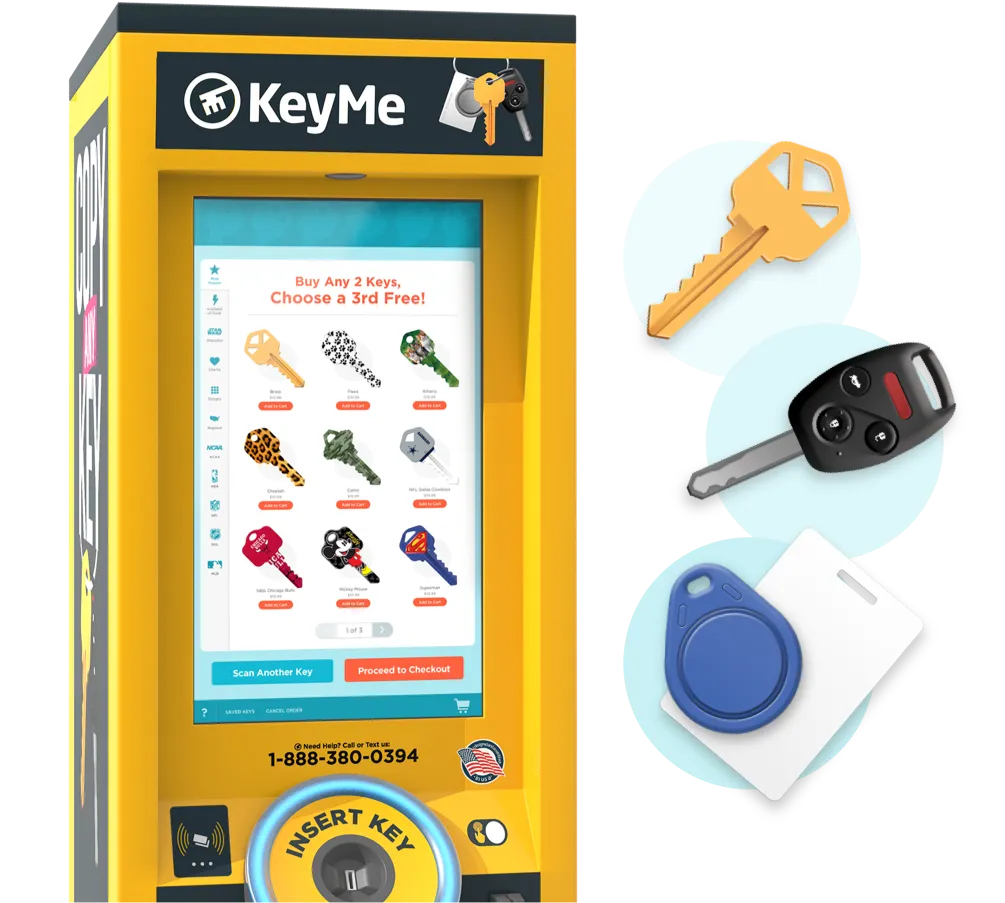
Need a spare key fast? Find a KeyMe kiosk near you to copy many house, office, and eligible car keys in just minutes.
What Information Should You Know Before Visiting a Kiosk?
Have the following available:
- Vehicle year
- Make
- Model
- Whether the vehicle uses push-button start
- Whether the key contains remote buttons
- Whether the original works normally
- Whether another spare already exists
If the kiosk identifies the key as unsupported, do not try to force the wrong service path.
A supported alternative may include:
- Automotive locksmith service
- Car key replacement
- Car key programming
- KeyMe Car Key Van service at participating retail locations for supported vehicles
What About Car Key Vans?
Some automotive keys require in-person cutting, programming, or both.
KeyMe Car Key Vans at participating retail locations provide in-person automotive key duplication and programming for supported vehicles.
This serves a different need from simple self-service duplication.
The important distinction is not whether one method is universally "better."
It is which service supports the vehicle and key technology involved.
Kiosk vs. Automotive Locksmith
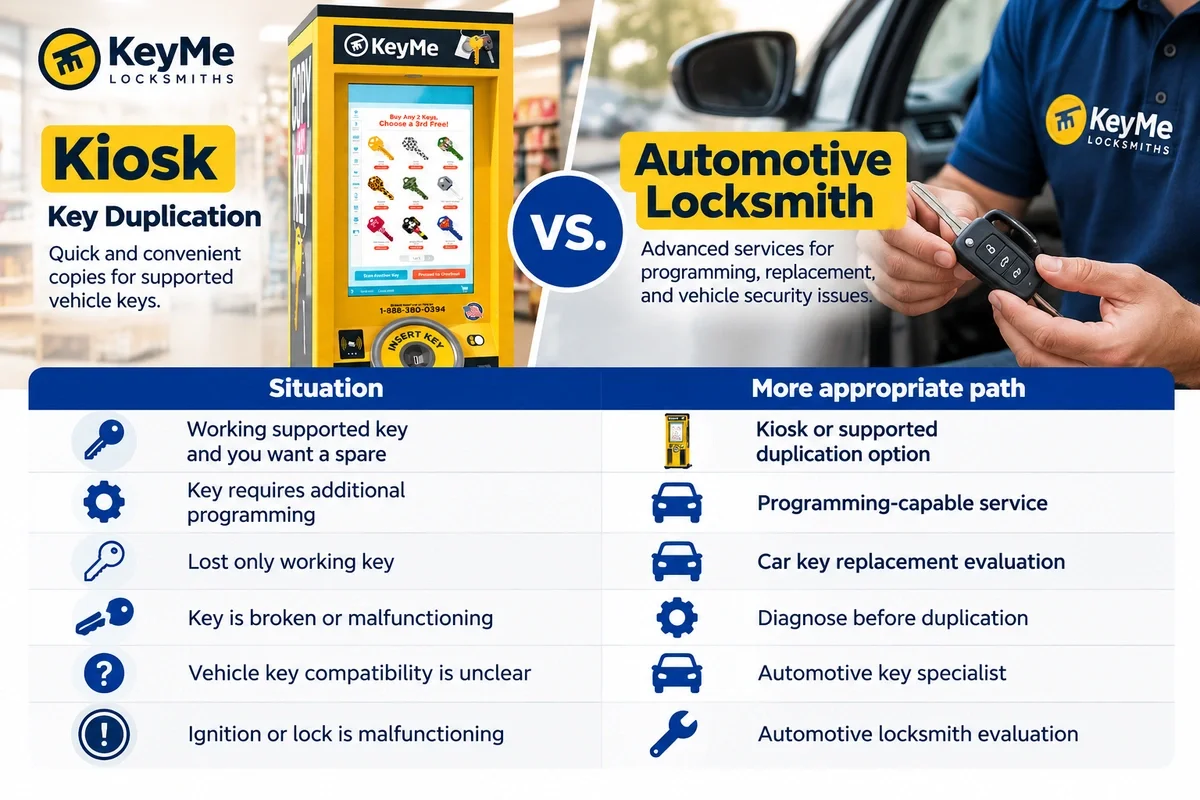
A useful way to think about the difference is by situation.
| Situation | More appropriate path |
|---|---|
| Working supported key and you want a spare | Kiosk or supported duplication option |
| Key requires additional programming | Programming-capable service |
| Lost only working key | Car key replacement evaluation |
| Key is broken or malfunctioning | Diagnose before duplication |
| Vehicle key compatibility is unclear | Automotive key specialist |
| Ignition or lock is malfunctioning | Automotive locksmith evaluation |
A locksmith can also provide services beyond duplication.
ALOA identifies replacement transponder and alarm fobs, duplicate keys, emergency services, and vehicle access among professional locksmith capabilities. ALOA: Locksmith Services
Why a Spare Car Key Is Different From an Emergency Replacement
Creating a spare is planned.
You still have:
- Vehicle access
- A functioning reference key
- Time to verify compatibility
- An opportunity to test the duplicate
Emergency replacement begins after that redundancy has already disappeared.
That is why planned duplication and all-keys-lost replacement should remain separate topics.
For the latter, see How Much Does It Cost to Replace a Car Key?.
Copy Your Key from Anywhere - Right from Your Phone
Skip the kiosk and copy your key from home. Upload a clear photo of an eligible house or car key, and KeyMe will create a precise duplicate and mail it directly to your door.
How KeyMe Supports Vehicle Keys
KeyMe offers several supported automotive key paths depending on the vehicle and situation.
These may include:
- Self-service duplication for eligible keys
- Car key replacement
- Car key programming
- KeyMe Car Key Vans for supported in-person duplication and programming
- Automotive locksmith services
"The right way to duplicate a car key starts with identifying the vehicle's key technology. A mechanical spare, transponder key, remote-head key, and proximity fob may all require different steps even though drivers commonly refer to all of them simply as car keys." - KeyMe Locksmiths
References
- National Highway Traffic Safety Administration: Vehicle Theft Prevention
- AAA: Smart Keys
- AAA: What to Do When You Lose Your Car Keys
- ALOA Security Professionals Association: What Services Does a Locksmith Provide?
- KeyMe Locksmiths: Car Key Replacement
- KeyMe Locksmiths: Car Key Programming
- KeyMe Locksmiths: How Car Key Programming Works
- KeyMe Locksmiths: What Types of Keys You Can and Can't Copy at a KeyMe Kiosk