

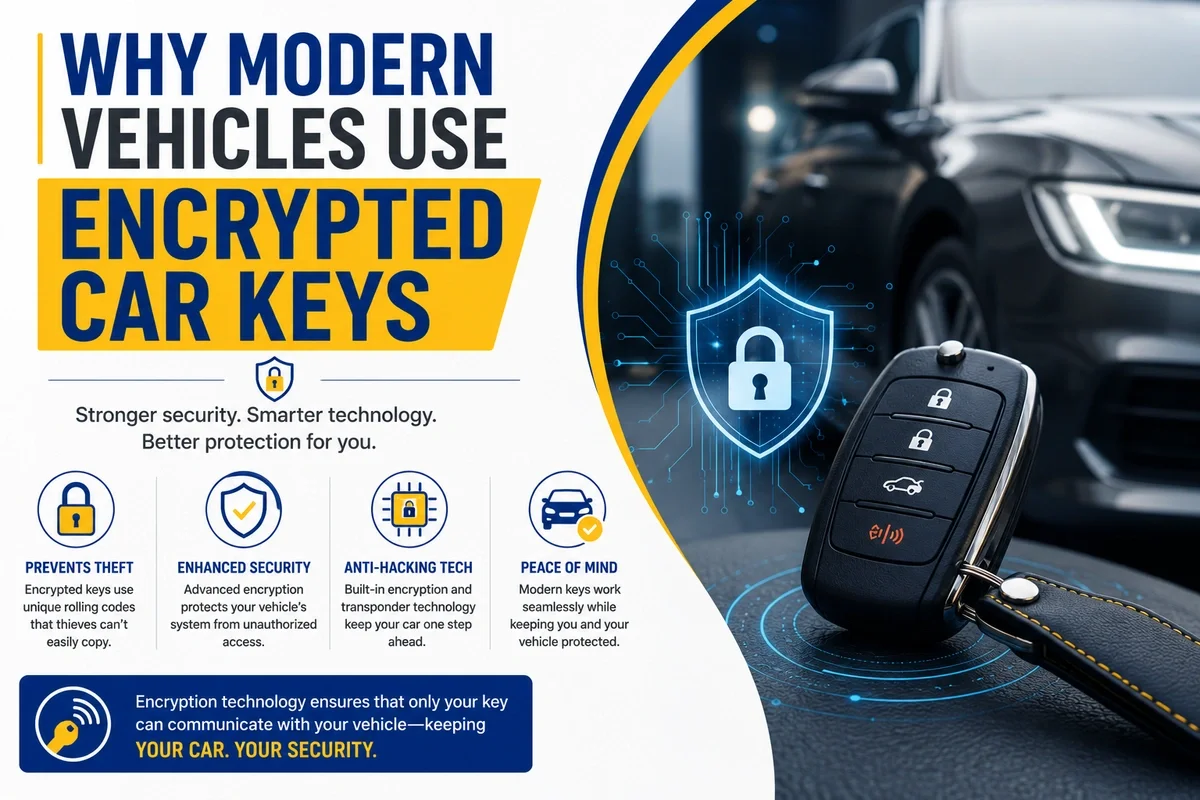
Modern vehicles use electronically authenticated keys because a physical key shape alone is no longer the only factor used to authorize vehicle operation. Many vehicles combine a mechanical key, transponder, smart key, or proximity fob with an immobilizer system that checks whether the electronic credential is recognized before allowing the vehicle to start.
That additional authorization layer helps explain why a key can physically fit a vehicle but still fail to start it, why replacement keys may need programming, and why modern car-key service can involve both mechanical cutting and electronic setup.
Summary
- Many modern vehicle keys contain electronic components in addition to a physical blade.
- An immobilizer system can prevent normal engine activation when an authorized electronic key is not recognized.
- NHTSA describes immobilizing devices as systems that can use computer chips in ignition keys or otherwise prevent the engine from operating without proper authorization.
- Transponder keys, remote-head keys, smart keys, and proximity keys can use different forms of electronic vehicle authorization.
- A mechanically correct key does not necessarily have the electronic authorization needed to start the vehicle.
- Cutting and programming are different parts of modern car-key service.
- Vehicle key technology varies by manufacturer, model, model year, and security platform.
- Smart-key convenience features and engine-start authorization are related but not necessarily the same function.
- Multiple authorized keys can exist for the same vehicle.
- If an authorized key is lost or stolen, managing that missing credential is a separate issue from understanding how the security system works.
Why Car Keys Became More Than Pieces of Cut Metal
Traditional vehicle keys relied primarily on mechanical interaction.
The key blade matched the lock or ignition cylinder, and the physical pattern determined whether the key could operate the vehicle.
Modern vehicles often add another layer.
The vehicle can require an electronic credential before allowing normal operation.
NHTSA describes immobilizing-type anti-theft devices as systems that can prevent thieves from bypassing the ignition system. Some use computer chips in ignition keys, while others interrupt electrical or fuel systems when proper authorization is absent.
That means modern vehicle access can involve two separate questions:
Does the key mechanically fit?
and
Does the vehicle electronically recognize it?
"A modern vehicle key may solve two different problems at once: mechanical access and electronic authorization. A blade can fit a lock while the vehicle separately decides whether the electronic credential is one it recognizes." - KeyMe Locksmiths
What Is an Encrypted Car Key?
The phrase "encrypted car key" is often used broadly to describe a vehicle key or fob that participates in an electronically secured authentication process.
That can include:
- Transponder keys
- Remote-head keys
- Smart keys
- Proximity keys
- Push-to-start key fobs
Not every vehicle uses the same electronic architecture.
Some systems rely on transponder identification.
Others use more advanced challenge-response or changing-code systems.
The important consumer takeaway is that the vehicle is not relying only on the visible physical shape of the key.
It is also checking for an authorized electronic credential.
What Is a Vehicle Immobilizer?
An immobilizer is an anti-theft system designed to prevent unauthorized vehicle operation.
NHTSA explains that immobilizing devices can prevent thieves from bypassing the ignition and that some systems incorporate computer chips into ignition keys.
A modern immobilizer can require the vehicle to recognize an authorized electronic key before normal engine operation is allowed.
Manufacturer implementations vary, but the general relationship looks like this:
Key or fob presents an electronic credential
↓
Vehicle security system checks it
↓
Credential recognized or rejected
↓
Vehicle allows or prevents applicable starting authorization
An NHTSA-hosted vehicle manual similarly describes an immobilizer system that prevents a key that has not been preregistered from starting the engine and notes that the keys contain electronic transmitters used for verification.
Need a Locksmith? We're here to help
Connect with a trusted local locksmith for fast, professional assistance when you need it most.
How Does the Vehicle Recognize the Key?
The exact process depends on the vehicle.
At a high level, the vehicle and key exchange or verify electronic information.
The vehicle then determines whether the presented credential belongs to its authorized set.
That electronic authorization can be separate from the mechanical key cut.
This is why a newly cut key can sometimes:
- Fit the door
- Turn a mechanical cylinder
- Match the original blade
but still fail to start the vehicle if the required electronic credential has not been established.
Transponder Keys
A transponder key contains an electronic component that communicates with the vehicle's security system.
Many transponder keys also contain a conventional mechanical blade.
That creates two layers:
Mechanical layer: the blade physically operates a compatible lock or ignition cylinder.
Electronic layer: the vehicle recognizes the transponder as authorized.
If only the blade is duplicated, the resulting key may not perform every function of the original.
For supported replacement needs, see car key programming.
Remote-Head Keys
A remote-head key combines several functions in one device.
Depending on the vehicle, it may include:
- Mechanical key blade
- Transponder
- Remote lock and unlock buttons
- Other remote functions
These functions should not be assumed to be one system.
For example, remote buttons can involve one communication pathway, while engine authorization can involve the immobilizer system.
A problem with one function does not automatically mean every function has failed.
Smart and Proximity Keys
Smart and proximity keys allow many vehicles to recognize an authorized key without requiring the driver to insert a traditional blade during normal operation.
The vehicle can detect the authorized electronic credential when it is nearby or inside the vehicle.
That can support functions such as:
- Passive entry
- Push-to-start
- Remote locking
- Remote unlocking
Many smart keys also contain a concealed mechanical backup blade.
That backup blade is an important reminder that electronic authorization and mechanical access remain separate layers.
Why Doesn't a Correctly Cut Key Always Start the Car?
Because cutting and authorization are not the same thing.
A cut key reproduces the applicable physical geometry.
That can be enough for older mechanical-only systems.
For a vehicle with an immobilizer, the electronic credential may also need to be recognized by the vehicle.
NHTSA has documented immobilizer systems in which properly coded electronic keys are required for normal vehicle activation.
So a physical blade may be correct while the electronic portion is incomplete or unauthorized.
This is why modern car-key service can involve both:
depending on the vehicle and key.
What Is Car Key Programming?
Car key programming establishes or updates the electronic relationship between a supported key and the vehicle.
Depending on the vehicle, programming can involve:
- Registering a transponder
- Adding a smart key
- Establishing proximity functionality
- Configuring supported remote functions
- Updating which keys the vehicle recognizes
The exact procedure varies significantly by manufacturer and platform.
A key that looks identical to the original does not automatically mean the vehicle will recognize it electronically.
Why Manufacturers Use Electronic Key Authentication
Electronic authentication adds a layer beyond mechanical key shape.
That matters because a purely mechanical system depends mainly on whether a physical object can operate the cylinder.
An electronic system can also require vehicle-specific authorization.
NHTSA notes that immobilizers are intended to prevent unauthorized normal vehicle operation by interfering with starting or engine activation when the required authorization is not present.
This can support:
- Vehicle-specific key recognition
- Immobilizer functionality
- Smart-key systems
- Push-to-start systems
- Management of multiple authorized keys
It does not make a vehicle theft-proof.
No single security technology eliminates every form of vehicle theft.
Can a Vehicle Have More Than One Authorized Key?
Yes.
Many vehicles are designed to recognize multiple authorized keys.
That allows a vehicle owner to have:
- Primary key
- Spare key
- Second-driver key
- Additional authorized key where supported
How many keys a vehicle can recognize and how they are managed depends on the vehicle's security system.
This becomes particularly important when one key goes missing.
The question then changes from:
How does the vehicle recognize authorized keys?
to:
Can the missing credential be removed from the authorized set?
That belongs to a separate service question.
Find a KeyMe Kiosk Near You
Need a spare key fast? Find a KeyMe kiosk near you to copy many house, office, and eligible car keys in just minutes.
Why Vehicle Compatibility Matters
Vehicle-key technology is not universal.
The correct service can depend on:
- Year
- Make
- Model
- Trim
- Key type
- Immobilizer system
- Existing keys
- Electronic functions involved
Two keys that look similar can have different electronic requirements.
Likewise, two vehicles from the same manufacturer can use different systems across model years.
For supported options, see KeyMe Vehicle Keys.
What Happens When You Need a Replacement Encrypted Key?
Replacement starts with identifying the vehicle and key system.
Depending on the vehicle, the service may involve:
- Creating the mechanical key
- Registering the electronic credential
- Programming remote functions
- Establishing smart-key functionality
- Verifying applicable vehicle functions
KeyMe provides car key replacement and car key programming for supported vehicles.
KeyMe Car Key Vans also provide in-person duplication and programming for supported vehicles at participating retail locations.
What If the Key Is Lost or Stolen?
A missing key creates a different issue from ordinary replacement.
The question is no longer just:
Can another key be created?
It is also:
Should the vehicle continue recognizing the missing electronic credential?
Depending on the vehicle, a qualified automotive locksmith may be able to update the vehicle's authorized-key records and remove a missing credential.
For that separate process, see Can a Locksmith Disable Lost or Stolen Car Keys?.
If the key was specifically stolen, see What to Do If Your Car Key Is Stolen for the broader incident-response steps.
Best Way to Understand Modern Car Key Security
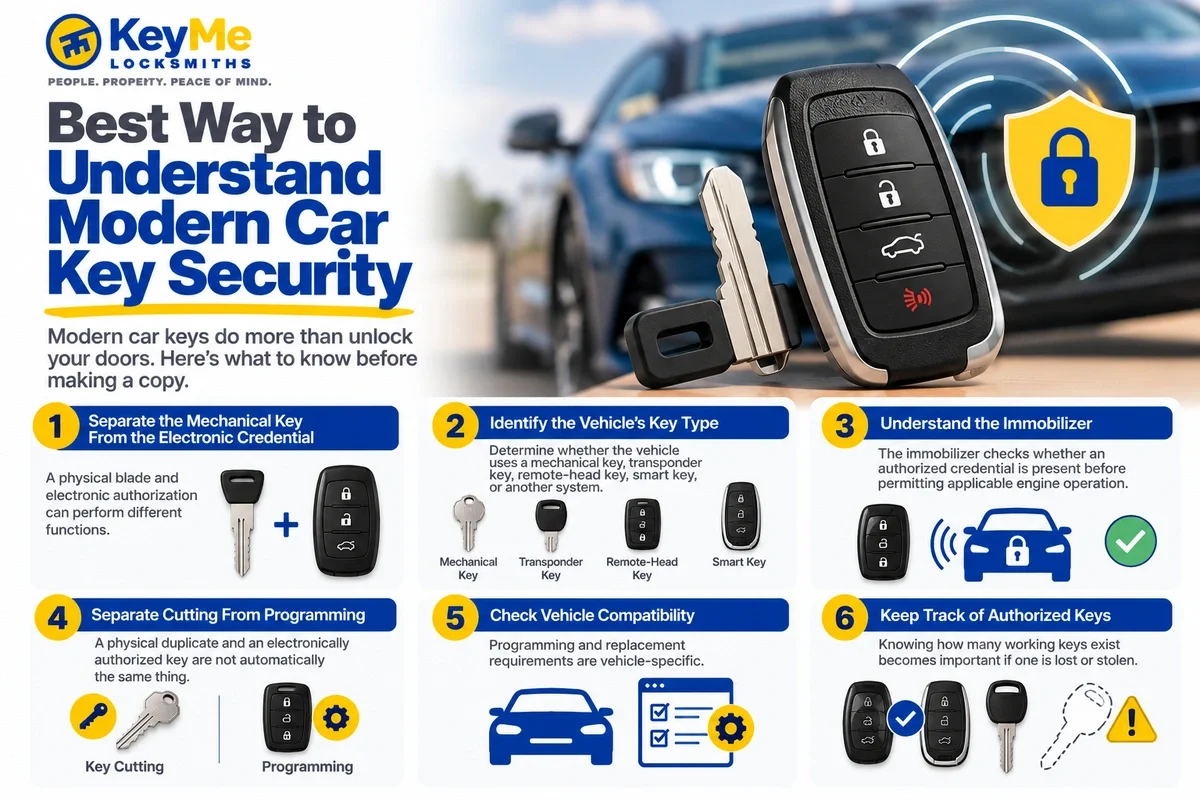
1. Separate the Mechanical Key From the Electronic Credential
A physical blade and electronic authorization can perform different functions.
2. Identify the Vehicle's Key Type
Determine whether the vehicle uses a mechanical key, transponder key, remote-head key, smart key, or another system.
3. Understand the Immobilizer
The immobilizer checks whether an authorized credential is present before permitting applicable engine operation.
4. Separate Cutting From Programming
A physical duplicate and an electronically authorized key are not automatically the same thing.
5. Check Vehicle Compatibility
Programming and replacement requirements are vehicle-specific.
6. Keep Track of Authorized Keys
Knowing how many working keys exist becomes important if one is lost or stolen.
Why Choose KeyMe for Vehicle Key Services?
KeyMe provides several automotive key service paths for supported vehicles.
These include:
- Vehicle keys
- Car key replacement
- Car key programming
- Lost car key replacement
- Car locksmith services
- Car Key Vans
The appropriate service depends on the vehicle, key technology, and whether the customer needs duplication, replacement, programming, or help with a missing credential.
Copy Your Key from Anywhere - Right from Your Phone
Skip the kiosk and copy your key from home. Upload a clear photo of an eligible house or car key, and KeyMe will create a precise duplicate and mail it directly to your door.
Modern Car Keys Combine Access With Authorization
A modern vehicle key can do more than physically fit a lock.
It can also act as an electronic credential that the vehicle evaluates before allowing normal operation.
That is why modern key service can involve:
Mechanical cutting
and
Electronic programming
as separate parts of the same overall job.
NHTSA's vehicle-theft guidance identifies immobilizing devices, including systems using computer chips in ignition keys, as an established form of vehicle anti-theft technology.
Once an authorized key goes missing, however, the question changes.
See Can a Locksmith Disable Lost or Stolen Car Keys? for how supported vehicles may allow missing electronic credentials to be removed from the authorized-key system.
References
- National Highway Traffic Safety Administration (NHTSA). Vehicle Theft Prevention. Current federal consumer guidance describing immobilizing anti-theft devices, including systems that use computer chips in ignition keys.
https://www.nhtsa.gov/vehicle-safety/vehicle-theft-prevention - National Highway Traffic Safety Administration (NHTSA). FMVSS No. 114 Interpretation. Federal background on theft-protection requirements and immobilizer-based vehicle activation systems.
https://www.nhtsa.gov/interpretations/gf005229-2 - KeyMe Locksmiths. Car Key Programming. Information about programming supported automotive keys.
https://key.me/car-key-programming - KeyMe Locksmiths. Vehicle Keys. Information about supported automotive key types and service options.
https://key.me/vehicle-keys - KeyMe Locksmiths. Car Key Replacement. Information about supported vehicle-key replacement services.
https://key.me/car-key-replacement