
How Push-to-Start Systems Communicate With Smart Keys
Push-to-start vehicles use wireless communication between the vehicle and a programmed smart key to verify authorized access before the engine starts. Instead of relying on a traditional metal key inserted into the ignition, these systems continuously exchange encrypted signals to determine whether the correct key is nearby.
Modern push-to-start systems are designed to improve both convenience and vehicle security. Drivers can unlock doors, start the engine, and operate certain vehicle functions without physically handling the key in many situations.
Understanding how these systems work can help explain common issues like:
- “Key not detected” warnings
- Smart key battery failures
- Push-button start problems
- Key programming requirements
- Vehicle lockouts involving proximity fobs
KeyMe Locksmiths connects drivers with locksmith professionals experienced in smart key programming and modern vehicle access systems.
What Is a Push-to-Start System?
A push-to-start system replaces the traditional ignition cylinder with:
- A wireless smart key or proximity fob
- Electronic vehicle authentication systems
- A push-button ignition interface
Instead of physically turning a key, drivers start the vehicle by pressing a button while the vehicle detects an authorized smart key nearby.
Most systems also support:
- Keyless entry
- Remote locking and unlocking
- Trunk access
- Passive entry features
How Smart Keys Communicate With the Vehicle
Push-to-start systems rely on short-range wireless communication between:
- The smart key
- Antennas located throughout the vehicle
- The vehicle’s onboard computer and immobilizer system
When the key enters a certain proximity range:
- The vehicle sends a signal searching for an authorized key
- The smart key responds with an encrypted identification code
- The vehicle verifies the code
- If authenticated, the vehicle allows ignition and access functions
This communication happens almost instantly.
“Smart keys constantly exchange encrypted information with the vehicle to confirm authorized access.” — KeyMe Locksmiths
Why Encryption Matters in Smart Key Systems
Modern vehicles use encrypted communication to help prevent:
- Unauthorized key duplication
- Vehicle theft
- Signal spoofing
- Hot-wiring attempts
Many systems use rolling or changing encrypted codes, meaning the communication updates continuously rather than using a fixed signal.
According to SAE International, encrypted automotive key systems have become increasingly sophisticated as manufacturers work to improve anti-theft protection and electronic security.
What Happens When You Press the Start Button?
When you press the ignition button:
- The vehicle checks for a nearby authorized smart key
- The immobilizer system verifies the encrypted code
- The transmission and brake conditions are checked
- The engine start sequence is authorized
If the system cannot verify the key, the engine typically will not start.
Common warning messages include:
- “Key not detected”
- “No key present”
- “Smart key system malfunction”
Why Push-to-Start Systems Sometimes Fail to Detect Keys
Several issues can interrupt communication between the vehicle and the smart key.
Weak or Dead Key Fob Battery
This is one of the most common causes of smart key problems.
A weak battery may cause:
- Reduced detection range
- Intermittent recognition
- Push-button start failure
- Delayed remote responses
According to Consumer Reports, low key fob battery power is one of the most frequent causes of smart key reliability complaints.
Signal Interference
Wireless interference from:
- Parking garages
- Electronic devices
- Cell towers
- Metal structures
can occasionally disrupt smart key communication.
Damaged Smart Keys
Drops, water exposure, and physical damage may affect:
- Internal chips
- Antennas
- Battery contacts
- Circuit boards
Programming or Synchronization Problems
Sometimes the vehicle and smart key lose proper communication due to:
- Electrical issues
- Vehicle computer resets
- Corrupted programming
- Failed software updates
Can Smart Keys Work Without Batteries?
Some vehicles include backup methods for starting the car if the smart key battery dies.
Depending on the manufacturer, this may involve:
- Holding the fob near the start button
- Using a hidden emergency key insert
- Placing the fob in a designated backup location
The exact procedure varies by vehicle.
Why Smart Keys Require Programming
Unlike traditional keys, smart keys must be electronically paired with the vehicle.
Programming may involve:
- Registering the key with the immobilizer system
- Syncing remote functions
- Pairing encrypted communication codes
Without proper programming:
- The vehicle may not start
- The doors may not unlock remotely
- Push-button ignition may fail
“A physically cut key alone is not enough for most push-to-start vehicles.” — KeyMe Locksmiths
Can Locksmiths Program Push-to-Start Smart Keys?
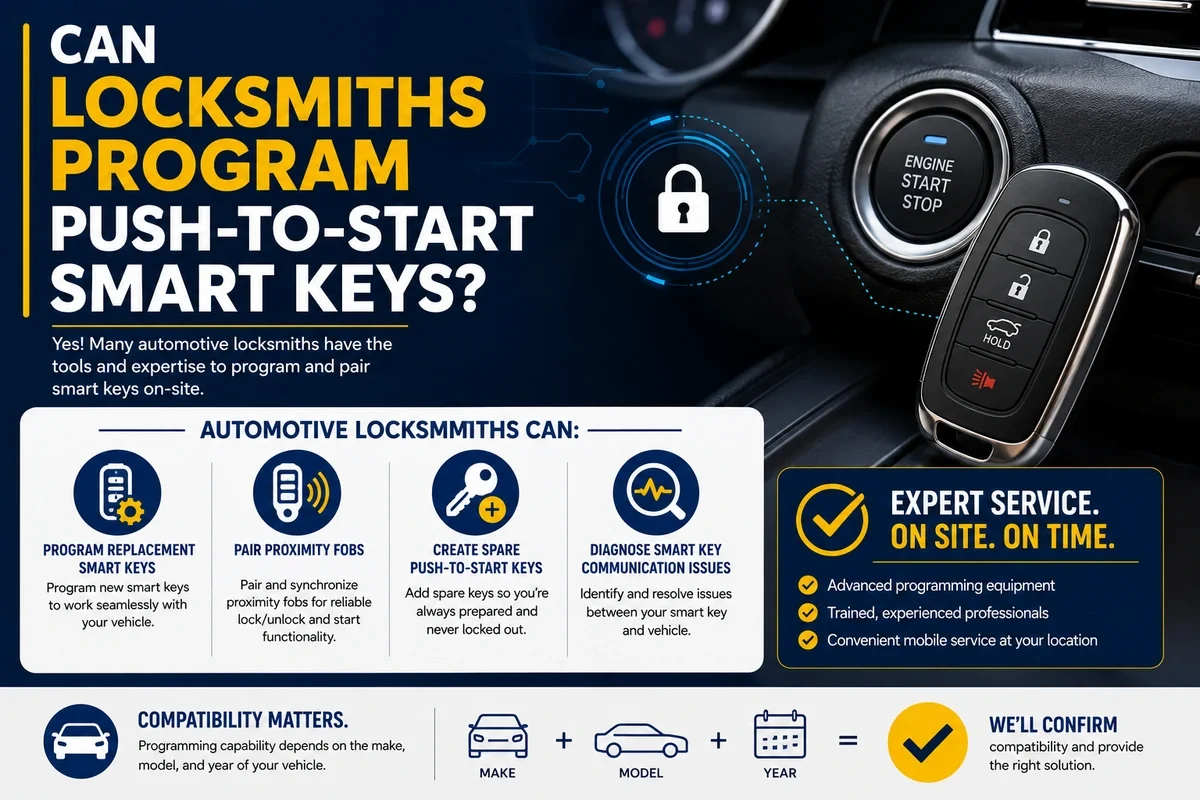
Many automotive locksmiths can:
- Program replacement smart keys
- Pair proximity fobs
- Create spare push-to-start keys
- Diagnose smart key communication issues
Compatibility depends on the make, model, and year of the vehicle.
KeyMe offers several smart key support options, including:
- Car key duplication for supported vehicles
- Online key copying for eligible key types
- Car key vans providing in-person cutting and programming at select retail locations
How Drivers Can Protect Smart Key Systems
Replace Key Fob Batteries Early
Weak batteries are one of the most common causes of communication failure.
Keep Spare Smart Keys Tested
Unused spare keys may develop battery or programming issues over time.
Avoid Extreme Heat & Moisture
Electronic key components can be damaged by environmental exposure.
Create a Backup Key Before an Emergency
Having a second programmed key can help reduce lockout and replacement complications.
Frequently Asked Questions
Why does my car say “key not detected” when the key is inside?
This may be caused by a weak battery, signal interference, or communication failure between the smart key and the vehicle.
Are push-to-start systems more secure than traditional keys?
Many modern systems use encrypted communication and immobilizer technology designed to improve theft prevention.
Can a locksmith replace a push-to-start smart key?
Many automotive locksmiths can replace and program compatible smart keys and proximity fobs.
Do smart keys always need batteries?
Most smart keys rely on batteries for wireless communication, though some vehicles include emergency backup starting procedures.
Why won’t my spare smart key work anymore?
Battery failure, lost programming, or internal damage may prevent the vehicle from recognizing the key.
Understanding Modern Smart Key Technology
Push-to-start systems rely on continuous encrypted communication between the vehicle and the smart key to balance convenience with security. As vehicle technology continues evolving, understanding how these systems work can help drivers better manage replacement keys, programming needs, and lockout situations.
Explore car key duplication, programming, and replacement solutions with KeyMe Locksmiths.
References
- SAE International — Automotive Electronic Security & Smart Key Systems https://www.sae.org/
- Consumer Reports — Smart Key & Key Fob Reliability Information https://www.consumerreports.org/cars/
- IEEE Spectrum — Vehicle Security & Wireless Automotive Technology https://spectrum.ieee.org/
About KeyMe Locksmiths
KeyMe Locksmiths is a leading provider of local locksmith services and key copy kiosks across 50 states and the District of Columbia. Proud to serve over 5 million customers, KeyMe Locksmiths cuts over 10 million keys annually. With more than 8,000 self-service kiosks in major retailers, an e-commerce platform delivering over 10,000 keys weekly, and a nationwide locksmith network, KeyMe Locksmiths provides fast, reliable solutions for residential,