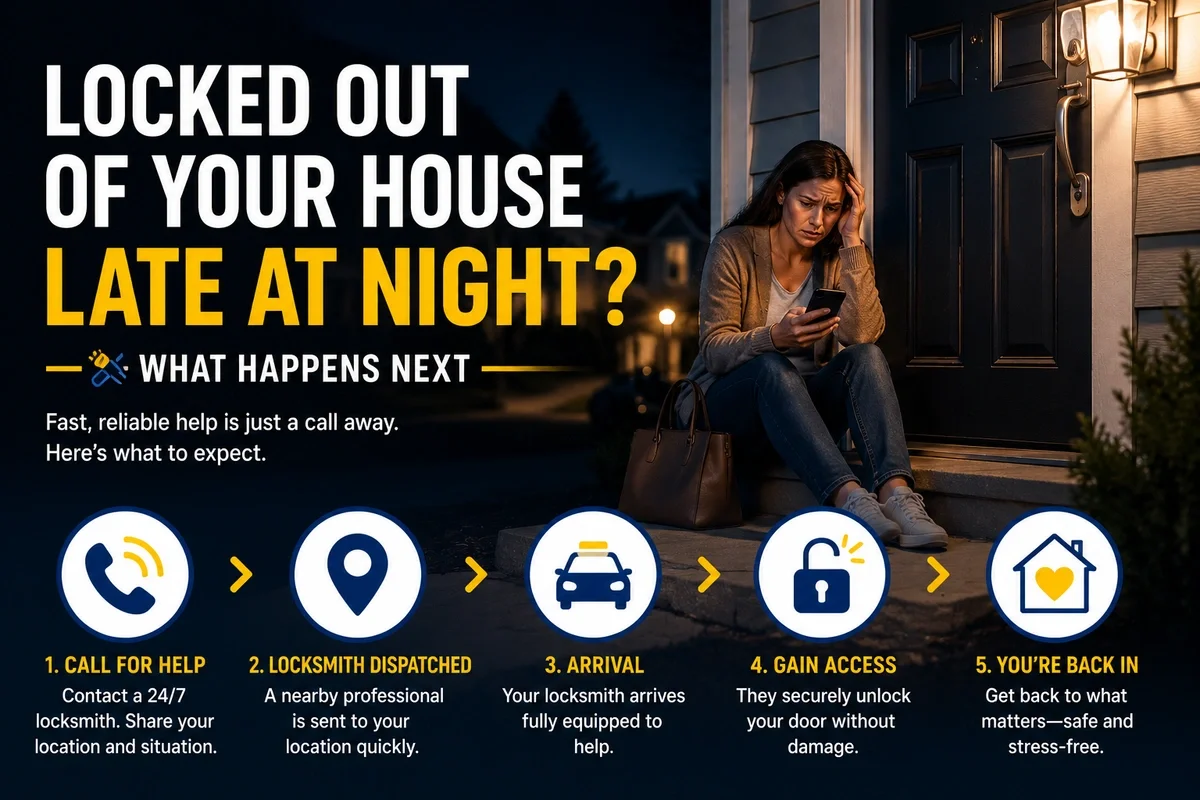
If you're locked out of your house late at night, move to a safe, well-lit place, confirm whether a trusted person has a spare key, and contact a 24/7 residential locksmith if you cannot regain normal access. Avoid forcing the door, damaging the lock, or attempting risky entry methods.
A nighttime house lockout can feel more urgent than the same problem during the day because:
- Fewer people may be awake to help
- Businesses may be closed
- Weather may be worse
- Visibility may be limited
- Your phone battery may be low
- Children, pets, medication, or other important needs may be inside
The goal is to regain legitimate access without turning a lockout into a damaged door, broken window, or personal-safety problem.
Summary
- Move somewhere safe and well-lit before troubleshooting the lockout.
- Check whether another household member or trusted person has a spare key.
- Check normal exterior entrances only if you can do so safely.
- Do not force doors, break windows, or attempt improvised lock-bypass methods.
- A 24/7 emergency locksmith may be appropriate when no normal access option is available.
- Be ready to provide your address and show that you are authorized to enter the home.
- Tell the locksmith whether the key is lost, broken, locked inside, or not operating correctly.
- If the key was lost, consider the security implications after access is restored.
- If the lock was already difficult to use, a lockout may reveal a separate hardware problem.
- Apartment residents have a different decision path involving property management and building access. See Emergency Locksmith Help for Apartment Lockouts.
Best Way to Handle a Late-Night House Lockout
Use this order:
- Move to a safe place.
- Confirm the type of lockout.
- Check whether someone has a spare key.
- Check normal, legitimate alternate entrances if it is safe to do so.
- Contact a 24/7 locksmith if no normal access option exists.
- Have identification or other proof of residence available.
- Once inside, determine whether anything else needs attention, such as a missing key or malfunctioning lock.
"During a late-night lockout, the first priority is not the lock. It is making sure you have a safe place to wait while you arrange legitimate access to the home." - KeyMe Locksmiths
Need a Locksmith? We're here to help
Connect with a trusted local locksmith for fast, professional assistance when you need it most.
1. Move Somewhere Safe and Well-Lit
Before focusing on the door, consider your surroundings.
If possible, wait somewhere such as:
- Porch or entry area with good lighting
- Trusted neighbor's home
- Nearby open business
- Lobby or common area you are authorized to use
- Vehicle, when it is safe and appropriate
- Another secure location nearby
Cold, heat, rain, poor visibility, or an isolated location can make the situation more serious.
If you believe there is an immediate danger to a person inside the home, contact the appropriate emergency service rather than treating the situation as an ordinary locksmith call.
2. Figure Out What Kind of Lockout You Have
The solution can depend on what happened.
Key Is Inside the House
You know where the key is, but you cannot reach it.
Key Is Lost
The key is missing and its location is unknown.
Key Is Broken
The key may have snapped or become damaged.
Key Will Not Turn
You have the key, but the lock is not functioning normally.
Door Closed Behind You
The entry may use a latch that locked automatically when the door closed.
These situations can look identical from outside the house but lead to different next steps.
3. Check Whether Someone Has a Spare Key
Before arranging service, think about authorized spare keys.
Potential keyholders may include:
- Spouse or partner
- Family member
- Trusted neighbor
- Housemate
- Other person you have intentionally given access
If a spare can be brought to you safely, it may resolve the lockout without changing anything about the lock.
4. Check Normal Alternative Entrances
If it is safe to do so, check whether another legitimate exterior door is normally accessible.
For example:
- Front door
- Back door
- Garage-entry door
Do not climb onto roofs, force windows, enter through unsafe openings, or damage the home trying to create another route.
The goal is to find an existing authorized entrance, not bypass the property's security.
5. Call a 24/7 Residential Locksmith When Needed
If no normal access option works, an emergency locksmith may be able to help with a supported residential lock.
When you call, provide:
- Address
- Which door is locked
- Lock type if known
- Whether the key is inside, lost, broken, or malfunctioning
- Whether the lock had problems before tonight
- Whether there are unusual access conditions around the home
Be clear about the situation rather than simply saying, "I'm locked out."
That information can help determine what kind of service is needed.
What Will a Locksmith Need From You?
A locksmith may need to establish that you are authorized to enter the property.
Depending on the situation, useful documentation can include:
- Government-issued ID
- Address documentation
- Property records
- Lease documentation if you rent a house
- Other reasonable evidence connecting you to the residence
If your wallet and identification are locked inside, explain that before the locksmith arrives.
What Happens When the Locksmith Arrives?
The locksmith will generally need to:
- Confirm the property and authorization.
- Inspect the door and lock.
- Determine the appropriate service for the specific hardware.
- Restore legitimate access where supported.
- Identify any separate lock problem discovered during service.
A routine lockout does not automatically mean the lock should be replaced.
Once access is restored, repair, rekeying, or replacement should be considered separately based on what actually happened.
What If Your House Key Is Lost?
A missing key changes the situation.
Getting inside solves the access problem.
It does not necessarily solve the key-control problem.
After you regain access, consider:
- Where the key may have been lost
- Whether it was attached to identifying information
- Which doors it operates
- Whether another copy still exists
- Whether someone could reasonably connect it to your home
Those questions determine whether further action may be appropriate.
For that decision, see What to Do After Losing Your House Keys.
What If Your Key Broke in the Lock?
Do not keep pushing the broken piece deeper into the cylinder.
A broken-key problem may require:
- Extraction
- Inspection of the lock
- Replacement key
- Repair if the lock was damaged
See broken key extraction for the dedicated service.
What If the Key Goes In but the Lock Will Not Turn?
That can indicate a different problem from a normal lockout.
Possible issues can involve:
- Worn key
- Worn cylinder
- Door misalignment
- Binding deadbolt
- Loose hardware
- Damaged lock
- Pressure between the door and frame
A lock that has been getting progressively harder to operate should not automatically be treated as a simple key problem.
After access is restored, lock repair and installation may be appropriate.
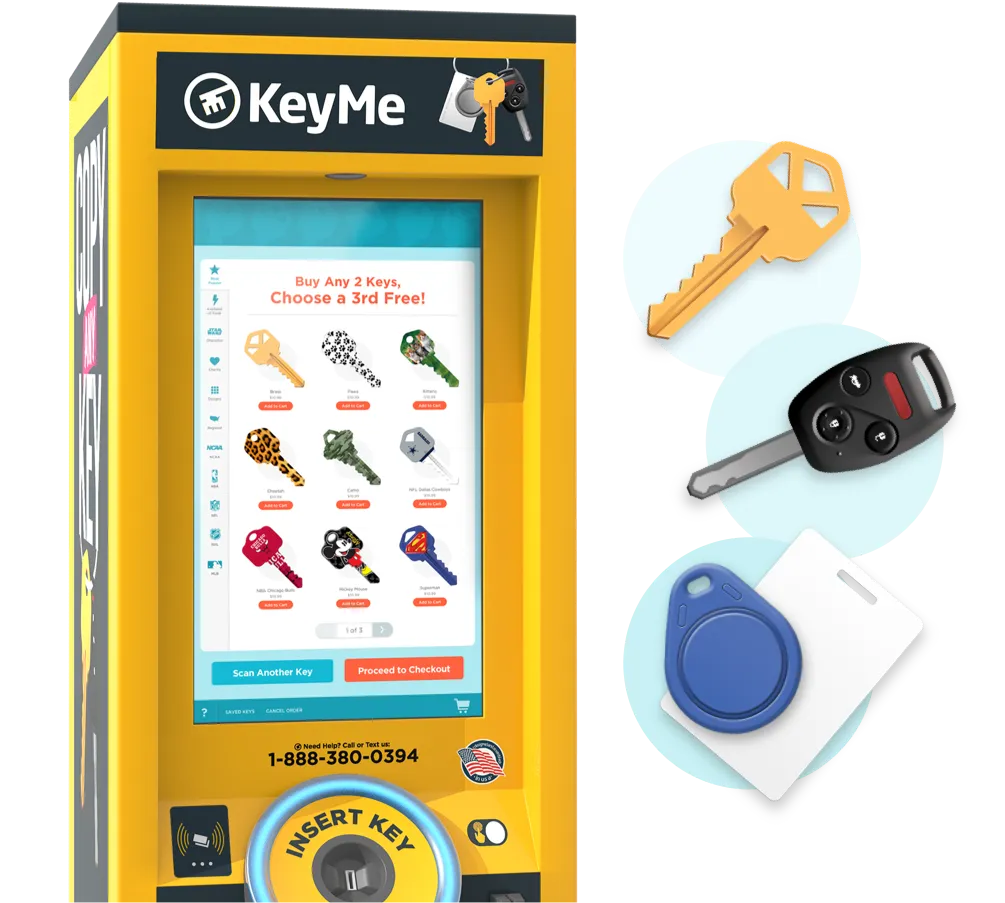
Find a KeyMe Kiosk Near You
Need a spare key fast? Find a KeyMe kiosk near you to copy many house, office, and eligible car keys in just minutes.
What If the Door Closes but the Deadbolt Will Not Work?
That is not primarily a lockout problem once you are back inside.
It may involve:
- Strike alignment
- Door sag
- Deadbolt alignment
- Loose hardware
- Frame movement
- Lock damage
Do not assume rekeying will fix a mechanical alignment problem.
Rekeying changes which key operates a compatible lock. It does not correct every hardware or door issue.
Should You Rekey the Lock After a House Lockout?
Not automatically.
Consider rekeying when the concern is who may have a working key, not simply because you were temporarily locked outside.
Examples include:
- Key is genuinely lost
- Unknown person may have obtained it
- Household access is changing
- You intentionally want old keys to stop working
For supported locks, see lock rekeying.
If you're deciding between changing the internal keying and installing new hardware, see Rekeying vs. Replacing Your Locks.
Should You Replace the Lock After a Lockout?
Again, not automatically.
Replacement may become relevant if:
- Lock is damaged
- Hardware has failed
- You want different features
- Existing lock is unsuitable
- You intentionally want to change the hardware
For supported residential hardware, see lock replacement.
The lockout itself is not proof that replacement is necessary.
Late-Night Lockout Situations That Need Extra Attention
Some lockouts involve more than inconvenience.
Child or Vulnerable Person Inside
If someone inside is in immediate danger, contact emergency services rather than waiting for an ordinary locksmith response.
Pet Inside
Consider temperature, health needs, and the length of time the animal will be unattended.
If there is an immediate welfare emergency, seek the appropriate emergency assistance.
Medication or Medical Equipment Inside
If missing access to essential medication or equipment creates an immediate medical concern, treat it as a health issue rather than only a locksmith issue.
Severe Weather
Extreme heat, cold, storms, or unsafe outdoor conditions can make waiting outside risky.
Move to a safe location while arranging access.
Phone Battery Is Nearly Dead
Preserve enough battery to:
- Call for help
- Receive calls from the locksmith
- Confirm your address
- Access digital identification or property information if needed
If possible, use a charger in a safe location.
What Not to Do During a House Lockout
Avoid turning a temporary inconvenience into a larger repair problem.
Do not:
- Force the door
- Kick or shoulder the door
- Break a window simply to gain entry
- Damage the lock
- Insert improvised objects into the cylinder
- Attempt online lock-bypass techniques
- Climb to unsafe windows or balconies
- Ask an unverified stranger to manipulate the lock
These approaches can create:
- Injury risk
- Broken glass
- Door damage
- Frame damage
- Lock damage
- Additional security problems
House Lockout vs. Apartment Lockout
They should not be handled exactly the same way.
House Lockout
Usually centers on:
- Homeowner or authorized resident
- Spare key
- Direct access to exterior doors
- Residential locksmith
- After-hours safety
Apartment Lockout
Can also involve:
- Property management
- Leasing office
- Common-area access
- Electronic fobs
- Master-key systems
- Building policies
If you live in a managed apartment property, see Emergency Locksmith Help for Apartment Lockouts.
How to Reduce the Risk of Another Late-Night Lockout
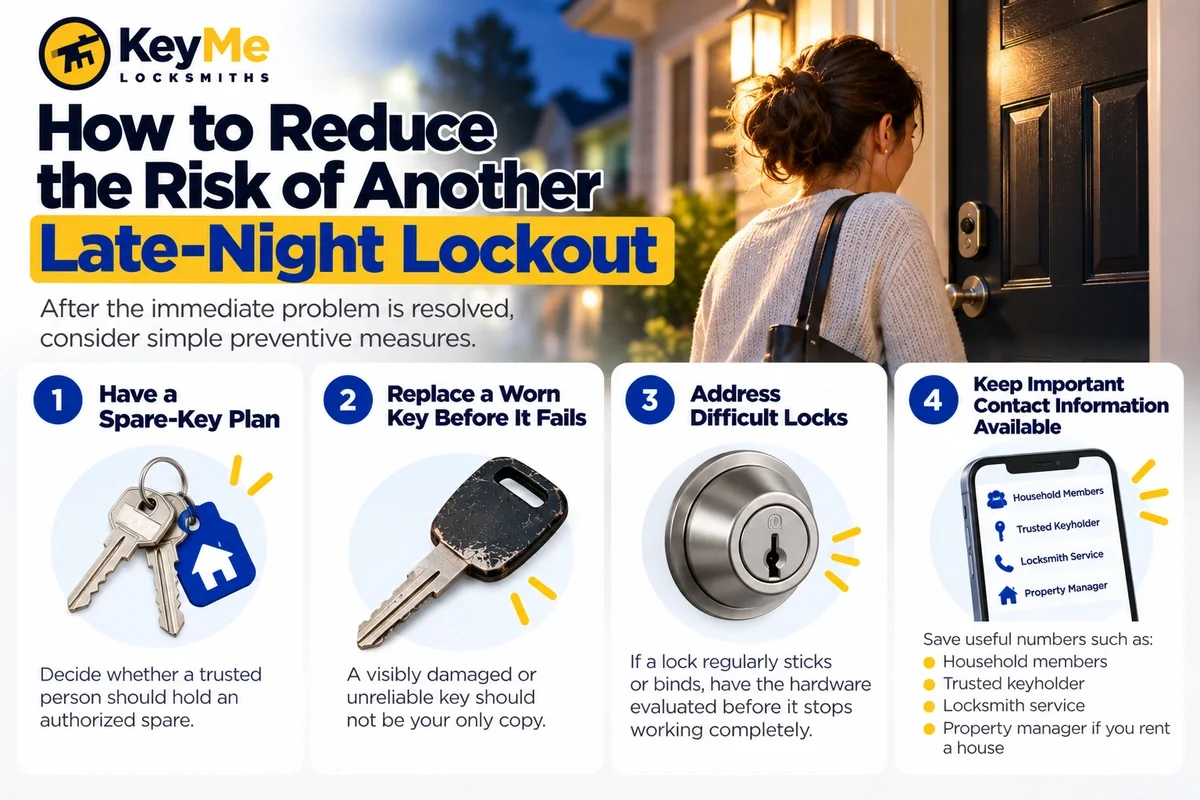
After the immediate problem is resolved, consider simple preventive measures.
Have a Spare-Key Plan
Decide whether a trusted person should hold an authorized spare.
Replace a Worn Key Before It Fails
A visibly damaged or unreliable key should not be your only copy.
Address Difficult Locks
If a lock regularly sticks or binds, have the hardware evaluated before it stops working completely.
Keep Important Contact Information Available
Save useful numbers such as:
- Household members
- Trusted keyholder
- Locksmith service
- Property manager if you rent a house
Know Which Key Operates Which Door
If your home has multiple keys, confusing them can create unnecessary problems during an already stressful lockout.
Copy Your Key from Anywhere - Right from Your Phone
Skip the kiosk and copy your key from home. Upload a clear photo of an eligible house or car key, and KeyMe will create a precise duplicate and mail it directly to your door.
How KeyMe Locksmiths Can Help With a House Lockout
KeyMe offers emergency locksmith services and residential locksmith services.
Depending on the situation and supported hardware, related services may include:
- Residential lockout assistance
- Broken key extraction
- Lock repair
- Lock rekeying
- Lock replacement
The appropriate service depends on whether the problem is simply access, a missing key, damaged hardware, or another underlying lock issue.
References
- KeyMe Locksmiths: Emergency Locksmith
- KeyMe Locksmiths: Residential Locksmith
- KeyMe Locksmiths: Lock Repair and Installation
- KeyMe Locksmiths: Lock Rekeying
- KeyMe Locksmiths: Lock Replacement
- KeyMe Locksmiths: Broken Key Extraction
- KeyMe Locksmiths: What to Do After Losing Your House Keys
- KeyMe Locksmiths: Rekeying vs. Replacing Your Locks
- KeyMe Locksmiths: Emergency Locksmith Help for Apartment Lockouts