
How Your Locks Actually Work
Most people use their locks thousands of times a year without ever thinking about the mechanics behind them. But understanding how your locks actually work can help you make better security decisions, recognize when something is failing, and know when it’s time to call a professional locksmith.
This guide breaks down the inner workings of the most common lock types, residential, commercial, and automotive, through simple, clear explanations.
Why Understanding Lock Mechanics Matters
Knowing how your locks function helps you:
-
Choose the right lock for your security needs
-
Spot early signs of wear or tampering
-
Understand why certain keys work and others don’t
-
Decide when upgrading or rekeying is the safer option
“Most lock issues start small, sticky turning, loose cylinders, or keys that feel ‘off.’ When customers understand how locks work, they’re far more prepared to protect their home or business.” - KeyMe Locksmiths
How the Most Common Lock Types Work
Below is a breakdown of how today’s most widely used locks actually function.
1. Pin Tumbler Locks (Used in Most Homes & Businesses)
Pin tumbler locks are the standard for residential and commercial doors. Their design hasn’t changed much in over a century because the mechanics are dependable and secure.
How They Work
Inside the lock cylinder are small stacks of pins, each with a top pin and a bottom pin. When you insert the correct key:
-
Each groove on the key lifts a pair of pins to a precise height.
-
The tops of all lower pins align at what’s called the shear line.
-
Once aligned, the cylinder can rotate, unlocking the door.
If even one pin is misaligned, the cylinder will not turn.
Why This Matters
-
Worn keys or rough-cut duplicates may fail to lift pins correctly.
-
Dirt or rust can cause pins to bind or jam.
-
Rekeying changes the pin configuration without replacing the entire lock.
Learn about rekeying services
2. Deadbolts (Extra Security for Exterior Doors)
Deadbolts provide stronger protection because they extend a solid steel bolt deep into the door frame.
How Deadbolts Work
-
Turning the key rotates a cam inside the lock.
-
The cam retracts or extends a heavy bolt.
-
When fully extended, the bolt resists forced entry and prying.
Deadbolts are available in single-cylinder (key outside, thumb-turn inside) or double-cylinder (key needed on both sides).
Why They Matter
Deadbolts are a crucial upgrade for exterior doors where maximum security is needed.
Explore lock installation and repair services
3. High-Security Locks (Advanced Protection)
High-security locks use additional technologies to resist drilling, picking, and unauthorized duplication.
Common Features
-
Sidebar mechanisms
-
Rotating or angled pins
-
Hardened steel inserts
-
Restricted keys (cannot be copied without authorization)
“Businesses choose high-security locks because they offer controlled access. Even if someone has a key blank, they can’t copy it without proper authorization.” - KeyMe Locksmiths
Learn more about commercial high-security solutions
4. Smart Locks (Electronic Access Control)
Smart locks replace or supplement mechanical keys with digital access.
How They Work
-
An internal motor turns the lock bolt.
-
Access is granted through a keypad, smartphone, Bluetooth, Wi-Fi, or biometric data.
-
Many systems allow remote locking and activity logs.
Benefits
-
No need for physical keys
-
Guest codes for temporary access
-
Tamper alerts and remote access
-
Integration with home security systems
KeyMe can help install and troubleshoot smart locks.
5. Automotive Locks & Electronic Immobilizers
Modern vehicles rely on both mechanical components and coded electronic systems.
How Car Locks Work
-
Older vehicles use mechanical wafers similar to pin tumblers.
-
Newer vehicles rely on electronic key fobs, transponders, and immobilizers.
-
For push-to-start cars, the fob communicates with the car via encrypted signals.
Why It Matters
If your key is damaged or lost, you may need both mechanical cutting and electronic programming for the new key or fob to function.
Explore automotive key replacement
Signs Your Lock Might Be Failing
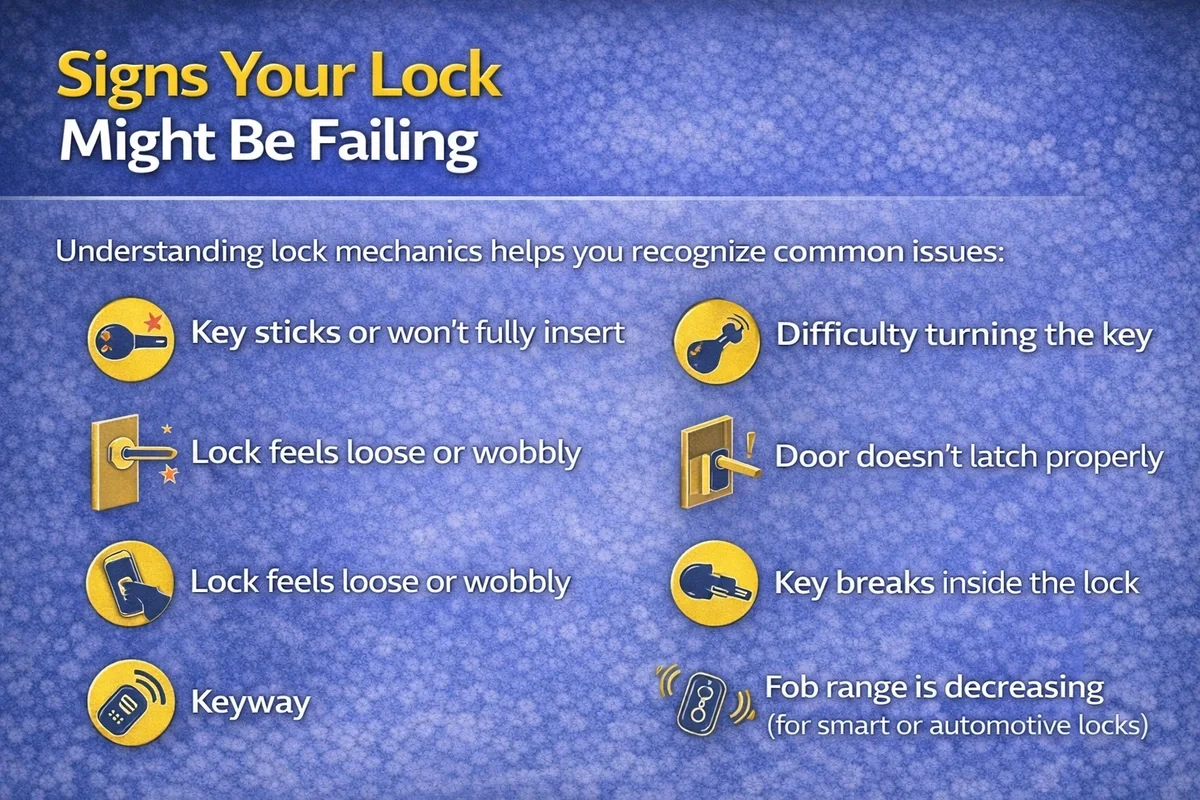
Understanding lock mechanics helps you recognize common issues:
-
Key sticks or won’t fully insert
-
Lock feels loose or wobbly
-
Difficulty turning the key
-
Door doesn’t latch properly
-
Key breaks inside the lock
-
Fob range is decreasing (for smart or automotive locks)
“A struggling lock is like a warning light, it rarely gets better on its own. Fixing the issue early can prevent full lock failure or a lockout.” - KeyMe Locksmiths
When to Call a Locksmith
If your lock is showing signs of wear, or if you’re considering upgrading your home or business security, a locksmith can:
-
Rekey or replace worn locks
-
Install deadbolts or smart locks
-
Improve door alignment
-
Duplicate or program keys
-
Provide high-security solutions
-
Assist with emergency lockouts
Find a KeyMe kiosk
Call for 24/7 locksmith service
Final Thoughts: Better Security Starts with Understanding the Basics
Locks may seem simple from the outside, but their internal mechanisms are highly engineered for your protection. By learning how your locks actually work, you’ll make smarter decisions about maintenance, upgrades, and home or business security.
Frequently Asked Questions
Can a lock wear out over time?
Yes. Locks experience internal wear from repeated use, which can affect pin alignment, cylinder movement, and overall performance. Over time, this can lead to sticking, jamming, or failure to turn properly.
Why do some keys work in multiple locks?
Keys can sometimes work in multiple locks if those locks share similar pin configurations or were part of a master key system. This is more common in commercial settings than in residential homes.
What is a master key system?
A master key system allows multiple locks to be opened with different individual keys, while also enabling a single master key to open all of them. These systems are commonly used in offices, apartment buildings, and commercial properties.
How do locksmiths make a key without the original?
Professional locksmiths can create a new key by decoding the lock itself. This involves reading the internal pin configuration or using specialized tools to determine the correct key cuts.
Can locks be upgraded without replacing the entire door?
Yes. Locks can typically be upgraded by replacing the cylinder or installing a new lock mechanism, such as a deadbolt or smart lock, without changing the door itself.
Are smart locks safer than traditional locks?
Smart locks can offer enhanced convenience and additional security features like access logs and remote control. However, their overall security depends on proper installation, strong passwords, and secure network connections.
What causes a lock to suddenly stop working?
Locks can fail due to internal wear, misalignment, broken components, or environmental factors like rust and debris buildup. Sudden failure is often the result of gradual deterioration reaching a tipping point.
Can environmental factors affect how a lock works?
Yes. Humidity, dirt, temperature changes, and corrosion can all impact internal lock components, causing stiffness, jamming, or reduced performance over time.
Is it better to repair or replace a lock?
It depends on the issue. Minor problems like dirt buildup or slight wear can often be repaired, while heavily worn or damaged locks are usually better replaced to maintain security.
How can I improve my overall lock security?
You can improve security by:
- Upgrading to deadbolts or high-security locks
- Rekeying after moving or losing keys
- Installing smart locks for access control
- Regularly maintaining and inspecting locks
For expert help, KeyMe Locksmiths offers 24/7 service and nationwide coverage—call anytime or find a kiosk near you.
About KeyMe Locksmiths
KeyMe Locksmiths is a leading provider of local locksmith services and key copy kiosks across 50 states and the District of Columbia. Proud to serve over 5 million customers, KeyMe Locksmiths cuts over 10 million keys annually. With more than 8,000 self-service kiosks in major retailers, an e-commerce platform delivering over 10,000 keys weekly, and a nationwide locksmith network, KeyMe Locksmiths provides fast, reliable solutions for residential, commercial, and vehicle needs. KeyMe Locksmiths is committed to delivering exceptional service backed by a 100% money-back guarantee. KeyMe Locksmiths also operates one of the nation’s leading retail media networks, connecting consumers to other brands seeking to advertise in-store and delivering over 2B monthly impressions.