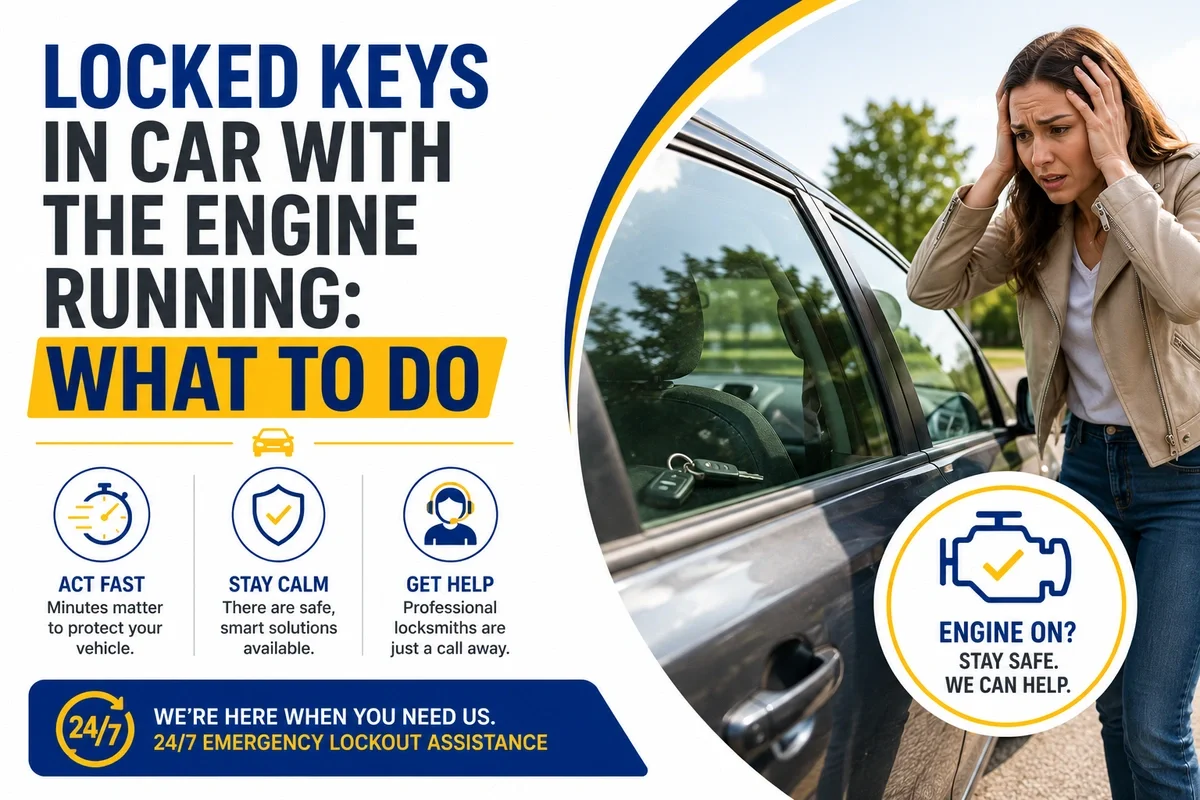
If your keys are locked inside a car while the engine is running, first make sure no child, pet, or vulnerable person is in immediate danger. If there is an urgent safety risk, call 911. Otherwise, move to a safe location, check for a legitimate unlocked access point or available spare key, and contact an automotive locksmith if you cannot regain access.
A running-car lockout is different from an ordinary lockout because the vehicle is still operating while you are outside it.
That can add concerns involving:
- Passenger safety
- Vehicle theft
- Traffic
- Weather
- Fuel use
- Vehicle location
Avoid forcing the door or attempting improvised entry methods that could damage the vehicle.
Summary
- If a child, pet, or vulnerable person is in danger inside the car, call 911 immediately.
- Move away from traffic or another unsafe area while staying near the vehicle when appropriate.
- Check whether another legitimate door or access point is already unlocked.
- Use a spare key if one is safely available.
- Do not force the window, door frame, weather seals, or locking hardware.
- An automotive locksmith may be able to restore access at the vehicle for supported situations.
- Be prepared to verify that you are authorized to access the vehicle.
- Once the situation is resolved, consider why the lockout happened before assuming the vehicle or key is malfunctioning.
Best Way to Handle Keys Locked in a Running Car
Use this order:
- Check for immediate danger.
- Call emergency services if someone inside is at risk.
- Move yourself to a safe location if the vehicle is near traffic or another hazard.
- Check for a normal unlocked entry point.
- Determine whether an authorized spare key is available.
- Contact an automotive locksmith if access still cannot be restored.
"A running-car lockout should be treated as a safety situation first and an access problem second. The right response depends on who is inside the vehicle, where the vehicle is located, and whether there is any immediate danger." - KeyMe Locksmiths
Why a Running-Car Lockout Needs Extra Attention
With a normal vehicle lockout, the main issue is that you cannot get inside.
When the engine is running, you also need to think about what is happening inside and around the vehicle.
A Passenger May Be Inside
A child, pet, older adult, or medically vulnerable passenger can turn a lockout into an emergency.
The Vehicle Is Still Operating
The engine continues to run until the vehicle is turned off or its operating conditions change.
The Car May Be in an Unsafe Location
A running vehicle parked:
- Near active traffic
- At the roadside
- In a loading area
- In an unfamiliar parking lot
- In extreme weather
can create additional risk.
The Vehicle May Be Easier to Steal
If the vehicle is running and unattended, stay nearby when it is safe to do so rather than leaving it unobserved.
Need a Locksmith? We're here to help
Connect with a trusted local locksmith for fast, professional assistance when you need it most.
What If a Child Is Locked Inside?
Call 911 immediately if a child is locked inside and cannot safely exit.
Do not spend critical time experimenting with the lock.
Tell emergency dispatch:
- Your location
- That a child is inside a locked vehicle
- Whether the vehicle is running
- Weather conditions
- The child's apparent condition
NHTSA warns that vehicle interiors can become dangerously hot quickly, and children are especially vulnerable to heatstroke.
Emergency responders should take priority over ordinary locksmith service when there is an immediate health or safety risk.
What If a Pet Is Locked Inside?
Evaluate the animal's condition and the environment.
If the pet appears distressed or is facing dangerous heat, cold, or another immediate threat, contact emergency services or local authorities as appropriate.
Do not assume that a running engine means the vehicle will remain at a safe temperature indefinitely.
First Check for Normal Access
Before arranging service, check whether there is another legitimate way into the vehicle.
That can include:
- Another unlocked door
- An unlocked hatch or liftgate where normal access is possible
- An authorized spare key held by someone nearby
Do not pry, bend, force, or manipulate the vehicle to create a new access point.
Do Not Rely on DIY Car-Opening Tricks
Videos and articles may suggest improvised ways to open a locked car.
The problem is that modern doors can contain:
- Wiring
- Electronic lock controls
- Airbag-related components
- Weather seals
- Window mechanisms
- Sensors
Forcing tools around the door can turn a lockout into a hardware, glass, trim, or electrical repair.
If normal access is unavailable, professional assistance is generally the safer path.
When to Call an Automotive Locksmith
Consider an automotive locksmith when:
- No legitimate door is unlocked
- No usable spare key is available
- The situation is not an immediate emergency requiring 911
- You are authorized to access the vehicle
- You need help at the vehicle's location
Automotive locksmiths evaluate the specific vehicle before deciding how to restore access.
For more on the professional process, see How Locksmiths Open Car Doors.
What Information Should You Give the Locksmith?
Providing accurate information can help the provider understand the situation before arriving.
Be ready with:
- Vehicle make
- Vehicle model
- Model year
- Your location
- Whether the engine is running
- Where the keys are visible, if known
- Whether anyone is inside
- Whether the vehicle uses a traditional key or smart key
- Any unusual lock or door behavior
Also mention access restrictions such as:
- Parking garage
- Gated property
- Roadside location
- Airport or secured parking
- Building garage
Why You May Be Asked to Verify Authorization
A locksmith should have reason to believe that the person requesting entry is authorized to access the vehicle.
Depending on the situation, you may be asked for identification or vehicle-related documentation.
If documentation is locked inside, explain that when arranging service.
Can a Push-to-Start Car Lock With the Key Inside?
It can happen depending on the vehicle, locking behavior, credential location, or system condition.
Smart-key systems are designed to detect electronic credentials, but they should not be treated as an absolute guarantee against every lockout scenario.
A smart key may be:
- In an unusual detection position
- Difficult for the vehicle to detect
- Experiencing battery or communication problems
- Inside luggage or another object
- Associated with vehicle-specific locking behavior
If the underlying problem is vehicle recognition rather than a simple lockout, see Key Not Detected Warning: Causes and Fixes.
Find a KeyMe Kiosk Near You
Need a spare key fast? Find a KeyMe kiosk near you to copy many house, office, and eligible car keys in just minutes.
What If the Key Fob Is Inside but the Doors Locked Anyway?
First solve the immediate access problem.
Afterward, consider whether there was an unusual circumstance such as:
- Manual locking
- A weak key-fob battery
- A second credential
- Unusual smart-key placement
- Vehicle-specific automatic locking behavior
- Possible electronic fault
Do not assume one accidental lockout proves that the smart-key system is defective.
If it happens repeatedly, have the vehicle or key system evaluated.
Should You Turn the Car Off Remotely?
Only use manufacturer-supported vehicle features you already know are designed for your vehicle.
Do not experiment with unfamiliar remote functions during an active lockout.
Vehicle apps and remote-service capabilities vary widely.
The owner's manual and manufacturer's official app documentation are the appropriate sources for vehicle-specific remote functions.
What If the Running Car Is in a Garage?
A running combustion-engine vehicle in an enclosed or poorly ventilated space can create a serious carbon monoxide hazard.
If the vehicle is running inside an enclosed garage and you cannot safely shut it off, move people away from the area and contact emergency services.
Do not remain in an enclosed space trying to solve the lockout.
What If the Car Is Running on the Roadside?
Your own safety comes first.
If possible:
- Move away from active traffic
- Stand behind an appropriate barrier
- Make yourself visible
- Avoid standing between vehicles
- Tell the service provider that you are roadside
If the vehicle itself creates a traffic hazard, contact emergency or roadside authorities as appropriate.
What Happens After the Car Is Open?
Once access is restored, confirm that:
- You have the key
- The doors operate normally
- The vehicle recognizes the credential
- No warning related to the key is displayed
If everything works normally, the event may have been an isolated lockout.
If the key or locking system behaves unexpectedly afterward, that may warrant separate diagnosis.
How to Reduce the Risk of Another Running-Car Lockout
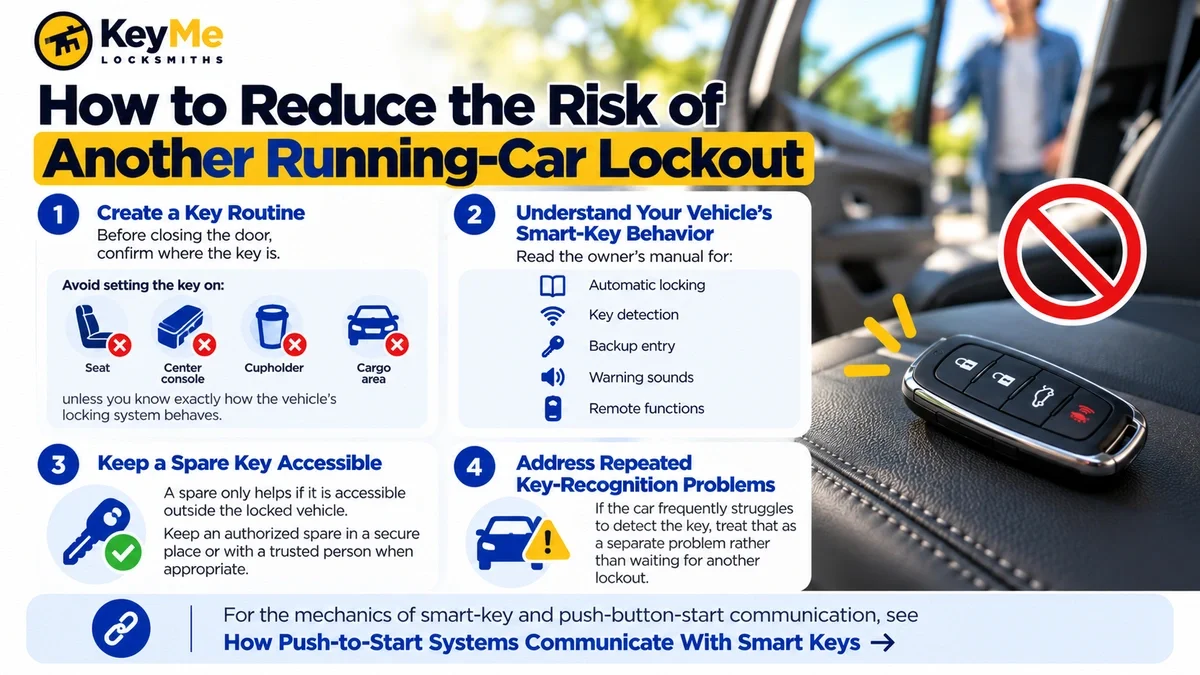
Create a Key Routine
Before closing the door, confirm where the key is.
Avoid setting the key on:
- Seat
- Center console
- Cupholder
- Cargo area
unless you know exactly how the vehicle's locking system behaves.
Understand Your Vehicle's Smart-Key Behavior
Read the owner's manual for:
- Automatic locking
- Key detection
- Backup entry
- Warning sounds
- Remote functions
Keep a Spare Key Accessible
A spare only helps if it is accessible outside the locked vehicle.
Keep an authorized spare in a secure place or with a trusted person when appropriate.
Address Repeated Key-Recognition Problems
If the car frequently struggles to detect the key, treat that as a separate problem rather than waiting for another lockout.
For the mechanics of smart-key and push-button-start communication, see How Push-to-Start Systems Communicate With Smart Keys.
Copy Your Key from Anywhere - Right from Your Phone
Skip the kiosk and copy your key from home. Upload a clear photo of an eligible house or car key, and KeyMe will create a precise duplicate and mail it directly to your door.
How KeyMe Can Help
If you are locked out of a vehicle and there is no immediate emergency requiring 911, KeyMe can help connect you with automotive locksmith services for supported situations.
For a standard vehicle lockout, you can also visit KeyMe's car lockout service page.
Locked Out With the Engine Running? Focus on Safety First
A running-car lockout is not the time to experiment with the vehicle.
Start by deciding whether anyone is in danger.
If there is an immediate safety threat, contact emergency services.
If there is not, stay in a safe location, use a legitimate spare or unlocked access point if available, and contact a professional automotive locksmith when needed.
Once you are back inside, review why the lockout occurred so you can reduce the chance of the same situation happening again.
References
- National Highway Traffic Safety Administration. Child Heatstroke Prevention. Guidance on the risks of children being left in vehicles and the rapid rise of vehicle interior temperatures.
https://www.nhtsa.gov/campaign/heatstroke - National Highway Traffic Safety Administration. Keyless Ignition Systems. Background on keyless vehicle operation and electronic key verification.
https://www.nhtsa.gov/driver-assistance-technologies/keyless-ignition-systems - KeyMe Locksmiths. How Locksmiths Open Car Doors. Overview of what to expect when an automotive locksmith evaluates a vehicle lockout.
https://key.me/article/how-locksmiths-open-car-doors - KeyMe Locksmiths. Key Not Detected Warning: Causes and Fixes. Dedicated troubleshooting guidance for smart-key recognition failures.
https://key.me/article/key-not-detected-warning-causes-and-fixes - KeyMe Locksmiths. How Push-to-Start Systems Communicate With Smart Keys. Explanation of vehicle-side smart-key detection and start authorization.
https://key.me/article/how-push-to-start-systems-communicate-with-smart-keys