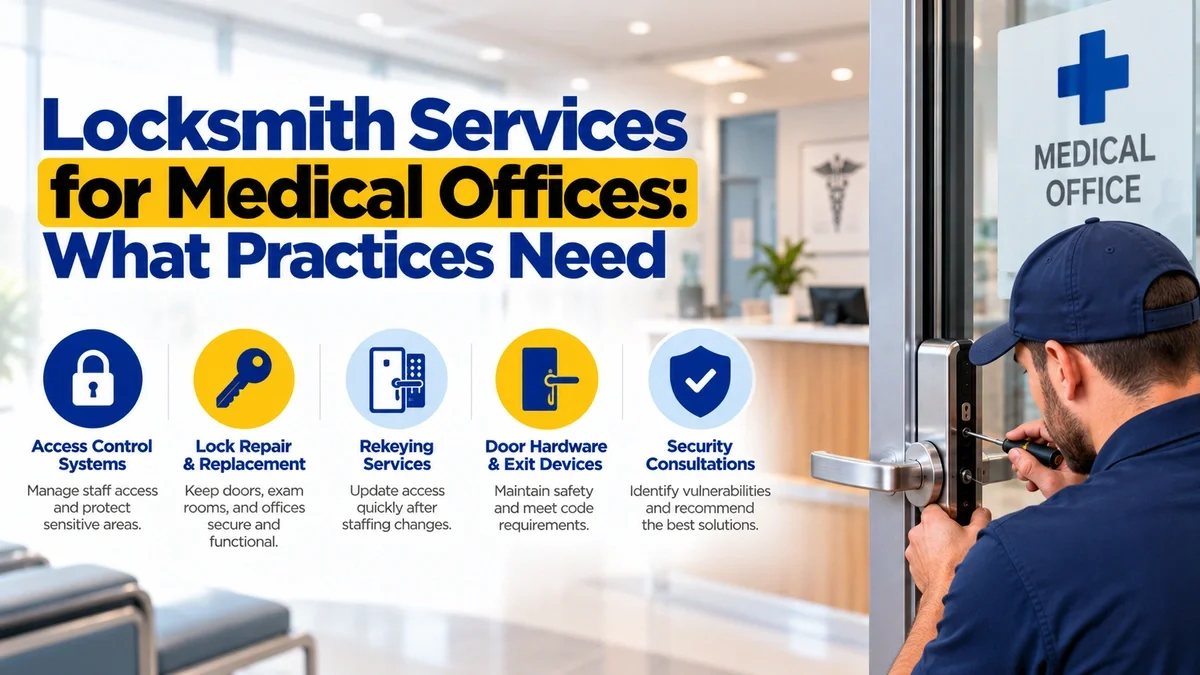
Locksmith services for medical offices can help practices manage physical access to entrances, staff areas, records rooms, medication or supply spaces, offices, and other controlled areas. Depending on the property, a commercial locksmith may assist with rekeying, lock replacement, master-key planning, restricted access, emergency lockouts, and the mechanical portions of an access-control system.
For a medical office, the goal is not simply to install stronger locks.
It is to make sure the right people can access the right spaces while unauthorized access is appropriately limited.
That principle aligns with federal healthcare security guidance. HHS explains that the HIPAA Security Rule's physical safeguards include facility access controls designed to limit physical access to electronic information systems and the facilities that house them while allowing properly authorized access.
Summary
- Medical offices can have very different access needs across patient, staff, records, storage, IT, and administrative spaces.
- Commercial locksmith services can support the mechanical side of that access strategy.
- Rekeying can be appropriate when existing hardware remains serviceable but old keys should stop working.
- Lock replacement may make more sense when hardware is damaged, outdated, or no longer fits the office's access plan.
- Employee turnover should trigger a review of keys and credentials.
- Broader-access keys such as master keys should receive tighter control.
- Physical keys and electronic credentials can be used together.
- HHS guidance specifically identifies facility access controls as part of the HIPAA Security Rule's physical safeguards.
- A locksmith can contribute to physical security, but HIPAA compliance is broader than locks and should not be treated as a locksmith-only responsibility.
Best Way to Plan Locksmith Services for a Medical Office
Start with the spaces, users, and access levels before choosing hardware.
1. Identify Controlled Areas
Common examples may include:
- Main entrance
- Reception area
- Staff-only corridors
- Exam rooms
- Administrative offices
- Records rooms
- IT or server spaces
- Supply rooms
- Medication-storage areas
- Utility or maintenance rooms
- Back entrances
Not every office will have all of these.
2. Define Who Needs Access
Consider:
- Physicians
- Nurses
- Medical assistants
- Front-desk staff
- Office managers
- IT personnel
- Cleaning staff
- Vendors
- Contractors
- Patients
- Visitors
3. Match Access to Roles
Avoid giving every employee the same key or credential unless the role genuinely requires it.
HHS guidance on facility security notes that covered entities should consider the people who need facility and equipment access and implement procedures that control access based on role or function.
4. Choose the Right Mechanical Strategy
Depending on the office, that might involve:
- Individual keyed locks
- Keyed-alike groups
- Master-key systems
- Restricted-key systems
- Electronic access combined with mechanical hardware
5. Define What Happens When Access Changes
Create procedures for:
- New hires
- Employee departures
- Lost keys
- Stolen keys
- Vendor access
- Office moves
- Renovations
- Emergency access
"A medical office access plan should begin with who needs access and why. The locks, keys, and credentials should support those permissions rather than determine them." - KeyMe Locksmiths
Need a Locksmith? We're here to help
Connect with a trusted local locksmith for fast, professional assistance when you need it most.
Medical Office Entrances
The main entrance may have very different requirements from internal staff doors.
Questions to consider include:
- Is the office open to patients only during business hours?
- Is after-hours staff access required?
- Do delivery or maintenance personnel need separate access?
- Does the entrance use a mechanical lock, electronic credential, or both?
- Who can authorize emergency access?
A commercial locksmith can assist with supported mechanical locking hardware, while more complex electronic systems may also require an access-control integrator or building-management team.
Staff-Only Areas
Medical offices often have areas that patients or visitors should not access freely.
Examples can include:
- Employee work areas
- Storage rooms
- Records rooms
- IT spaces
- Back offices
- Supply areas
HHS guidance says physical safeguards can include locked doors and restricted areas as part of measures to prevent unauthorized physical access, tampering, and theft.
That does not mean every internal room needs the same lock.
Instead, determine what degree of control makes sense for each space.
Medical Records and Administrative Areas
Medical records may exist in:
- Electronic systems
- Paper files
- Scanned archives
- Administrative storage
HHS notes that healthcare organizations should maintain reasonable physical safeguards and gives examples including securing medical records with locks or passcodes and limiting access to keys or codes.
A locksmith may support the mechanical side through:
- Lock repair
- Lock replacement
- Rekeying
- Key-control planning
- Mechanical access to records rooms
The broader privacy and information-security requirements remain the responsibility of the healthcare organization.
IT and Equipment Spaces
Electronic health information may depend on physical infrastructure.
HHS guidance specifically includes protecting electronic information systems and the facilities in which they are housed from unauthorized access.
For a medical practice, that can make controlled access relevant to spaces containing:
- Servers
- Networking equipment
- Backup systems
- Certain workstations
- Communications equipment
Mechanical locks may be one layer of that access strategy.
Rekeying After Employee Turnover
Employee departure is a natural time to review access.
Ask:
- Were all keys returned?
- Did the employee have a master key?
- Did they have access to restricted rooms?
- Were any duplicates authorized?
- Are electronic credentials still active?
If existing lock hardware is in good condition but an old key should stop working, rekeying may be appropriate.
For a broader explanation of the decision, see Rekeying vs. Replacing Your Locks.
When Lock Replacement Makes More Sense
Rekeying changes which key operates compatible existing hardware.
Replacement changes the hardware itself.
Consider lock replacement when:
- Lock hardware is damaged
- A lock repeatedly fails
- Existing hardware no longer fits the access plan
- The office is upgrading door hardware
- The current lock is incompatible with the desired configuration
- Renovations change the door's function
A locksmith can help evaluate the mechanical condition of the opening.
Master Key Systems in Medical Offices
A master-key system can simplify access across multiple rooms.
For example:
- Front-desk key opens limited administrative areas
- Clinical staff key opens designated clinical spaces
- Office manager key opens a broader set of doors
- Authorized management key opens most compatible locks
The advantage is operational flexibility.
The tradeoff is that losing a higher-level key can expose more openings.
That makes key-control procedures important.
Track:
- Who receives each key
- Key number or identifier
- Access level
- Date issued
- Return status
- Lost-key incidents
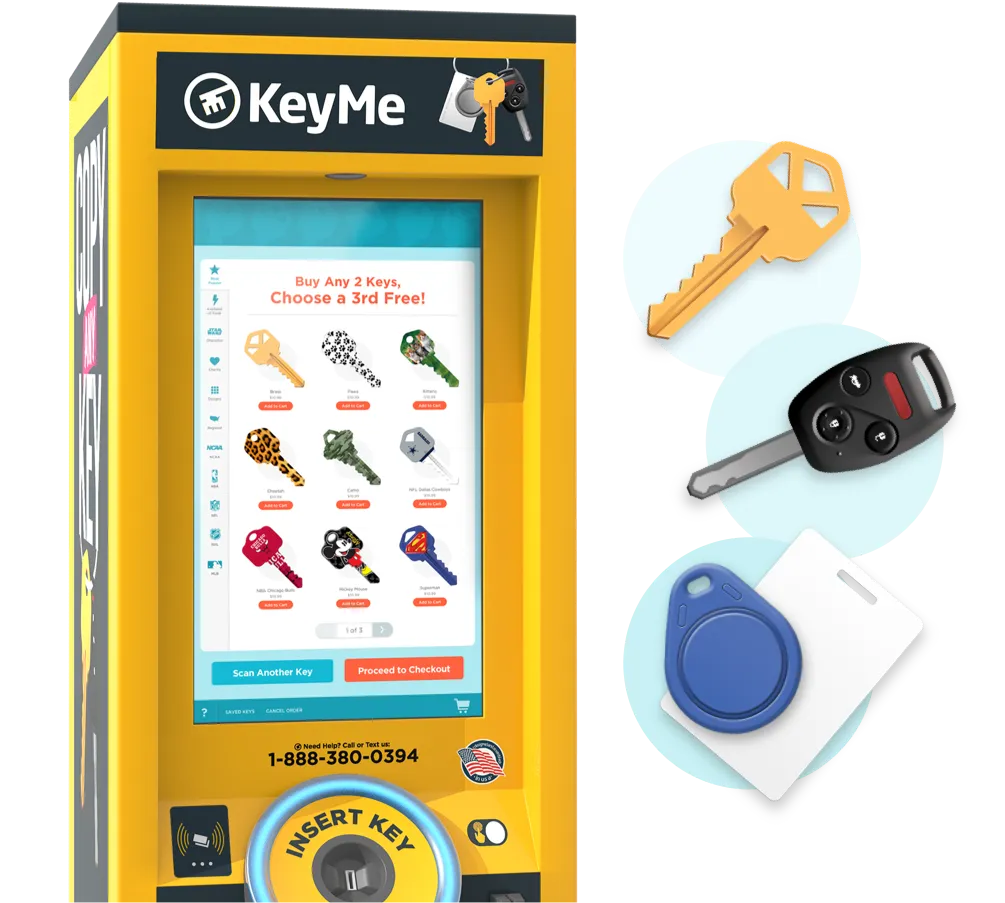
Find a KeyMe Kiosk Near You
Need a spare key fast? Find a KeyMe kiosk near you to copy many house, office, and eligible car keys in just minutes.
Vendor and Cleaning Staff Access
Medical offices often rely on third parties such as:
- Cleaning companies
- IT contractors
- Equipment technicians
- Building maintenance
- Delivery services
Do not automatically provide permanent broad-access keys.
Instead, determine:
- Which rooms are needed?
- When is access required?
- Can a lower-level key be used?
- Who authorizes access?
- How is the key returned?
- What happens when the vendor relationship ends?
HHS facility-security guidance explicitly includes visitor and role-based access considerations.
Physical Keys vs. Electronic Access
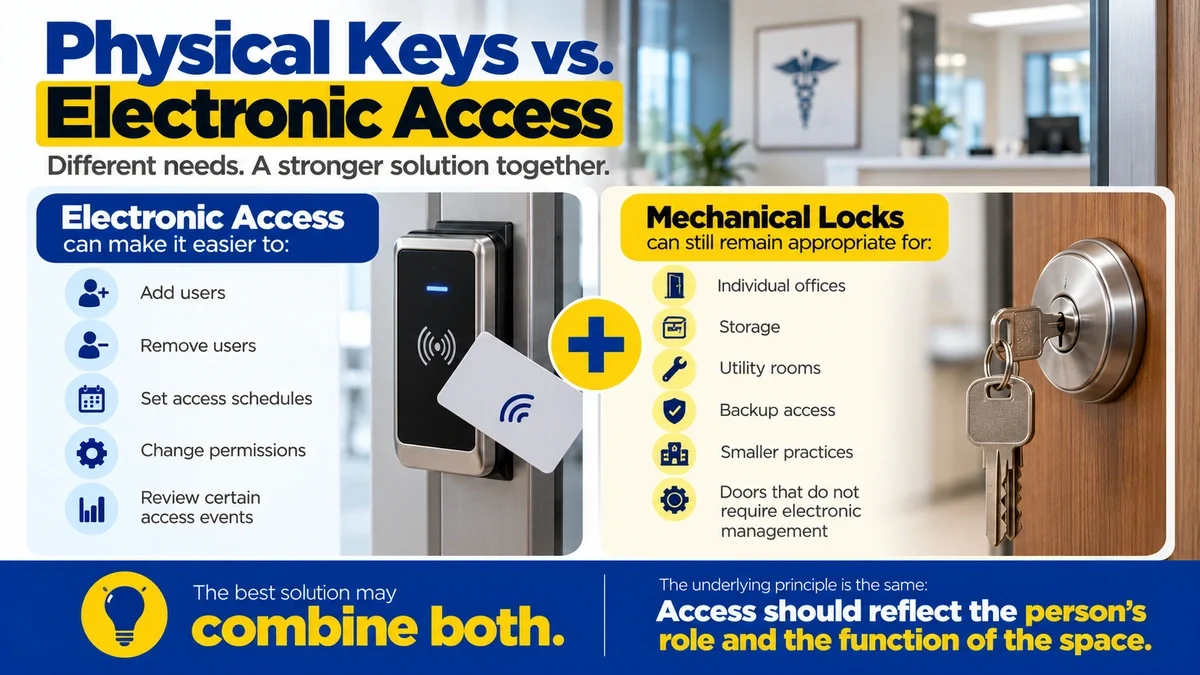
Electronic access can make it easier to:
- Add users
- Remove users
- Set access schedules
- Change permissions
- Review certain access events
Mechanical locks can still remain appropriate for:
- Individual offices
- Storage
- Utility rooms
- Backup access
- Smaller practices
- Doors that do not require electronic management
The best solution may combine both.
The underlying principle is the same:
Access should reflect the person's role and the function of the space.
What About Lost or Unreturned Keys?
A missing key deserves more attention when it opens broader or more sensitive areas.
Ask:
- Which doors does it operate?
- Is the key identifiable?
- Is it a master key?
- Where was it lost?
- Could someone connect it to the office?
- Does the current keying allow affected locks to be rekeyed?
Not every missing key requires the same response.
A low-level office key and a master key should be evaluated differently.
Medical Office Lockouts
Lockouts can affect:
- Main entrance
- Staff entrance
- Administrative office
- Storage room
- Mechanical room
- Other restricted areas
When a lockout occurs, authorization matters.
A commercial locksmith may need to verify that the person requesting access is authorized to enter the space before providing service.
For urgent mechanical access needs, KeyMe also provides emergency locksmith services.
Physical Security and HIPAA
A locksmith should not be described as making an office "HIPAA compliant."
HIPAA security includes:
- Administrative safeguards
- Physical safeguards
- Technical safeguards
HHS specifically identifies facility access controls as one component of physical safeguards.
Locks can support that physical-access strategy, but compliance decisions should reflect the organization's broader risk analysis, policies, workflows, systems, and legal obligations.
When to Call a Commercial Locksmith
A medical office may need locksmith assistance when:
- Rekeying is required
- Lock hardware is damaged
- Employees leave without returning keys
- New restricted spaces are created
- A master-key system needs to be changed
- A lock stops operating correctly
- Mechanical access needs to be restored
- Door hardware needs replacement
- Renovations change access requirements
For supported needs, KeyMe offers commercial locksmith services, lock repair and installation, lock replacement, and rekeying.
Copy Your Key from Anywhere - Right from Your Phone
Skip the kiosk and copy your key from home. Upload a clear photo of an eligible house or car key, and KeyMe will create a precise duplicate and mail it directly to your door.
Locksmith Services for Medical Offices: The Bottom Line
Medical-office locksmith services are most useful when they support a clearly defined access plan.
Start by determining:
-
Who needs access?
-
Which spaces do they need?
-
What type of credential should they use?
-
What happens when they leave?
-
How will lost or unreturned keys be handled?
HHS guidance emphasizes limiting physical access to appropriate individuals while ensuring authorized access remains available.
For medical offices, the strongest strategy combines key control, appropriate mechanical hardware, documented authorization, employee procedures, and any necessary electronic access systems.
References
- U.S. Department of Health and Human Services. HIPAA Security Rule: Physical Safeguards. Guidance on facility access controls and protecting electronic information systems from unauthorized physical access.
https://www.hhs.gov/hipaa/for-professionals/faq/what-does-the-security-rule-mean-by-physical-safeguards/index.html - U.S. Department of Health and Human Services. Security Standards: Physical Safeguards. Detailed HHS guidance on facility access controls, workstation security, device controls, and physical access procedures.
https://www.hhs.gov/sites/default/files/ocr/privacy/hipaa/administrative/securityrule/physsafeguards.pdf - U.S. Department of Health and Human Services. Summary of the HIPAA Security Rule. Overview of administrative, physical, and technical safeguards.
https://www.hhs.gov/hipaa/for-professionals/security/laws-regulations/index.html - U.S. Department of Health and Human Services. HIPAA Privacy Rule. Federal guidance on protecting health information and applying reasonable safeguards.
https://www.hhs.gov/hipaa/for-professionals/privacy/laws-regulations/index.html - KeyMe Locksmiths. Rekeying vs. Replacing Your Locks. Guidance on deciding whether an access change requires new keying or new hardware.
https://key.me/article/rekeying-vs-replacing-your-locks