

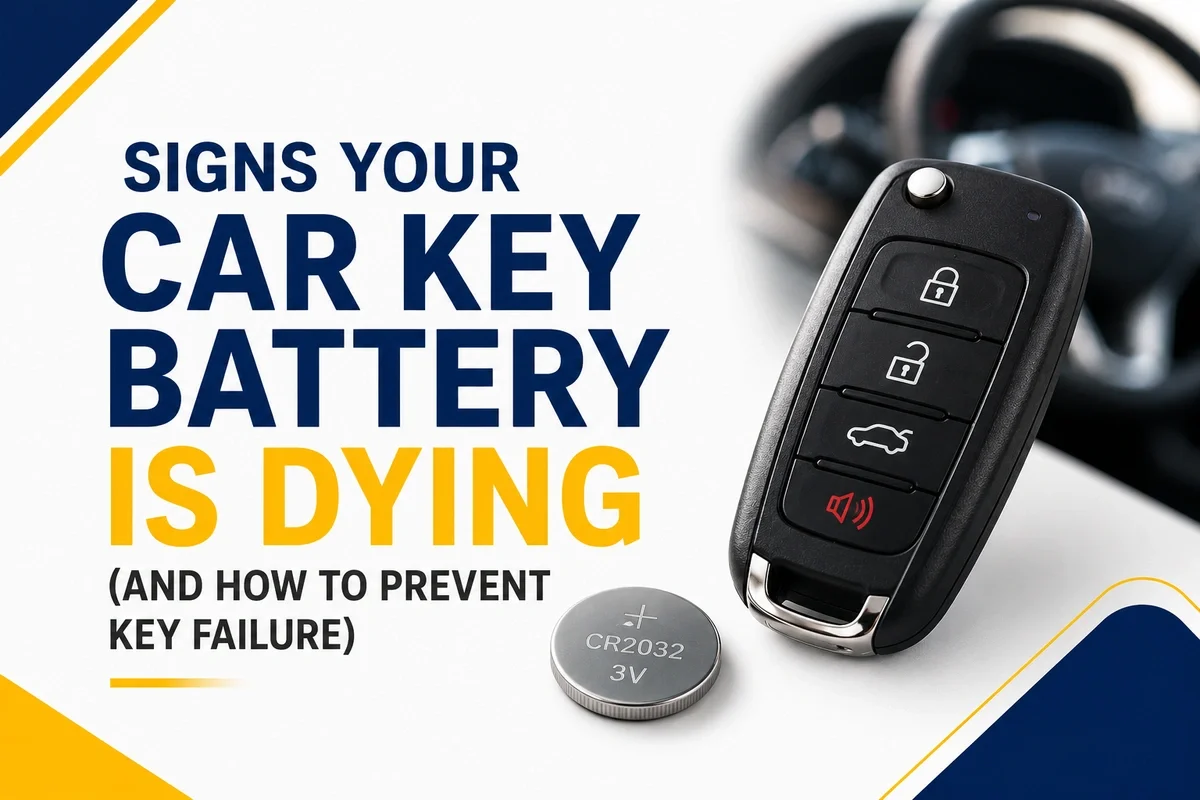
A weakening car key battery usually gives several warning signs before it fails completely. You may notice reduced remote range, delayed lock and unlock response, intermittent operation, or dashboard messages indicating the key fob battery is low. Replacing the battery at the first sign of declining performance can help prevent unexpected lockouts and ensure your vehicle continues recognizing the key reliably.
Summary
- Reduced remote range and inconsistent button response are often the earliest signs of a weak key fob battery.
- Many newer vehicles display a "Key Fob Battery Low" warning before the battery fails completely.
- A dead battery doesn't damage the key fob, but it can prevent remote entry and affect push-button start systems.
- Most key fob batteries last several years under normal use, though temperature and usage habits can shorten battery life.
- Replacing the battery proactively is one of the easiest ways to avoid an unexpected vehicle lockout.
Why Choose KeyMe Locksmiths?
Whether you need a replacement key fob, spare key, or automotive locksmith assistance, KeyMe Locksmiths connects drivers with experienced professionals nationwide.
Available automotive services may include:
- Key fob replacement
- Smart key replacement
- Transponder key programming
- Car key duplication
- Lost car key replacement
- Vehicle lockout assistance
- Automotive locksmith services
For many supported vehicles, KeyMe also offers Car Key Vans at select retail locations that provide on-site key cutting and programming. For residential customers, Online Key Copying allows eligible house keys to be duplicated by securely uploading a key photo and having the finished key shipped directly to their home.
"Most key fob batteries don't fail without warning. Instead, they gradually lose voltage, causing communication between the key and vehicle to become less reliable. Recognizing those early symptoms allows drivers to replace the battery before they're unexpectedly locked out or unable to start the vehicle." — KeyMe Locksmiths
Need a Locksmith? We're here to help
Connect with a trusted local locksmith for fast, professional assistance when you need it most.
Why Your Car Key Battery Matters
Modern vehicle keys do much more than unlock doors.
Depending on your vehicle, the key fob may be responsible for:
- Locking and unlocking doors
- Remote trunk release
- Remote start
- Push-button ignition
- Passive keyless entry
- Vehicle security authentication
Every time you press a button—or, in many vehicles, simply approach the car—the key fob communicates wirelessly with onboard systems.
That communication depends on a small lithium coin-cell battery.
As battery voltage gradually declines, communication becomes less reliable, often producing warning signs long before the battery stops working entirely.
How Long Do Car Key Batteries Last?
Most vehicle key fobs use lithium coin-cell batteries such as CR2032, CR2025, or similar models.
Battery life varies depending on:
- Vehicle manufacturer
- Frequency of use
- Climate
- Storage conditions
- Passive entry features
Many drivers can expect several years of normal operation before replacement becomes necessary.
Vehicles equipped with passive proximity systems may use battery power more frequently because the key continuously communicates with the vehicle when nearby.
Early Warning Signs Your Key Battery Is Weak
Recognizing early symptoms allows you to replace the battery before it leaves you without reliable vehicle access.
1. Reduced Operating Range
One of the earliest signs is a noticeable reduction in remote range.
Instead of unlocking your vehicle from across a parking lot, you may need to stand much closer before the buttons respond.
As battery voltage decreases, the signal transmitted by the key becomes weaker, reducing effective operating distance.
2. Delayed Lock or Unlock Response
Another common symptom is delayed communication.
You might notice:
- Doors unlock a few seconds after pressing the button.
- Multiple button presses are required.
- Remote commands occasionally fail before working again.
These intermittent delays often indicate the battery is approaching the end of its useful life.
3. Inconsistent Operation
Weak batteries don't usually fail all at once.
Instead, the key may work normally one day and struggle the next.
You may notice:
- Unlock works but lock doesn't.
- Trunk release responds inconsistently.
- Push-button start occasionally fails to recognize the key.
- One button responds better than another.
Because battery output gradually declines, inconsistent behavior is often one of the clearest warning signs.
4. Dashboard Battery Warnings
Many newer vehicles actively monitor communication with the key fob.
Depending on the manufacturer, you may receive messages such as:
- Key Fob Battery Low
- Replace Key Battery Soon
- Key Not Detected (intermittently)
These alerts often appear before complete battery failure, giving drivers time to replace the battery proactively.
5. Complete Loss of Remote Function
Eventually, a depleted battery may no longer provide enough power for reliable communication.
At that point:
- Remote buttons may stop working.
- Passive entry may fail.
- Push-button start may not recognize the key.
- The vehicle may require a backup starting procedure, depending on the manufacturer.
Fortunately, many vehicles include a concealed mechanical key or emergency starting procedure that allows access even when the battery has failed.
Find a KeyMe Kiosk Near You
Need a spare key fast? Find a KeyMe kiosk near you to copy many house, office, and eligible car keys in just minutes.
What Shortens a Car Key Battery's Lifespan?
Although key fob batteries are designed to last for years, several factors can cause them to lose power more quickly.
Understanding what affects battery life can help you avoid unexpected failures and replace the battery before it disrupts your day.
Frequent Use
Every time you lock, unlock, or remotely start your vehicle, the key fob uses battery power.
Drivers who frequently use:
- Remote start
- Remote trunk release
- Panic alarms
- Passive keyless entry
may notice batteries require replacement sooner than drivers who use these features less often.
Extreme Temperatures
Like most batteries, lithium coin cells perform best within a moderate temperature range.
Extended exposure to:
- High summer heat
- Freezing winter temperatures
- Direct sunlight inside a parked vehicle
can temporarily affect battery performance and may shorten overall battery life over time.
Whenever possible, avoid leaving your key fob inside a hot vehicle for extended periods.
Passive Keyless Entry Systems
Many newer vehicles continuously communicate with the key fob whenever it's nearby.
This allows convenient features such as:
- Automatic door unlocking
- Push-button start
- Hands-free trunk access
Because these systems communicate more frequently than traditional remote-entry systems, they may consume battery power at a faster rate.
Physical Damage
A key fob battery isn't the only component that can fail.
Repeated drops, moisture exposure, or impact can damage:
- Battery contacts
- Internal circuit boards
- Buttons
- Battery compartment connections
If replacing the battery doesn't restore reliable operation, the key itself may require inspection or replacement.
How to Prevent Key Battery Failure
Replacing a battery is simple. Getting stranded because it wasn't replaced doesn't have to be.
These habits can help keep your key working reliably.
Replace the Battery Before It Fails
Don't wait until the key stops working completely.
If you notice:
- Reduced operating range
- Delayed response
- Dashboard warnings
- Intermittent operation
replace the battery promptly rather than waiting for complete failure.
Learn Your Vehicle's Backup Entry Method
Many drivers don't realize their vehicle includes a backup access method until the battery dies.
Depending on the manufacturer, this may include:
- A hidden mechanical key
- A designated location for starting the vehicle with a depleted key fob
- An emergency proximity procedure
Reviewing your owner's manual before you need these features can save valuable time during an unexpected battery failure.
Keep a Spare Battery Available
Many key fobs use common lithium coin-cell batteries that are widely available.
Keeping a replacement battery at home or in a travel kit can make battery replacement quick and convenient when the first warning signs appear.
Always confirm the correct battery type for your specific key fob before purchasing replacements.
Protect Your Key Fob
Simple habits can help extend both battery life and the overall life of the key.
Try to:
- Keep the key fob dry.
- Avoid dropping it.
- Store it away from prolonged heat.
- Replace damaged battery covers promptly.
- Avoid placing heavy objects on top of the key.
Good physical care helps protect both the battery and the electronics inside the key.
Create a Spare Key Before You Need One
A spare key provides more than convenience.
It can:
- Reduce the impact of a lost or damaged key.
- Provide an immediate backup if one key develops problems.
- Allow multiple drivers to access the vehicle.
- Simplify future key replacement.
Planning ahead is often much easier than replacing a key after it's lost.
When Should You Replace the Battery vs. Replace the Key?
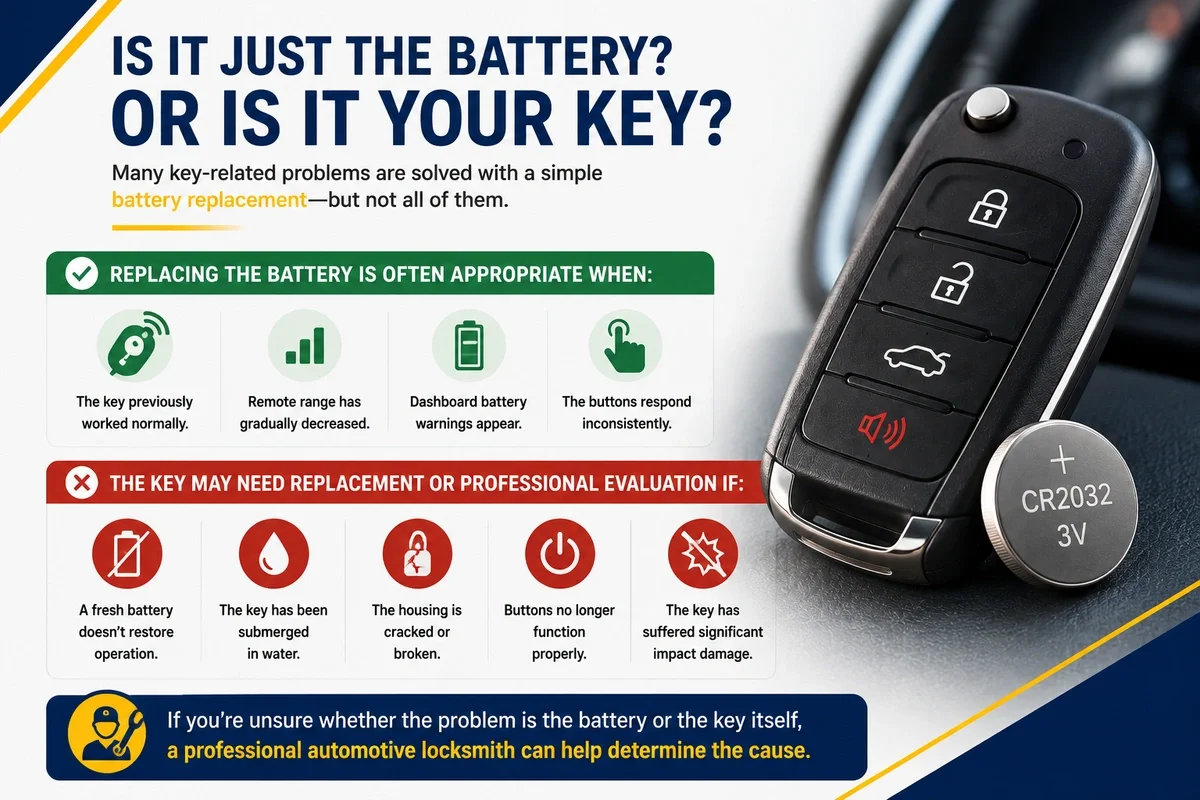
Many key-related problems are solved with a simple battery replacement—but not all of them.
Replacing the battery is often appropriate when:
- The key previously worked normally.
- Remote range has gradually decreased.
- Dashboard battery warnings appear.
- The buttons respond inconsistently.
However, the key itself may require replacement or professional evaluation if:
- A fresh battery doesn't restore operation.
- The key has been submerged in water.
- The housing is cracked or broken.
- Buttons no longer function properly.
- The key has suffered significant impact damage.
If you're unsure whether the problem is the battery or the key itself, a professional automotive locksmith can help determine the cause.
Copy Your Key from Anywhere - Right from Your Phone
Skip the kiosk and copy your key from home. Upload a clear photo of an eligible house or car key, and KeyMe will create a precise duplicate and mail it directly to your door.
Replace the Battery Before It Becomes a Bigger Problem
A weak key fob battery rarely fails without warning. Reduced range, delayed response, intermittent operation, and dashboard alerts often provide plenty of notice that it's time for a replacement. Addressing these early signs can help you avoid unexpected lockouts and maintain reliable access to your vehicle.
By replacing batteries proactively, protecting your key fob from damage, and keeping a spare key available, you can reduce the likelihood of future interruptions while extending the life of your vehicle's access system.
References
- National Highway Traffic Safety Administration (NHTSA). Vehicle Safety Resources. https://www.nhtsa.gov/
- National Institute for Automotive Service Excellence (ASE). Consumer Automotive Information. https://www.ase.com/
- Associated Locksmiths of America (ALOA). Consumer Resources. https://www.aloa.org/
- KeyMe Locksmiths service information for automotive locksmith services, Car Key Vans, and Mobile Key Scanning.