

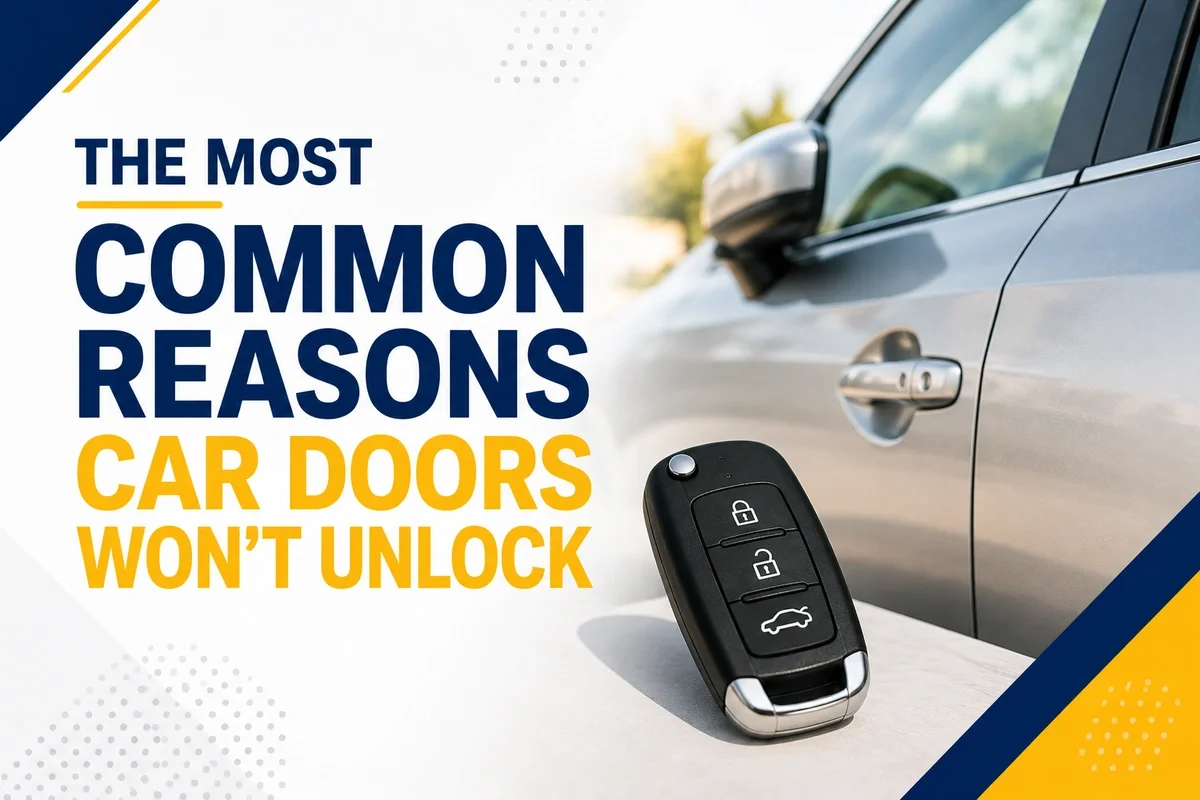
A car door may fail to unlock for several reasons, including a dead key fob battery, a malfunctioning door lock actuator, a worn key, a frozen lock, or an issue with the vehicle's electrical or security system. Because modern vehicles combine mechanical locks with sophisticated electronic components, the problem isn't always where it first appears. Understanding how your vehicle's locking system works can help you identify the likely cause, avoid unnecessary damage, and determine when professional assistance is the best solution.
Summary
- Car doors may fail to unlock because of key fob battery problems, faulty lock actuators, damaged keys, frozen locks, or electrical system issues.
- Modern vehicles rely on both mechanical locks and electronic security systems, meaning lock problems aren't always mechanical.
- Many lock issues can be diagnosed by observing whether the problem affects one door, every door, or only the remote controls.
- Avoid forcing a stuck key or lock, as this can damage the key, lock cylinder, or door hardware.
- Professional automotive locksmiths can diagnose mechanical and electronic lock problems, replace keys, program key fobs, and help restore vehicle access.
Why Choose KeyMe Locksmiths?
Whether you're dealing with a vehicle lockout, a malfunctioning key fob, or a door that simply won't unlock, KeyMe Locksmiths connects drivers with experienced automotive locksmith professionals across the country.
Available automotive services may include:
- Vehicle lockout assistance
- Car key replacement
- Smart key replacement
- Key fob replacement
- Transponder key programming
- Broken key extraction
- Ignition key replacement
For many supported vehicles, KeyMe also offers Car Key Vans at select retail locations that provide on-site automotive key cutting and programming. For residential customers, Online Key Copying allows eligible house keys to be duplicated by securely uploading a key photo, with the finished key shipped directly to the customer.
"Modern vehicle locks are part of a much larger access system that includes electronic modules, security software, remote transmitters, and mechanical hardware. When a door won't unlock, identifying which component has stopped communicating is often more important than the lock itself." — KeyMe Locksmiths
How Modern Car Door Locks Work
Today's vehicle door locks are far more advanced than the simple mechanical locks found on older vehicles.
Depending on the make and model, unlocking a door may involve communication between several systems, including:
- The key or key fob
- A transponder chip
- Wireless antennas
- Door lock actuators
- Body control modules
- Vehicle security systems
- The vehicle battery
When you press the unlock button—or simply approach a vehicle equipped with passive entry—these systems exchange information before the doors respond.
Because several components work together, a failure anywhere along that chain can prevent the doors from unlocking.
Need a Locksmith? We're here to help
Connect with a trusted local locksmith for fast, professional assistance when you need it most.
1. Dead or Weak Key Fob Battery
One of the most common reasons a vehicle won't unlock is also one of the simplest.
Key fobs rely on small coin-cell batteries that gradually lose power through everyday use.
Unlike a household battery that stops working all at once, key fob batteries often decline gradually.
You may notice:
- Reduced operating range
- Needing to press buttons multiple times
- Intermittent unlocking
- Push-button start becoming inconsistent
- Dashboard messages indicating the key isn't detected
Cold weather can temporarily reduce battery performance, making existing battery problems more noticeable during winter months.
Fortunately, many vehicles include a concealed mechanical key inside the fob that allows drivers to manually unlock the driver's door if the battery becomes depleted.
Replacing the battery often restores normal operation, although continued problems may indicate another issue.
2. Faulty Door Lock Actuator
Every power door lock contains a small electric motor called a door lock actuator.
When you press the unlock button, this motor physically moves the lock mechanism inside the door.
Like any mechanical component, actuators eventually wear over time.
Common symptoms include:
- Clicking sounds inside the door
- One door refusing to unlock
- Intermittent operation
- Locks that only move partway
Because each door typically has its own actuator, it's common for only one door to stop working while the others continue functioning normally.
"Drivers often assume the lock itself has broken when the actuator is actually the component that's worn out. Since each door operates independently, a single failed actuator doesn't necessarily affect the rest of the vehicle." — KeyMe Locksmiths
3. Frozen Door Locks
Winter weather introduces challenges that many drivers don't encounter during the rest of the year.
Moisture can enter the lock cylinder or accumulate around door seals before freezing overnight.
When temperatures drop, that moisture may prevent the lock from turning or stop the latch from releasing.
If your lock appears frozen, avoid:
- Forcing the key
- Twisting the key aggressively
- Pouring boiling water on the lock
These actions may damage the key, crack components, or allow additional water to enter the lock and freeze again later.
Instead, consider using a lock-safe de-icer or allowing the lock to warm gradually.
4. Worn or Damaged Keys
Sometimes the problem isn't the lock—it's the key.
Every time a key is inserted into a lock or ignition, the metal experiences a small amount of wear.
Over many years, keys may develop:
- Rounded edges
- Bent blades
- Hairline cracks
- Worn cuts
A worn key may still operate occasionally before becoming increasingly difficult to use.
If you have a spare key, testing it can help determine whether the issue lies with the key or the lock itself.
Replacing a worn key before it fails completely can often prevent unexpected lockouts.
5. Vehicle Battery or Electrical System Problems
Many drivers assume a key fob or lock has failed when the real problem is the vehicle's electrical system.
Power door locks rely on electricity supplied by the vehicle battery and controlled by several onboard modules. If the battery is discharged or there's an interruption in the electrical system, the doors may not respond to the key fob or interior lock buttons.
Common signs of a vehicle battery issue include:
- Interior lights won't turn on.
- The dashboard remains dark.
- The key fob doesn't unlock the doors.
- Power door lock switches don't respond.
- Push-button start won't activate.
In many vehicles, the hidden mechanical key inside the key fob can still unlock the driver's door even when the battery has no power.
"Electronic door locks depend on much more than the key fob. If the vehicle itself isn't receiving adequate power, the locking system may stop responding even though the locks themselves are perfectly functional." — KeyMe Locksmiths
If your vehicle battery appears to be the problem, restoring power may also restore normal operation of the locking system.
Find a KeyMe Kiosk Near You
Need a spare key fast? Find a KeyMe kiosk near you to copy many house, office, and eligible car keys in just minutes.
6. Security System or Immobilizer Problems
Modern vehicles use sophisticated anti-theft systems designed to prevent unauthorized access and starting.
These systems continuously communicate with the vehicle's key before allowing certain functions, including unlocking on some models and push-button ignition.
If communication is interrupted, you may notice:
- "Key Not Detected" messages
- Intermittent remote operation
- Push-button start failures
- Remote unlocking that suddenly stops working
- Warning lights related to the vehicle's security system
Communication problems may occur after:
- Replacing the vehicle battery
- Replacing the key fob battery
- Programming a replacement key
- Electrical repairs
- Damage to the key fob
Depending on the vehicle, restoring communication may require professional diagnostic equipment capable of communicating with the vehicle's onboard security modules.
7. Door Latch or Linkage Problems
Not every lock problem actually involves the lock.
Inside every vehicle door are several mechanical components that connect the lock, latch, door handle, and electronic actuator.
Over time these components may:
- Wear
- Loosen
- Become misaligned
- Break
- Stick because of corrosion
When this happens, you may notice symptoms such as:
- The lock appears to unlock but the door won't open.
- The inside handle works but the outside handle doesn't.
- The door opens only after pulling the handle multiple times.
- The lock button moves but the latch never releases.
These issues are particularly common on older vehicles and high-mileage daily drivers.
Because the latch and lock work together, a latch problem can easily be mistaken for a failed lock.
8. Wiring Problems Inside the Door
Modern vehicle doors contain much more than locks.
Many also house:
- Power windows
- Speakers
- Mirrors
- Blind-spot sensors
- Courtesy lights
- Door lock actuators
All of these systems receive power through a flexible wiring harness that passes between the body of the vehicle and the door.
After years of opening and closing, these wires may become damaged from repeated movement.
Signs of wiring problems may include:
- Locks that work intermittently
- Windows failing at the same time as the locks
- Speakers cutting in and out
- Mirrors or switches behaving unpredictably
Because wiring issues can affect several systems simultaneously, diagnosing them often requires electrical testing rather than simple lock repair.
9. Collision or Door Alignment Problems
Even a relatively minor collision can affect how a vehicle door closes and locks.
After an impact, the door may no longer align correctly with the latch or striker plate.
Possible symptoms include:
- Doors that require extra force to close
- Locks that seem to unlock but won't release
- Misaligned door gaps
- Increased wind noise
- Difficulty opening or closing the door
These issues aren't always immediately noticeable after a collision, especially if the damage appears cosmetic.
If lock problems begin shortly after body repairs or an accident, the door alignment may be contributing to the issue.
10. Problems With the Lock Cylinder
Although electronic systems receive much of the attention today, many vehicles still include a traditional mechanical lock cylinder.
Over time, the cylinder itself may develop problems caused by:
- Dirt and debris
- Corrosion
- Internal wear
- Lack of lubrication
- Attempted theft or vandalism
Unlike electronic failures, cylinder problems often become progressively worse.
Drivers may notice:
- Keys becoming harder to insert.
- Increased resistance when turning.
- The key sticking in the lock.
- The lock working only occasionally.
Addressing these symptoms early may help prevent complete lock failure.
How to Diagnose a Car Door That Won't Unlock

Before assuming the lock is broken, take a few moments to identify exactly what's happening.
Ask yourself:
Does every door have the same problem?
If every door refuses to unlock, the issue may involve:
- The key fob
- Vehicle battery
- Security system
- Electrical system
If only one door is affected, it's more likely to involve:
- Door actuator
- Lock linkage
- Mechanical latch
- Door wiring
Does the manual key still work?
If the mechanical key unlocks the vehicle but the remote doesn't, the issue may involve:
- Key fob battery
- Key programming
- Electronic communication
If neither works, the problem may involve the lock cylinder or internal door hardware.
Do other electrical accessories work?
If windows, mirrors, interior lighting, and door locks all stop functioning together, an electrical issue may be affecting multiple systems.
Looking at the entire vehicle rather than only the lock often helps narrow down the cause.
Copy Your Key from Anywhere - Right from Your Phone
Skip the kiosk and copy your key from home. Upload a clear photo of an eligible house or car key, and KeyMe will create a precise duplicate and mail it directly to your door.
When Should You Call a Locksmith?
Some lock problems can be resolved by replacing a key fob battery or using the mechanical key.
Professional assistance may be appropriate if:
- You're completely locked out.
- The key breaks inside the lock.
- The lock cylinder won't turn.
- The key fob no longer communicates with the vehicle.
- The door unlocks but won't open.
- A replacement key requires programming.
- Multiple attempts to unlock the vehicle have been unsuccessful.
Professional automotive locksmiths have specialized equipment that allows them to diagnose mechanical locks, electronic access systems, Smart Keys, and immobilizer-related issues for many supported vehicles.
The Best Way to Solve a Car Door Lock Problem
The fastest solution isn't always replacing parts—it's identifying the actual cause.
A weak battery, damaged key, faulty actuator, broken linkage, or security system communication problem can all produce similar symptoms while requiring completely different repairs.
Rather than forcing a lock or replacing parts based on guesswork, taking a systematic approach can help determine whether the issue is mechanical, electrical, or electronic. That diagnosis often saves both time and unnecessary repairs.
Preventing Future Car Door Lock Problems
While not every lock issue can be prevented, routine maintenance and a few simple habits can reduce the likelihood of unexpected lockouts and help keep your vehicle's locking system operating reliably.
Replace Key Fob Batteries Before They Fail
Many key fob batteries weaken gradually rather than failing all at once.
If you notice:
- Reduced operating range
- Intermittent button response
- Delayed unlocking
- Dashboard messages related to key recognition
consider replacing the battery before it fails completely.
Routine battery replacement helps maintain consistent communication between the key and your vehicle.
Create a Spare Key Before You Need One
One of the easiest ways to prepare for an unexpected lockout is to have a second working key.
Creating a duplicate while you still have an authorized key is often simpler than replacing every lost key from scratch.
A spare key can:
- Provide backup access during emergencies.
- Allow multiple household members to drive the vehicle.
- Reduce downtime if the primary key is lost or damaged.
- Simplify future replacement for many vehicle types.
Protect Your Keys From Damage
Keys and key fobs are designed for everyday use, but repeated drops, moisture exposure, and excessive force can shorten their lifespan.
To help extend the life of your key:
- Avoid dropping it on hard surfaces.
- Keep electronic fobs away from excessive moisture.
- Don't overload keychains with heavy accessories.
- Replace cracked or damaged key shells promptly.
- Store spare keys in a secure location.
Protecting the key itself can help prevent both mechanical and electronic failures.
Keep Mechanical Locks in Good Condition
Even if you normally use your remote or Smart Key, your vehicle's mechanical lock still plays an important role.
Occasionally:
- Test the manual key.
- Keep the lock cylinder clean.
- Address sticking or difficult operation early.
- Have worn keys replaced before they stop working.
Many drivers discover their mechanical key no longer functions only after the key fob battery has failed.
Address Small Problems Early
Locks rarely fail without warning.
Early signs may include:
- Clicking sounds
- Delayed unlocking
- Stiff manual operation
- Intermittent remote response
- One door behaving differently than the others
Having these symptoms inspected early may prevent more significant repairs later.
Understanding Why Your Car Door Won't Unlock
A car door that won't unlock doesn't always indicate a broken lock. Modern vehicles rely on a combination of mechanical hardware, electronic components, wireless communication, and onboard security systems, any of which can affect how the doors operate.
Whether the issue stems from a weak key fob battery, a worn key, a faulty actuator, frozen hardware, or a communication problem between the key and the vehicle, recognizing the symptoms can help you respond appropriately and avoid unnecessary damage. Addressing small issues early, maintaining your keys and locks, and creating a spare key before it's needed can go a long way toward preventing future lockouts.
When the cause isn't immediately clear, professional automotive locksmiths have the tools and expertise to diagnose both mechanical and electronic access problems, helping restore reliable vehicle access while minimizing disruption.
References
- National Highway Traffic Safety Administration (NHTSA). Vehicle Safety Resources. https://www.nhtsa.gov/
- National Institute for Automotive Service Excellence (ASE). Consumer Automotive Information. https://www.ase.com/
- Associated Locksmiths of America (ALOA). Consumer Resources. https://www.aloa.org/
- Society of Automotive Engineers (SAE). Vehicle Electronics and Security Resources. https://www.sae.org/
- KeyMe Locksmiths service information for automotive locksmith services, Car Key Vans, and Mobile Key Scanning.