
The Keys Americans Order Online Most: What KeyMe Data Reveals About Online Key Scanning, Household Access, and the Future of Key Duplication
Nine Out of Ten Mobile Key Orders Are for Residential Keys
When consumers think about digital key technology, they often picture advanced vehicle keys, smart fobs, or emerging smartphone-based access systems.
The data tells a different story.
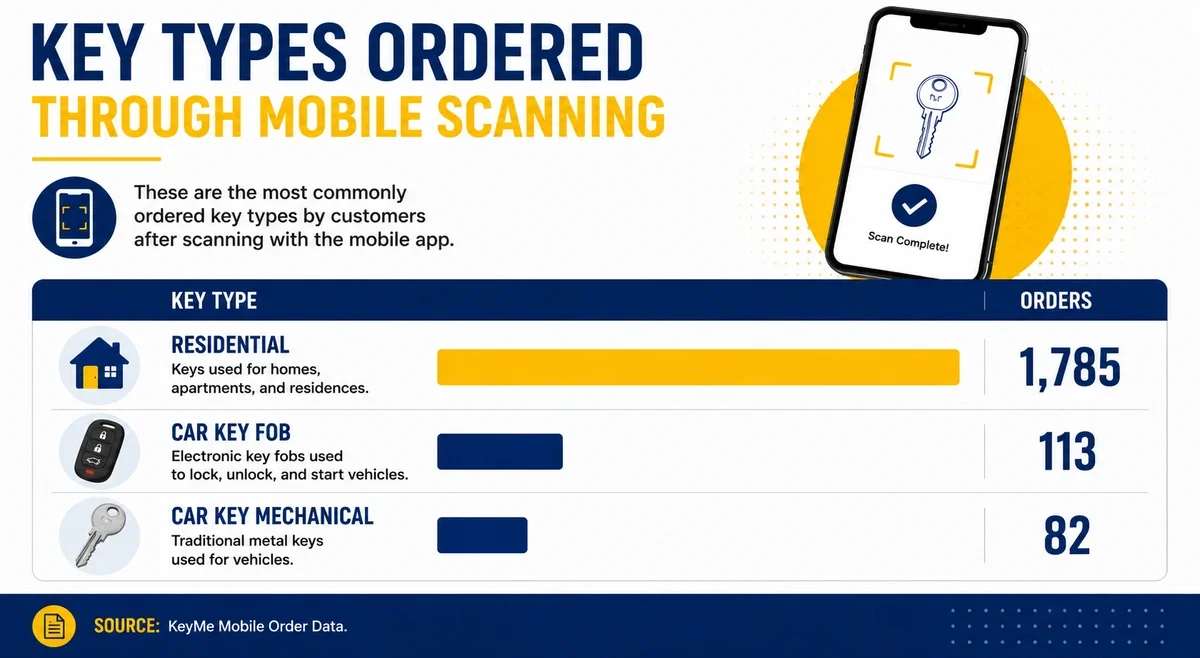
According to KeyMe mobile ordering data, residential keys overwhelmingly dominate online key duplication activity. During the reporting period, residential keys generated 1,785 orders compared with 113 AKG orders and just 82 vehicle-key orders. In other words, roughly nine out of every ten mobile key orders involved residential access rather than automotive or specialty keys.
That finding reveals something important about how consumers actually use mobile key-scanning technology.
They are not primarily solving emergencies.
They are planning ahead.
As smartphones become increasingly integrated into everyday life, consumers are beginning to manage household access the same way they manage banking, shopping, travel, and food delivery: remotely, conveniently, and on their own schedule.
Key Findings
Residential Keys Account for Approximately 90% of Mobile Orders
The vast majority of online key duplication activity involves residential keys, making household access management the dominant use case for mobile key scanning.
Vehicle Keys Represent a Small Share of Mobile Orders
Despite their importance in the broader locksmith industry, vehicle keys account for only a small percentage of online ordering activity.
Mobile Ordering Is Primarily a Planning Tool
Consumer behavior suggests online key duplication is often used to create backups and shared-access copies before a problem occurs.
Organic Search Drives Most Orders
More than 63% of purchases originated through organic search, indicating that consumers are actively seeking remote key duplication solutions.
Convenience Is the Primary Driver
The strongest behavioral pattern visible in the data is a preference for completing key duplication without making a dedicated trip to a store.
Chart: Key Types Ordered Through Mobile Scanning
Key Insight
Approximately 90% of all mobile key orders are residential keys.
The overwhelming dominance of residential orders suggests consumers view mobile key scanning primarily as a household access-management tool rather than an emergency replacement service.
Why Residential Keys Dominate Mobile Ordering
The data makes one thing clear: consumers overwhelmingly choose mobile ordering for home-access needs.
From a locksmith perspective, that makes perfect sense.
Unlike emergency lockouts or vehicle key issues, residential key duplication is often proactive rather than reactive.
Common motivations include:
- Creating a backup key
- Giving access to a spouse or partner
- Preparing for a new roommate
- Providing access to a caregiver
- Creating an emergency key for a trusted neighbor
- Managing a vacation property
- Supporting a rental property
These situations rarely require immediate service.
Instead, they benefit from convenience.
"The majority of mobile key orders aren't driven by urgency," says a KeyMe residential access specialist. "They're driven by planning. Consumers recognize they need another key and choose a process that fits into their schedule rather than making a dedicated trip."
That distinction helps explain why residential keys dominate mobile ordering activity.
The need exists long before the key is actually required.
Mobile Scanning Reflects the Rise of Household Access Management
One of the most important trends visible in the data is the growing shift from key replacement to access management.
Historically, key duplication often occurred after a problem emerged.
Today, consumers are increasingly using mobile technology to proactively manage access for:
- Family members
- Children
- Roommates
- Caregivers
- Dog walkers
- House cleaners
- Property managers
- Trusted neighbors
A duplicate key is no longer just a spare.
It has become a coordination tool.
"What we're seeing is a shift from ownership to access management," says a KeyMe consumer access analyst. "Consumers aren't just duplicating keys because they lost one. They're creating systems that allow multiple trusted people to access homes, properties, and shared spaces."
This trend mirrors broader changes occurring across American households, where access is increasingly distributed among multiple trusted individuals.
The Convenience Economy Has Reached Key Duplication
Consumers increasingly expect services to fit into their schedules rather than requiring dedicated errands.
Food delivery.
Banking.
Prescription refills.
Shopping.
Now key duplication.
Mobile scanning allows consumers to create a duplicate key from virtually anywhere using a smartphone.
The process eliminates several traditional barriers:
- Driving to a store
- Remembering to bring a key
- Waiting in line
- Making a special trip
- Returning later for pickup
Instead, the duplication process can begin the moment someone realizes they need a spare.
That shift fundamentally changes consumer behavior.
The easier duplication becomes, the more likely consumers are to create backups before they experience a lockout or lose access.
Search Behavior Reveals Strong Consumer Intent
Another revealing finding comes from acquisition data.
More than 63% of purchases originated through organic search.
That suggests consumers are not stumbling across mobile duplication accidentally.
They are actively looking for solutions.
Common search motivations likely include:
- Copy a key online
- Duplicate a house key from a photo
- Order a spare key
- Replacement key online
- Backup key delivery
These users already know they need another key.
The mobile platform simply provides a more convenient path.
"The search data suggests consumers are intentionally looking for remote duplication options," says a KeyMe digital services expert. "People increasingly understand that creating a spare key doesn't require a special trip. They're discovering a more convenient workflow and adopting it."
Why Vehicle Keys Represent a Small Share of Mobile Orders
Vehicle keys account for a relatively small portion of online orders despite generating significant demand elsewhere in the locksmith industry.
This is not surprising.
Modern vehicle keys often involve:
- Electronic programming
- Embedded transponders
- Vehicle-specific security systems
- Push-to-start technology
- Authentication procedures
Many automotive key situations require specialized programming equipment or in-person support.
Residential keys, by contrast, are often ideal candidates for remote duplication.
The result is a natural concentration of online ordering activity around household access rather than automotive access.
Mobile Duplication Is About Planning, Not Emergencies
Traditional locksmith services frequently address urgent situations.
Lost keys.
Broken keys.
Lockouts.
Mobile ordering behaves differently.
The customer journey involves scanning, selecting shipping options, completing payment, and waiting for delivery. That process naturally aligns with planned duplication rather than emergency response.
Consumers appear to be ordering keys because:
- They only have one working key
- A family member needs access
- They want an emergency backup
- They recently moved
- They manage multiple properties
- They are preparing for future needs
These are proactive decisions.
Not reactive ones.
What the Data Suggests About the Future of Key Duplication
The broader trend is becoming increasingly clear.
Consumers expect key duplication to behave like other modern digital services:
- Accessible online
- Available on demand
- Convenient to complete
- Delivered directly
Physical keys remain essential.
But the process surrounding them is becoming increasingly digital.
"What stands out in the data is how practical consumer behavior is," says a KeyMe consumer access analyst. "People are using mobile scanning for the keys they use most frequently and the keys they're most likely to want backups for. That's overwhelmingly residential access."
Rather than replacing locksmith services, mobile ordering appears to be creating an entirely new category: proactive household key management.
Frequently Asked Questions About Mobile Key Scanning
Why do residential keys dominate online key orders?
Residential keys are often duplicated proactively rather than during emergencies. Consumers commonly create spare keys for family members, roommates, caregivers, or backup purposes, making them especially well suited for remote ordering.
What does the dominance of residential orders reveal about consumer behavior?
It suggests consumers view mobile scanning primarily as a convenience and planning tool rather than a solution for urgent lock or key problems.
Why aren't vehicle keys a larger share of mobile orders?
Many vehicle keys involve programming, security verification, and specialized equipment that may require additional steps beyond standard key duplication. Residential keys are generally simpler candidates for remote ordering.
Are consumers using mobile scanning because they lost their keys?
Not necessarily. The data suggests many consumers are creating backups before they experience a lockout, lose access, or need to share entry with another trusted person.
What life events most commonly lead to online key duplication?
Common triggers include moving, adding a roommate, creating family backup keys, preparing a rental property, supporting a caregiver, or realizing only one working key remains.
What does the growth of mobile key ordering suggest about the future?
It suggests consumers increasingly expect everyday services to be accessible digitally. Key duplication is becoming part of a broader convenience economy where tasks that once required dedicated trips can now be completed remotely.
What is the biggest lesson from the data?
The strongest trend is proactive access management. Consumers are increasingly using digital tools to prepare for future needs rather than waiting for key-related problems to occur.
Methodology
This analysis is based on proprietary KeyMe mobile-ordering data covering residential, vehicle, and AKG key orders. Additional behavioral insights were informed by KeyMe's experience supporting residential key duplication, mobile key scanning, and access-management needs nationwide. The analysis evaluates how consumers are adopting remote key duplication technology and what that behavior reveals about modern household access patterns.
About KeyMe Locksmiths
KeyMe Locksmiths is a leading provider of local locksmith services and key copy kiosks across 50 states and the District of Columbia. Proud to serve over 5 million customers, KeyMe Locksmiths cuts over 10 million keys annually. With more than 8,000 self-service kiosks in major retailers, an e-commerce platform delivering over 10,000 keys weekly, and a nationwide locksmith network, KeyMe Locksmiths provides fast, reliable solutions for residential, commercial, and vehicle needs. KeyMe Locksmiths is committed to delivering exceptional service backed by a 100% money-back guarantee. KeyMe Locksmiths also operates one of the nation’s leading retail media networks, connecting consumers to other brands seeking to advertise in-store and delivering over 2B monthly impressions.