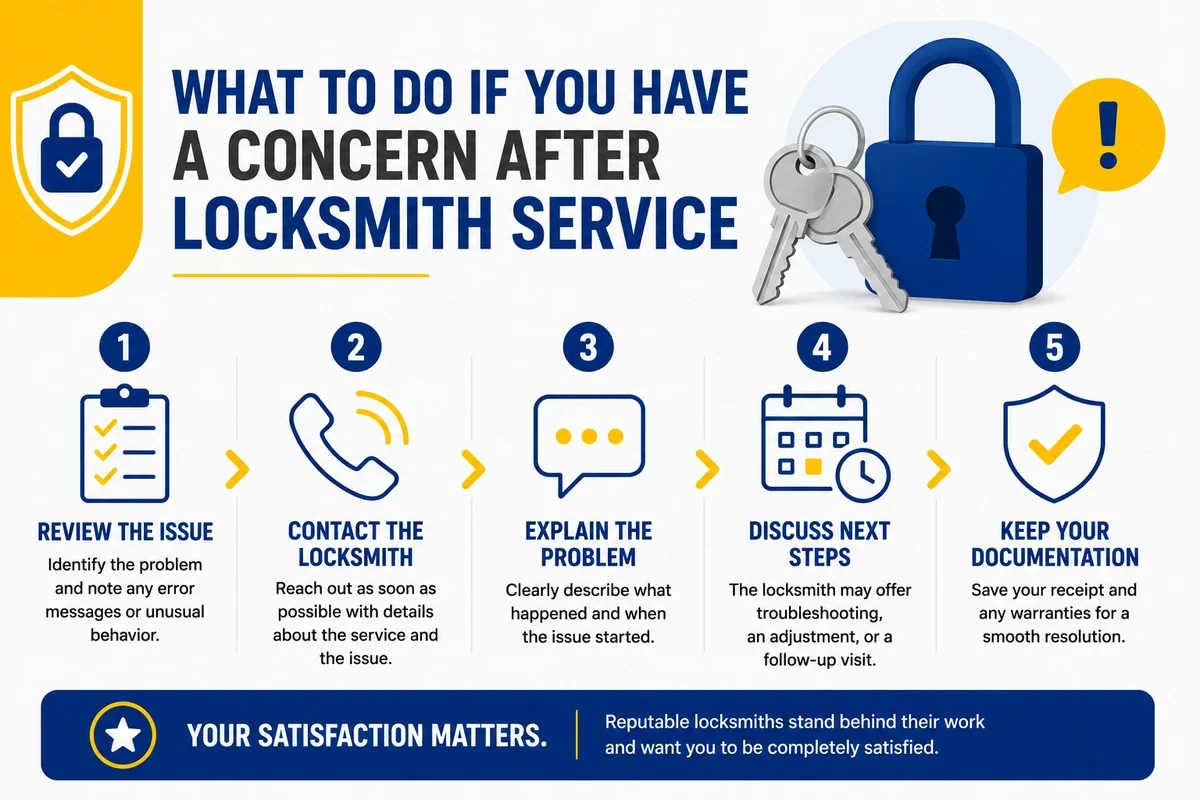
If you have a concern after locksmith service, start by documenting exactly what happened. Keep your receipt or service confirmation, write down the sequence of events, save relevant messages, and take photos or videos if there is a visible or repeatable problem.
A clear record can help separate the original locksmith issue from the work that was recommended, the service you authorized, and the concern you noticed afterward.
If the service was arranged through KeyMe Locksmiths, contact KeyMe support with the information you have available so the specific service experience can be reviewed.
Summary
- Keep your receipt, service confirmation, and relevant messages.
- Write down what service you originally requested.
- Record what the locksmith found and recommended after arriving.
- Note what work you remember authorizing.
- Document any problem you noticed after the service.
- Take photos or videos when they can clearly show the issue.
- Avoid changing or discarding relevant hardware before documenting it when practical.
- Contact KeyMe support with a concise timeline and supporting information.
- If you want to understand what happens after feedback is submitted, see how KeyMe reviews locksmith service feedback.
Best Way to Handle a Concern After Locksmith Service
The best way to handle a post-service concern is to create a clear record before contacting support.
A useful sequence is:
- Identify the exact concern.
- Preserve your service documentation.
- Write down what happened before, during, and after the visit.
- Document visible or repeatable problems.
- Compare the work performed with what you understood you were authorizing.
- Contact KeyMe support with the relevant information.
- Keep your documentation while the concern is being reviewed.
You do not need to diagnose the technical cause yourself. The goal is to explain what you observed accurately.
Need a Locksmith? We're here to help
Connect with a trusted local locksmith for fast, professional assistance when you need it most.
Step 1: Identify the Exact Concern
Start by describing the problem as specifically as possible.
Instead of:
"The locksmith service didn't work."
A more useful description would be:
"After the service, the exterior key enters the deadbolt but stops before completing the turn."
Or:
"I requested help with a home lockout. After the locksmith arrived, additional lock work was recommended, and I am unclear about what I authorized."
Specific observations make it easier to understand which part of the service experience needs review.
Common concerns may involve:
- A lock that does not operate as expected
- A newly cut or programmed key that has a functional issue
- A door that no longer closes or latches normally
- Questions about work that was performed
- Confusion about additional work recommended on-site
- Differences between what you remember approving and what appears on the service documentation
- Communication or professional-conduct concerns
- Questions about the service total or listed work
- Difficulty understanding what happened during the visit
Different concerns require different information, so defining the issue first helps organize everything else.
Step 2: Keep Your Receipt and Service Documentation
Save any documentation connected with the locksmith visit.
This might include:
- Receipt or invoice
- Appointment confirmation
- Service confirmation
- Text messages
- Emails
- Provider information
- Photos taken during or after the appointment
- Notes you made during the visit
Your receipt can be particularly useful because it may show the service category, provider information, completed work, or other details associated with the appointment.
Do not rely only on memory when written documentation is available.
Step 3: Write a Short Service Timeline
A simple timeline can help explain how the concern developed.
Record:
Before the Locksmith Arrived
What problem caused you to request service?
For example:
- Locked out of a home
- Lost car key
- Broken key
- Lock that would not turn
- Damaged deadbolt
- Door that would not lock
- Vehicle key or fob issue
During the Visit
What did the provider tell you after inspecting the problem?
Record anything you remember about:
- The provider's assessment
- Recommended work
- Parts or hardware discussed
- Additional problems discovered
- Changes from the service you initially requested
- Work you were asked to authorize
After the Service
What happened after the work was completed?
For example:
- The original problem was resolved, but another function changed.
- The lock worked initially but later became difficult to operate.
- A key worked in one function but not another.
- You reviewed the receipt and had a question about the work listed.
- You realized that your understanding of the authorized work differed from what was completed.
Keeping these stages separate can make the service experience easier to evaluate.
Step 4: Document Visible or Repeatable Problems
If your concern involves something you can see or reproduce, documentation can provide useful context.
Examples include:
- A key stopping at the same point in a lock
- A door failing to latch
- A deadbolt not lining up correctly
- A vehicle remote button not performing the expected function
- Visible damage around hardware
- A replacement key functioning differently from another working key
Photos may help document visible conditions.
A short video may be useful when movement or function is important, such as showing a lock that repeatedly stops at the same position.
Keep the documentation focused on the problem rather than trying to determine the technical cause yourself.
Find a KeyMe Kiosk Near You
Need a spare key fast? Find a KeyMe kiosk near you to copy many house, office, and eligible car keys in just minutes.
Step 5: Separate the Original Problem From the Post-Service Concern
This distinction can be important.
Suppose a locksmith was originally called because a key would not turn.
After the locksmith inspected the lock, additional work was recommended.
Later, the customer reports that the lock still feels difficult to operate.
Several different stages are involved:
- The condition before service
- The locksmith's on-site assessment
- The work recommended
- The work authorized
- The work completed
- The condition afterward
Documenting those stages helps avoid treating every post-service symptom as though it began after the visit.
The same principle applies to vehicle keys, smart locks, door hardware, commercial locks, and other locksmith services.
Step 6: Review What Work You Authorized
Authorization helps establish what the customer and provider understood would be performed.
Try to remember:
- What service you originally requested
- What the provider recommended after arriving
- Why additional work was recommended, if applicable
- What work you agreed to
- Whether parts or hardware were discussed
- Whether the scope changed after work began
If you are unsure what service authorization means, see Understanding Locksmith Service Authorization.
That guide explains why authorization should relate to a specific scope of work rather than a general instruction to "fix the problem."
For future service visits, Questions to Ask Before Locksmith Work Begins provides a practical checklist for confirming the recommendation before work starts.
Step 7: Understand Why the Recommendation May Have Changed
Not every locksmith problem can be fully diagnosed before a provider sees the lock, key, door, vehicle, or hardware.
For example:
- A lockout may reveal a damaged cylinder.
- A broken key may reveal an existing lock problem.
- A rekey request may uncover damaged hardware.
- A vehicle key request may require programming after the vehicle is identified.
- A door that appears to have a lock problem may also have an alignment issue.
A changed recommendation is not automatically evidence of a problem.
The important question is whether the changed condition and recommended work were explained clearly.
For more detail, see Why Locksmith Estimates Can Change After Arrival.
Step 8: Explain the Concern Clearly When Contacting Support
A useful support message does not need to be long.
Try to include:
- Service date
- Service location
- Original service request
- Provider information, if available
- What the provider found
- What work was recommended
- What work you understood you authorized
- What work was completed
- The concern you noticed afterward
- Relevant photos, videos, receipts, or messages
Focus on observable facts.
Instead of:
"The locksmith ruined my lock."
Consider:
"Before the visit, the key was difficult to turn but still operated the deadbolt. After the service, the key enters fully but stops before the deadbolt moves."
The second description gives support more information to work with without assuming the cause.
Different Types of Post-Service Concerns
The Lock or Door Does Not Work as Expected
Describe the exact function that changed.
For example:
- Does the key enter fully?
- Does it turn?
- Does the latch move?
- Does the deadbolt extend?
- Does the door close correctly?
- Does the problem occur with more than one key?
A functional description is more useful than simply saying the lock is "broken."
A Car Key or Fob Has a Problem
Record which functions work and which do not.
Depending on the key, that might include:
- Mechanical door access
- Lock button
- Unlock button
- Trunk or hatch button
- Ignition
- Push-button start
- Proximity detection
Automotive key problems can involve several separate functions, so identifying the exact symptom matters.
You Have a Question About Additional Work
Start with the original request.
Then explain:
- What the provider discovered
- What additional work was recommended
- What explanation you received
- What you remember approving
This helps establish whether the concern involves the technical recommendation, the authorization process, or the communication around it.
You Have a Question About the Service Documentation
Keep your receipt or invoice and identify the specific line item or service description you are asking about.
Avoid relying on a general statement such as "the invoice looks wrong."
Pointing to the specific service, hardware, or entry you are questioning gives support a clearer starting point.
You Have a Concern About Provider Conduct
Write down what happened while the details are fresh.
Include:
- What was said or done
- Approximately when it happened
- Who was present
- Whether it related to authorization, communication, property, or another aspect of the visit
Stick to specific actions and statements rather than assumptions about intent.
Copy Your Key from Anywhere - Right from Your Phone
Skip the kiosk and copy your key from home. Upload a clear photo of an eligible house or car key, and KeyMe will create a precise duplicate and mail it directly to your door.
What Not to Do Before Your Concern Is Documented
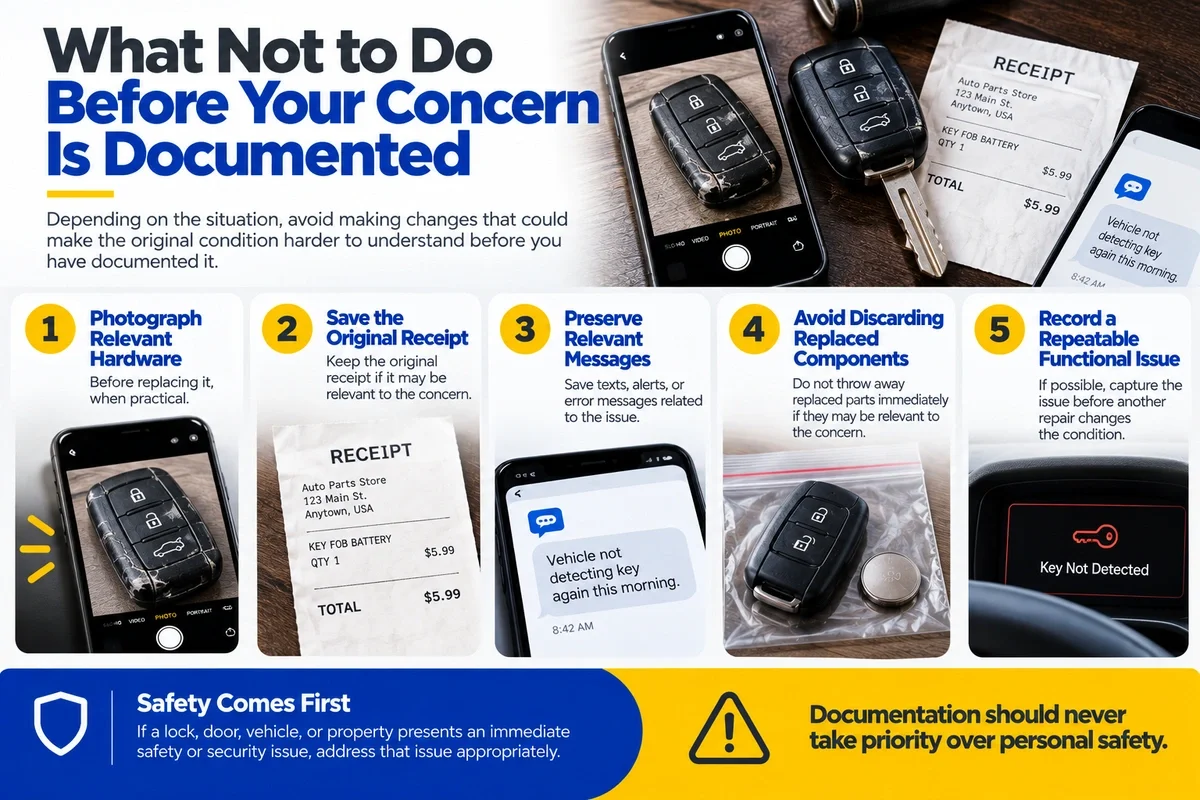
Depending on the situation, avoid making changes that could make the original condition harder to understand before you have documented it.
For example, when practical:
- Photograph relevant hardware before replacing it.
- Save the original receipt.
- Preserve relevant messages.
- Avoid discarding replaced components immediately if they are relevant to the concern.
- Record a repeatable functional issue before another repair changes the condition.
Safety comes first. If a lock, door, vehicle, or property presents an immediate safety or security issue, address that issue appropriately.
Documentation should never take priority over personal safety.
How KeyMe Reviews Service Feedback
Once feedback is submitted, the question changes from "What should I document?" to "How is the information evaluated?"
KeyMe can use the details provided to better understand areas such as:
- Communication
- Scope of work
- Customer authorization
- Professional conduct
- Completed service
- Support follow-up
For a deeper explanation of that process, read How KeyMe Reviews Locksmith Service Feedback.
That article focuses on how feedback can provide context around a locksmith visit rather than repeating the steps for documenting an active concern.
Why Choose KeyMe Locksmiths
KeyMe Locksmiths helps customers request locksmith service for residential, automotive, commercial, and emergency access needs.
When questions arise after a visit, clear documentation can help establish what service was requested, what was recommended on-site, what was authorized, and what happened afterward.
"When reviewing a post-service concern, the most useful starting point is a clear sequence of events. Separate the original problem, the provider's assessment, the work you authorized, and the condition you observed afterward. That makes the concern much easier to understand." - KeyMe Locksmiths