

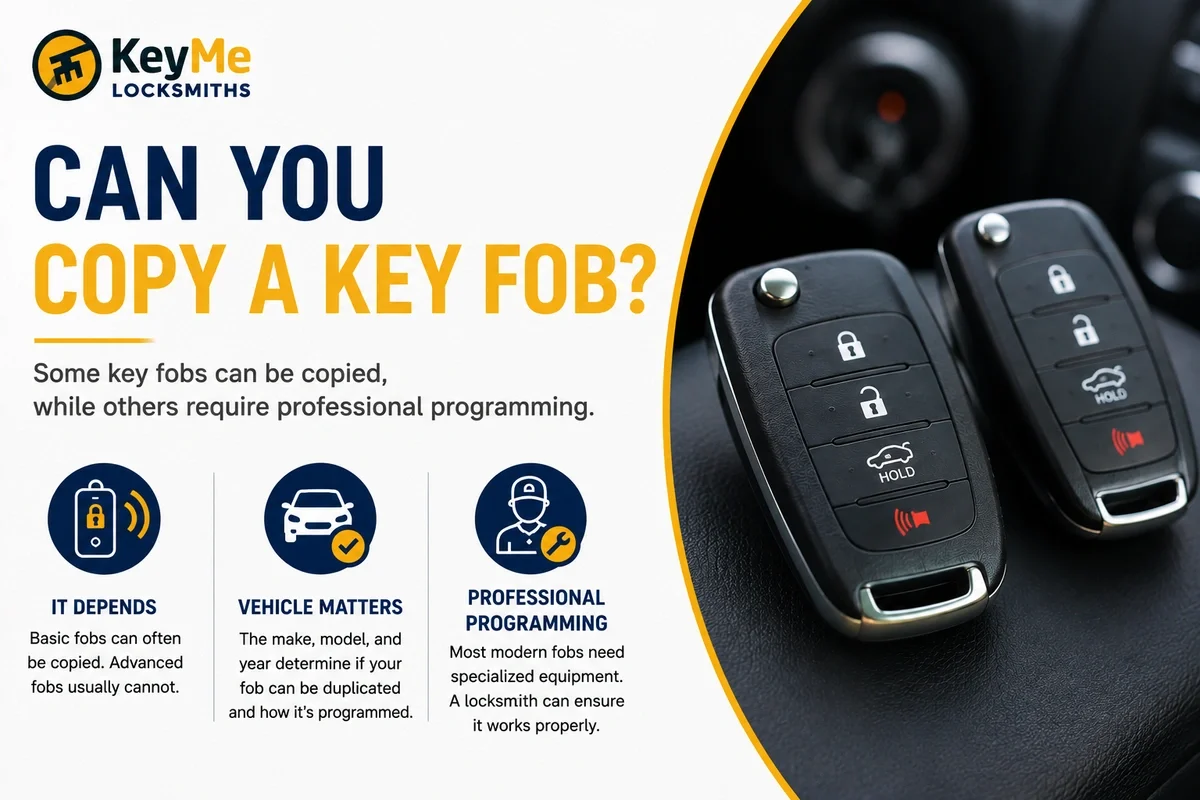
Yes, many key fobs can be copied, but it depends on the technology, security configuration, and whether you are authorized to duplicate the credential. Some apartment, office, gym, and amenity-access fobs use RFID technology that supports duplication, while encrypted, high-security, or centrally managed credentials may intentionally prevent it.
KeyMe supports duplication of many common RFID-based key fobs at participating self-service kiosks. The kiosk checks compatibility before copying, so users do not need to identify the exact RFID technology themselves before beginning the process.
Understanding the difference between a simple access credential and a higher-security managed credential can help you know when copying is possible—and when a property manager or system administrator needs to issue a replacement.
Summary
- Many common RFID key fobs used for apartments, offices, gyms, and shared amenities can be copied when the technology is supported and the user is authorized.
- KeyMe key copy kiosks can check whether a supported fob is compatible before duplication.
- Encrypted, high-security, proprietary, or administrator-controlled credentials may intentionally prevent copying.
- NIST guidance on physical access control emphasizes matching authentication methods to security risk, which helps explain why higher-security facilities may use credentials designed to resist simple duplication.
- A copied fob does not create new building permissions; it reproduces supported credential data from an existing authorized fob.
- Building rules still matter. Lease terms, HOA policies, employer rules, or access-control policies may limit who is allowed to create an additional credential.
- If a fob cannot be duplicated, replacement may need to be coordinated through building management, an HOA, an employer, or the access-system administrator.
What Determines Whether a Key Fob Can Be Copied?
Not all key fobs work the same way.
Whether a fob can be duplicated depends on several factors, including:
- The credential technology
- Encryption or other security features
- The access system's configuration
- Property or employer policies
- Whether the credential is active
- Whether the user is authorized to create another copy
The technology matters because physical access systems can use very different levels of authentication.
The National Institute of Standards and Technology (NIST) recommends a risk-based approach when selecting authentication methods for physical access control systems. Its guidance for federal facilities recognizes that different environments require different authentication strengths depending on the risk being protected against.
While apartment and office fobs are not necessarily government PIV credentials, the broader principle is useful: higher-security environments may intentionally use stronger credentials that are more difficult to reproduce.
“The biggest factor isn't simply whether the credential looks like a key fob. It's what technology and security controls are inside it. Two nearly identical fobs can interact with access systems in very different ways.” — KeyMe Locksmiths
Types of Key Fobs That Are Commonly Copied
Many everyday access fobs use RFID technology that can be duplicated when compatible.
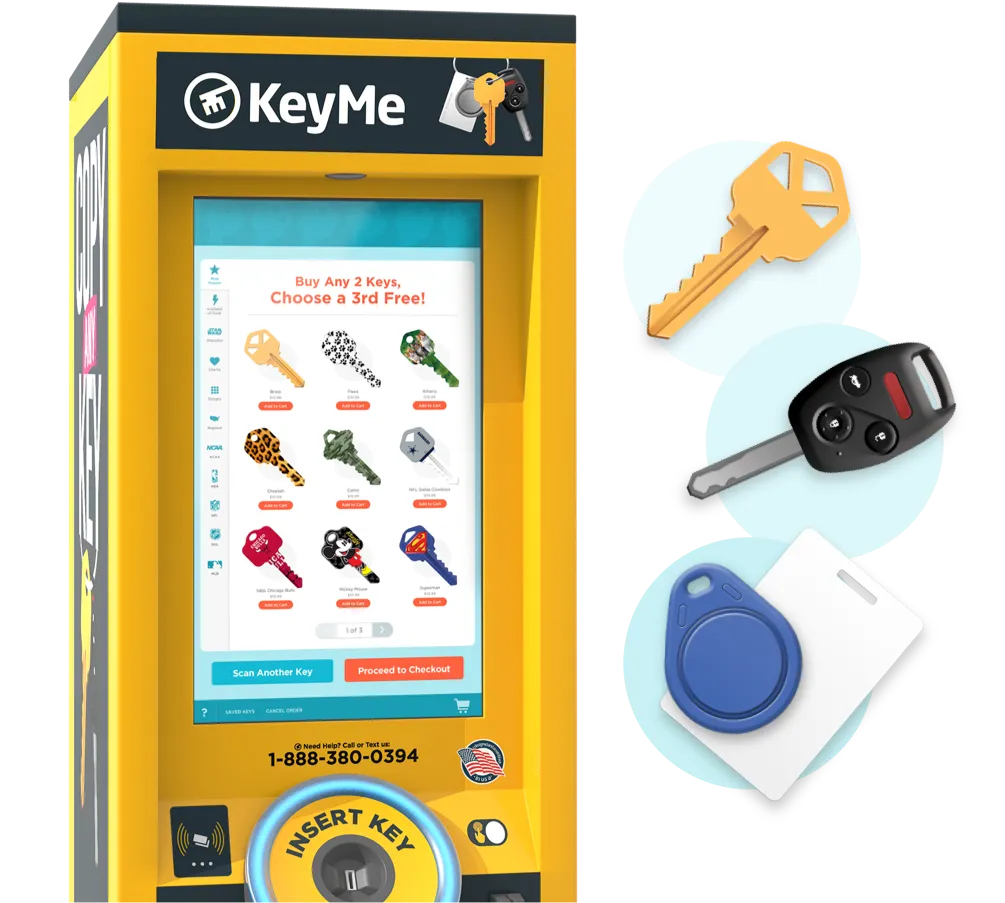
KeyMe's RFID key fob copying service supports many commonly used access credentials, including compatible fobs used for:
- Apartments and condominiums
- Office buildings
- Gyms
- Shared amenities
- Gated communities
- Other common residential and commercial access systems
According to KeyMe's key fob service information, participating kiosks can read and duplicate many standard RFID and non-encrypted proximity fobs. The kiosk performs a compatibility check before copying.
That distinction is important. A fob's shape does not determine whether it can be copied; the credential technology inside it does.
Need a Locksmith? We're here to help
Connect with a trusted local locksmith for fast, professional assistance when you need it most.
Key Fobs That Usually Can't Be Copied
Some credentials are deliberately designed to make duplication difficult or prevent it altogether.
These can include:
- Encrypted fobs
- High-security credentials
- Proprietary access technologies
- Credentials managed by restricted access-control systems
- Fobs that require administrator-issued enrollment
- Unsupported RFID formats
NIST's physical access-control guidance helps explain why these differences exist. NIST recommends choosing authentication mechanisms based on security risk rather than treating every building or access point identically.
A low-risk shared amenity and a highly restricted facility, for example, may use very different credential technologies.
“When a credential is encrypted or tightly controlled by the access system, restrictions on duplication are part of the security design—not a technical inconvenience.” — KeyMe Locksmiths
If a credential isn't supported, the appropriate next step may be requesting another fob directly from property management, an HOA, an employer, or the access-system administrator.
For commercial properties dealing with broader access or physical lock issues, a commercial locksmith may also be able to evaluate the property's locks and other access hardware.
How Key Fob Copying Works
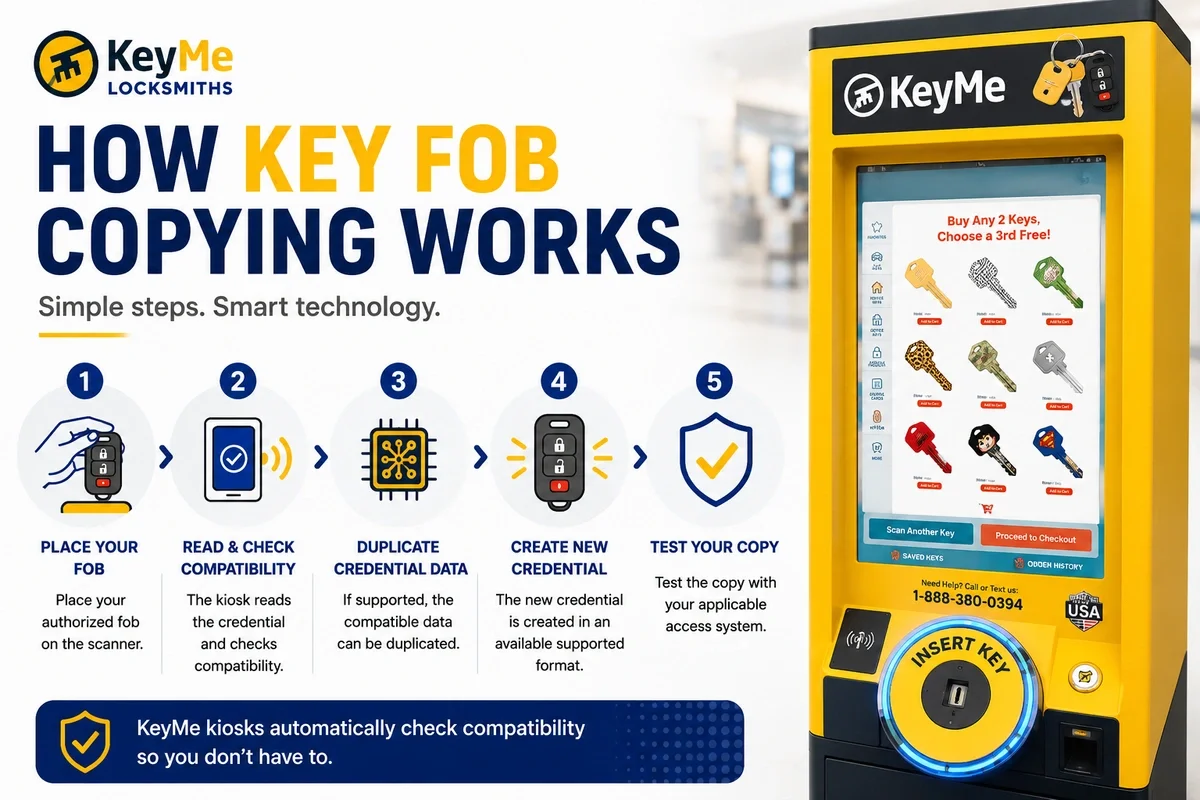
When a fob is supported, the process is generally straightforward.
At a participating KeyMe kiosk:
- Place the authorized fob on the scanner.
- The kiosk reads the credential and checks compatibility.
- If the format is supported, the compatible credential data can be duplicated.
- The new credential is created in an available supported format.
- The copy should be tested with the applicable access system.
KeyMe's service information states that its kiosks perform the compatibility check automatically, so users don't have to determine the credential technology on their own before trying the service.
“Compatibility should be established before duplication. That protects the user from relying on a credential that isn't compatible with the original access system and helps preserve the access rules already established by the property.” — KeyMe Locksmiths
Does Copying a Fob Add New Access Permissions?
No.
A copy of a compatible fob does not automatically give the user access to additional doors, floors, or amenities that the original credential could not open.
The building's access-control system determines what the credential is authorized to access.
This distinction reflects a fundamental physical-access principle identified by NIST: organizations should verify authorization before granting physical access and control entry using appropriate access-control systems or devices.
In practical terms, the fob carries the credential, but the building's access-control system determines what that credential can access.
Is It Legal to Copy a Key Fob?
You should only duplicate a key fob when you are authorized to possess and use the additional credential.
The technical ability to copy a fob does not override:
- Lease agreements
- HOA rules
- Employer policies
- Property-management procedures
- Access-control agreements
NIST's broader physical-security guidance reinforces the importance of controlling physical access devices and determining who is authorized to enter protected facilities.
For apartment residents or employees, the practical takeaway is to check the applicable rules before creating a spare.
Unauthorized duplication may violate a lease, employment policy, building rule, or other access agreement even when the credential is technically compatible with duplication.
Find a KeyMe Kiosk Near You
Need a spare key fast? Find a KeyMe kiosk near you to copy many house, office, and eligible car keys in just minutes.
Why Someone Might Want a Key Fob Copy
An additional authorized fob can be useful in several everyday situations.
Backup Access
A spare can provide another way to enter if the primary fob is misplaced or damaged.
For apartments that also use conventional keyed locks, keeping a spare physical key may provide additional backup. KeyMe offers key copying services for many supported residential key types.
Authorized Household Members
Apartment or condo residents may need an additional credential for another authorized occupant or household member, subject to property policies.
Shared Workspaces
Businesses may need multiple authorized credentials for employees, although employer and access-system rules should always be followed.
Avoiding a Single Point of Failure
If one working credential is lost or damaged, having an authorized backup can reduce the chance of an unexpected access problem.
The key is that duplication should support authorized access, not bypass the building's access-management process.
Copying vs. Replacing a Key Fob
These are not always the same thing.
Key Fob Duplication
Duplication generally makes sense when:
- You still have a working fob.
- The fob is compatible.
- You are authorized to create an additional copy.
- You want a backup credential.
For a compatible credential, you can use KeyMe's RFID key fob service to check available duplication options.
Key Fob Replacement
Replacement may be necessary when:
- The original is lost.
- The original has been deactivated.
- The credential is damaged.
- The building uses an encrypted or managed system.
- The property requires credentials to be issued centrally.
If a credential has been lost, asking management to deactivate the missing credential and issue another authorized credential may be more appropriate than simply trying to recreate it.
What Happens if Your Key Fob Can't Be Copied?
An unsupported result doesn't necessarily mean something is wrong with the fob.
It may mean the system uses:
- Encryption
- A proprietary credential format
- A higher-security authentication method
- Administrator-managed enrollment
- An RFID format not supported by the kiosk
In those cases, contact the party responsible for managing the access system.
That might be:
- Your landlord
- Apartment management
- Your HOA
- Your employer
- Building security
- A facility administrator
If the issue involves the physical door lock rather than the electronic credential, KeyMe also provides locksmith services for residential and commercial access problems.
For an urgent apartment or house access issue involving a conventional lock, home lockout service may be more appropriate than attempting to solve the problem through fob duplication.
Why Access-Control Security Varies by Building
Not every property faces the same security requirements.
NIST's SP 800-116 Rev. 1 recommends a risk-based strategy for physical-access authentication. In practice, that means stronger authentication methods may be appropriate as the consequences of unauthorized access increase.
A basic residential amenity room may not require the same credential technology as a data center, government facility, restricted workplace, or another sensitive area.
That helps explain why one RFID fob may be straightforward to duplicate while another seemingly similar credential is encrypted or tightly administrator-controlled.
The difference is often intentional.
For property managers and businesses, electronic credentials are also only one part of access security. Mechanical locks, commercial door hardware, master key arrangements, and other access points may require separate commercial locksmith services.
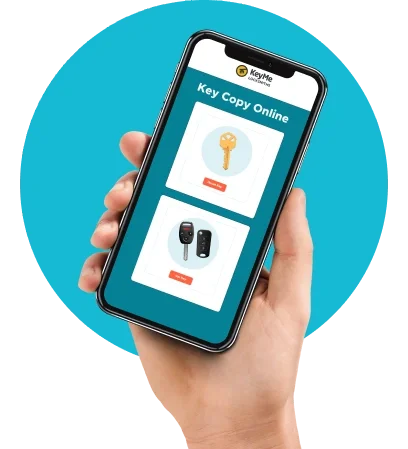
Copy Your Key from Anywhere - Right from Your Phone
Skip the kiosk and copy your key from home. Upload a clear photo of an eligible house or car key, and KeyMe will create a precise duplicate and mail it directly to your door.
Best Way to Get a Key Fob Copy
If you have a working fob and are authorized to duplicate it, start by checking whether the credential is supported.
A participating KeyMe self-service kiosk can scan the fob and determine compatibility. If the credential is supported, follow the kiosk instructions to create the duplicate and test it with the appropriate access point.
If the fob isn't supported:
- Don't attempt to bypass its security controls.
- Contact the property or system administrator.
- Ask whether another authorized credential can be issued.
- If the problem is actually with a mechanical lock or door rather than the fob, use the appropriate locksmith service instead.
The right solution depends on whether the problem involves the credential, access permissions, or physical lock hardware.
Key Fob Duplication When It's Supported and Authorized
Many everyday RFID access fobs can be duplicated, but compatibility and authorization both matter.
KeyMe's service information states that participating kiosks can copy many standard RFID and non-encrypted proximity credentials used for apartments, offices, gyms, gated communities, and shared amenities. The kiosk checks compatibility before duplication begins.
At the same time, NIST's physical-access guidance helps explain why some credentials use stronger authentication and tighter administrative control: access technology should reflect the security requirements of the environment.
If you have an authorized working fob, you can explore KeyMe key fob copying or find a KeyMe kiosk to check compatibility.
If your problem involves a physical lock rather than the electronic credential, find locksmith services near you to determine the appropriate next step.
References
- KeyMe Locksmiths. Key Fob Copy. Information about supported RFID credentials, kiosk compatibility checks, duplication procedures, and unsupported credentials.
https://key.me/rfid - KeyMe Locksmiths. Key Copy Kiosks. Information about KeyMe's self-service kiosk network and available key duplication services.
https://key.me/kiosks - National Institute of Standards and Technology (NIST). Guidelines for the Use of PIV Credentials in Facility Access, SP 800-116 Rev. 1. Guidance on physical access-control authentication and risk-based credential selection.
https://www.nist.gov/publications/guidelines-use-piv-credentials-facility-access - National Institute of Standards and Technology (NIST). Using Personal Identity Verification (PIV) Credentials in Physical Access Control Systems. Guidance on authentication mechanisms and facility security risk.
https://www.nist.gov/publications/using-personal-identity-verification-piv-credentials-physical-access-control-systems - National Institute of Standards and Technology (NIST). SP 800-171 Rev. 3 — Physical Access Control. Guidance on verifying physical access authorization,