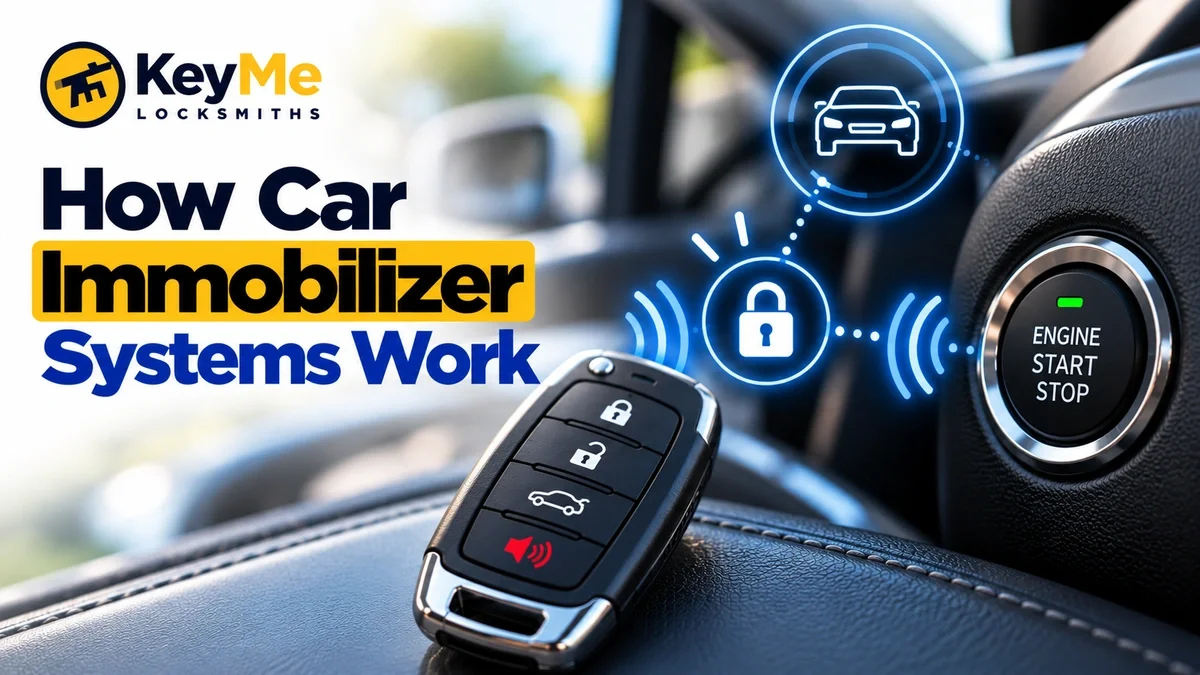
A car immobilizer is an electronic anti-theft system that helps prevent a vehicle from operating unless it recognizes an authorized key or credential.
Depending on the vehicle, the immobilizer system may involve a transponder inside the key, antennas or readers in the vehicle, security or body-control electronics, and the engine control module. When you try to start the vehicle, these components work together to determine whether the key is authorized.
If the required electronic authorization succeeds, the vehicle can permit normal engine operation. If it does not, the immobilizer can prevent or interrupt the vehicle from running.
This is why a perfectly cut metal key may open some vehicles but still be unable to start them.
Summary
- A car immobilizer is an electronic vehicle-theft deterrent.
- The system checks for an authorized electronic credential before permitting normal vehicle operation.
- Many immobilizer keys contain a transponder in addition to the physical key blade.
- The vehicle contains its own reader, antenna, control electronics, and engine-related components.
- A physical copy of a key may not start an immobilizer-equipped vehicle unless the required electronic credential is also recognized.
- Traditional transponder-key vehicles and push-button-start vehicles can both use immobilizer functions.
- Smart-key systems may integrate immobilizer functionality into a broader keyless-access system.
- Programming determines which supported credentials the vehicle recognizes, but the programming process itself is a separate topic.
- A failed authorization and a "Key Not Detected" warning are related concepts, but troubleshooting that warning deserves its own diagnostic process.
- Encryption and protected credential communication also deserve separate treatment from the basic function of the immobilizer.
Best Way to Understand a Car Immobilizer
Think of an immobilizer as an electronic gatekeeper between the key and normal vehicle operation.
A simplified process looks like this:
- The driver presents or carries the key.
- The vehicle attempts to identify the electronic credential.
- The system compares or validates the credential against what the vehicle expects.
- The immobilizer determines whether authorization has succeeded.
- If authorization succeeds, the vehicle permits normal engine or propulsion operation.
- If authorization fails, the system prevents or interrupts that operation.
NHTSA describes immobilizing-type anti-theft devices as systems that can prevent thieves from bypassing the ignition or hot-wiring a vehicle. Some accomplish this through computer chips in the key or by disabling electricity or fuel needed for engine operation.
"The important difference between a mechanical key and an immobilizer-equipped key is that physical access and electronic authorization can be two separate things. The blade may fit the lock, while the vehicle still requires the correct electronic credential before it will operate." - KeyMe Locksmiths
What Is an Engine Immobilizer?
An engine immobilizer is part of the vehicle's anti-theft architecture.
Its purpose is to prevent normal vehicle operation when the expected electronic authorization is missing.
NHTSA documentation of manufacturer immobilizer systems shows that this can involve communication among components such as:
- Electronic key or transponder
- Immobilizer antenna or reader
- Body or security control unit
- Engine control module
- Other vehicle control modules
The exact architecture varies substantially by vehicle.
What stays consistent is the principle:
Possessing something that mechanically fits the vehicle does not necessarily provide electronic permission to start it.
Why Do Cars Use Immobilizers?
Traditional ignition systems could rely heavily on mechanical locks.
Modern immobilizer systems add another layer.
Instead of asking only:
"Does this key physically fit?"
the vehicle can also ask:
"Is this an electronic credential I recognize?"
NHTSA categorizes immobilizers as anti-theft devices specifically because they can interfere with attempts to bypass a vehicle's ignition system or hot-wire the vehicle.
Vehicle theft remains a significant problem. NHTSA reported that more than 850,700 vehicles were stolen in 2024, although thefts declined 17% from 2023. That national theft figure does not measure immobilizer effectiveness by itself, but it provides context for why manufacturers continue to use layered vehicle-security technologies.
Need a Locksmith? We're here to help
Connect with a trusted local locksmith for fast, professional assistance when you need it most.

What Are the Main Parts of an Immobilizer System?
The components depend on the vehicle, but immobilizer architecture generally involves both the credential and vehicle.
1. The Authorized Key or Credential
The driver's key may contain a transponder or another electronic credential.
That credential is different from the metal cuts on the blade.
The blade handles mechanical interaction where applicable.
The electronic portion provides information the immobilizer system can evaluate.
Toyota documentation hosted by NHTSA, for example, explains that an immobilizer-equipped key transmits an electronic code to the vehicle and that the engine starts only when the credential is accepted by the immobilizer system.
For the physical and electronic components inside a modern smart key, see What Happens Inside a Smart Car Key?.
2. Immobilizer Antenna or Reader
The vehicle needs a way to communicate with the key.
In traditional transponder-key systems, a reader or antenna may be located around or near the ignition area.
When the key is inserted, the vehicle can receive information from the transponder.
Manufacturer service information filed with NHTSA describes systems in which an immobilizer antenna receives a key ID and passes it into vehicle control electronics for validation.
Push-button-start vehicles use a different physical arrangement, but they still need vehicle-side components capable of detecting and communicating with the authorized credential.
3. Immobilizer or Security Control Electronics
The credential information needs to be evaluated somewhere.
Depending on the vehicle, that function may involve:
- Immobilizer module
- Body control module
- Security control unit
- Smart-key module
- Other integrated vehicle electronics
The names and architecture vary.
There is not one universal "immobilizer box" found in every vehicle.
4. Engine Control Module
The engine control module, often abbreviated ECM, can also be part of the authorization process.
Manufacturer documentation available through NHTSA shows systems where key, security, and ECM-related identification information must correspond before normal engine operation continues.
This is why the immobilizer is better understood as a system than as a single component.
How Does a Car Immobilizer Work?
The exact process differs among manufacturers, but a simplified traditional transponder-key sequence looks like this:
Step 1: The Key Is Presented
The driver inserts the key or otherwise places the credential where the vehicle can detect it.
Step 2: The Vehicle Reads the Electronic Credential
The immobilizer antenna or related reader communicates with the key's electronic component.
Step 3: The Credential Is Evaluated
Vehicle electronics determine whether the credential matches or otherwise satisfies the system's authorization requirements.
Step 4: The Vehicle's Modules Validate the Request
Depending on the architecture, more than one control module may participate.
Some manufacturer systems compare identification information among the key, body/security electronics, and engine control module.
Step 5: Engine Operation Is Permitted or Prevented
If the authorization succeeds, normal operation can proceed.
If the expected authorization does not occur, the immobilizer can prevent the engine from starting or cause it to stop.
One manufacturer immobilizer manual submitted to NHTSA describes a system where the engine stops if the relevant IDs fail to match within the required period.
Why Can a Copied Metal Key Open the Door but Not Start the Car?
Because mechanical access and electronic authorization are different.
Imagine a key with:
- Correct mechanical cuts
- No recognized electronic credential
The blade may physically operate a compatible door cylinder.
But when the driver attempts to start the vehicle, the immobilizer looks for electronic authorization.
Toyota documentation explains this distinction directly: a physical copy may provide door access, while the engine will not start unless the electronic code is also accepted by the immobilizer.
This is an important reason modern car key replacement can involve more than cutting metal.
What Is the Transponder's Role?
A transponder is an electronic component associated with the key.
In an immobilizer-equipped system, it provides information the vehicle uses during authorization.
That does not mean every transponder system works identically.
Transponders can differ by:
- Vehicle manufacturer
- Model
- Model year
- Immobilizer generation
- Credential technology
This article focuses on the transponder's place in the immobilizer system.
For the separate question of how passive transponders receive power and why some keys require batteries while others do not, see Why Some Car Keys Need Batteries and Others Don't.
Does an Immobilizer Key Need a Battery?
Not necessarily.
Some traditional immobilizer transponders are passive and do not need a conventional replaceable fob battery for the immobilizer function.
A key may even combine:
- Passive transponder
- Battery-powered remote buttons
Honda service information available through NHTSA, for example, describes immobilizer keys whose electronic immobilizer circuitry is separate from an optional battery-operated remote transmitter. Keys without remote transmitters in that documented system contain no batteries.
The battery question is therefore separate from whether the vehicle uses an immobilizer.
How Do Immobilizers Work With Push-Button Start?
Push-button-start vehicles can also use immobilizer functions.
The major difference is that the driver does not insert a conventional ignition key.
Instead, the vehicle must determine that an authorized smart key is present.
NHTSA documentation of smart-key systems describes vehicles communicating with the electronic key, identifying the credential, and permitting engine starting after successful recognition.
Manufacturer service documentation also shows that smart-key systems can integrate immobilizer functionality into broader keyless-entry and engine-start electronics rather than relying on a separate traditional immobilizer module.
The principle remains:
The vehicle requires successful electronic authorization before normal operation is allowed.
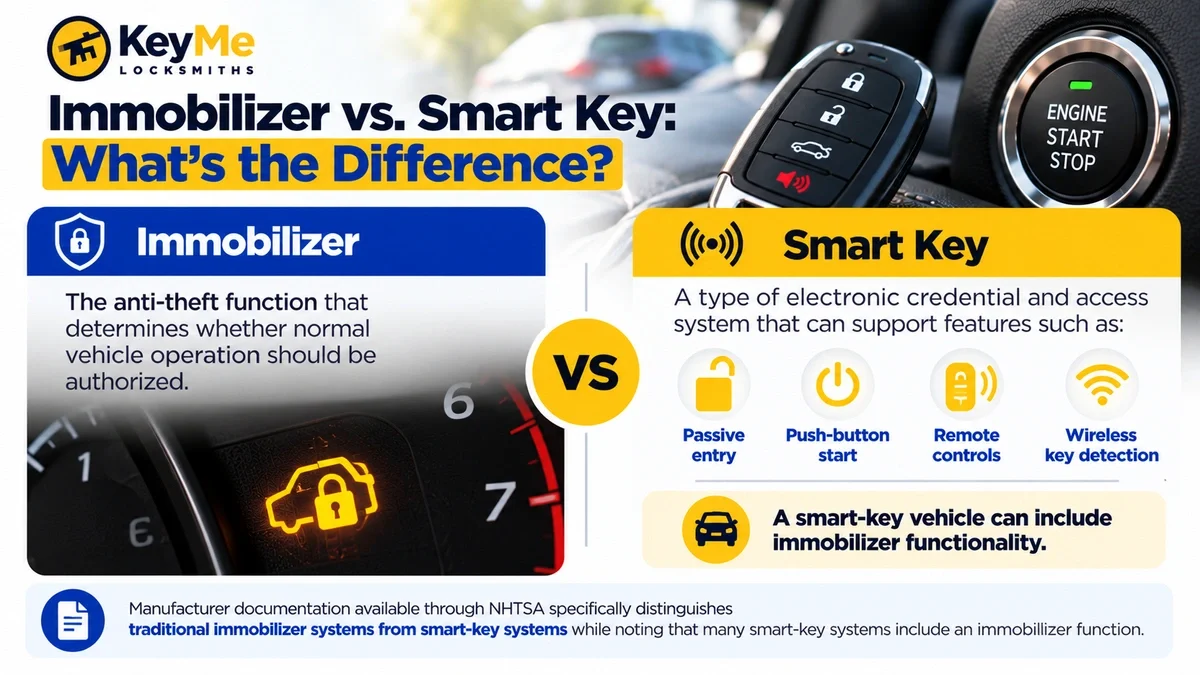
Immobilizer vs. Smart Key: What's the Difference?
These terms describe different things.
Immobilizer
The anti-theft function that determines whether normal vehicle operation should be authorized.
Smart Key
A type of electronic credential and access system that can support features such as:
- Passive entry
- Push-button start
- Remote controls
- Wireless key detection
A smart-key vehicle can include immobilizer functionality.
Manufacturer documentation available through NHTSA specifically distinguishes traditional immobilizer systems from smart-key systems while noting that many smart-key systems include an immobilizer function.
Immobilizer vs. Car Alarm
These systems serve different purposes.
Alarm
Typically tries to detect or draw attention to unauthorized entry or tampering.
Immobilizer
Prevents normal vehicle operation without the required authorization.
NHTSA separates anti-theft technologies into categories including audible/visible devices and immobilizing-type devices.
A vehicle can use both.
The alarm may sound while the immobilizer independently prevents normal engine operation.
What Happens When the Immobilizer Does Not Recognize the Key?
The exact behavior varies by vehicle.
Possible outcomes can include:
- Engine does not start
- Engine starts briefly and stops
- Immobilizer or security indicator appears
- Vehicle does not enter a normal ready state
Manufacturer service documents show examples where failed ID validation can cause the engine to stop and illuminate an immobilizer indicator.
However, this article should not be used as a troubleshooting checklist.
Failure to start does not prove that the immobilizer itself is defective.
Problems can involve:
- Key recognition
- Programming
- Key electronics
- Vehicle battery or electrical systems
- Security modules
- Other vehicle systems
If the vehicle specifically reports that it cannot recognize the key, see Key Not Detected Warning: Causes and Fixes.
Find a KeyMe Kiosk Near You
Need a spare key fast? Find a KeyMe kiosk near you to copy many house, office, and eligible car keys in just minutes.
What Does the Immobilizer Warning Light Mean?
Many vehicles have a security or immobilizer indicator.
Its exact behavior varies by manufacturer.
A flashing indicator while the vehicle is parked may simply indicate that the anti-theft system is active.
A warning during an attempted start may have a different meaning.
Because indicator behavior is vehicle-specific, use the owner's manual for the exact interpretation.
Do not assume that every security light indicates a failed immobilizer.
Why Does a Replacement Key Need Electronic Authorization?
Because creating the correct mechanical shape and becoming an authorized electronic credential are different steps.
A compatible replacement key may need to be registered or programmed before the immobilizer recognizes it.
That process determines which electronic credentials the vehicle accepts.
This article intentionally does not duplicate that procedure.
For the dedicated explanation, see How Car Key Programming Works.
Does Programming Change the Immobilizer?
Programming can update which supported credentials the vehicle recognizes, depending on the system and procedure.
That can matter when:
- Adding another key
- Replacing a missing key
- Handling an all-keys-lost situation
- Removing authorization for a missing credential where supported
But immobilizer operation and programming are different content intents.
The immobilizer is the system performing authorization.
Programming is the process used to establish or modify authorized credentials.
What About Encrypted or Protected Car Keys?
Some modern vehicle-key systems use more sophisticated authentication than simply transmitting an unchanging identifier.
For the immobilizer, the relevant point is simply that the vehicle must successfully validate the credential before authorizing operation.
The deeper security question, including why modern manufacturers protect credential communication against simple copying or reuse, belongs in Why Modern Vehicles Use Encrypted Car Keys.
Keeping those concepts separate prevents "immobilizer" from becoming an umbrella article for every aspect of automotive key security.
Can the Immobilizer Be Separate From the Door Locks?
Yes.
Vehicle access and vehicle-start authorization can be separate functions.
A mechanical door key may grant access to the cabin while the immobilizer still prevents the vehicle from operating.
Conversely, a smart-key system may electronically manage both entry and starting while treating them as distinct authorization events.
That distinction is especially important when diagnosing why a vehicle opens normally but does not start.
Why Do Different Vehicles Use Different Immobilizer Designs?
Immobilizer technology has evolved across:
- Manufacturers
- Vehicle generations
- Mechanical-key systems
- Transponder systems
- Remote-head keys
- Smart-key systems
- Hybrid and electric vehicles
One manufacturer technical document available through NHTSA notes that hybrids may require additional authentication involving the system that controls electric propulsion because the vehicle can become mobile without the gasoline engine running.
That illustrates an important principle:
The security system is designed around how that specific vehicle is authorized to become operational.
There is no single immobilizer architecture shared by every car.
Why Vehicle Year, Make, and Model Matter
When replacing or servicing an immobilizer-equipped key, the exact vehicle matters.
Two vehicles can use:
- Similar-looking keys
- Different transponders
- Different immobilizer generations
- Different control modules
- Different authorization procedures
- That is why automotive key service begins with accurate vehicle identification.
For supported vehicles, KeyMe car key replacement and car key programming services take the specific vehicle and key system into account.
Where KeyMe Car Key Vans Fit In
For supported vehicles, KeyMe Car Key Vans provide in-person automotive key duplication and programming at participating Home Depot locations.
For immobilizer-equipped vehicles, the relevant question is whether the replacement credential and vehicle are supported and whether the required electronic setup can be performed for that application.
You can check participating locations and schedules here:
When Is an Immobilizer Issue Really a Key Problem?
From the driver's perspective, several different failures can look similar:
The car will not start.
But that symptom alone does not identify the cause.
A problem could potentially involve:
- Credential
- Key programming
- Electronic communication
- Vehicle-side reader
- Control module
- Another vehicle system entirely
The useful distinction is whether the immobilizer is doing its job by refusing an unrecognized credential or whether part of the authorization system is malfunctioning.
That distinction often requires vehicle-specific diagnosis.
Copy Your Key from Anywhere - Right from Your Phone
Skip the kiosk and copy your key from home. Upload a clear photo of an eligible house or car key, and KeyMe will create a precise duplicate and mail it directly to your door.
How KeyMe Supports Immobilizer-Equipped Car Keys
For supported vehicles, KeyMe provides automotive key services including:
- Car key replacement
- Car key programming
- Automotive locksmith services
- Scheduled KeyMe Car Key Van services at participating retail locations
The exact service path depends on the vehicle, key system, whether another working credential exists, and the underlying problem.
References
- NHTSA: Vehicle Theft Prevention
- NHTSA: Smart Key Interpretation
- NHTSA: Engine Immobilizer Interpretation
- NHTSA: Electronic Key Interpretation
- KeyMe Locksmiths: What Happens Inside a Smart Car Key?
- KeyMe Locksmiths: Why Some Car Keys Need Batteries and Others Don't
- KeyMe Locksmiths: How Car Key Programming Works
- KeyMe Locksmiths: Key Not Detected Warning: Causes and Fixes
- KeyMe Locksmiths: Why Modern Vehicles Use Encrypted Car Keys