

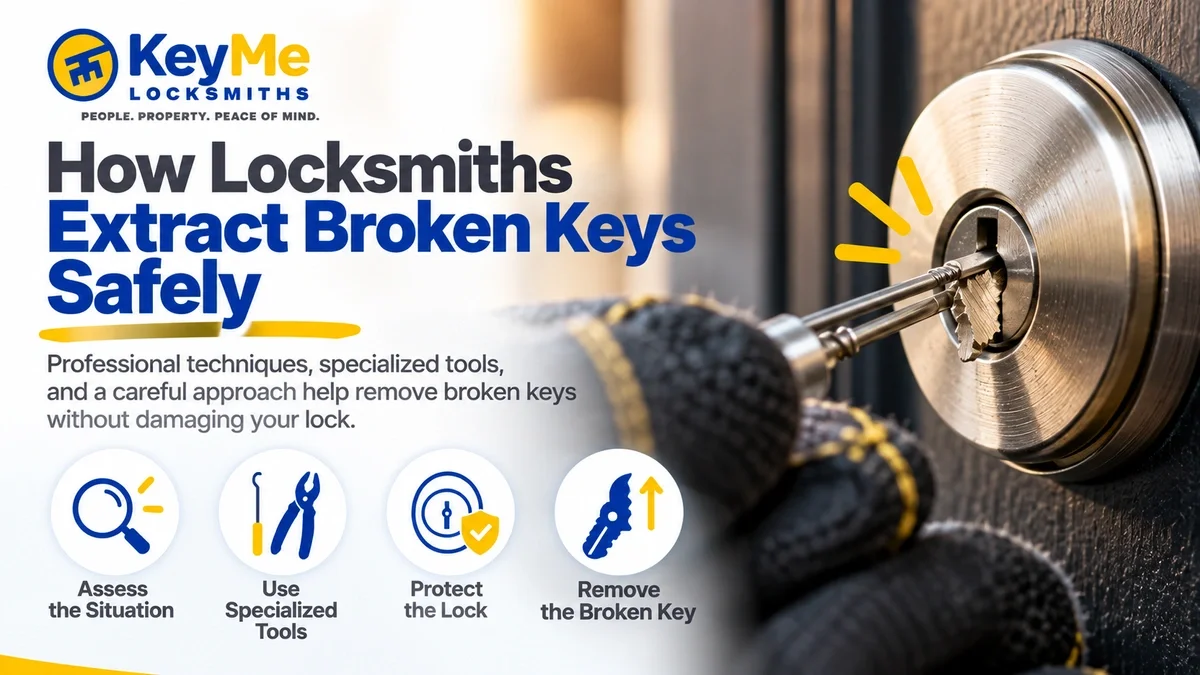
When a key breaks inside a lock, a locksmith first evaluates where the fragment is located, the condition and position of the lock, the type of key and cylinder involved, and whether the hardware was already difficult to operate. The extraction approach depends on those findings. After the fragment is removed, the locksmith can evaluate the lock for damage, resistance, or another condition that may have contributed to the break.
A broken key is not automatically a broken lock.
Likewise, successfully removing the fragment does not automatically mean the underlying problem has been resolved.
The professional service involves two separate questions:
How should the key fragment be removed?
and
Why did the key break in the first place?
Summary
- Stop applying force after a key breaks.
- Do not push another key into a keyway that already contains a fragment.
- A locksmith evaluates the fragment position, lock type, lock position, and hardware condition before deciding how to proceed.
- There is no single extraction method appropriate for every broken key.
- A fragment that is partly visible presents a different situation from one located deeper inside the cylinder.
- The locksmith may also need to determine whether the lock was already malfunctioning.
- After extraction, the lock should be checked for normal operation.
- Broken-key extraction does not automatically mean the lock needs repair.
- A broken key does not automatically mean the lock should be rekeyed or replaced.
- The reason the key failed should still be considered after the immediate obstruction is removed.
What Happens When a Key Breaks Inside a Lock?
When a key snaps, part of the blade may remain inside the lock cylinder.
The exact condition can vary.
The fragment may be:
- Partially visible
- Flush with the keyway
- Deeper inside the lock
- Broken while the lock was in its normal position
- Broken while turning
- Associated with a lock that was already sticking or binding
Those details affect how a professional evaluates the situation.
"Broken-key extraction starts with the condition that actually exists at the lock. Where the fragment sits, how the lock was positioned when the key failed, and whether the hardware was already resisting operation all help determine what needs to happen next." - KeyMe Locksmiths
What Should You Do Immediately After a Key Breaks?
The most important first step is simple:
Stop applying force.
Do not:
- Continue twisting the remaining piece
- Insert another key into the occupied keyway
- Push objects into the lock
- Try to drive the fragment deeper
- Continue manipulating the lock after resistance increases
If another normal authorized entrance is available, use it rather than continuing to work on the broken key.
If professional assistance is needed, KeyMe provides broken key extraction for supported situations.
Why Improvised Removal Attempts Can Complicate the Problem
A key fragment already takes up space inside the cylinder.
Adding improvised objects can:
- Push the fragment deeper
- Interfere with internal components
- Add debris or another object to the keyway
- Alter the original condition
- Make professional assessment more difficult
The objective is not to turn one obstruction into several.
A locksmith can evaluate the fragment in its existing position before deciding what approach is appropriate.
Need a Locksmith? We're here to help
Connect with a trusted local locksmith for fast, professional assistance when you need it most.
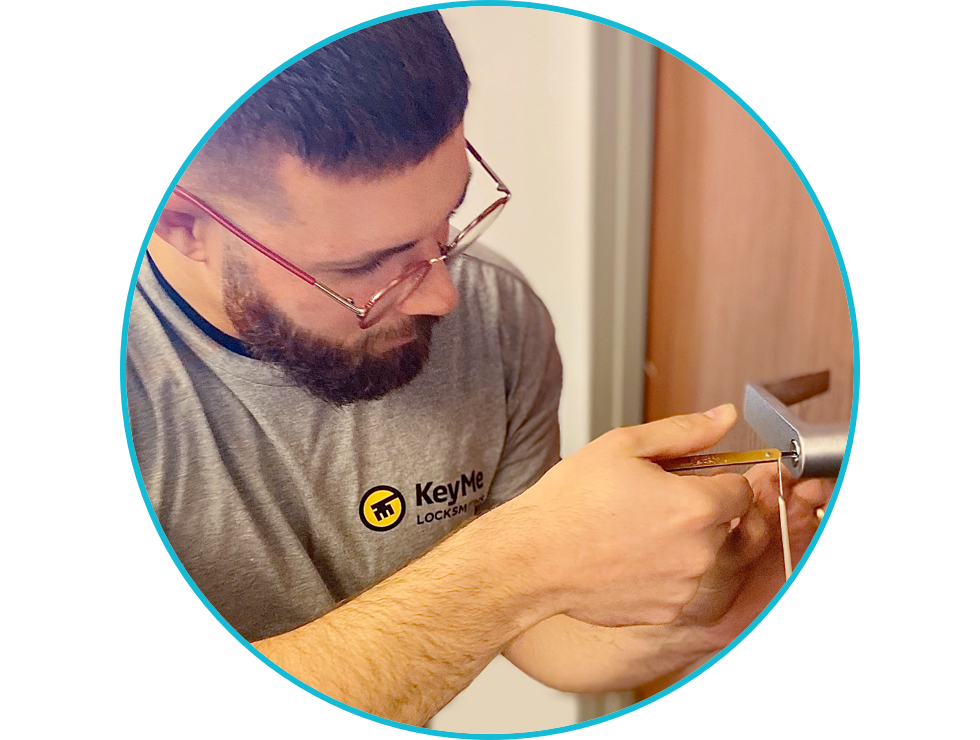
Step 1: The Locksmith Identifies the Lock and Key Situation
Professional extraction begins with assessment.
The locksmith may need to identify:
- Lock type
- Key type
- Cylinder condition
- Amount of key visible
- Whether the lock was turned
- Whether the key was already bent or worn
- Whether the lock was sticking beforehand
- Whether the door or frame was creating resistance
- Whether previous removal attempts were made
This information helps distinguish a straightforward extraction from a broader hardware problem.
Step 2: The Locksmith Evaluates Where the Fragment Is Located
Fragment position matters.
A piece that remains partly accessible is different from one sitting deeper inside the cylinder.
The locksmith evaluates where the fragment is located before selecting an appropriate professional method.
This is one reason there is no universal extraction process for every broken key.
The condition of the specific keyway and lock determines the approach.
Step 3: The Locksmith Considers the Position of the Lock
If the key broke while the lock was being turned, the lock may not be resting in its normal position.
That condition matters because the cylinder, internal components, and fragment can all be affected by the state of the lock at the time of failure.
The locksmith needs to understand that condition before proceeding.
Step 4: The Locksmith Selects an Appropriate Extraction Approach
Professional locksmiths use tools and methods suited to the specific lock, keyway, fragment position, and hardware condition.
The objective is to remove the obstruction while preserving serviceable hardware where appropriate.
The exact approach varies.
A professional locksmith may need to respond differently depending on:
- Fragment depth
- Lock type
- Key design
- Cylinder condition
- Existing damage
- Whether the lock is under mechanical tension
Because those conditions differ from job to job, broken-key extraction should not be treated as a single universal technique.
Step 5: The Fragment Is Removed
Once the locksmith has selected an appropriate approach, the immediate objective is to remove the key fragment from the cylinder.
Extraction resolves the physical obstruction.
It does not, by itself, establish:
- Why the key broke
- Whether the lock is functioning normally
- Whether another key will operate smoothly
- Whether the door is aligned properly
- Whether the cylinder was damaged
Those questions are evaluated after the fragment is removed.
What Happens After the Broken Key Is Removed?
The next step is checking the lock.
KeyMe's broken-key service information notes that professional service may include evaluating the lock or ignition after extraction to determine whether additional problems exist.
The locksmith may consider:
- Does the cylinder move normally?
- Is there unusual resistance?
- Is visible damage present?
- Does another known-good key operate normally?
- Does the lock behave differently with the door open and closed?
- Did the key break because the lock was already malfunctioning?
This post-extraction evaluation is important because the broken key may have been the result of another mechanical problem.
What If the Lock Was Already Sticking?
This is one of the most important situations to identify.
Suppose the key had required more force for several weeks before it finally broke.
Removing the fragment solves the immediate obstruction.
It does not necessarily solve the original resistance.
If the lock still:
- Binds
- Sticks
- Turns roughly
- Requires unusual force
- Behaves inconsistently
then lock repair may need to be evaluated.
For broader warning signs and causes, see Common Causes of Broken Keys.
Find a KeyMe Kiosk Near You
Need a spare key fast? Find a KeyMe kiosk near you to copy many house, office, and eligible car keys in just minutes.
What If the Door Is Causing the Resistance?
Sometimes the lock itself is not the only factor.
Associated Locksmiths of America notes that poor door alignment can create difficult lock operation.
A useful comparison is whether the lock operates differently:
Door open: normal operation
Door closed: binding or resistance
If that pattern exists after extraction, the door, frame, strike, latch, or deadbolt alignment may deserve attention.
Replacing the key alone would not correct a door-alignment problem.
Does the Lock Need Repair After Broken-Key Extraction?
Not automatically.
Extraction removes the broken fragment.
Repair is a separate service.
If the lock operates normally after the fragment is removed and no separate malfunction is identified, repair may not be needed solely because the key broke.
If a mechanical problem remains, lock repair can be evaluated.
This distinction helps separate the immediate obstruction from the condition of the hardware.
Does the Lock Need to Be Rekeyed?
Not automatically.
Rekeying changes which mechanical key operates compatible lock hardware.
A key breaking does not inherently change who should have access.
Rekeying may be relevant if:
- Access needs have changed
- A key is lost or unaccounted for
- Old keys should no longer work
- The property has another key-control reason for changing access
Those are separate from the extraction itself.
Does the Lock Need to Be Replaced?
Not automatically.
Lock replacement changes the hardware.
Replacement may be considered if the locksmith identifies:
- Damaged hardware
- A failed component
- A condition that makes the existing lock unsuitable
- Another separate reason the hardware needs to change
A broken key alone does not establish that the lock must be replaced.
What Happens to the Broken Key?
Once the key fragment has been removed, the customer still needs a usable key.
The next step depends on what other authorized keys exist.
Possible situations include:
Another Good Key Exists
That key can help confirm whether the lock now operates normally.
A Spare Needs to Be Created
If a good working source exists, key copying or key cutting may be appropriate for a supported key.
The Broken Key Was the Only Key
The situation may require a different key-replacement process.
For a house lock, a locksmith can evaluate the lock and available options.
For a vehicle, car key replacement may be relevant depending on the vehicle and key system.
Broken House Key Extraction
Residential broken-key situations can involve:
- Deadbolt
- Knob lock
- Lever lock
- Entry-door cylinder
- Other supported residential hardware
The locksmith evaluates both the broken fragment and the condition of the opening.
If the problem involves more than the fragment itself, KeyMe also provides residential locksmith services and lock repair.
Broken Key Extraction in a Commercial Property
Commercial environments can introduce additional considerations.
These may include:
- Commercial lock hardware
- Master-key systems
- Building access procedures
- Property authorization
- Different cylinder types
- Shared or controlled access relationships
If the lock participates in a master-key system, any additional work after extraction should consider the intended keying structure.
KeyMe provides commercial locksmith services for supported applications.
Copy Your Key from Anywhere - Right from Your Phone
Skip the kiosk and copy your key from home. Upload a clear photo of an eligible house or car key, and KeyMe will create a precise duplicate and mail it directly to your door.
Broken Car Key Extraction
A mechanical vehicle key can break in a door cylinder or, on applicable vehicles, in an ignition.
Automotive situations require vehicle-specific evaluation.
After extraction, the next question is what kind of replacement or key functionality the vehicle requires.
Depending on the vehicle, a replacement can involve:
- Mechanical cutting
- Transponder functionality
- Remote functions
- Electronic programming
KeyMe provides car locksmith services, car key replacement, and car key programming for supported vehicles.
Why Did the Key Break?
Extraction addresses the immediate obstruction.
It does not answer the larger prevention question.
The key may have broken because of:
- Wear
- Physical damage
- Repeated force
- Lock resistance
- Door alignment
- A poorly operating duplicate
- Another mechanical issue
For a complete prevention and warning-sign guide, see Common Causes of Broken Keys.
Best Way to Handle a Broken Key in a Lock
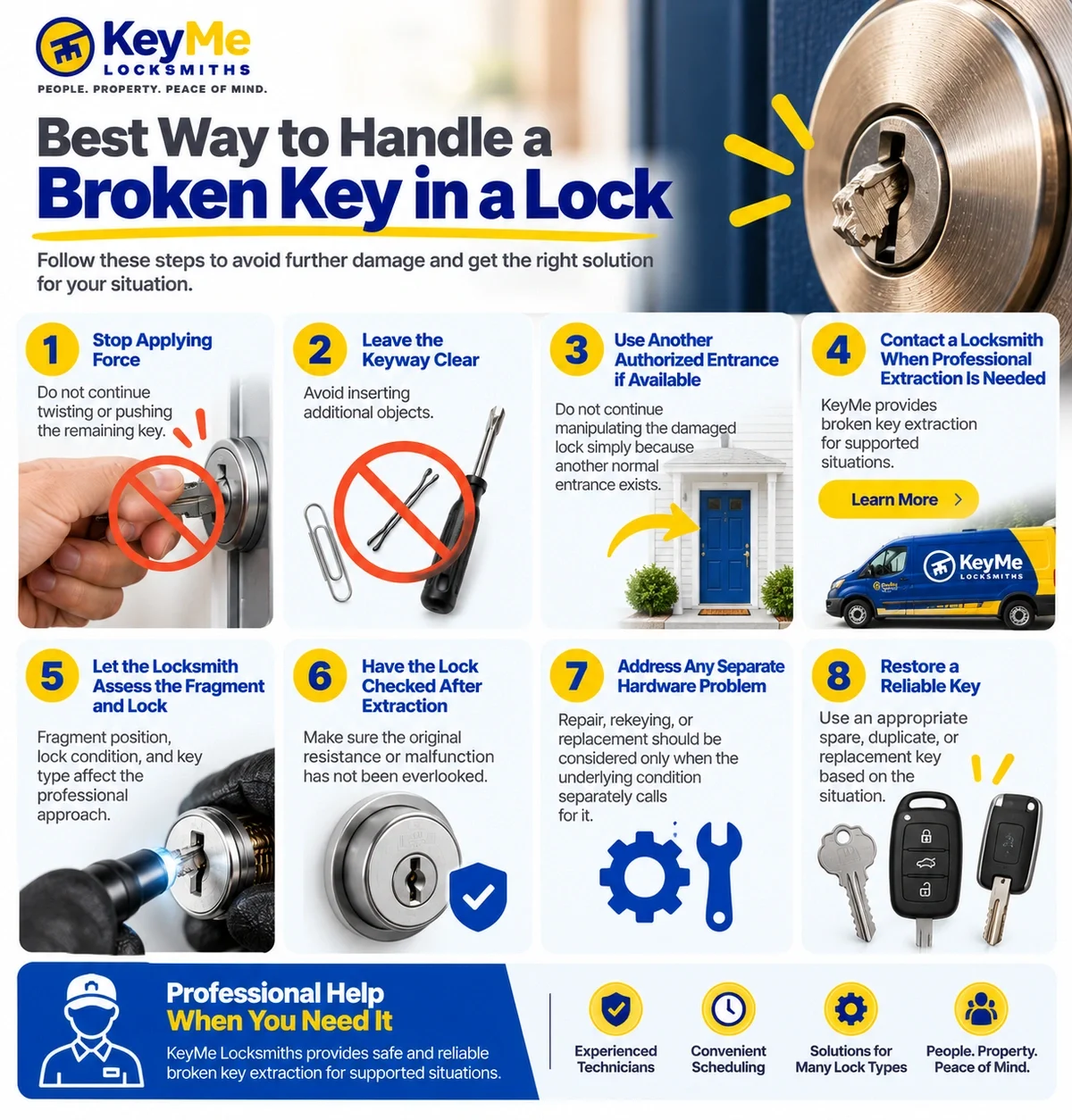
1. Stop Applying Force
Do not continue twisting or pushing the remaining key.
2. Leave the Keyway Clear
Avoid inserting additional objects.
3. Use Another Authorized Entrance if Available
Do not continue manipulating the damaged lock simply because another normal entrance exists.
4. Contact a Locksmith When Professional Extraction Is Needed
KeyMe provides broken key extraction for supported situations.
5. Let the Locksmith Assess the Fragment and Lock
Fragment position, lock condition, and key type affect the professional approach.
6. Have the Lock Checked After Extraction
Make sure the original resistance or malfunction has not been overlooked.
7. Address Any Separate Hardware Problem
Repair, rekeying, or replacement should be considered only when the underlying condition separately calls for it.
8. Restore a Reliable Key
Use an appropriate spare, duplicate, or replacement key based on the situation.
Why Choose KeyMe Locksmiths?
KeyMe provides broken key extraction and related locksmith services for supported residential, commercial, and automotive needs.
Depending on what the locksmith finds after extraction, related services may include:
The appropriate follow-up depends on the condition of the key, lock, door, or vehicle after the broken fragment has been removed.
Extraction Solves the Obstruction, Not Always the Cause
A broken key creates an immediate problem because part of the key may remain inside the lock.
Professional extraction focuses first on removing that obstruction.
Afterward, the locksmith can answer the equally important question:
Why did the key break?
If the lock operates normally and the key itself was damaged, the next step may simply involve restoring a good working key.
If the lock remains difficult to operate, the underlying hardware or door condition deserves attention.
For prevention and warning signs, see Common Causes of Broken Keys.
References
- KeyMe Locksmiths. Broken Key Extraction. KeyMe service information covering broken-key extraction and related lock or ignition evaluation.
https://key.me/broken-key-extraction - Associated Locksmiths of America (ALOA). Common Lock Issues. Consumer guidance on worn keys, lock wear, weather, and door alignment as potential contributors to difficult lock operation.
https://www.aloa.org/consumers/commonlockissues - KeyMe Locksmiths. Lock Repair and Installation. Information about supported locksmith repair services when a mechanical problem remains after extraction.
https://key.me/locksmith-repair-install