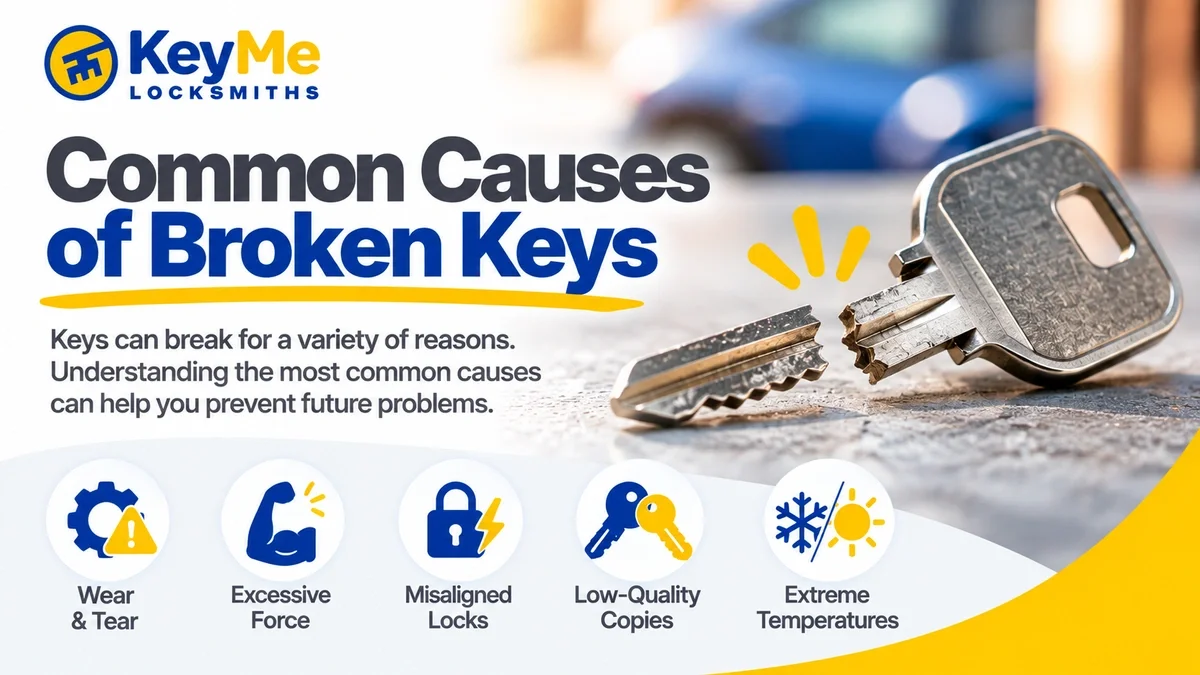
Keys usually break because of a combination of wear, physical damage, repeated force, or resistance inside the lock or door opening. A key that becomes harder to insert, turn, or remove should not be ignored. Increasing resistance can mean the key is wearing out, the lock is developing a mechanical problem, or the door is putting extra pressure on the locking hardware.
Recognizing those warning signs early can help you address the problem before the key snaps inside the lock.
Summary
- Keys can weaken gradually through everyday use.
- A visibly bent, cracked, or heavily worn key should be evaluated before continued use.
- Forcing a key that does not turn normally can increase the chance of breakage.
- A sticking lock can put additional stress on the key.
- Door and strike alignment can make a deadbolt harder to operate.
- A poorly operating duplicate should not be forced simply because another key works.
- If several good keys struggle in the same lock, the lock or door may be the actual problem.
- A key that increasingly requires jiggling or extra pressure is giving you a warning sign.
- Creating a spare while you still have a good working source can help avoid relying on a badly worn key.
- If the key has already broken inside the lock, the problem has shifted from prevention to broken key extraction.
Why Do Keys Break?
Most keys do not fail without warning.
They usually experience gradual changes first.
A key may become:
- Worn
- Bent
- Cracked
- Difficult to turn
- Harder to remove
- Increasingly dependent on jiggling or positioning
At the same time, the lock or door may also change.
Associated Locksmiths of America notes that difficult lock operation can be related to worn keys, lock wear, weather, or poor door alignment. That means the key itself is only one part of the system.
"When a key starts taking more effort to use, the important question is not just whether the key still works. It is why more force is suddenly required. Wear in the key, lock, door, or opening can all contribute." - KeyMe Locksmiths
Need a Locksmith? We're here to help
Connect with a trusted local locksmith for fast, professional assistance when you need it most.
1. Normal Wear From Repeated Use
Keys are used over and over again.
Everyday use can gradually affect their shape and condition.
Look for:
- Rounded or visibly worn areas
- Thinning
- Bending
- Surface damage
- Cracks
- Increasing difficulty during normal operation
A key does not have to stop working completely before wear becomes relevant.
If one key has become difficult to use while another authorized key operates the same lock normally, compare their condition before continuing to force the worn key.
2. Forcing a Key That Does Not Turn Normally
One of the most important warning signs is increasing resistance.
If a key suddenly requires more force than usual, stop.
Do not assume that turning harder will solve the problem.
Resistance can come from:
- Key wear
- Cylinder wear
- Deadbolt binding
- Door alignment
- Debris or contamination
- Internal hardware problems
The more force applied to a weakened or bent key, the greater the chance that the key itself becomes the point of failure.
3. A Sticking or Worn Lock
Sometimes the key is not the primary problem.
If the lock has become increasingly difficult to operate, the key may be absorbing extra stress every time it is used.
Warning signs can include:
- Key turns inconsistently
- Cylinder feels rough
- Key becomes difficult to insert
- Key becomes difficult to remove
- Deadbolt resists movement
- Multiple known-good keys behave similarly
If several keys struggle in the same lock, consider lock repair rather than assuming every key is defective.
For broader troubleshooting, see The Most Common Home Lock Problems.
4. Door and Strike Alignment Problems
A lock can appear to be failing when the real problem is the relationship between the door and frame.
A simple comparison can provide useful information:
Lock works normally with the door open but becomes difficult when the door closes:
The door, frame, deadbolt, latch, or strike alignment may be involved.
Lock is difficult with the door open and closed:
The lock or key itself may deserve more attention.
ALOA identifies poor door alignment as one cause of difficult lock operation.
If a deadbolt has to be forced because the bolt does not line up cleanly with the strike, the key can experience additional twisting force every time the lock is used.
5. A Bent or Cracked Key
A visibly bent or cracked key should not be treated as a normal everyday key simply because it still works.
Damage can develop from:
- Drops
- Heavy key rings
- Twisting
- Being caught in a pocket or bag
- Previous forced use
- Using the key for another purpose
A key that is already physically deformed has less margin for additional stress.
If another good authorized key is available, use that instead while the damaged key is evaluated or replaced.
6. A Duplicate That Does Not Operate Normally
Not every duplicate behaves exactly like the key used as its source.
If one copied key:
- Requires jiggling
- Must be pulled back slightly
- Needs extra pressure
- Works in one lock but not another
- Behaves differently from the source key
do not normalize that behavior by continuing to force it.
Instead, compare the duplicate with the original or another known-good key.
See Why Some Copied Keys Don't Work for symptom-based troubleshooting.
7. Copying From a Worn Source Key
A key can still open a lock while being a poor source for another generation of copies.
If you are planning to make a spare, start with the best-condition working key available.
If several keys exist, compare:
- Which one works most smoothly
- Which one shows the least wear
- Which one is the known original
- Which one is already a duplicate
For detailed pre-copy guidance, see How to Get the Best Key Copy From an Original Key.
Find a KeyMe Kiosk Near You
Need a spare key fast? Find a KeyMe kiosk near you to copy many house, office, and eligible car keys in just minutes.
8. Using the Wrong Key
Many keys look similar enough that a person may accidentally insert the wrong one.
If the key:
- Will not fully enter
- Stops unexpectedly
- Will not turn
- Feels clearly different from normal
verify that you are using the correct key before applying more pressure.
Forcing an incorrect key can damage both the key and the lock.
9. Environmental Conditions Can Increase Resistance
Environmental conditions can affect the lock and door opening.
Examples can include:
- Cold weather
- Moisture
- Corrosion
- Dirt or debris
- Seasonal door movement
The most important issue is not the weather itself, but whether the lock suddenly requires more effort than normal.
If seasonal changes consistently make the same lock difficult to operate, the opening should be evaluated rather than relying on additional force.
10. Using a Key as a Tool
A key is designed to operate a specific lock.
Using it for another task can introduce damage unrelated to normal lock use.
Avoid using keys to:
- Pry
- Scrape
- Open packages
- Turn unrelated objects
- Bend or lever something
Even slight deformation can affect how the key sits inside the cylinder.
Warning Signs a Key May Be at Risk of Breaking
Do not wait for the key to snap before paying attention to changes.
Warning signs include:
- Visible bending
- Cracks
- Significant wear
- Key feels weaker or more flexible than before
- Increasing resistance when turning
- Difficulty inserting or removing the key
- Need for repeated jiggling
- Key must be held in an unusual position
- Another authorized key works much more smoothly
- Lock has become increasingly difficult with several keys
These symptoms do not guarantee that the key will break, but they are reasons to stop forcing it and investigate the cause.
Is the Key or the Lock the Problem?
One of the most useful troubleshooting steps is comparison.
One Key Struggles, Another Works Normally
The problem may be more closely related to the key.
Several Good Keys Struggle in the Same Lock
The lock or opening deserves more attention.
Key Works With the Door Open but Not Closed
Door or strike alignment may be contributing.
Key Has Visible Damage and the Lock Works Normally With Another Key
Replace or stop relying on the damaged key.
This comparison helps prevent unnecessary key copying when the real issue is the lock, or unnecessary lock work when one damaged key is the outlier.
What Should You Do Before a Key Breaks?
Stop Forcing It
Resistance is useful information.
Compare Another Authorized Key
If another known-good key works normally, the first key may need to be retired.
Inspect the Key
Look for bending, cracking, heavy wear, or visible damage.
Check Whether the Lock Is Creating Resistance
If several keys struggle, consider lock repair.
Address Door Alignment Problems
If the lock behaves differently when the door is open and closed, the complete opening should be evaluated.
Create a Spare While a Good Source Still Exists
If you have only one reliable working key, consider making an authorized backup before that key becomes worn or damaged.
KeyMe offers key-copy services, KeyMe kiosks, and other supported duplication options.
What If the Key Has Already Broken?
Once the key has snapped, the immediate priority changes.
If part of the key remains inside the cylinder:
- Stop applying force.
- Do not push another key into the occupied keyway.
- Avoid inserting improvised objects into the lock.
- Use another authorized entrance if one is available.
- Contact a locksmith if professional removal is needed.
KeyMe provides broken key extraction for supported situations.
For the professional-service process, see How Locksmiths Extract Broken Keys.
Best Way to Reduce the Risk of Key Breakage
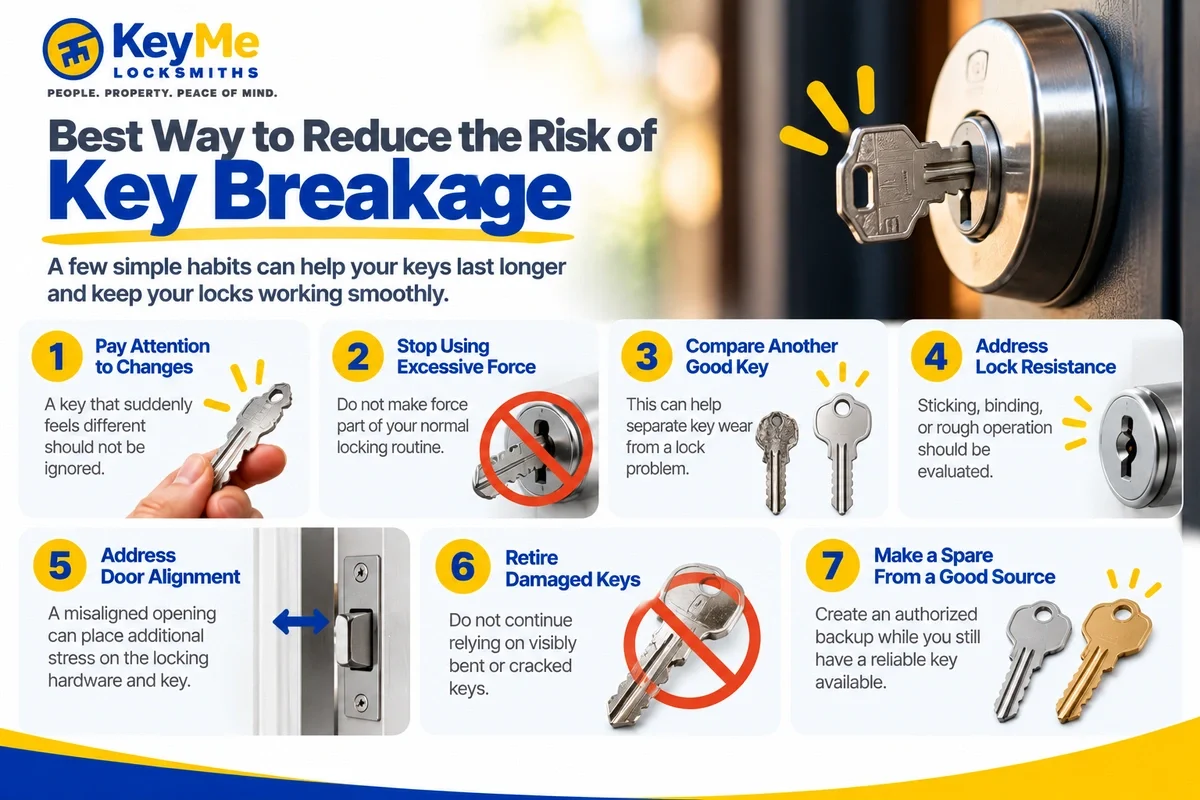
1. Pay Attention to Changes
A key that suddenly feels different should not be ignored.
2. Stop Using Excessive Force
Do not make force part of your normal locking routine.
3. Compare Another Good Key
This can help separate key wear from a lock problem.
4. Address Lock Resistance
Sticking, binding, or rough operation should be evaluated.
5. Address Door Alignment
A misaligned opening can place additional stress on the locking hardware and key.
6. Retire Damaged Keys
Do not continue relying on visibly bent or cracked keys.
7. Make a Spare From a Good Source
Create an authorized backup while you still have a reliable key available.
Copy Your Key from Anywhere - Right from Your Phone
Skip the kiosk and copy your key from home. Upload a clear photo of an eligible house or car key, and KeyMe will create a precise duplicate and mail it directly to your door.

Why Choose KeyMe Locksmiths?
KeyMe provides residential locksmith services and related support for lock, key, and access problems.
Relevant services include:
The right service depends on whether the problem is the key, the lock, the door opening, or a combination of those factors.
Treat Resistance as a Warning Sign
Keys often give you useful information before they fail.
A key that becomes difficult to turn, increasingly worn, visibly bent, or dependent on extra force should not be treated as normal.
The same is true of a lock that has become harder to operate.
The best prevention strategy is to identify whether the problem belongs to the key, lock, or door opening while the key is still intact.
If the key has already snapped and part of it remains inside the lock, continue with How Locksmiths Extract Broken Keys.
References
- Associated Locksmiths of America (ALOA). Common Lock Issues. Consumer guidance on worn keys, lock wear, weather, and door alignment as causes of difficult lock operation.
https://www.aloa.org/consumers/commonlockissues - KeyMe Locksmiths. Broken Key Extraction. KeyMe service information covering broken keys, stiff locks, wear, and extraction needs.
https://key.me/broken-key-extraction - KeyMe Locksmiths. Key Copy. Information about supported KeyMe key-duplication options.
https://key.me/key-copy