

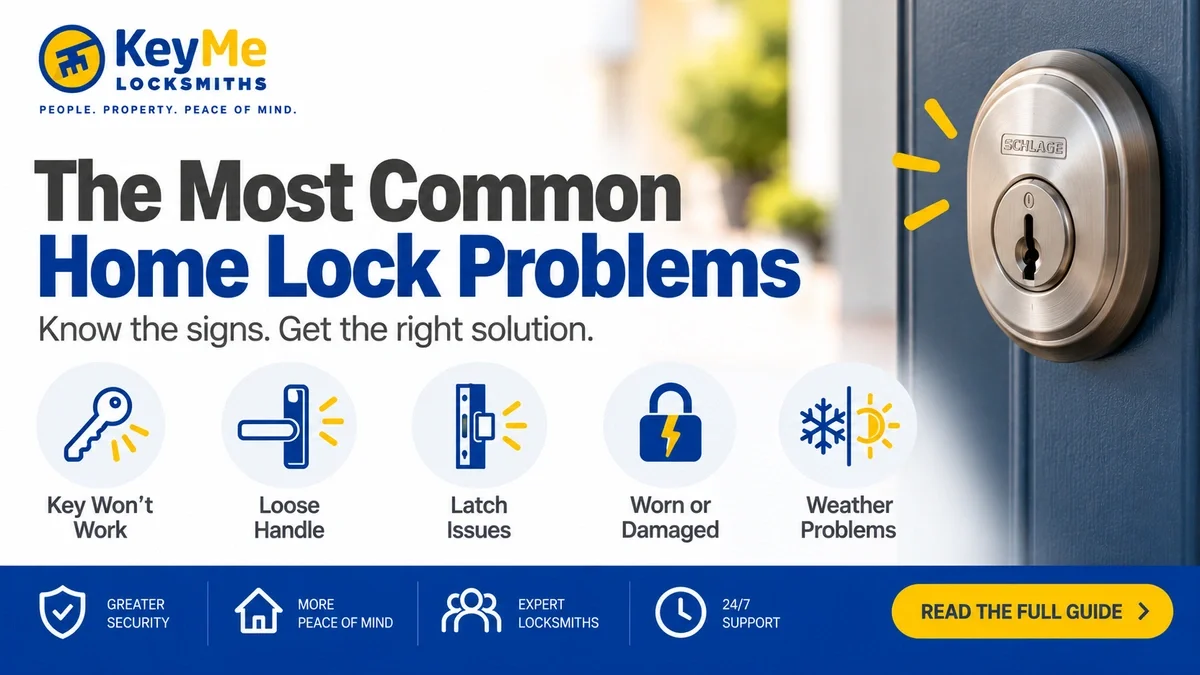
Common home lock problems include keys that become difficult to turn, deadbolts that bind when the door closes, sticking latches, loose handles, worn keys, and locks that operate inconsistently. The important thing to know is that the lock itself is not always the cause.
A door, frame, strike, hinge, key, cylinder, or latch can all affect how a lock operates.
Associated Locksmiths of America (ALOA) identifies weather conditions, poor door alignment, worn or poorly duplicated keys, lubrication needs, and normal lock wear among common reasons a door lock becomes difficult to use. ALOA also notes that poor door alignment is responsible for many problems people initially describe as "lock" issues.
Before replacing a lock, identify the exact symptom and determine which part of the opening is responsible.
Summary
- A difficult lock does not automatically need to be replaced.
- If one key works poorly but another authorized key works normally, investigate the key first.
- If several good keys have the same problem, the cylinder or other lock hardware deserves closer evaluation.
- If a deadbolt works with the door open but binds when the door closes, door or strike alignment may be responsible.
- A door that must be pushed, pulled, or lifted to lock often points to an alignment issue.
- Loose knobs and levers can indicate mounting or internal hardware problems.
- A sticking latch is different from a sticking key and should be diagnosed separately.
- Weather can temporarily change how a door fits within its frame.
- A broken key should be removed carefully rather than pushed farther into the cylinder.
- Diagnose the problem before deciding between lock repair, rekeying, and lock replacement.
Why "My Lock Is Broken" Doesn't Tell You the Whole Story
When a homeowner says a lock is not working, several components could be involved.
The problem might be the:
- Key
- Cylinder
- Deadbolt
- Latch
- Knob or lever
- Strike
- Hinges
- Door
- Frame
Those components interact.
For example, a perfectly functional deadbolt can become difficult to turn if the door shifts enough that the bolt no longer lines up cleanly with the strike.
Likewise, a worn key can make a functional cylinder seem defective.
"The symptom tells you where to start, but not necessarily what needs to be replaced. A locksmith may inspect the key, lock, strike, hinges, door, and frame before determining what is actually causing the problem." - KeyMe Locksmiths
Need a Locksmith? We're here to help
Connect with a trusted local locksmith for fast, professional assistance when you need it most.
1. Your Key Is Difficult to Insert or Remove
What You May Notice
- The key stops partway into the lock.
- You need to wiggle it.
- It takes extra effort to remove.
- The problem has gradually become worse.
Possible Causes
The issue may involve:
- A worn key
- A bent or damaged key
- A poorly duplicated key
- Wear inside the cylinder
- Debris or another internal obstruction
- Lock hardware that needs appropriate maintenance
ALOA notes that keys naturally show wear with age and that creating copies from already worn keys can cause additional operating problems.
What to Check
If you have another authorized key, compare how it operates.
One key has difficulty: The key itself may be the problem.
Several good keys have difficulty: The cylinder or lock deserves further evaluation.
Avoid repeatedly forcing a key that is becoming harder to insert or remove.
For supported keys, KeyMe offers key duplication and key cutting.
2. Your Key Goes In but Won't Turn Easily
A key that inserts normally but will not rotate smoothly can point to several different conditions.
Possible causes include:
- Key wear
- Cylinder wear
- Deadbolt resistance
- Door alignment
- Strike alignment
- Internal lock problems
Start by determining whether the problem changes when the door is open.
If the key turns normally with the door open but becomes difficult when the door closes, the problem may not be the cylinder at all.
That makes the next symptom particularly important.
3. The Deadbolt Works With the Door Open but Not Closed
This is one of the most useful lock troubleshooting clues.
What You May Notice
- Deadbolt turns smoothly while the door is open.
- Deadbolt becomes difficult after closing the door.
- You need to push or pull the door while turning the key.
- The bolt hits the edge of the strike.
What It Can Mean
The bolt may no longer line up correctly with the opening in the frame.
ALOA says poor door alignment is a common source of lock problems and notes that worn hinges, shifting frames, and even improperly installed weatherstripping can affect how the latch meets the strike.
Possible areas to inspect include:
- Strike position
- Loose hinges
- Door sag
- Frame movement
- Weatherstripping
- Door expansion or contraction
Replacing the cylinder will not solve an alignment problem.
4. You Have to Push, Pull, or Lift the Door to Lock It
This is another strong indication that the complete door opening needs attention.
If the door only locks when you:
- Pull it toward you
- Push against it
- Lift the handle
- Apply pressure near the frame
the door, hinges, or strike may no longer be positioned correctly.
ALOA specifically recommends checking hinge condition when diagnosing door-alignment problems.
This symptom may gradually worsen if the underlying condition is not addressed.
A locksmith evaluating the problem may inspect both the hardware and the way the door sits within the frame.
5. One House Key Works Better Than Another
If one authorized key operates the lock normally while another does not, that difference is important.
Look for:
- Rounded cuts
- Visible wear
- Bent blade
- Cracks
- Poorly made duplicate
A lock that works correctly with one key is less likely to have the same type of internal failure as a lock that rejects every properly cut key.
ALOA advises that worn keys can cause operating issues and notes that making copies from a better original may correct some problems associated with worn duplicates.
If you're making a replacement copy, see How to Get the Best Key Copy From an Original Key.
6. Several Good Keys Are Difficult to Turn
This symptom shifts attention back toward the lock or opening.
If several known-good keys encounter the same resistance, possible causes include:
- Worn cylinder
- Internal lock wear
- Deadbolt problem
- Latch problem
- Door alignment
Again, test with the door open and closed.
Problem remains with door open: The lock hardware deserves closer attention.
Problem occurs mainly with door closed: Investigate alignment.
If the underlying cause is unclear, a residential locksmith can evaluate the opening.
Find a KeyMe Kiosk Near You
Need a spare key fast? Find a KeyMe kiosk near you to copy many house, office, and eligible car keys in just minutes.
7. The Latch Sticks
The latch is usually the spring-loaded component that holds the door closed before the deadbolt is engaged.
Signs of a Latch Problem
- The handle turns but the latch retracts slowly.
- The latch remains partially extended.
- The door will not close without force.
- The latch sticks inside the door.
- The handle does not fully retract it.
ALOA notes that latches are particularly susceptible to wear because they operate repeatedly every time a door is used.
Possible causes include:
- Latch wear
- Internal lock wear
- Handle or lever problem
- Alignment
- Appropriate lubrication needs
A malfunctioning latch and a malfunctioning cylinder are different problems, even when both are part of the same lockset.
8. The Door Closes but the Latch Won't Catch
If the latch moves correctly but does not engage the strike, inspect alignment.
Possible reasons include:
- Door sag
- Loose hinges
- Strike movement
- Frame movement
- Door swelling
- Improper weatherstripping
Try slowly closing the door while watching where the latch meets the strike.
If the latch lands above, below, or against the edge of the strike opening, the problem is likely broader than the lock cylinder.
9. The Knob or Lever Is Loose
A loose handle should not be ignored simply because the key still works.
You may notice:
- Lever moving up and down
- Knob wobbling
- Trim shifting against the door
- Handle not returning normally
- Increasing movement over time
Depending on the lock design, the cause can involve:
- Mounting hardware
- Lever assembly
- Internal mechanism
- Lock body
- Door preparation
Not every loose component requires a complete lock replacement.
A locksmith can determine whether lock repair or replacement is appropriate.
10. The Lock Works Differently Depending on the Weather
Doors and frames can move slightly as temperature and humidity change.
ALOA specifically identifies humidity, temperature, and direct sunlight as environmental factors that can affect door and lock performance.
A weather-related problem may appear as:
- Lock working in the morning but not later
- Deadbolt binding during humid conditions
- Door becoming harder to close seasonally
- Latch missing the strike during certain conditions
If the problem occurs only under particular environmental conditions, note when it happens.
That information can help distinguish the symptom from a cylinder that fails consistently.
11. Your Key Broke Inside the Lock
A broken key creates both an immediate problem and a diagnostic question.
The immediate issue is removing the broken fragment.
The second question is:
Why did the key break?
Possible contributing factors include:
- Worn key
- Bent key
- Excessive force
- Difficult cylinder
- Deadbolt binding
- Door alignment
Avoid pushing the fragment farther inside with improvised tools.
KeyMe offers broken key extraction for supported situations.
Once the fragment is removed, the underlying resistance should also be evaluated.
12. The Lock Has Become Increasingly Loose or Inconsistent
Locks wear through use.
ALOA notes that repeated insertion and removal of keys contributes to wear and that high-use locks can wear over time.
Signs of developing wear may include:
- Increasing cylinder movement
- Inconsistent turning
- Repeated sticking
- Loose components
- Latch problems
This does not mean there is one universal age when a residential lock must be replaced.
Condition and performance matter more than age alone.
What About Smart Locks?
Smart locks can have both mechanical and electronic problems.
A complaint may involve:
- Battery
- Keypad
- App
- Electronic credential
- Mechanical deadbolt
- Physical key cylinder
- Door alignment
If a smart deadbolt's motor struggles only when the door is closed, the issue may still be mechanical alignment.
If the lock operates physically but electronic access fails, follow the manufacturer's troubleshooting procedures for the specific product.
For a broader comparison, see Smart Lock vs. Traditional Lock.
Repair, Rekey, or Replace?
These services solve different problems.
Repair
Lock repair may be appropriate when a serviceable component or related part of the opening is malfunctioning.
Rekey
Rekeying changes which mechanical key operates compatible existing hardware.
It does not inherently repair a mechanical problem.
Replace
Lock replacement may be appropriate when hardware is damaged, repeatedly unreliable, incompatible with the door, or no longer suitable for the homeowner's needs.
For a complete decision guide, see Rekeying vs. Replacing Your Locks.
Copy Your Key from Anywhere - Right from Your Phone
Skip the kiosk and copy your key from home. Upload a clear photo of an eligible house or car key, and KeyMe will create a precise duplicate and mail it directly to your door.

How Residential Lock Standards Fit Into the Picture
When replacement is appropriate, it is useful to evaluate the specific hardware rather than choosing solely by appearance or brand.
BHMA's current ANSI/BHMA A156.39-2025 standard establishes performance requirements for residential locksets and latches, including durability, security, and finish. Its ANSI/BHMA A156.40-2025 standard does the same for residential deadbolts.
BHMA certification uses independent laboratory testing to evaluate products against the applicable standard.
That does not diagnose your existing lock, but it provides useful criteria when replacement hardware is being considered.
Best Way to Troubleshoot a Home Lock Problem
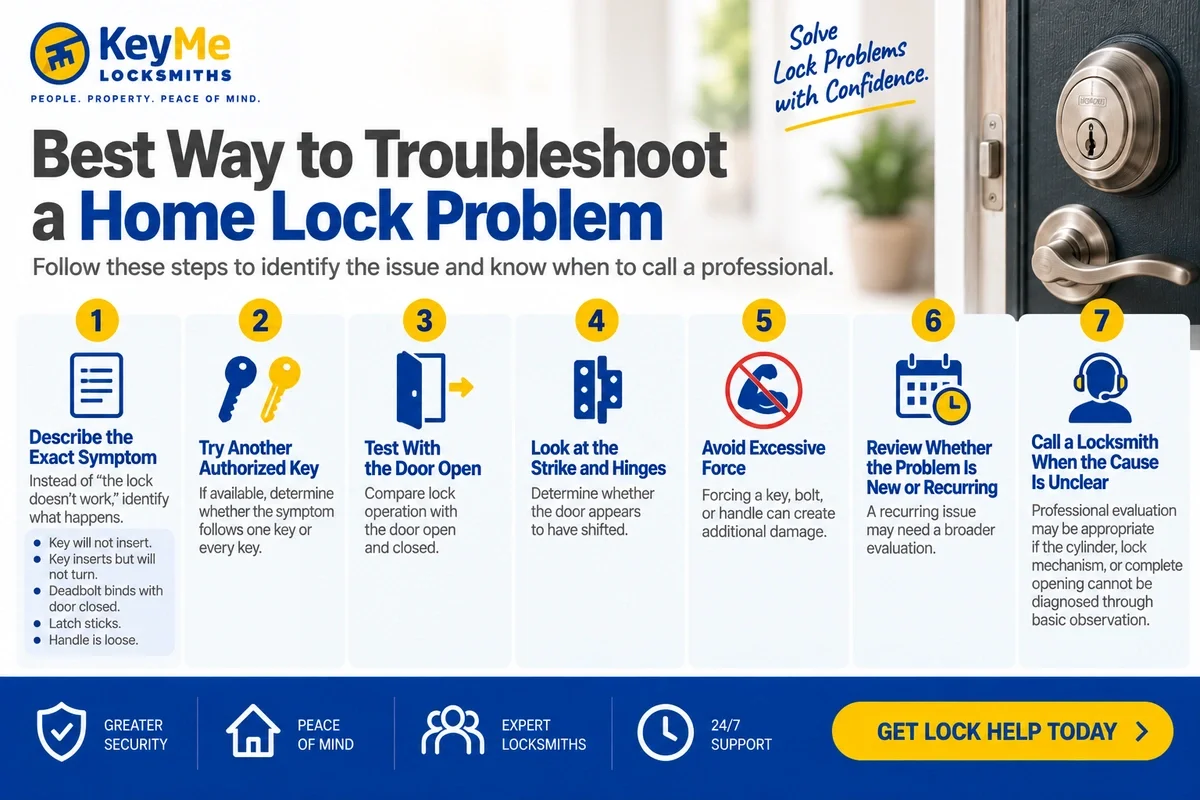
Instead of "the lock doesn't work," identify what happens.
For example:
- Key will not insert.
- Key inserts but will not turn.
- Deadbolt binds with door closed.
- Latch sticks.
- Handle is loose.
2. Try Another Authorized Key
If available, determine whether the symptom follows one key or every key.
3. Test With the Door Open
Compare lock operation with the door open and closed.
4. Look at the Strike and Hinges
Determine whether the door appears to have shifted.
5. Avoid Excessive Force
Forcing a key, bolt, or handle can create additional damage.
6. Review Whether the Problem Is New or Recurring
A recurring issue may need a broader evaluation.
7. Call a Locksmith When the Cause Is Unclear
Professional evaluation may be appropriate if the cylinder, lock mechanism, or complete opening cannot be diagnosed through basic observation.
Diagnose the Symptom Before Replacing the Lock
The most important lesson is that a lock problem is often an opening problem.
The key, cylinder, latch, deadbolt, strike, hinges, door, and frame all affect how the lock operates.
ALOA's troubleshooting guidance reinforces that distinction by identifying alignment, weather, worn keys, lubrication needs, and lock wear as separate causes of difficult operation.
Start with the symptom.
Test the door.
Compare keys.
Inspect alignment.
Then determine whether the actual solution is repair, rekeying, replacement, or another adjustment.
If your locks operate normally but you want to evaluate broader access and security concerns around your entrances, see Home Security Red Flags.
KeyMe provides residential locksmith services, lock repair and installation, lock rekeying, lock replacement, lock installation, and broken key extraction.
References
- Associated Locksmiths of America (ALOA). Common Lock Issues. Guidance on weather, door alignment, lubrication, worn keys, worn locks, and latches.
https://www.aloa.org/consumers/commonlockissues - Builders Hardware Manufacturers Association. ANSI/BHMA A156.39-2025 Residential Locksets and Latches. Current residential standard covering durability, security, and finish requirements for bored locksets and latches.
https://buildershardware.com/ANSI-BHMA-Standards/Hardware-Highlights/A15639-2025-Residential-Locksets-and-Latches - Builders Hardware Manufacturers Association. ANSI/BHMA A156.40-2025 Residential Deadbolts. Current residential deadbolt standard covering durability, security, finish, and product performance.
https://buildershardware.com/ANSI-BHMA-Standards/Hardware-Highlights/A15640-2025-Residential-Deadbolts