

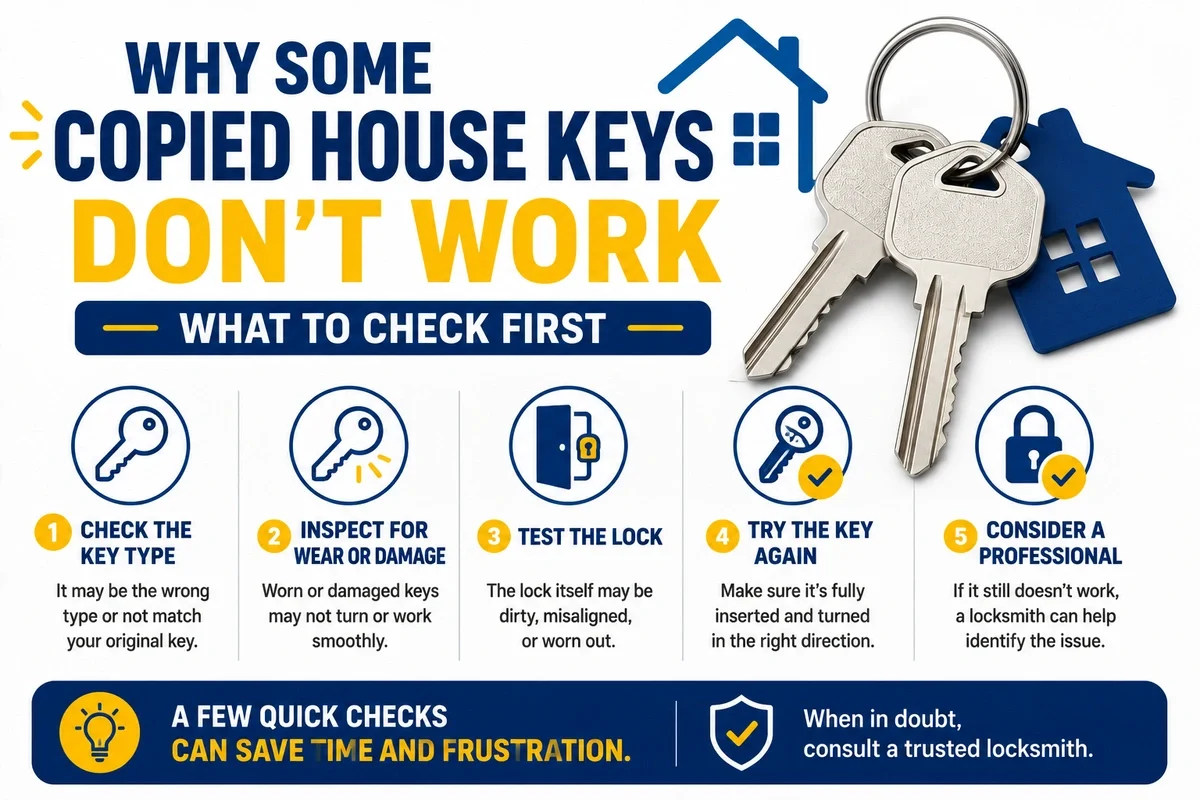
If a copied key doesn't work, don't force it. Compare it with the key it was copied from, test whether the original still operates the lock normally, and pay attention to exactly how the duplicate fails. A copied key may have trouble because of the condition of the source key, the duplicate itself, the lock or door, an incompatible key type, or electronic programming requirements for certain vehicle keys.
The symptom provides useful clues.
A duplicate that will not fully enter a lock presents a different problem from one that enters but will not turn. And if both the original and duplicate are difficult to use, the lock or door may deserve more attention than the copy.
Summary
- Do not force a duplicate that does not operate normally.
- Compare the duplicate's behavior with the source key.
- If the original works smoothly but the duplicate does not, investigate the duplicate or duplication process.
- If both keys have trouble, the lock, door, or source key may be contributing.
- A copy made from an already-worn duplicate can reproduce existing wear or inaccuracies.
- A key that works in one lock but not another may reveal differences between the locks rather than a universally defective duplicate.
- Vehicle keys may require more than physical cutting because electronic authorization or programming can also be involved.
- Testing with the door open can help distinguish a key problem from door or strike alignment.
- Document exactly how the copy fails before seeking support.
- If you have not made the copy yet, start with How to Get the Best Key Copy From an Original Key.
Start With the Exact Symptom
"My copied key doesn't work" can describe several different situations.
For example:
- The key will not fully enter.
- The key enters but will not turn.
- The key turns only when jiggled.
- The key works in one lock but not another.
- The original works but the duplicate does not.
- Neither the original nor duplicate works smoothly.
- A vehicle key unlocks the door but does not start the vehicle.
- Those symptoms do not necessarily have the same cause.
"A failed key copy should be diagnosed by comparing what the original and duplicate actually do. Whether the key inserts, turns, works in multiple locks, or performs the electronic functions expected of it can help narrow down where the problem is." - KeyMe Locksmiths
Need a Locksmith? We're here to help
Connect with a trusted local locksmith for fast, professional assistance when you need it most.
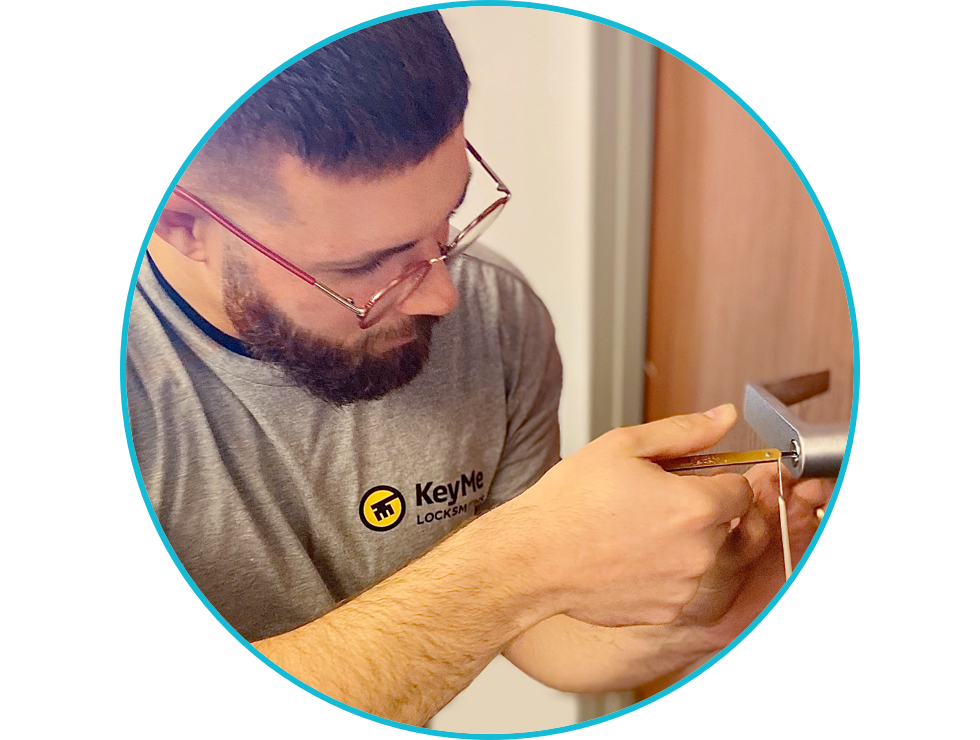
1. The Copied Key Won't Go All the Way Into the Lock
If a new duplicate will not fully enter the keyway, stop rather than pushing harder.
Possible issues can include:
- An incompatible key profile
- A physical problem with the duplicate
- Burrs or irregularities
- Damage to the key
- A problem with the lock itself
Compare the duplicate with the working source key.
Does the original still enter smoothly?
If so, the difference between the two keys becomes particularly important.
If neither key enters normally, the lock itself may need evaluation.
2. The Copied Key Goes In but Won't Turn
A key that inserts fully but will not rotate presents a different diagnostic problem.
Possible factors include:
- Source-key wear
- Differences in the duplicate
- Cylinder wear
- Lock malfunction
- Door or strike alignment
Try the original key.
Original Works Normally
If the original consistently operates the lock but the duplicate does not, focus first on the duplicate and source-key relationship.
Original Also Has Trouble
If the original sticks, requires jiggling, or turns inconsistently, the duplicate may not be the only issue.
Associated Locksmiths of America identifies worn keys, poorly duplicated keys, worn locks, weather, and door alignment among causes of difficult lock operation.
For lock-specific troubleshooting, see The Most Common Home Lock Problems.
3. The Copied Key Works Only When You Jiggle It
A new duplicate should not require an unusual technique to operate normally.
If you have to:
- Jiggle it
- Pull it slightly outward
- Push it sideways
- Apply unusual pressure
- Try several times
stop and compare its behavior with the source key.
If the original requires the same technique, the source key or lock may already have a problem.
If only the duplicate requires it, the copy itself deserves closer attention.
Do not normalize a new duplicate that works only after repeated manipulation.
4. The Original Works but the Duplicate Doesn't
This is one of the most useful diagnostic comparisons.
If the original:
- Enters smoothly
- Turns normally
- Operates the lock consistently
but the duplicate does not, that helps separate the problem from a lock that is universally malfunctioning.
At that point, useful questions include:
- Was the source actually the original key?
- Was it already worn?
- Is the duplicate the correct type?
- Does the duplicate show visible damage or irregularity?
- Does the problem occur in every lock the original operates?
If the copy came from a KeyMe kiosk or another KeyMe duplication option, gather the relevant order or transaction details before contacting support.
5. Both the Original and Duplicate Are Difficult to Use
This changes the diagnosis significantly.
If both keys:
- Stick
- Require jiggling
- Bind
- Work only intermittently
the lock or door may be contributing to the problem.
ALOA notes that door alignment is a frequent source of conditions homeowners initially perceive as lock problems. Worn locks and worn keys can also cause difficult operation.
Try operating the lock with the door open when that can be done normally and safely.
If both keys work with the door open but become difficult after the door closes, investigate alignment between the lock and strike.
A residential locksmith can evaluate the complete opening when the source is unclear.
Find a KeyMe Kiosk Near You
Need a spare key fast? Find a KeyMe kiosk near you to copy many house, office, and eligible car keys in just minutes.
6. The Duplicate Was Made From Another Duplicate
Keys can accumulate generations.
Imagine:
Original → Copy 1 → Copy 2 → Copy 3
Each later copy depends on the physical characteristics of the key used as its source.
If that source already contains wear or deviations from the original, those characteristics can affect subsequent copies.
ALOA specifically notes that duplicating old or worn keys can cause problems and that, in some circumstances, returning to an original source can correct issues.
This is why identifying the best available source matters.
For future duplicates, see How to Get the Best Key Copy From an Original Key.
7. The Copy Works in One Lock but Not Another
This can happen when one key is intended to operate multiple locks.
Suppose the original operates:
- Front door
- Back door
- Garage entry
but the new duplicate works smoothly in only two of them.
Do not immediately assume that either the copy or the third lock is definitively at fault.
Different cylinders can have different amounts of wear.
The original may also have worn over time in a way that allows it to continue operating several locks even though a new copy behaves differently.
Compare the original and duplicate across each relevant lock and record where the failure occurs.
That pattern can help a locksmith or support team understand the issue.
8. The New Key Works With the Door Open but Not Closed
This is an important clue because it may have little to do with the duplicate itself.
If the duplicate turns normally while the door is open but the deadbolt becomes difficult when the door closes, check the original under the same conditions.
If both behave similarly, the door or strike may be misaligned.
ALOA identifies poor door alignment as a common source of difficult lock operation and notes that hinges, frames, and weatherstripping can affect how locking hardware meets the strike.
Replacing the duplicate again would not necessarily correct an alignment problem.
9. The Source Key Was Already Worn
A key can still open a lock while showing significant wear.
Signs can include:
- Rounded cuts
- Polished or worn edges
- Slight bending
- Inconsistent operation
- Need for jiggling
- Need to pull the key back slightly before turning
If the duplicate was made from a source already showing these symptoms, the source itself becomes part of the diagnosis.
For future copies, use the cleanest, least-worn working source available.
10. The Wrong Duplication Method Was Used for the Key Type
Not every key is duplicated the same way.
Common mechanical house keys are different from:
- Restricted keys
- Specialty keys
- Transponder vehicle keys
- Remote-head keys
- Smart or proximity vehicle keys
- Electronic access credentials
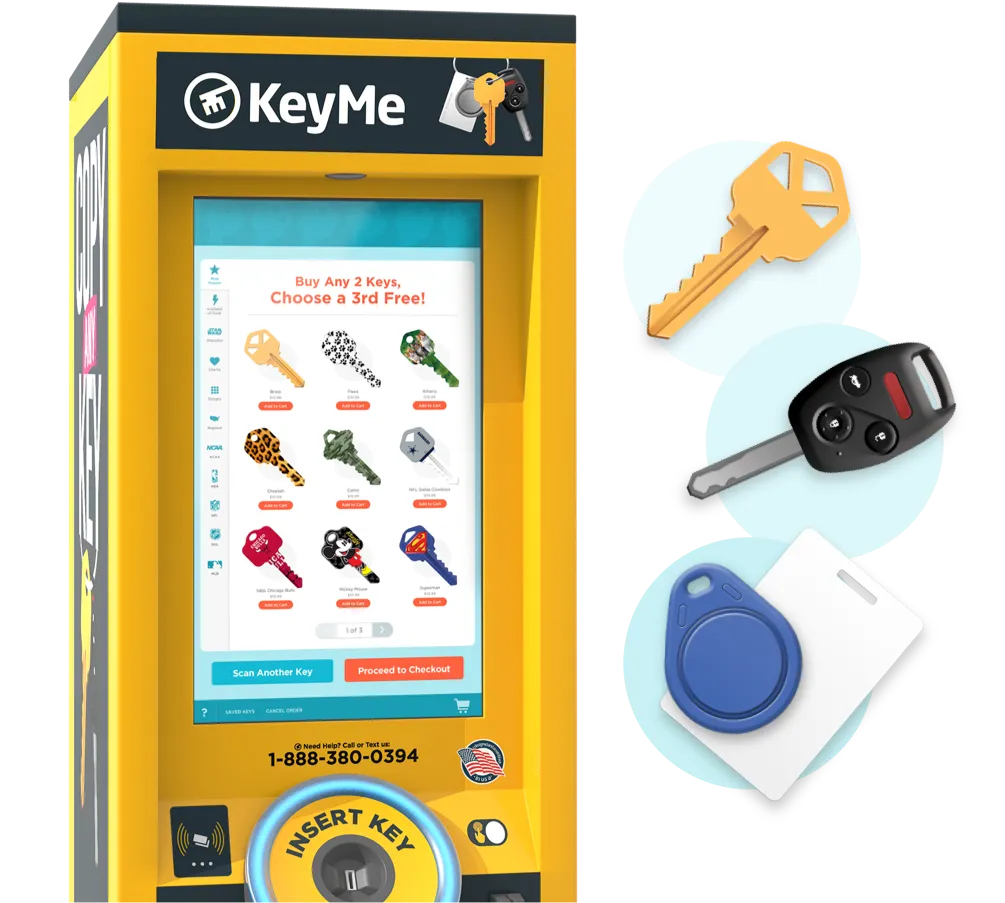
KeyMe currently offers several different duplication paths depending on the key and situation.
Eligible keys can be copied through KeyMe kiosks. KeyMe's online/mobile key scanning allows customers to upload a photo of an eligible key, which is processed and cut at a central facility before the finished key is shipped home. KeyMe also offers Car Key Vans for in-person vehicle key duplication and programming at participating retail locations.
For more about kiosk compatibility, see What Types of Keys You Can and Can't Copy at a KeyMe Kiosk.
11. The Copied Car Key Opens the Door but Won't Start the Vehicle
Automotive keys introduce an additional layer of troubleshooting.
The physical blade and the vehicle's electronic authorization system can perform different functions.
Depending on the vehicle and key type, a replacement may involve:
- Physical cutting
- Transponder authorization
- Remote functions
- Key programming
- Proximity or push-to-start functionality
A key that mechanically unlocks a door has demonstrated that its blade can operate that particular mechanical lock.
That does not establish that the vehicle electronically recognizes the key for starting.
If programming is required, KeyMe provides car key programming for supported vehicles.
For a broader overview, see How Car Key Programming Works.
12. The Copy Looks Different From the Original
Visual differences do not automatically establish that a duplicate is incorrect.
KeyMe's current FAQ notes that some KeyMe keys may look different from the original depending on the key option selected.
The more useful question is whether the key performs the functions it is supposed to perform.
Do not attempt to manually reshape or alter a new key simply because it looks different.
If the key does not operate correctly, document the difference and the exact failure behavior.
Best Way to Troubleshoot a Copied Key That Doesn't Work
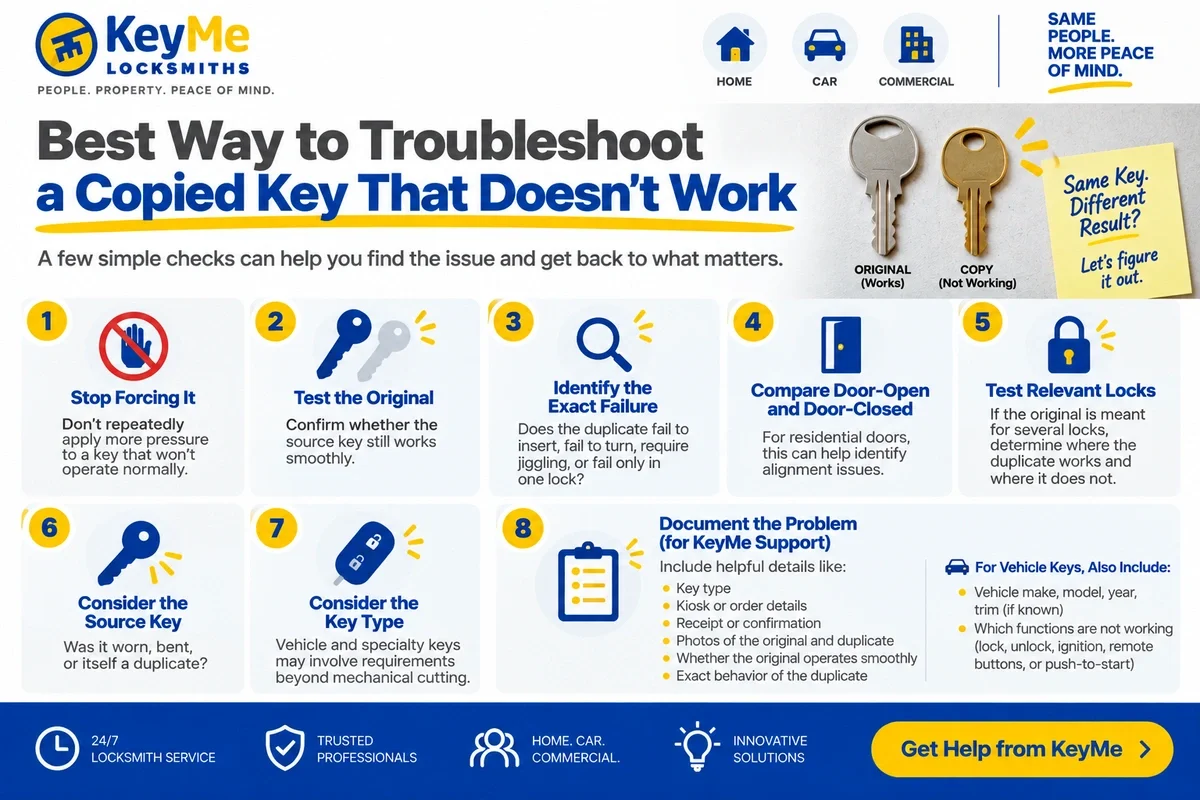
1. Stop Forcing It
Do not repeatedly apply more pressure to a key that will not operate normally.
2. Test the Original
Confirm whether the source key still works smoothly.
3. Identify the Exact Failure
Does the duplicate fail to insert, fail to turn, require jiggling, or fail only in one lock?
4. Compare Door-Open and Door-Closed Operation
For residential doors, this can help identify alignment issues.
5. Test Relevant Locks
If the original is intended to operate several locks, determine where the duplicate works and where it does not.
6. Consider the Source Key
Was it worn, bent, or itself a duplicate?
7. Consider the Key Type
Vehicle and specialty keys may involve requirements beyond mechanical cutting.
8. Document the Problem
For a KeyMe key-copy issue, useful information can include:
- Key type
- Kiosk or order details
- Receipt or confirmation
- Photos of the original and duplicate
- Whether the original operates smoothly
- Exact behavior of the duplicate
For vehicle keys, KeyMe's current support guidance also recommends providing the vehicle make, model, year, trim if known, and identifying which functions are not working, such as lock, unlock, ignition, remote buttons, or push-to-start.
Copy Your Key from Anywhere - Right from Your Phone
Skip the kiosk and copy your key from home. Upload a clear photo of an eligible house or car key, and KeyMe will create a precise duplicate and mail it directly to your door.
When Should the Lock Be Evaluated Instead?
A failed duplicate does not always mean another copy is the solution.
Consider lock repair or locksmith evaluation when:
- Multiple good keys have the same problem.
- The lock operates inconsistently.
- The deadbolt binds when the door closes.
- The cylinder appears damaged.
- The latch or other hardware is malfunctioning.
If you're unsure whether the key or lock is responsible, see The Most Common Home Lock Problems.
A Failed Copy Is a Troubleshooting Problem
When a duplicate does not work, start by comparing it with the source.
Original works, duplicate doesn't: Investigate the duplicate and source-key relationship.
Both keys struggle: Investigate the lock, door, and source-key condition.
Key works in some locks but not others: Compare the affected cylinders.
Car key opens the door but doesn't start the vehicle: Investigate electronic authorization or programming requirements.
Duplicate requires force or jiggling: Stop using force and determine why.
KeyMe provides key-copy services, key cutting, car key programming, and locksmith assistance for supported needs.
If you have not made your duplicate yet, see How to Get the Best Key Copy From an Original Key for guidance on choosing the best source before duplication.
References
- Associated Locksmiths of America (ALOA). Common Lock Issues. Consumer guidance addressing worn keys, poorly duplicated keys, lock wear, weather, and door alignment.
https://www.aloa.org/consumers/commonlockissues - KeyMe Locksmiths. Frequently Asked Questions. Current KeyMe guidance covering key-copy troubleshooting, information useful for customer support, online key copying, and duplication methods.
https://key.me/frequently-asked-questions - KeyMe Locksmiths. Key Copy. Current overview of KeyMe kiosk, mobile key scanning, and locksmith-assisted duplication options.
https://key.me/key-copy