

When a locksmith tells you that a lock should be rekeyed, a cylinder needs attention, the strike is misaligned, or your property could benefit from a different keying system, understanding those terms can help you make a more informed decision about the service.
Locksmiths work with much more than the visible lock on a door. A problem that feels like a "bad lock" could actually involve the key, cylinder, latch, deadbolt, strike, door alignment, electronic credential, or another part of the opening.
That is why a locksmith may recommend repairing or adjusting one component rather than replacing everything.
The terminology in this guide is based primarily on the Lock Industry Standards and Training (LIST) Council's Professional Locksmith Dictionary, current published version 01-10-2023. LIST Council develops standardized terminology specifically for the locksmith and security industry, and states that its definitions have been adopted by manufacturers, industry publications, associations, and training programs.
This guide translates relevant professional terminology into everyday language so homeowners, renters, property managers, and business owners can better understand what a locksmith may be doing and recommending.
Summary
- A locksmith may diagnose the key, cylinder, latch, deadbolt, strike, door, frame, or electronic access system rather than simply deciding whether a "lock is broken."
- Rekeying changes the combination of an existing lock or cylinder so access can be changed without necessarily replacing all of the hardware.
- The cylinder is the portion of many keyed locks that contains the components responsible for recognizing the correct mechanical key.
- Keyed alike means two or more locks or cylinders have the same combination, allowing them to operate with the same corresponding key.
- A master key system creates different levels of authorized access rather than simply making every lock use one key.
- Interchangeable cores allow the keyed core of compatible hardware to be removed and changed separately from the complete lock.
- In electronic systems, a credential can authorize access without being a traditional mechanical key.
- Automotive locksmith terminology may include transponder keys, immobilizers, remote-head keys, key programming, and all-keys-lost situations.
- Before approving work, ask which component is causing the problem, what the locksmith proposes to change, and whether the existing hardware can remain in service.
Why Locksmith Terminology Matters to Consumers
The LIST Council traces its standardized locksmith terminology to a professional glossary first released in 1982. The organization says the terminology developed through that effort has since been adopted throughout much of the locksmith and security industry.
The current LIST dictionary contains terminology covering mechanical locks, keys, master keying, safes, automotive security, electronic access control, door hardware, and other specialized areas.
Consumers do not need to learn all of it.
A smaller group of terms, however, can make it much easier to understand a service recommendation.
For example, these statements mean very different things:
- "Your lock needs to be rekeyed."
- "Your cylinder should be replaced."
- "Your strike is out of alignment."
- "Your door needs new hardware."
- "These locks can be keyed alike."
- "This property needs a master key system."
Understanding the difference helps you know what is actually being changed.
"A locksmith's first job is to identify where the problem is occurring. The key, cylinder, lock mechanism, strike, door alignment, and frame all interact. Understanding which component is causing the problem makes it much easier for a customer to understand why a particular service is being recommended." - KeyMe Locksmiths
Rekeying: Changing Which Key Operates the Lock
What Your Locksmith Means
LIST Council defines rekeying as changing the existing combination of a cylinder or lock so it works with a different key combination.
For consumers, the important distinction is simple:
Rekeying changes key access without necessarily replacing the complete lock.
The locksmith works with the internal keying of compatible hardware so the lock responds to a different key.
Why Would a Locksmith Recommend Rekeying?
You might hear this recommendation after:
- Moving into a new home
- A tenant moves out
- Losing a key
- Ending a contractor's access
- Changing employees
- Giving out keys you can no longer account for
- Purchasing a property with an unknown key history
The hardware itself may still work properly. The issue is that you want to change who can open it.
Rekeying vs. Replacing a Lock
These services solve different problems.
Rekeying: Changes which key operates compatible existing hardware.
Lock replacement: Replaces some or all of the existing lock hardware.
If your existing hardware functions properly and meets your needs, rekeying a lock may be an option.
If components are damaged, worn, incompatible with your needs, or you want different hardware, lock replacement may be considered instead.
Ask Your Locksmith
"Is there anything wrong with the hardware itself, or are you recommending rekeying simply to change access?"
Cylinder: The Part That Recognizes Your Key
What Your Locksmith Means
The cylinder is the portion of many mechanical locks containing the components that interact with the key.
When you insert the correct key, its cuts position internal components so the cylinder can operate.
That means a locksmith saying "the cylinder is the problem" does not necessarily mean the complete lock needs to be removed.
Signs a Locksmith May Investigate the Cylinder
A locksmith may inspect it if:
- Your key is difficult to insert.
- The key enters but does not turn normally.
- Several known-good keys have the same problem.
- The cylinder feels unusually loose.
- Operation has become inconsistent.
The locksmith may also examine the key itself before determining that the cylinder is responsible.
What Might Be Recommended?
Depending on the hardware and diagnosis:
- Servicing the cylinder
- Rekeying the cylinder
- Replacing the cylinder
- Replacing the complete lock
KeyMe offers lock repair and installation when a lock needs professional evaluation.
Ask Your Locksmith
"Is only the cylinder being replaced, or are you recommending a complete new lock?"
Need a Locksmith? We're here to help
Connect with a trusted local locksmith for fast, professional assistance when you need it most.
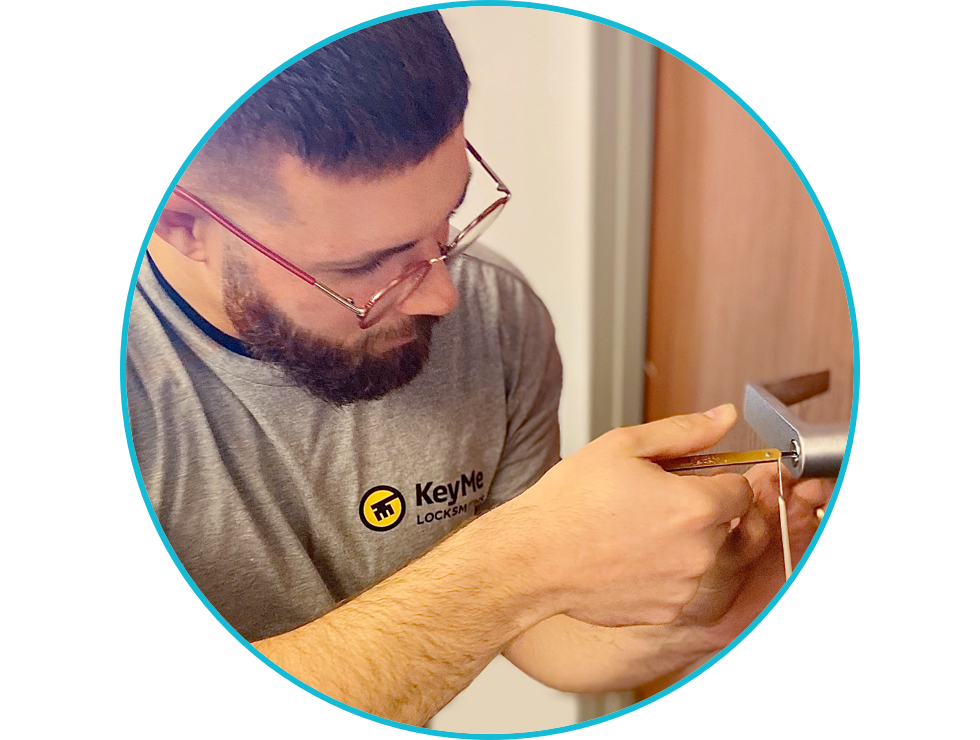
Deadbolt: The Bolt That Provides Deliberate Locking
What Your Locksmith Means
LIST Council defines a deadbolt as a bolt that requires deliberate action to extend and resists pressure in the unlocking direction when fully extended.
For a typical homeowner, this is the solid bolt you extend into the door frame when locking the door.
Why Might a Deadbolt Stop Working Properly?
The deadbolt itself is not always the problem.
A locksmith may investigate:
- Bolt operation
- Strike alignment
- Door position
- Frame condition
- Hinges
- Internal lock components
Here is an important diagnostic clue:
If the deadbolt moves normally while the door is open but becomes difficult when the door is closed, the locksmith may investigate alignment between the door and frame.
Replacing the deadbolt without addressing an alignment problem may not address the underlying issue.
Ask Your Locksmith
"Is the deadbolt failing, or is something preventing it from lining up with the frame?"
Strike: Where the Lock Meets the Door Frame
What Your Locksmith Means
The strike is the component mounted on or in the frame that receives the latch or bolt.
It is easy to overlook because most consumers naturally focus on the lock attached to the door.
But the two must align correctly.
Why Would a Locksmith Adjust the Strike?
Possible symptoms include:
- The door will not latch unless you push it.
- You have to pull the door toward you while locking it.
- The deadbolt hits the edge of the opening.
- The latch rubs against the strike.
- A previously smooth lock has become difficult to operate.
These symptoms do not necessarily mean the lock has failed.
The door may have shifted relative to the frame.
Strike Reinforcement
LIST Council separately defines a strike reinforcer as a metal plate installed behind a strike and attached to the door frame using long screws.
A locksmith evaluating door security may therefore look beyond whether the bolt simply fits into the opening.
Ask Your Locksmith
"Is this a lock problem or a door-and-strike alignment problem?"
Latch vs. Deadbolt: What's the Difference?
These components perform different jobs.
Latch
A latch is generally the component that retracts as you turn the knob or lever and then engages when the door closes.
Deadbolt
A deadbolt requires a deliberate locking action.
Why does that matter?
If the door does not stay closed normally, the locksmith may investigate the latch and strike alignment.
If the door closes but the locking bolt will not extend properly, the locksmith may investigate the deadbolt, strike, or alignment.
Telling a locksmith exactly what the door is doing can help narrow the diagnosis.
Keyway: Why Similar-Looking Keys Don't Always Fit
What Your Locksmith Means
LIST Council defines the keyway as the opening in a lock or cylinder shaped to accept a particular key section.
In plain language:
The keyway helps determine which physical key profiles can enter the lock.
Two keys may look nearly identical to you while having different profiles along their blades.
If the profiles are incompatible, one key cannot properly enter the other's keyway.
Why Would a Locksmith Talk About Keyways?
Keyway compatibility becomes important when:
- You want several doors to use the same key.
- A cylinder needs replacement.
- You have locks from different manufacturers or systems.
- A property uses restricted keys.
- You are planning a master key system.
Ask Your Locksmith
"Are my existing locks compatible with the same keyway?"
Keyed Alike: One Key for Multiple Locks
LIST Council defines Keyed Alike (KA) as two or more locks or cylinders having the same combination.
For a consumer, that can mean one corresponding key operates several compatible locks.
For example:
- Front door
- Back door
- Garage entry door
could potentially be configured for the same key when the hardware is compatible.
Keyed Alike Is Not the Same as Master Keyed
This distinction is particularly useful.
With a keyed-alike arrangement, the relevant locks share the same combination.
A master key system creates levels of access.
If carrying multiple household keys is the issue you are trying to solve, ask a residential locksmith whether compatible existing locks can be keyed alike.
Keyed Different: Separate Keys for Separate Locks
LIST Council defines Keyed Different (KD) as a group of locks or cylinders that are combinated differently.
In other words, each lock is intended to operate with its corresponding key rather than sharing one common combination.
This can be desirable when access needs to remain separate.
For example, a business may intentionally want:
- One key for an office
- Another for a storage room
- Another for a utility area
The important point is that using one key for everything is not automatically the best access arrangement.
The correct approach depends on who should be able to open each door.
Master Key System: Different Keys With Different Access Levels
What Your Locksmith Means
LIST Council defines a master key as a key capable of operating a group of locks or cylinders that can also be operated by their own change keys.
This creates an access hierarchy.
Consider an apartment property:
Resident A's key: Apartment A
Resident B's key: Apartment B
Authorized management key: Designated Apartments A and B
Resident A's key does not need to open Apartment B for an authorized management key to operate both.
Where Are Master Key Systems Used?
Common applications include:
- Apartment buildings
- Offices
- Commercial properties
- Educational facilities
- Institutional buildings
- Property-management portfolios
Why Would a Locksmith Recommend One?
The objective is usually access management, not simply convenience.
Different users can receive keys corresponding to the doors they are authorized to enter.
A commercial locksmith can help evaluate the appropriate keying arrangement for a business or managed property.
Ask Your Locksmith
"Can you show me which doors each level of key will operate?"
Interchangeable Core: Changing the Keyed Core Without Replacing Everything
LIST Council uses IC as the abbreviation for interchangeable core and recognizes both large-format and small-format interchangeable-core systems.
These are especially relevant to commercial and institutional properties.
What Does It Mean for the Customer?
In compatible hardware, the keyed core can be removed independently of the complete lock.
That can be useful when access needs change frequently.
You may encounter interchangeable cores in:
-
Office buildings
-
Universities
-
Apartment properties
-
Institutional facilities
-
Commercial properties
If your locksmith says "we only need to change the core," ask whether the rest of the existing hardware will remain in place.
Mortise Lock: A Lock Body Installed Inside the Door
A mortise lock has a lock body installed into a prepared pocket in the edge of the door.
These are common in many:
- Commercial buildings
- Apartment buildings
- Older properties
- Heavy-duty entrances
- Historic buildings
Why Does Identifying a Mortise Lock Matter?
The lock contains multiple components that may be individually serviceable.
A locksmith could potentially recommend attention to:
- The cylinder
- Internal lock body
- Latch
- Deadbolt
- Trim
- Complete assembly
Do not assume that a problem with one component means every part of the mortise lock needs replacement.
Ask Your Locksmith
"Which part of the mortise lock is actually causing the problem?"
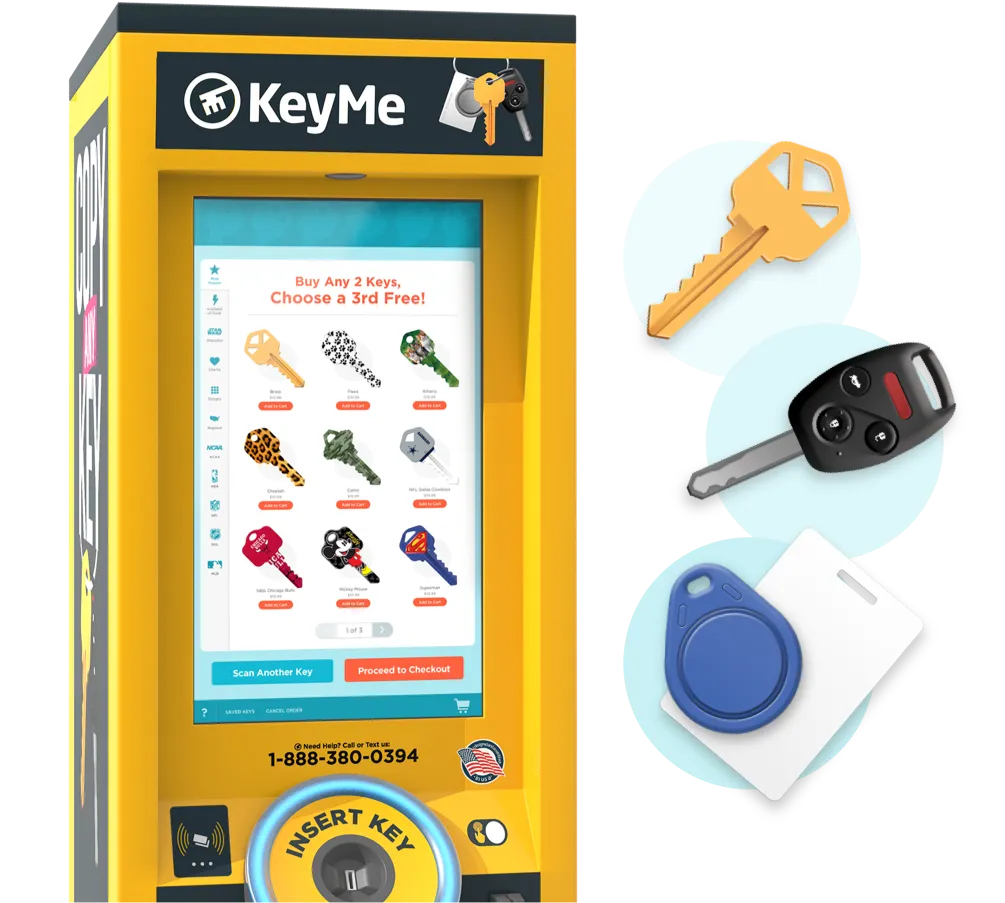
Find a KeyMe Kiosk Near You
Need a spare key fast? Find a KeyMe kiosk near you to copy many house, office, and eligible car keys in just minutes.
Key Blank: The Starting Point for a Mechanical Key
LIST Council defines a key blank as material manufactured to the proper size and configuration so it can be cut into a key.
In everyday terms, it is the uncut starting key.
The blank must be compatible with the lock's keyway before the appropriate cuts are created.
This is why a locksmith or key-cutting service cannot simply use any blank that looks roughly like your existing key.
Second-Generation Duplicate: Why Copying Copies Matters
One particularly useful consumer term in the LIST dictionary is second generation duplicate.
LIST Council defines it as a key reproduced from a first-generation duplicate.
Why should a consumer care?
Because the key being presented for duplication may itself already be a copy rather than the original reference key.
If you have several copies available, bring the key that operates the lock most reliably when seeking key duplication.
If every existing key operates poorly, the problem may warrant evaluation rather than simply creating another copy.
Key Code: When a Key Can Be Created From Information Instead of Another Key
LIST Council defines a code in part as a designation assigned to a particular key combination for reference when additional keys or cylinders may be needed.
This helps explain something consumers sometimes find surprising:
A locksmith does not always need to trace an existing physical key to create another key.
Depending on the lock or vehicle, authorized key information may sometimes be used to originate a key.
This is particularly relevant in certain automotive situations where no working key remains.
AKL: "All Keys Lost"
If an automotive locksmith says AKL, LIST Council defines the abbreviation as All Keys Lost.
That is an important service distinction.
A driver who has one functioning key and wants another is in a different situation from a driver with no working keys remaining.
An all-keys-lost situation may require the locksmith to identify the correct key, originate it, and address the vehicle's electronic security requirements.
KeyMe provides lost car key replacement for supported vehicles.
Transponder or Chip Key: Why Cutting May Not Be Enough
LIST Council defines a chip key as a key incorporating an electronic component that communicates with another vehicle component to allow or prevent starting. The dictionary directs readers to related terminology including transponder key.
This distinction explains why two automotive services are often discussed separately:
Key cutting creates the required physical key configuration.
Programming addresses electronic recognition when the vehicle requires it.
A key can therefore be physically correct but still require electronic authorization before it can start a particular vehicle.
For supported vehicles, KeyMe offers car key replacement and car key programming.
Immobilizer: Why the Car May Reject a Physically Correct Key
LIST Council defines an immobilizer as an automotive anti-theft device that prevents the vehicle from starting or being driven unless the appropriate electronic credential is present.
This is another reason modern car locksmith work can involve more than cutting metal.
If your replacement key turns mechanically but the vehicle will not authorize starting, the locksmith may investigate whether the electronic credential is properly recognized by the vehicle's security system.
Credential: Not Every "Key" Is a Mechanical Key
The current LIST dictionary defines a credential as an identifying or authorizing instrument, other than a mechanical key, capable of causing entry to be allowed.
That concept is important for modern properties.
A credential could be associated with an electronic access system rather than a traditional lock and key.
Examples can include compatible:
-
Access cards
-
Key fobs
-
Electronic credentials
If a credential stops providing access, the physical lock itself may be working normally.
The issue could instead involve the credential or access-control system.
KeyMe supports duplication of many compatible authorized RFID key fobs.
Electronic Access Control: When the Problem Isn't a Traditional Lock
The LIST dictionary uses EAC as the abbreviation for Electronic Access Control.
Consumers increasingly encounter electronic access in:
- Apartment buildings
- Offices
- Multifamily properties
- Shared amenities
- Controlled entrances
A locksmith investigating an electronically controlled opening may therefore be dealing with more than a mechanical cylinder.
Depending on the system, the problem could involve:
- The physical locking hardware
- Credential recognition
- Electronic components
- Door alignment
- Power or system operation
Understanding that distinction can prevent a common misunderstanding: a door that will not grant access does not automatically have a broken mechanical lock.
Fail-Safe: What Happens When Power Is Lost
LIST Council defines fail-safe as a security-device feature designed to release for safety purposes during a loss of power.
This term may come up when discussing electrified commercial openings.
If a locksmith describes hardware as fail-safe, they are explaining how that hardware behaves when electrical power is unavailable.
This can have implications beyond everyday security, including life-safety and building requirements.
Consumers should not assume that "fail-safe" means "better" or "less secure." It describes an operating characteristic that must be appropriate for the opening.
Door Preparation or "Prep": Why New Hardware May Not Simply Fit
LIST Council defines prep as the location and dimensions of cutouts and reinforcing in a door or frame required to accept hardware. It also uses the term as a verb for preparing a door or frame for installation.
This explains why a locksmith may examine measurements before recommending a replacement lock.
Different hardware can require different:
- Bore dimensions
- Backsets
- Edge preparations
- Door thicknesses
- Reinforcement
- Frame preparations
If new hardware does not match the existing preparation, lock installation may involve more than simply removing one lock and tightening screws on another.
Ask Your Locksmith
"Will this replacement fit the existing door preparation, or does the door need modification?"
R&R: "Remove and Replace"
The LIST dictionary defines R&R as a common service notation meaning remove and replace.
If you see R&R on paperwork or hear a technician use it, it generally means the existing component is being removed and another installed in its place.
The useful follow-up question is:
"Exactly which component is being removed and replaced?"
That could mean a cylinder, lockset, closer, or another piece of hardware rather than necessarily everything on the door.
National Service Provider: A Term Consumers May Encounter
The 2023 LIST dictionary defines a national service provider as a nationwide maintenance contracting company that supplies the subcontracted services of a local technician to a customer.
This is particularly relevant to:
- Multilocation businesses
- Property managers
- Retail operations
- Commercial facilities
It helps distinguish the organization coordinating service nationally from the technician performing work locally.
Authority Having Jurisdiction: Why Some Hardware Recommendations Involve Code
LIST Council defines the Authority Having Jurisdiction (AHJ) as the individual or office responsible for interpreting and enforcing applicable building, fire, life-safety, or accessibility requirements.
This becomes particularly important for commercial doors.
If a locksmith says a certain type of hardware is required, ask whether the recommendation relates to:
- Security
- Door function
- Fire protection
- Egress
- Accessibility
- Another applicable requirement
A commercial opening is not always governed solely by the owner's preferred level of security.
Copy Your Key from Anywhere - Right from Your Phone
Skip the kiosk and copy your key from home. Upload a clear photo of an eligible house or car key, and KeyMe will create a precise duplicate and mail it directly to your door.
What Does "Replace the Lock" Really Mean?
This is one of the most useful things consumers can clarify.
A locksmith working on a door could potentially:
- Adjust the strike.
- Service the cylinder.
- Rekey the cylinder.
- Replace the cylinder.
- Repair the latch.
- Repair or replace the deadbolt.
- Correct compatible hardware alignment.
- Change an interchangeable core.
- Replace the complete lockset.
Those are very different services.
If a locksmith recommends replacement, ask what is being replaced and why.
"Customers do not need to know every technical term in the locksmith industry, but they should understand the recommendation. A useful explanation identifies the problem, the component involved, what work is being proposed, and what will function differently once the work is complete." - KeyMe Locksmiths
Best Way to Evaluate a Locksmith Recommendation
When a locksmith explains a problem, work through these five questions.
1. What Is Actually Wrong?
Start with the symptom.
For example:
- The key sticks.
- The key turns but the deadbolt does not move.
- The door will not latch.
- The old tenant still has a key.
- The key broke.
- The fob stopped granting access.
2. Which Component Is Responsible?
Ask whether the locksmith has identified a problem with the:
- Key
- Cylinder
- Lock mechanism
- Latch
- Deadbolt
- Strike
- Door or frame
- Electronic credential
- Access-control system
3. What Service Is Being Recommended?
Clarify whether the proposed work is:
- Adjustment
- Repair
- Rekeying
- Cylinder replacement
- Core replacement
- Complete lock replacement
- Key duplication
- Electronic or car key programming
4. What Will Be Different Afterward?
For an access-related service, ask:
- Which existing keys will continue working?
- Which keys will stop working?
- Will I receive different keys?
- Is the existing lock remaining?
- Are electronic credentials changing?
5. Why Is This Option Being Recommended?
The recommendation should correspond to the actual problem.
For example, if the hardware is functioning properly but an old key needs to stop working, ask why replacement would be preferable to rekeying.
If the locksmith recommends new hardware, ask what condition or requirement makes replacement appropriate.
Questions Consumers Can Ask a Locksmith
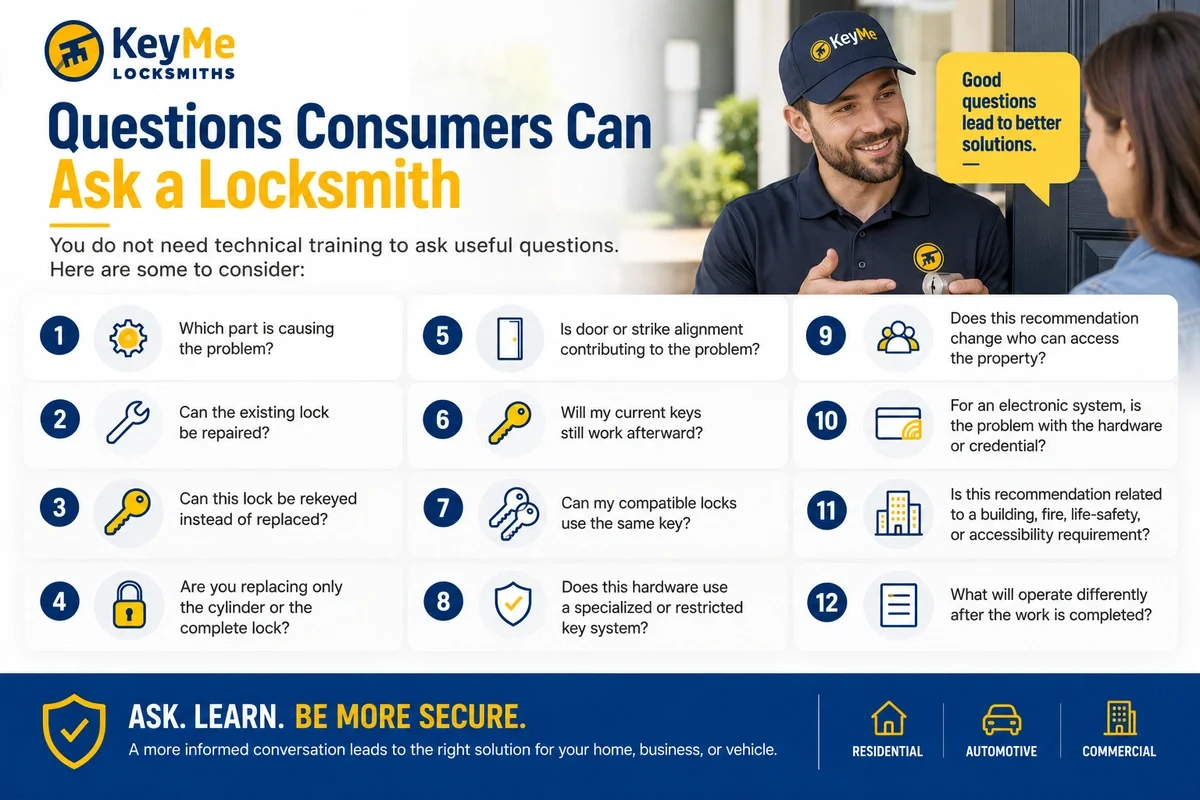
You do not need technical training to ask useful questions.
Consider asking:
- Which part is causing the problem?
- Can the existing lock be repaired?
- Can this lock be rekeyed instead of replaced?
- Are you replacing only the cylinder or the complete lock?
- Is door or strike alignment contributing to the problem?
- Will my current keys still work afterward?
- Can my compatible locks use the same key?
- Does this hardware use a specialized or restricted key system?
- Does this recommendation change who can access the property?
- For an electronic system, is the problem with the hardware or credential?
- Is this recommendation related to a building, fire, life-safety, or accessibility requirement?
- What will operate differently after the work is completed?
Understanding the Recommendation Is More Important Than Knowing the Jargon
You do not need to memorize a locksmith dictionary.
A few distinctions can make a professional recommendation much easier to understand:
- Rekeying changes which key operates compatible hardware.
- The cylinder is responsible for recognizing the mechanical key in many locks.
- The deadbolt and strike must align properly.
- The keyway affects which key profiles fit a cylinder.
- Keyed-alike locks share a combination.
- Master key systems create different levels of access.
- Interchangeable cores allow compatible keyed cores to be changed independently.
- Electronic credentials and mechanical keys are different forms of access.
- Automotive immobilizers can require electronic authorization in addition to a correctly cut key.
Most importantly, a lock is only one component of a complete opening. A locksmith may need to consider the key, cylinder, lock mechanism, door, strike, frame, and access requirements before determining the appropriate service.
When you understand what is wrong, what is being changed, and why, you are in a much better position to understand the locksmith's recommendation.
KeyMe offers residential locksmith services, commercial locksmith services, lock repair and installation, lock installation, lock replacement, rekeying, and key cutting.
References
- Lock Industry Standards and Training (LIST) Council. The Professional Locksmith Dictionary. Current published version: January 10, 2023.
https://www.listcouncil.org/ - The LIST Council identifies the January 10, 2023 edition as the current downloadable version of The Professional Locksmith Dictionary. LIST Council states that its terminology has been adopted by locksmith and security manufacturers, publications, associations, and training programs.
- Lock Industry Standards and Training (LIST) Council. What Is the LIST Council?
https://www.listcouncil.org/what-is-the-list-council/ - Background on the development of standardized locksmith terminology, beginning with the industry's 1982 glossary and evolving into The Professional Locksmith Dictionary.
- Lock Industry Standards and Training (LIST) Council. Peer Review.
https://www.listcouncil.org/peer-review/ - LIST Council's peer-review process for terminology proposed for inclusion in the dictionary. The site's newest posted peer-review terminology is dated February 6, 2023 and includes Depth and Space Data (DSD), Full Size Interchangeable Core (FSIC), Trigger Device (TD), and an updated wafer tumbler definition.