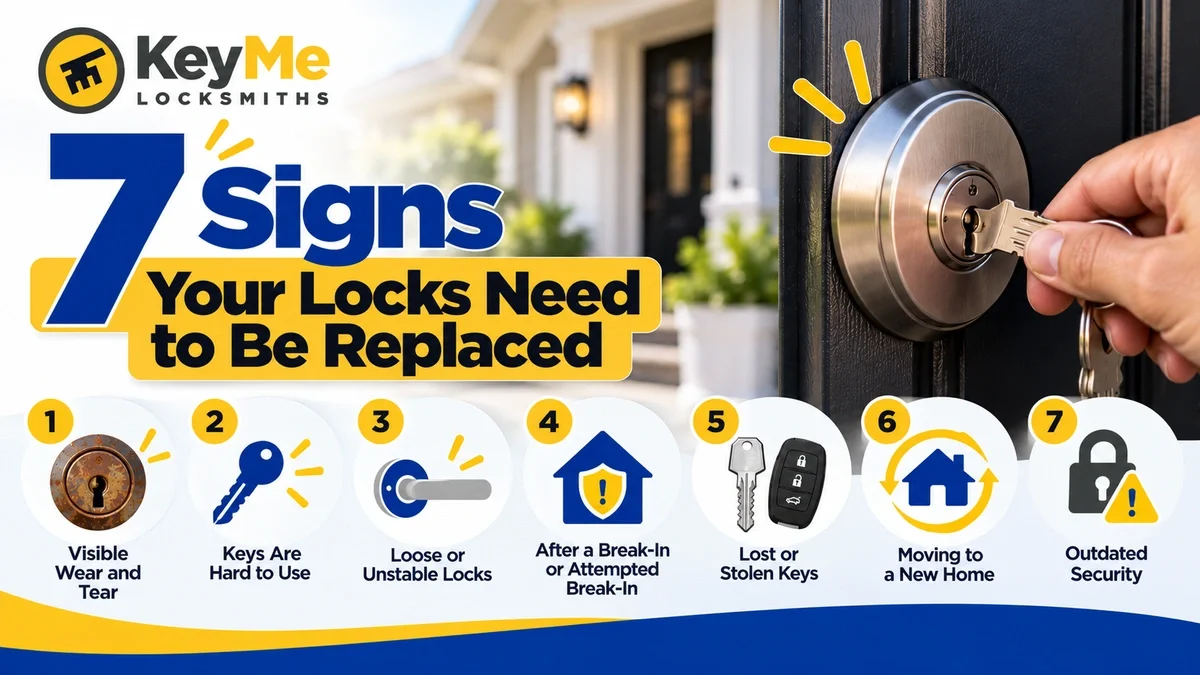
Your lock may need to be replaced if it is physically damaged, repeatedly fails despite appropriate repairs, no longer works reliably with a good key, has severely worn components, or no longer meets the security or access needs of the property. However, a sticking or difficult lock does not automatically need replacement. Problems with the key, door alignment, lubrication, or strike can create similar symptoms.
The important first step is identifying what is actually failing before replacing otherwise functional hardware.
Summary
- Visible damage to the cylinder, lock body, latch, deadbolt, or other hardware is one of the clearest reasons to consider replacement.
- If multiple known-good keys have trouble with the same lock, the hardware deserves closer inspection.
- A lock that continues to fail after appropriate repair or adjustment may be reaching the end of its useful service life.
- Latches, deadbolts, cylinders, and other mechanical components can wear through repeated use.
- Changing security or access needs can justify replacement even when the existing lock still works.
- A new door, renovation, or change in door preparation can make existing hardware incompatible.
- If a lock works with the door open but binds when the door is closed, investigate door and strike alignment before replacing it.
- If your only goal is to stop old keys from working, rekeying may be more appropriate than replacing the lock.
Best Way to Decide Whether a Lock Needs Replacement
Before choosing repair, rekeying, or replacement, work through the problem in this order.
1. Try a Known-Good Key
If one key has trouble but another works normally, the key may be the problem.
If several good keys behave the same way, the lock deserves more attention.
2. Operate the Lock With the Door Open
If the lock works normally while the door is open but becomes difficult when the door is closed, the problem may involve:
- Strike alignment
- Hinges
- Door sag
- Frame movement
- Weatherstripping
Replacing the lock without correcting the door may leave you with the same problem.
3. Look for Physical Damage
Inspect the visible hardware for cracks, looseness, deformation, broken components, or signs that the lock has been forced.
4. Consider the Repair History
A first-time sticking problem is different from hardware that has repeatedly required service.
5. Define What You Are Trying to Accomplish
If you only need different keys to operate the lock, rekeying may solve the problem.
If the hardware itself is damaged, incompatible, or no longer provides the features you need, replacement becomes more relevant.
"A difficult lock is a symptom, not a diagnosis. Before replacing the hardware, identify whether the resistance is coming from the key, cylinder, latch, strike, hinges, door alignment, or the lock itself." - KeyMe Locksmiths
Need a Locksmith? We're here to help
Connect with a trusted local locksmith for fast, professional assistance when you need it most.
1. The Lock Is Physically Damaged
Visible damage is one of the strongest indicators that replacement may be appropriate.
Warning signs can include:
- Cracked lock housing
- Broken trim
- Severely loose components
- Damaged cylinder
- Deadbolt that no longer extends correctly
- Worn or damaged latch
- Evidence that the hardware has been forced
Physical damage can interfere with both normal operation and the lock's ability to perform its intended function.
ALOA Security Professionals Association notes that lock components wear through use and specifically identifies the latch as a component that can experience significant wear.
The important distinction is which component has failed.
If the problem is limited to a serviceable component, lock repair may still be appropriate.
If the lock body, cylinder, latch, deadbolt, or other critical hardware is significantly compromised, replacement may make more sense.
2. A Good Key Still Will Not Operate the Lock Reliably
Before blaming the lock, rule out the key.
ALOA identifies worn and poorly duplicated keys as common causes of difficult lock operation.
A key may be the stronger suspect when:
- Only one key has trouble
- The everyday key is visibly worn
- A recent duplicate performs worse than another key
- The key is bent or damaged
If a known-good key works smoothly, replacing the lock would address the wrong problem.
The situation changes when multiple good keys produce the same symptom.
For example, if several working keys all:
- Bind
- Require jiggling
- Fail to turn consistently
- Become increasingly difficult to insert or remove
the cylinder or other lock hardware deserves closer inspection.
3. The Same Lock Keeps Failing After Repairs or Adjustments
An isolated lock problem does not necessarily justify replacement.
Repeated failures are more significant.
A lock may become a stronger replacement candidate when the same hardware repeatedly needs:
- Adjustment
- Lubrication
- Cylinder work
- Latch repair
- Hardware tightening
- Other corrective service
The key question is whether those repairs are resolving the underlying issue or temporarily treating the same recurring symptom.
Before replacing the hardware, however, inspect the complete door opening.
ALOA identifies poor door alignment as a major source of apparent lock problems. Worn hinges, shifting frames, and weatherstripping can prevent the latch or deadbolt from lining up correctly with the strike.
If the door is causing the failure, installing a new lock without correcting the alignment may simply recreate the problem.
4. The Latch or Deadbolt No Longer Operates Consistently
The latch and deadbolt perform much of the mechanical work each time the door is used.
Signs of deterioration can include:
- Latch sticking inside the door
- Deadbolt failing to extend fully
- Bolt retracting inconsistently
- Handle no longer retracting the latch normally
- Excessive looseness
- Door requiring unusual force to lock
Repeated use places mechanical stress on this hardware.
BHMA's current residential standards evaluate locksets and deadbolts for characteristics including operation, durability, security, strength, and finish. The standards are intended to provide a consistent way to evaluate hardware performance under defined test conditions.
Real-world performance still depends on factors such as:
- Installation
- Door and frame construction
- Usage
- Maintenance
- Environmental conditions
A lock should therefore be evaluated based on its actual condition rather than assuming every product has a specific universal lifespan.
5. The Lock Is Showing Significant Wear From Long-Term Use
Locks are mechanical devices, and mechanical components wear over time.
ALOA notes that wear occurs through repeated key insertion and operation and that high-use hardware can accumulate more wear.
Common high-use doors include:
- Main entrances
- Apartment doors
- Garage-to-home doors
- Rental-property entrances
- Shared building entrances
Signs of accumulated wear can include:
- Increasing key resistance
- Loose cylinder movement
- Inconsistent latch operation
- Repeated sticking
- Excessive play in handles or trim
Wear alone does not automatically mean the entire lock needs replacement.
If maintenance or repair restores consistent operation, the hardware may remain serviceable.
If the lock remains unreliable despite appropriate maintenance, replacement becomes more reasonable.
6. Your Security or Access Needs Have Changed
A lock can still function mechanically while no longer being the right lock for the property.
Your needs may change after:
- A renovation
- Converting part of the home to a rental
- Creating a separate entrance
- Adding smart-home access
- Changing who needs regular entry
- Reorganizing how multiple doors are keyed
- Moving into a property with mismatched hardware
Before replacing anything, define the problem.
If the Problem Is Who Has a Key
You may not need new hardware.
Rekeying vs. replacing your locks explains the distinction in more detail, but the basic difference is straightforward:
Rekeying changes which key operates the existing lock.
Replacement changes the hardware itself.
If the Problem Is the Hardware or Features
Replacement may be appropriate when you intentionally want:
- Smart access
- Keypad entry
- Different lock technology
- Different hardware type
- New key-management features
- Hardware compatible with a renovation
In that case, lock installation can help confirm compatibility with the door and opening.
7. The Existing Lock No Longer Fits the Door or Opening
Sometimes the lock is not worn out. It simply no longer fits the application.
That can happen after:
- Installing a new door
- Changing door thickness
- Rebuilding a frame
- Changing the door preparation
- Switching hardware types
- Adding a smart deadbolt
- Replacing older or unusual hardware
Lock performance depends on more than the lock itself.
The hardware also needs to work with the:
- Door preparation
- Backset
- Door thickness
- Frame
- Strike
- Intended function
BHMA notes that real-world hardware performance is affected by installation as well as door and frame construction.
If a renovation changes those conditions, new hardware may be required even if the old lock was functioning properly before the change.
Find a KeyMe Kiosk Near You
Need a spare key fast? Find a KeyMe kiosk near you to copy many house, office, and eligible car keys in just minutes.
A Sticking Lock Does Not Automatically Need Replacement
This is one of the most important distinctions in lock troubleshooting.
ALOA identifies several potential reasons a lock may become difficult to operate, including:
- Weather
- Door misalignment
- Lubrication needs
- Worn keys
- Poorly duplicated keys
- Lock wear
Several of those problems can occur without the lock itself being defective.
Use the Door-Open Test
Operate the lock while the door is open.
Then close the door and try again.
If the lock works smoothly when open but becomes difficult after the door closes, investigate alignment.
Possible causes include:
- Strike position
- Loose or worn hinges
- Frame movement
- Weatherstripping
- Door sag
That pattern is a strong reason to inspect the door before replacing the lock.
Repair vs. Rekey vs. Replace
These services solve different problems.
Repair
Repair makes sense when a component or installation issue can be corrected while the existing hardware remains appropriate.
Examples can include loose hardware, certain latch problems, alignment issues, or serviceable cylinder problems.
Rekey
Rekey when the lock itself still works but you want to change which keys can operate it.
That may be relevant after:
- Moving into a home
- Losing a key
- Changes in occupancy
- Old copies remaining in circulation
For a homeowner-focused explanation, see How Lock Rekeying Works for New Homeowners.
Replace
Consider replacement when:
- Hardware is physically damaged
- Wear is significant
- The same lock repeatedly fails
- Repair is no longer appropriate
- The hardware no longer fits the door
- You intentionally want a different type of lock
A professional diagnosis should identify which problem the proposed service is solving.
What Should You Look for in a Replacement Lock?
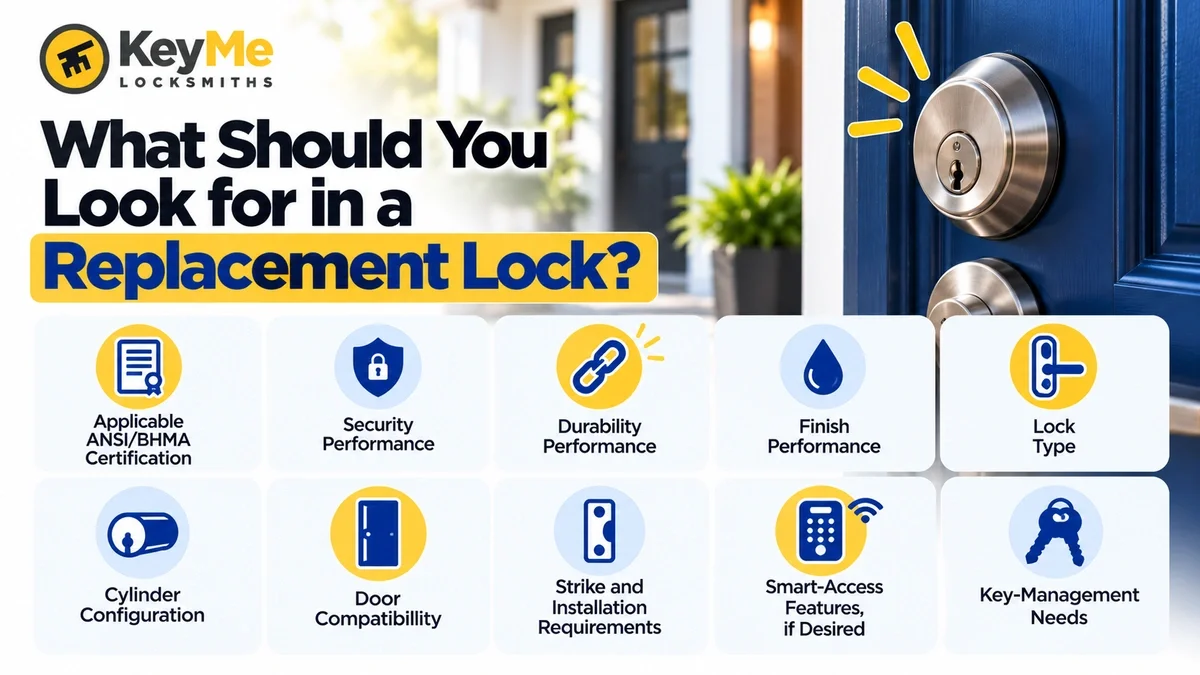
If replacement is appropriate, do not choose a new lock based only on appearance or brand.
Consider:
- Applicable ANSI/BHMA certification
- Security performance
- Durability performance
- Finish performance
- Lock type
- Cylinder configuration
- Door compatibility
- Strike and installation requirements
- Smart-access features, if desired
- Key-management needs
BHMA's certification program uses independent laboratory testing to determine whether participating products meet applicable ANSI/BHMA standards.
For residential hardware, ANSI/BHMA A156.39-2025 covers residential locksets and latches, while ANSI/BHMA A156.40-2025 covers residential deadbolts.
These standards address categories including durability, security, operation, strength, and finish.
Certification does not eliminate the importance of installation.
A well-rated lock that is installed poorly or does not fit the door correctly may not perform as intended.
Should You Replace Every Lock at the Same Time?
Not necessarily.
If one lock is physically damaged, there is no automatic requirement to replace every functioning lock in the home.
However, replacing one lock can be a useful opportunity to review the property's broader access setup.
Consider whether:
- Multiple doors unnecessarily require different keys
- Compatible hardware could be keyed alike
- Some locks need repair while another needs replacement
- Existing keys should continue working
- You want a more consistent hardware arrangement
A residential locksmith can evaluate the complete property rather than treating every door as an unrelated problem.
When to Call a Locksmith
Professional evaluation is useful when you cannot confidently determine whether the problem originates with:
- The key
- Cylinder
- Lock mechanism
- Latch
- Deadbolt
- Strike
- Hinges
- Door or frame
It is particularly worth getting help when the lock is visibly damaged, several known-good keys have trouble, the hardware repeatedly fails, a key has broken inside the lock, or you are changing the property's access system.
The goal should be to identify the actual failure before choosing repair, rekeying, or replacement.
Copy Your Key from Anywhere - Right from Your Phone
Skip the kiosk and copy your key from home. Upload a clear photo of an eligible house or car key, and KeyMe will create a precise duplicate and mail it directly to your door.

7 Signs Your Locks Need to Be Replaced: The Bottom Line
Replace a lock when there is good evidence that the hardware itself is the problem or when the existing hardware no longer meets the needs of the property.
The strongest signs include:
- Physical damage
- Continued difficulty with multiple good keys
- Repeated failure after appropriate repairs
- Worn or inconsistent latch or deadbolt operation
- Significant long-term hardware wear
- Changed security or access needs
- Incompatibility with the door or opening
But do not treat every sticking lock as a failed lock.
First rule out the key, door alignment, strike, hinges, maintenance needs, and other correctable causes.
Repair when the hardware remains serviceable. Rekey when the issue is which keys should work. Replace when the hardware itself is damaged, unreliable, incompatible, or no longer appropriate for the opening.
References
- ALOA Security Professionals Association. Common Lock Issues. Consumer guidance covering door alignment, weather, lubrication, worn or poorly duplicated keys, hardware wear, and when professional service may be needed.
https://www.aloa.org/consumers/commonlockissues - ALOA Security Professionals Association. Should I Change My Locks? Consumer guidance addressing access changes after taking possession of a property and situations where rekeying may be appropriate.
https://www.aloa.org/consumers/changelocks - Builders Hardware Manufacturers Association. ANSI/BHMA A156.39-2025 Residential Locksets and Latches. Current residential lockset standard addressing performance requirements including durability, security, operation, strength, and finish.
https://buildershardware.com/ANSI-BHMA-Standards/Hardware-Highlights/A15639-2025-Residential-Locksets-and-Latches - Builders Hardware Manufacturers Association. ANSI/BHMA A156.40-2025 Residential Deadbolts. Current residential deadbolt standard addressing performance requirements including durability, security, operation, strength, and finish.
https://buildershardware.com/ANSI-BHMA-Standards/Hardware-Highlights/A15640-2025-Residential-Deadbolts - Builders Hardware Manufacturers Association. Certification Program. Information about independent laboratory testing and BHMA certification for products meeting applicable ANSI/BHMA standards.
https://buildershardware.com/Certification-Program - KeyMe Locksmiths. Rekeying vs. Replacing Your Locks. Guidance on when existing hardware can remain in place and when replacing the lock may be more appropriate.
https://key.me/article/rekeying-vs-replacing-your-locks - KeyMe Locksmiths. How Lock Rekeying Works for New Homeowners. Explanation of rekeying when the goal is to change who can access a home without replacing functioning hardware.
https://key.me/article/how-lock-rekeying-works-for-new-homeowners