
America’s Most Popular Backup Keys: What KeyMe Duplication Data Reveals About Family Access, Emergency Planning, and Everyday Convenience
The Most Common Backup Key in America Isn't a Car Key. It's the Front-Door Key.
When Americans decide to create a backup key, they're usually not preparing for a dramatic lockout.
They're planning for everyday life.
Analysis of proprietary KeyMe duplication data reveals that traditional residential house keys account for the overwhelming majority of key-copying activity nationwide. Dispensed brass house keys generated more than 152,000 transactions across major retail channels, dwarfing vehicle keys, RFID credentials, and specialty products. Painted house keys generated more than 56,000 additional transactions, while mail-order house keys accounted for thousands more.
The data suggests that backup key creation is fundamentally about access management.
Americans aren't simply replacing lost keys. They're creating systems that allow families, roommates, caregivers, trusted neighbors, and emergency contacts to access homes when needed.
In many cases, the duplicate key is less about security than it is about coordination.
Key Findings
Traditional House Keys Dominate Backup-Key Creation
Across Menards, Walmart, and other retail locations, dispensed brass house keys generated approximately 152,000 transactions, making them by far the most commonly duplicated key type in the dataset. Painted house keys added roughly 56,000 more transactions.
Family Sharing Appears to Be a Major Driver
The scale of residential duplication activity suggests that many copies are created to support multiple household members rather than replace lost originals.
Backup Planning Outpaces Emergency Replacement
The transaction volume strongly indicates that many consumers are duplicating keys before a problem occurs rather than after access has been lost.
Convenience Drives Duplication Behavior
The highest-volume categories are the simplest and most practical keys used every day.
Americans Continue to Prioritize Physical Access
Despite the growth of smart-home technology, traditional residential keys remain the dominant form of household access management.
Chart: The Keys Americans Duplicate Most Often
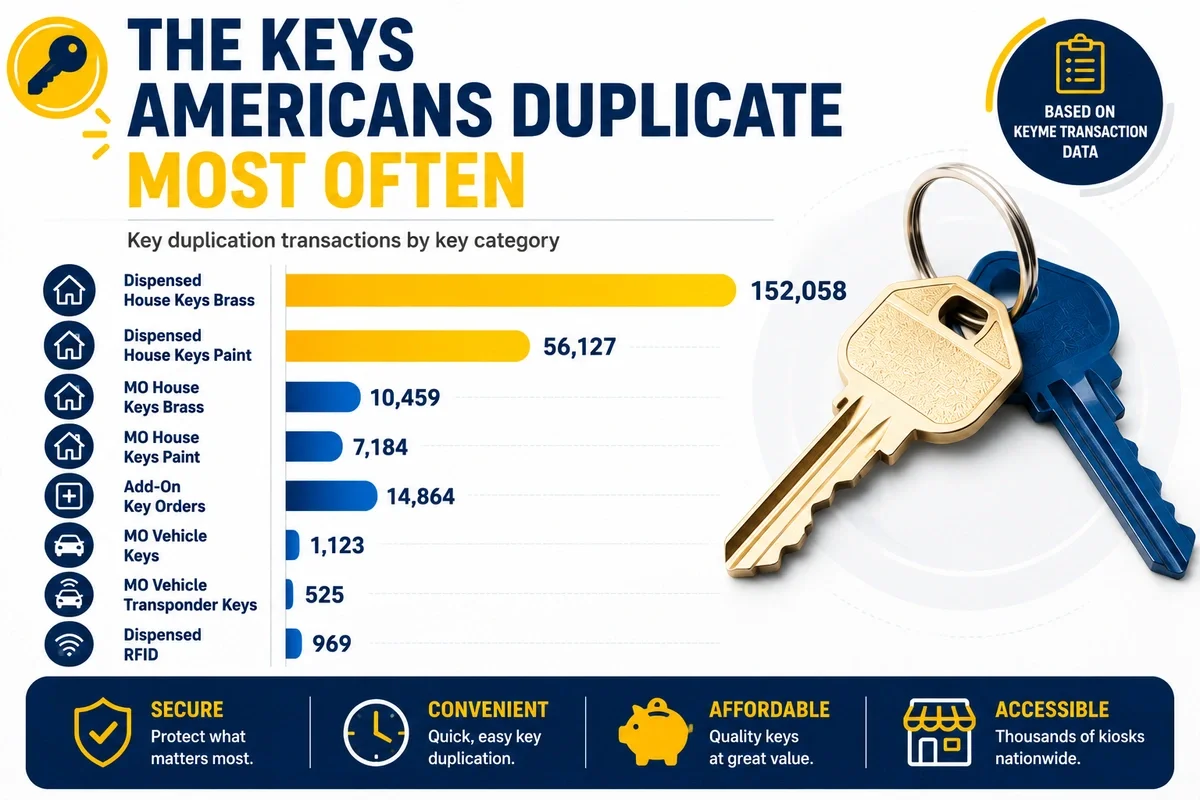
Source: KeyMe transaction data. Totals aggregated across available retail channels.
Why Front-Door Keys Dominate Backup Behavior
The data points to a simple reality:
The front door remains the most important access point in American life.
Unlike many other keys, residential keys rarely serve just one person.
A single household may require access for:
- Spouses and partners
- Children and teenagers
- Roommates
- Elderly family members
- Caregivers
- Dog walkers
- House cleaners
- Trusted neighbors
- Emergency contacts
Every additional person creates another reason to duplicate a key.
“The majority of backup keys are created because access needs expand over time,” says a KeyMe residential locksmith specialist. “Families grow, responsibilities change, children become more independent, and households naturally require more than one working key.”
That helps explain why basic brass house keys remain America's most duplicated backup key.
They solve a universal access problem.
The Hidden Story Behind Painted Keys
One of the most interesting findings in the data is the sheer volume of painted house keys.
More than 56,000 painted key transactions appear across the dataset.
That suggests many households are not simply creating additional keys.
They are organizing them.
Painted keys help distinguish:
- Front-door keys
- Back-door keys
- Mailbox keys
- Garage keys
- Rental-property keys
- Guest keys
- Family-member copies
Color-coding may seem minor, but it reflects a broader trend toward intentional household access management.
The more keys people manage, the more important identification becomes.
The Rise of the Emergency Backup Key
One of the clearest behavioral trends visible in duplication activity is preparedness.
Many consumers appear to create copies before they need them.
The purpose isn't daily use.
It's avoiding future inconvenience.
Common backup-key scenarios include:
- Leaving a key with a trusted relative
- Storing an emergency copy separately
- Creating a spare before a child receives independent access
- Preparing for travel
- Replacing a missing spare before the last key is lost
“One of the most common situations we see is someone realizing they only have one working key left,” says a KeyMe locksmith operations specialist. “Creating a backup before that final key disappears is often the difference between a simple duplicate and a much more complicated replacement process.”
The data suggests many consumers are making that decision proactively.
Why Add-On Orders Reveal a Convenience Trend
The dataset includes nearly 15,000 add-on transactions.
While smaller than house-key volume, this category reveals an important behavioral pattern.
Once consumers decide to duplicate a key, they frequently decide to make additional copies at the same time.
That reflects convenience-driven thinking:
"If I'm already making one backup, I may as well make another."
These extra copies often serve practical purposes:
- One for a spouse
- One for a child
- One for emergency storage
- One for a trusted friend or family member
The duplication event becomes an opportunity to solve multiple access needs simultaneously.
What the Data Says About Modern Families
Perhaps the most interesting takeaway from the data is that duplication activity often mirrors life transitions.
Many backup keys are created when:
- Children become old enough to come home independently
- Couples move in together
- Elderly parents need assistance
- Families purchase a new home
- Roommates share responsibilities
- Households hire recurring service providers
In other words, a duplicate key often represents a change in trust, responsibility, or access.
“A copied key is often a milestone,” says a KeyMe consumer access analyst. “It can represent independence, caregiving, household growth, or simply better preparation. The key itself is small, but the decision behind it often reflects a meaningful change in how a household operates.”
Why Physical Keys Continue to Matter
Smart locks, mobile credentials, and connected-home technology continue to grow.
Yet the transaction data shows that traditional keys remain central to household access.
The reason is simple.
Physical keys are:
- Familiar
- Reliable
- Easy to share
- Independent of batteries
- Compatible with millions of existing locks
For many households, a backup key remains the simplest form of preparedness available.
What the Data Suggests About the Future of Backup Keys
The strongest trend is not technological.
It is behavioral.
Americans increasingly view keys as tools for coordinating access rather than simply opening doors.
The modern duplicate key serves multiple purposes:
- Daily convenience
- Family sharing
- Emergency preparedness
- Property management
- Household coordination
The data suggests that backup keys are becoming less about replacement and more about resilience.
People are not waiting for problems.
They are planning around them.
Frequently Asked Questions
What is the most commonly duplicated backup key in America?
Traditional residential brass house keys generate by far the highest transaction volume in the dataset, significantly outperforming vehicle keys, RFID credentials, and specialty key categories.
Why do people make backup keys if they already have a working key?
Many consumers create backup keys to support family members, prepare for emergencies, simplify shared access, or avoid being left with only one working key.
What do painted-key trends reveal about consumer behavior?
Painted keys suggest households are increasingly organizing and identifying different access points rather than managing a single key for every purpose.
Are most duplicate keys made because someone lost a key?
Not necessarily. The transaction volume suggests many duplicates are created proactively to support access-sharing and preparedness rather than replacing a lost key.
What life events most often lead to key duplication?
Common triggers include moving, adding household members, helping aging relatives, sharing access with roommates, and creating emergency backup plans.
What is the biggest lesson from the data?
The strongest trend is that Americans increasingly use duplicate keys to manage relationships and responsibilities, not just locks. The modern backup key is often a tool for household coordination and preparedness.
Methodology
This analysis is based on proprietary KeyMe transaction data covering key-duplication activity across major retail and mail-order channels nationwide. Findings were derived from the Total Transactions data by product category, including dispensed house keys, mail-order house keys, RFID products, vehicle keys, transponder keys, and related add-on services.
To identify behavioral patterns, KeyMe analyzed transaction volume across key categories and interpreted those findings using the operational expertise of KeyMe locksmith specialists, residential access professionals, and consumer key-duplication teams. The resulting insights reflect real-world duplication behavior observed across hundreds of thousands of transactions rather than consumer surveys or self-reported preferences.
The purpose of this report is to understand why Americans create backup keys, which types of keys they duplicate most often, and what those decisions reveal about household access, preparedness, and convenience trends nationwide.
About KeyMe Locksmiths
KeyMe Locksmiths is a leading provider of local locksmith services and key copy kiosks across 50 states and the District of Columbia. Proud to serve over 5 million customers, KeyMe Locksmiths cuts over 10 million keys annually. With more than 8,000 self-service kiosks in major retailers, an e-commerce platform delivering over 10,000 keys weekly, and a nationwide locksmith network, KeyMe Locksmiths provides fast, reliable solutions for residential, commercial, and vehicle needs. KeyMe Locksmiths is committed to delivering exceptional service backed by a 100% money-back guarantee. KeyMe Locksmiths also operates one of the nation’s leading retail media networks, connecting consumers to other brands seeking to advertise in-store and delivering over 2B monthly impressions.